
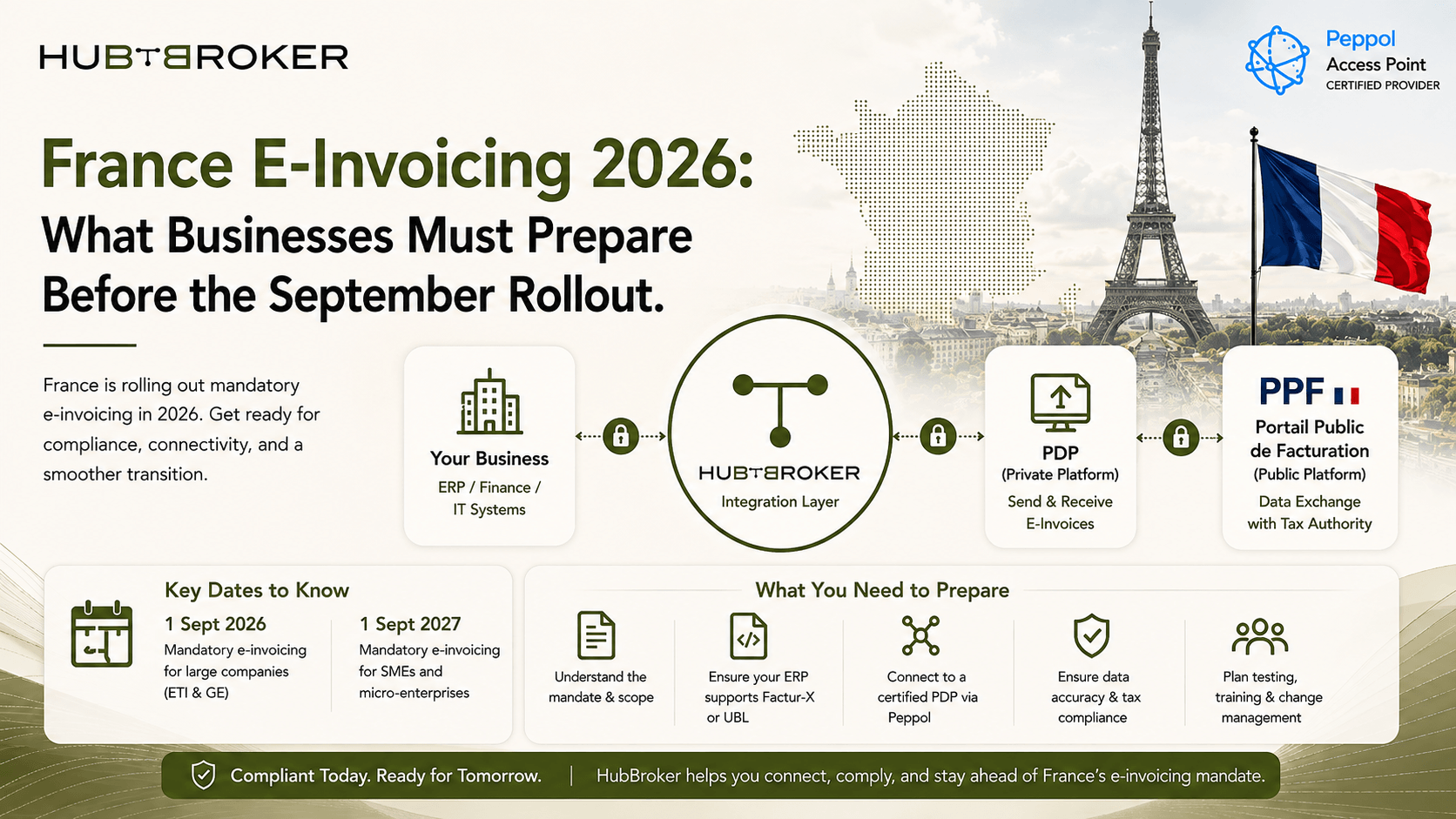
France E-Invoicing 2026: What Businesses Must Prepare Before the September Rollout
From 1 September 2026, France’s e-invoicing reform will change more than just invoice format. Finance and IT teams need to make sure ERP data, invoice routing, platform connection, reporting flow and error handling are ready before the deadline. For France e-invoicing 2026, all businesses in scope must be able to receive electronic invoices from this date.
Large and mid-sized companies also need to start issuing e-invoices and follow e-reporting requirements.
Key Takeaways
➡ All businesses in scope must be ready to receive e-invoices from 1 September 2026.
➡ Large enterprises and ETIs must also send e-invoices and e-report from this date.
➡ SMEs and micro-enterprises follow from 1 September 2027.
➡ A normal PDF sent by email will not be enough.
➡ Businesses need a plateforme agréée and a proper ERP integration.
➡ E-invoicing and e-reporting do not follow exactly same transaction flow.
What Changes With France E-Invoicing 2026?
France is moving domestic B2B invoicing into a more structured electronic process. For qualifying transactions between businesses established in France, invoices need to move through a plateforme agréée, which is an approved e-invoicing platform. A normal PDF sent directly by email is not enough because the invoice need to contain structured data and go through the required platform process.
The older name PDP (Plateforme de Dématérialisation Partenaire) can still be found in older documents. Current official communication is using the term plateforme agréée. The PPF is also not working as the original public invoice exchange portal that was first planned. Its role is now more focused around directory and regulatory data.
Who Needs to Be Ready for September 2026?
France is introducing the requirements in different stages.
Date | Requirement |
|---|---|
1 September 2026 | All businesses in scope must be able to receive e-invoices. Large enterprises and ETIs must also issue e-invoices and send required e-reporting data. |
1 September 2027 | SMEs and micro-enterprises must also start issuing e-invoices and follow e-reporting requirements. |
This means even smaller businesses should not ignore the 2026 date. They may not need to issue mandatory e-invoices until 2027, but they still need to be ready to receive them from September 2026.
What Should Businesses Prepare Before September 2026?
1. Map Your Current Invoice Flows
Start by checking how invoices are moving today. Separate:
✔ Domestic B2B invoices
✔ B2C transactions
✔ International invoices
✔ Public-sector invoices
✔ Incoming invoices
✔ Outgoing invoices
Different transactions can follow different process, so putting everything into one flow can create problems later. Some transactions may need e-invoicing, while others need e-reporting or another route such as Chorus Pro.
2. Check ERP and Accounting Data
A structured invoice depends heavily on good data. Businesses should check if required customer details, tax information, transaction data, delivery information and invoice values are available correctly inside the ERP. If the data is wrong at ERP level, the electronic invoice may also be wrong.
Finance and IT should especially review customer master data because missing or old information can cause invoice errors.
3. Review Invoice Formats
Businesses should check whether their systems can create and receive the formats used in the French e-invoicing setup. This can include:
A normal PDF workflow may need to be changed. The goal is not only to create a readable invoice. The receiving system also need structured data that can be processed automatically.
4. Plan Platform Connectivity
Businesses need to decide which plateforme agréée will be used and how the ERP will connect with it. The connection should handle:
Sending invoices
Receiving invoices
E-reporting data
Invoice status
Rejection messages
Other required responses
This part should be planned early because platform connection can affect ERP mappings and internal finance processes.
5. Define Validation and Error Handling
Not every invoice will go through correctly on first try. Some invoices can fail because of:
Missing fields
Incorrect customer details
Tax errors
Routing problems
Duplicate invoices
Wrong invoice format
Finance and IT teams should decide who will check these errors and how corrected invoices will be sent again. Only sending the invoice is not enough. The business should also know what happen when something fails.
6. Synchronize Invoice Status
Finance teams need to see what is happening after the invoice leaves the ERP. This can include statuses like:
Sent
Received
Accepted
Rejected
Processing
Paid
If the external platform shows an invoice as rejected but ERP still shows it as successfully sent, Finance team may work with wrong information. Status updates should therefore come back into the business process wherever possible.
7. Test Before Production
Do not wait until September 2026 to test the first invoice. Businesses should test normal and problem scenarios before go-live. This should include:
Normal invoices
Credit notes
VAT scenarios
Customer identifiers
Missing fields
Rejected invoices
Status responses
E-reporting flows
Testing different cases can show where mappings or business processes still need changes.
E-Invoicing vs E-Reporting: What Does Your Business Need?
➡ E-invoicing mainly applies to qualifying domestic B2B transactions between businesses established in France.
➡ E-reporting is used for transaction information which is outside the normal domestic B2B invoice flow. This can include relevant B2C and international transactions, and payment information where required.
This means one business can need both processes. For example, a company selling to French businesses, consumers and foreign customers may need different flows from the same ERP. That is why transaction type should be identified before invoice data is routed.
How Should Your ERP Connect to France’s E-Invoicing Ecosystem?
A simple setup can look like this:
 The integration layer can handle:
ERP data extraction
Invoice format conversion
Validation
Routing
Status updates
Error messages
E-reporting data
Response handling
This can help keep French technical requirements outside the main ERP as much as possible. If rules or formats change later, businesses may then update the integration layer instead of changing several ERP processes.
What Should You Look for in a France E-Invoicing Solution?
Before selecting a provider, check:
ERP and accounting system compatibility
API and EDI integration options
Support for French invoice formats
Connection with a current plateforme agréée
Invoice validation
Error handling
Status tracking
Audit visibility
E-reporting support
Support for other countries
For companies operating in several markets, it can be useful to keep one ERP connection while country-specific formats and routing are managed separately.
How Can HubBroker Help Prepare for France E-Invoicing 2026?
HubBroker provides ERP integration, EDI, API connectivity, document conversion, validation and e-invoicing capabilities. This can help reduce manual invoice work and avoid putting too much country-specific logic directly inside the ERP. HubBroker also supports Peppol-based e-invoicing for other European invoice flows.
For France, the setup still need to work with a France-approved plateforme agréée. HubBroker can support the ERP-side integration and automation while the required French platform connection is included in the project. Businesses should start preparing ERP data, invoice flows, platform connectivity and exception handling before the rollout date.
Preparing for France e-invoicing 2026?
HubBroker can help review your ERP, invoice flows and integration requirements and build a more automated setup for e-invoicing and e-reporting.
