
Which EDI providers support Dynamics 365 Finance & Operations for high-volume Danish distributors?
For Danish distributors handling thousands of documents, small processing problems can disrupt daily work. Customers and suppliers often use different document formats, leaving teams to correct or re-enter information. Businesses searching for which EDI providers support Dynamics 365 Finance & Operations Denmark need more than a connection to Microsoft’s ERP. They need dependable document exchange, clear error handling, and support for Danish invoicing requirements. Compare providers against real distribution work, not feature lists.
Which EDI provider integrate with Dynamics 365 Finance & Operations?
HubBroker is among the providers offering EDI or business document integration for Microsoft Dynamics 365. The right choice depends on existing systems, partners, and documents.
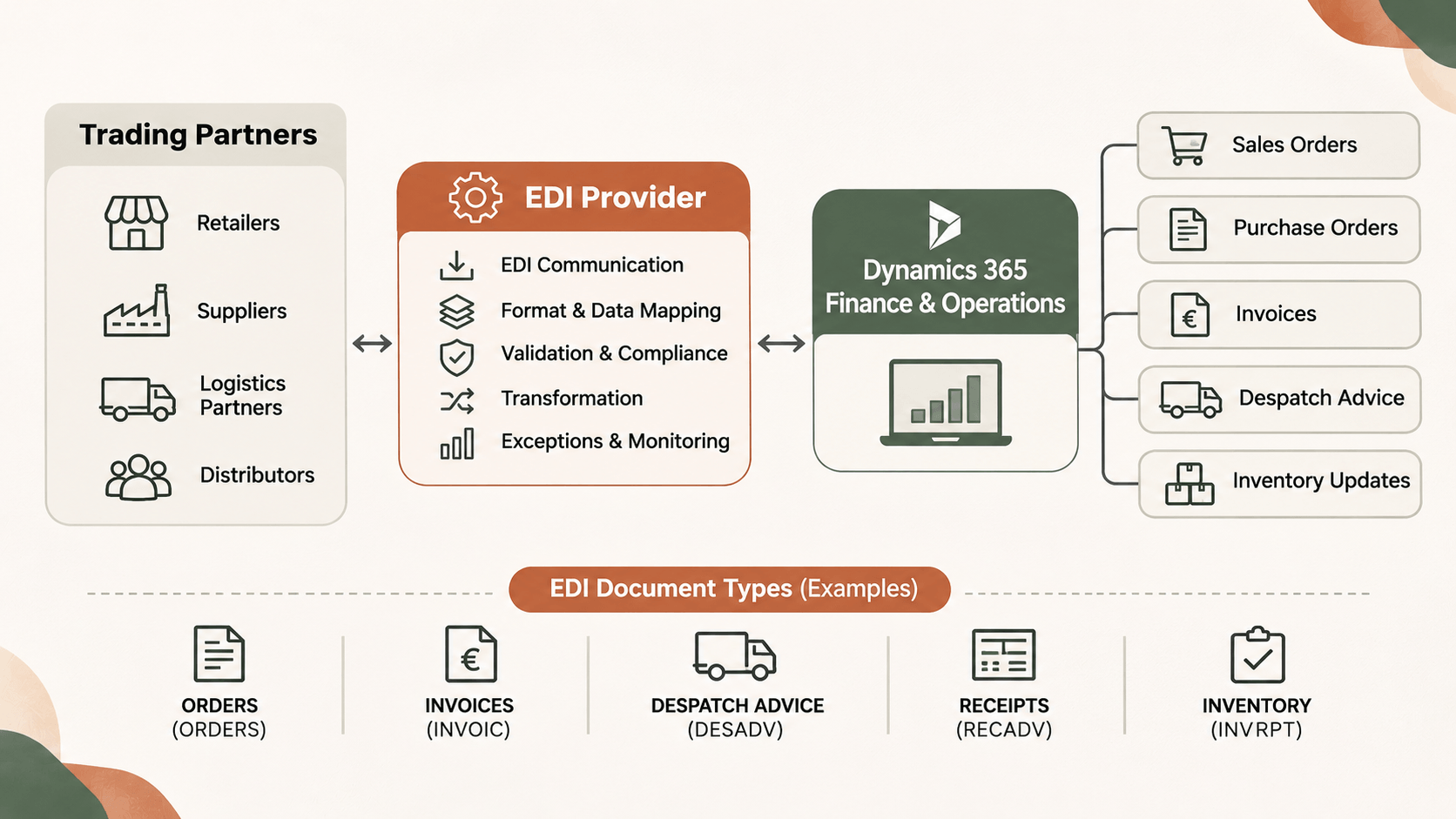
HubBroker connects Dynamics 365 Finance & Operations with trading partners using EDI, APIs, and electronic document exchange. Its platform handles document conversion, partner-specific mappings, automated processing, and Peppol connectivity. It focuses on exchanging documents with trading partners and supporting distribution processes through connected workflows. HubBroker offering covers electronic document exchange and wider partner connectivity. These providers are not interchangeable. Ask each provider to show exactly how your current ERP setup and partner documents would be handled.
Why do high-volume distributors need specialized EDI integration?
One customer order can lead to an acknowledgement, warehouse activity, dispatch information, and an invoice. Those messages may pass between a distributor, its suppliers, transport providers, and customers, sometimes using different identifiers or formats.
Without integration, staff might download an order, fix a product code, type details into Dynamics 365, and send a confirmation separately. That becomes difficult during busy periods. EDI can remove repeated entry and move information directly between connected systems. Still, sending many files is only part of the challenge. Distributors may operate several warehouses, apply customer-specific prices, update stock frequently, or receive incomplete documents. They need to know what happens when a message fails, whether staff can find it quickly, and how it gets corrected without losing track of the original transaction.
What Danish EDI requirements should distributors consider?
Danish public-sector invoicing has established rules, and businesses should check them before selecting a provider. NemHandel is part of Denmark’s electronic business document infrastructure. OIOUBL and Peppol BIS are important document formats, while recipient identification and supported transport arrangements also affect successful delivery. Electronic invoicing is required for transactions with Danish public authorities. It is not a universal requirement for every Danish B2B invoice.
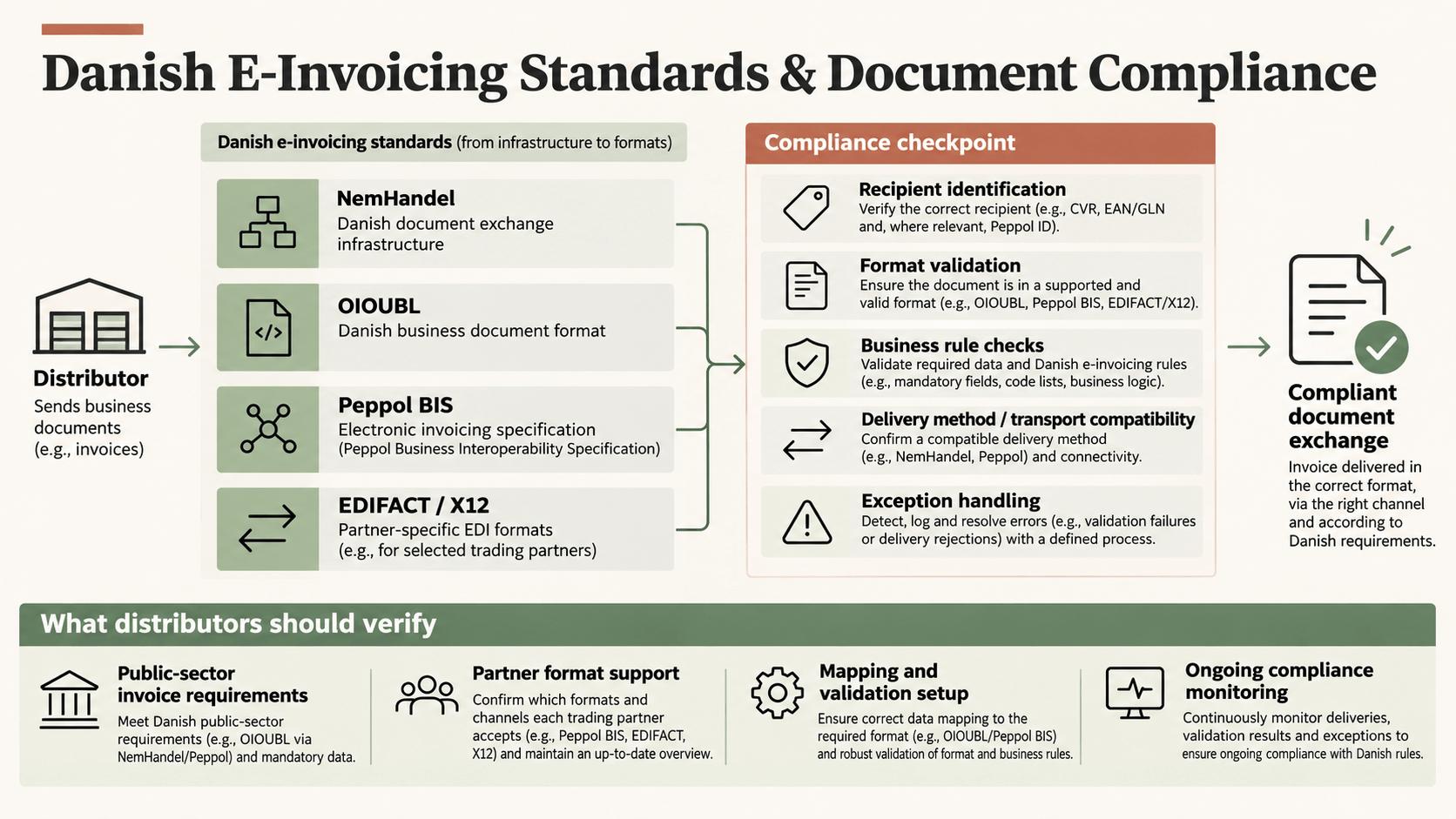
However, digital bookkeeping rules create electronic invoicing capability obligations for businesses covered by those rules. A provider should explain how its service fits the customer's actual obligations rather than treating all invoices alike. International distribution adds another layer. A retailer might request EDIFACT, another partner might use XML or X12, and a public-sector recipient may need a Peppol-compatible invoice. Check whether each format is supported in your proposed setup and whether mapping, validation, or connection fees apply.
How should Danish distributors evaluate EDI providers before implementation?
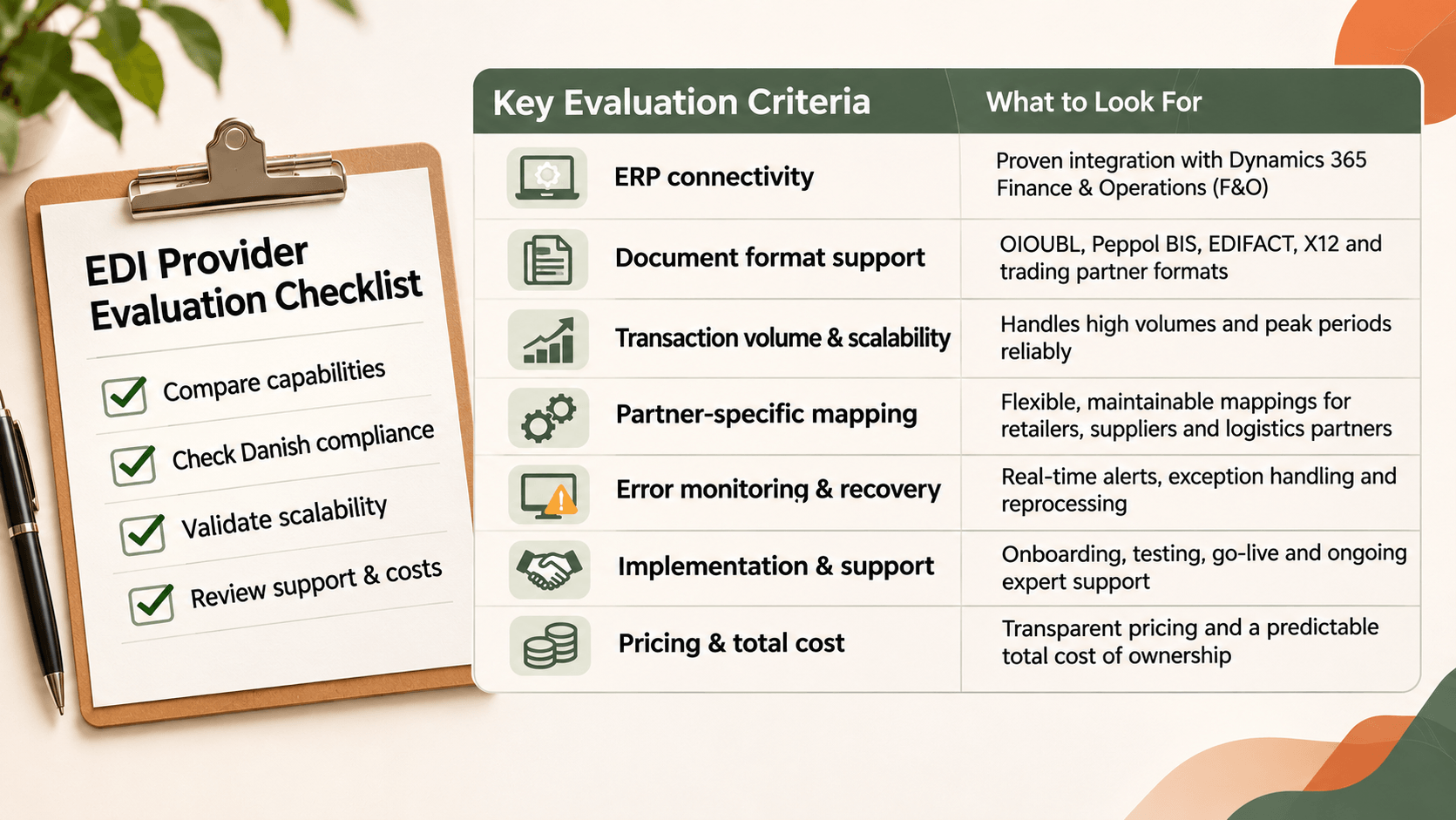
A useful comparison starts with real transactions, not a polished sales demonstration. Gather typical documents, include examples that previously caused problems, and ask vendors to process them through the proposed workflow.
What to review | Why it matters | What to ask |
|---|---|---|
Document types | Partners request different messages | Which documents are covered? |
ERP connection | Existing configurations vary | How does data enter F&O? |
Peak volume | Busy periods create pressure | Can you demonstrate peak loads? |
Danish invoicing | Delivery rules differ | How are NemHandel and Peppol handled? |
Partner mapping | Fields rarely match perfectly | Who maintains mapping changes? |
Error recovery | Rejected messages need attention | Can staff trace and retry failures? |
Pricing and support | Costs continue after launch | What are the ongoing charges? |
Once these points are clear, run a pilot with actual trading partner samples. Include orders, confirmations, invoices, and dispatch advice where relevant. Check how quickly exceptions appear, who resolves them, and whether the records remain easy to follow. This gives teams evidence to compare.
How HubBroker supports high-volume Dynamics 365 F&O EDI integration
HubBroker offers Danish distributors a way to connect Dynamics 365 Finance & Operations with customers, suppliers, and logistics partners without asking everyone to send the same file format. Its integration services cover document transformation, trading partner mappings, EDI communication, and ERP connectivity. HubBroker also provides Peppol Access Point services for electronic invoicing.
Distributors can discuss order flows, invoice exchange, monitoring, and support together, then assess how the proposed configuration would fit their existing processes. The right provider should demonstrate reliable document handling, useful exception reporting, and support for the standards your partners actually use. Compare HubBroker with other providers. To explore the fit, Book a HubBroker demonstration with examples of your Dynamics 365 workflows and trading partner requirements.
