

ViDA Is a 2030 Deadline. So Why Does It Decide What You Build in 2027?
Ask most finance teams about ViDA and you get a version of the same answer: it's a 2030 problem, we'll look at it after the current ERP project.
That's a reasonable read of the calendar and a bad read of the situation. Because between now and 2030, your company will almost certainly be forced onto a national e-invoicing mandate anyway. Whatever you build to satisfy that mandate is the system you'll be living with when ViDA arrives. The 2027 decision sets the 2030 outcome.
What ViDA actually is, and what it isn't
The three pillars, briefly
VAT in the Digital Age is a package the Council of the EU formally adopted on 11 March 2025. It covers three things: Digital Reporting Requirements built on e-invoicing, new VAT rules for platform operators, and an extension of the One-Stop Shop into a single VAT registration.
Only the first pillar changes how you issue invoices. The other two matter for tax registration and for platform businesses, but they don't touch your document flows.
The date everyone quotes: 1 July 2030
From 1 July 2030, e-invoicing becomes the default for intra-EU B2B transactions, and invoice data must be reported to tax authorities. Single VAT Registration goes live earlier, on 1 July 2028, with the deemed supplier rule becoming mandatory on 1 January 2030.
The date almost nobody quotes: 2025
Here's the part that gets skipped. When ViDA entered into force, Member States stopped needing European Commission approval to impose domestic B2B and B2C e-invoicing mandates.
That single change is why your 2027 calendar is filling up. The national mandates arriving over the next two years aren't separate from ViDA. They're a direct consequence of it.
The ViDA e-invoicing requirements, unpacked
Three requirements drive the technical work.
Structured formats only. Invoices must follow the European standard EN 16931. Unstructured formats, including PDF, stop counting as valid tax invoices for in-scope transactions. A PDF sent by email is a document. It is not an invoice.
Reporting close to the transaction. Invoice data goes to the tax authority rather than sitting in a periodic summary. This replaces recapitulative statements for intra-EU supplies.
Convergence, eventually. Domestic regimes that existed before 1 January 2024, such as Italy's, get until January 2035 to harmonise. Anything introduced after that must converge by July 2030.
Worth knowing: EN 16931 has already been revised for B2B use, with the updated version in force since February 2026. The standard you build against is not the one your B2G project used in 2019.
Why 2027 is the year your architecture gets locked in
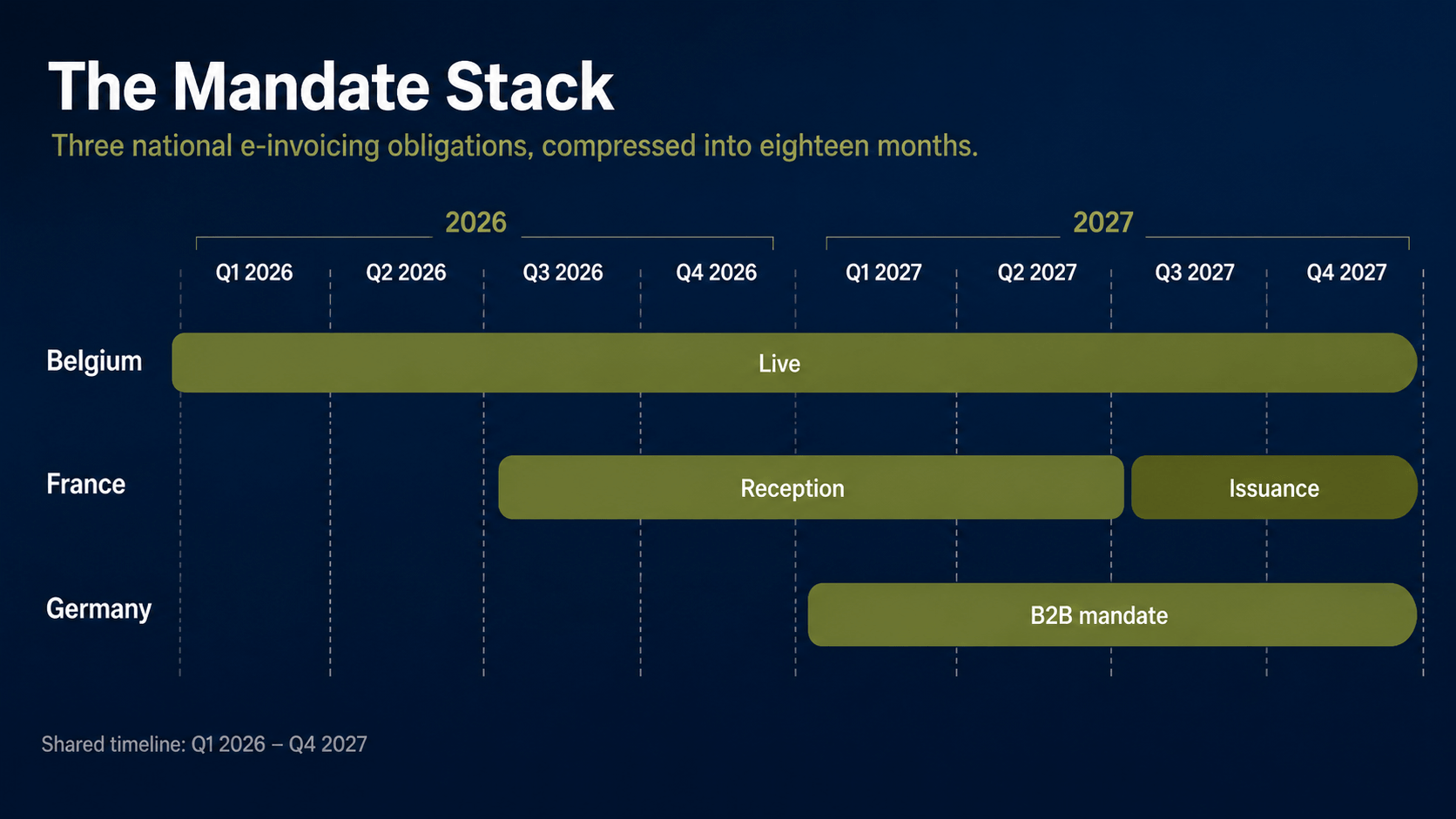
Look at what lands before ViDA does. Germany's B2B mandate is scheduled for January 2027. France requires large and medium enterprises to receive structured invoices from September 2026, with issuance for smaller companies following in September 2027. Belgium went live in January 2026. Poland's KSeF is on its own track. (Verify each of these against the national tax authority before acting.)
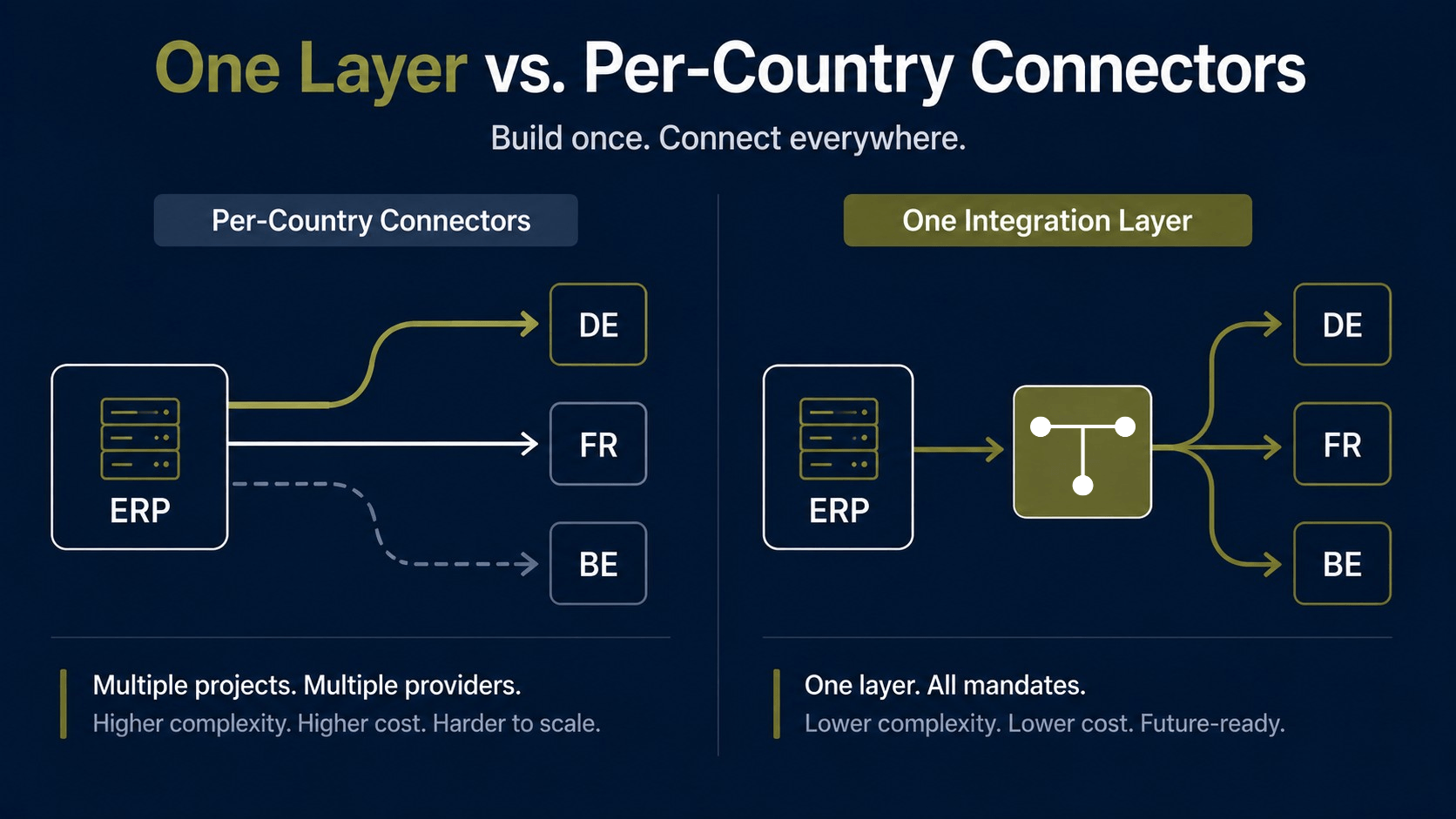
If you trade in three of those countries, you have three compliance projects landing inside eighteen months. And the tempting move, the one that gets approved fastest, is to solve each one separately: a connector for Germany, a provider for France, a file export for Belgium.
That works until July 2030, at which point you are rebuilding all three.
What a ViDA-ready setup looks like
Structured data leaving the ERP. If your invoice starts life as a PDF and gets converted afterward, you're managing a translation layer forever. The fix is getting clean, structured data out of the finance system in the first place. HubBroker's ERP EDI integration work is usually where this starts, and PDF to XML conversion covers the inbound side where suppliers haven't caught up.
One layer, many national channels. Rather than a connector per mandate, one e-invoicing setup that routes to whichever national channel applies. Peppol handles a growing share of this, and understanding the difference between 4-corner and 5-corner models tells you a lot about which countries will need a reporting hop and which won't.
Validation before send. Rejections are the hidden cost of e-invoicing mandates. Checking format and tax fields upfront through a certified Peppol Access Point keeps AR teams out of the rework loop.
Inbound handling that scales. Receiving is half the obligation. Intelligent Document Processing covers the suppliers who will keep emailing PDFs long after the rules change.
A practical readiness sequence
Map which of your entities trade in which mandate countries, and when each obligation bites.
Check what your ERP can actually emit today. Test it, don't assume it.
Decide the routing question now: one integration layer, or one project per country.
Fix master data. VAT numbers, participant identifiers, and buyer references cause more rejections than format errors do.
Build for EN 16931 as the baseline, then add national profiles on top.
FAQ
Does ViDA apply to domestic invoices? The July 2030 obligation covers intra-EU B2B supplies. Domestic e-invoicing is a national decision, which is exactly why the 2027 mandates exist.
Is Peppol mandatory under ViDA? No. ViDA mandates EN 16931-compliant structured invoicing and reporting, not a specific network. Peppol is the route several Member States have chosen.
Do we need a new ERP? Usually not. The gap is normally in how data leaves the ERP, not in the ERP itself. An integration layer sits on top of what you already run.
What happens to summary invoices? They remain permitted for supplies within the same calendar month.
We already comply with Italy's SdI. Are we done? For now. Regimes in place before January 2024 have until January 2035 to converge, but that's a deferral, not an exemption.
Where to start
If you're scoping a 2027 mandate project right now, the useful exercise is mapping your current invoice flows against both dates at once: what the national rule demands next year, and what ViDA will demand in 2030. Most of the time the same build covers both, provided you decide that before you start rather than after.
Happy to walk through what that looks like for your setup get in touch and we'll take a look at your current flows.
