
E-Invoicing ROI Calculator Which Costs Should Finance Teams Measure?
E-invoicing ROI can look better than reality when calculations only compare software fees with paper, postage or data-entry cost. The bigger picture also includes employee time, exceptions, corrections, approvals, reconciliation, integration work and country-specific requirements. Finance teams need a proper baseline first. Only then can an e-invoicing ROI calculator show whether automation is creating measurable value or simply moving cost from Finance to IT, suppliers or another part of the business.
How Do You Calculate E-Invoicing ROI?
Start with your own annual invoice volume and current processing cost instead of using a generic industry number. First calculate what the existing process costs each year. Then estimate what the automated process will cost and separate ongoing operating cost from one-time implementation investment.
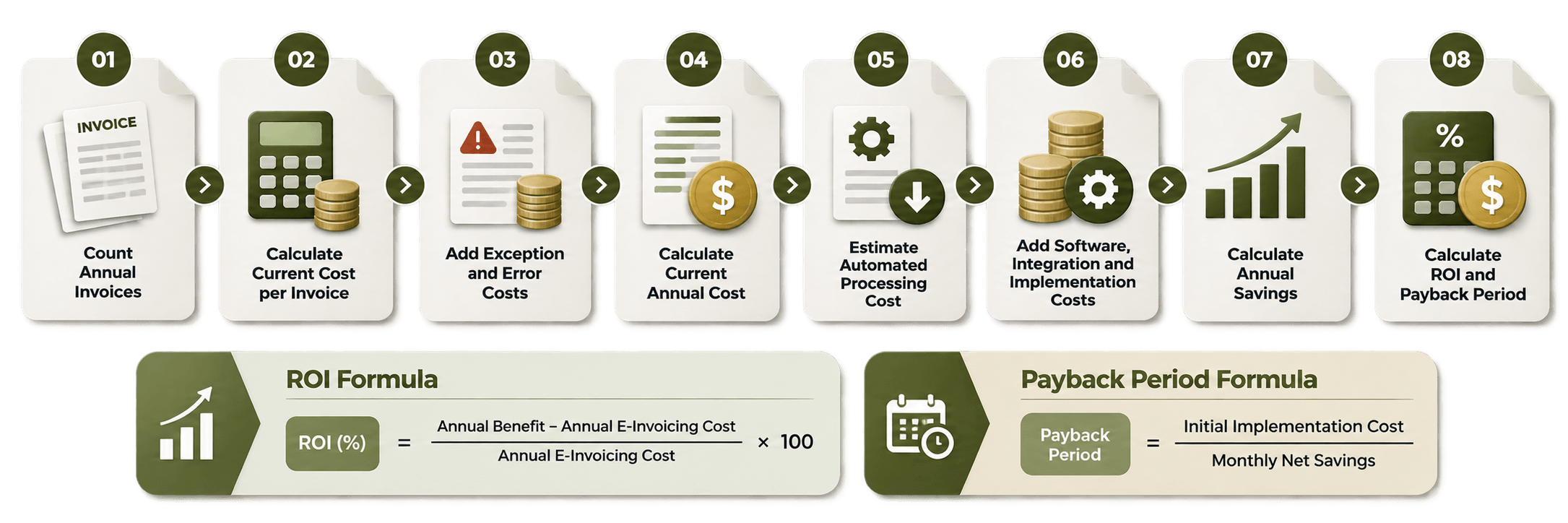
Annual benefit should include savings or avoided costs that Finance can actually support with data. Do not automatically treat every hour saved as cash saving. If staff remain on same payroll and the released time is not used somewhere else, the full labour value may not be a real financial saving.
What Is the Real Cost of Processing an Invoice?
The cost per invoice should include the full workflow, not only the time used for entering invoice data.
Measure how much AP or AR time is spent receiving invoices, checking information, fixing errors, chasing approvals, answering supplier or customer questions, posting transactions into ERP, reconciling records, storing documents and investigating duplicates.
Cost Area | What Finance Should Measure | Example Metric |
|---|---|---|
Manual processing | Staff effort per invoice | Minutes × labour cost |
Exceptions | Manual resolution effort | Cost per exception |
Errors | Correction and rework | Cases × handling cost |
Integration | ERP/API support | Annual IT cost |
Software | Platform/provider charges | Annual recurring cost |
Compliance | Country-specific processing | Internal/external cost |
If current processing cost is missing important work, the ROI result will also be incomplete. This is why Finance should measure the real process before comparing providers or automation options.
Which E-Invoicing Costs Should Finance Teams Measure?
A proper e-invoicing business case should include both one-time setup costs and recurring operational costs. One-time costs may include ERP integration, mapping, testing, project management, employee training, supplier or customer onboarding and country rollout work. Recurring costs can include subscription fees, transaction charges, support, monitoring, integration maintenance, mapping updates and ongoing internal IT effort.
For European organisations, multi-country requirements can add more cost than expected. Structured invoices, national validation rules, Peppol connectivity, VAT processes and different supplier or customer channels may require separate configuration and regular maintenance. A PDF sent by email is digital, but it does not provide same automation value as structured machine-readable invoice data. The European Commission also separates structured e-invoices from visual digital invoices because structured data can be processed automatically and reduces manual re-entry into business systems.
How Much Can Invoice Automation Save?
Savings should be divided into hard savings and efficiency savings. Hard savings directly reduce business expenditure. This may include postage, paper, outsourced data entry, duplicate software tools or external invoice-processing charges. Efficiency savings work differently. They reduce the amount of employee time used for manual entry, validation, corrections, approval follow-up and exception handling. This distinction matters.
If automation saves 1,000 working hours but payroll cost stays exactly same and employees do not use that time for other useful work, Finance should not simply report the full labour value as cash saving.
A practical calculation can follow this process:
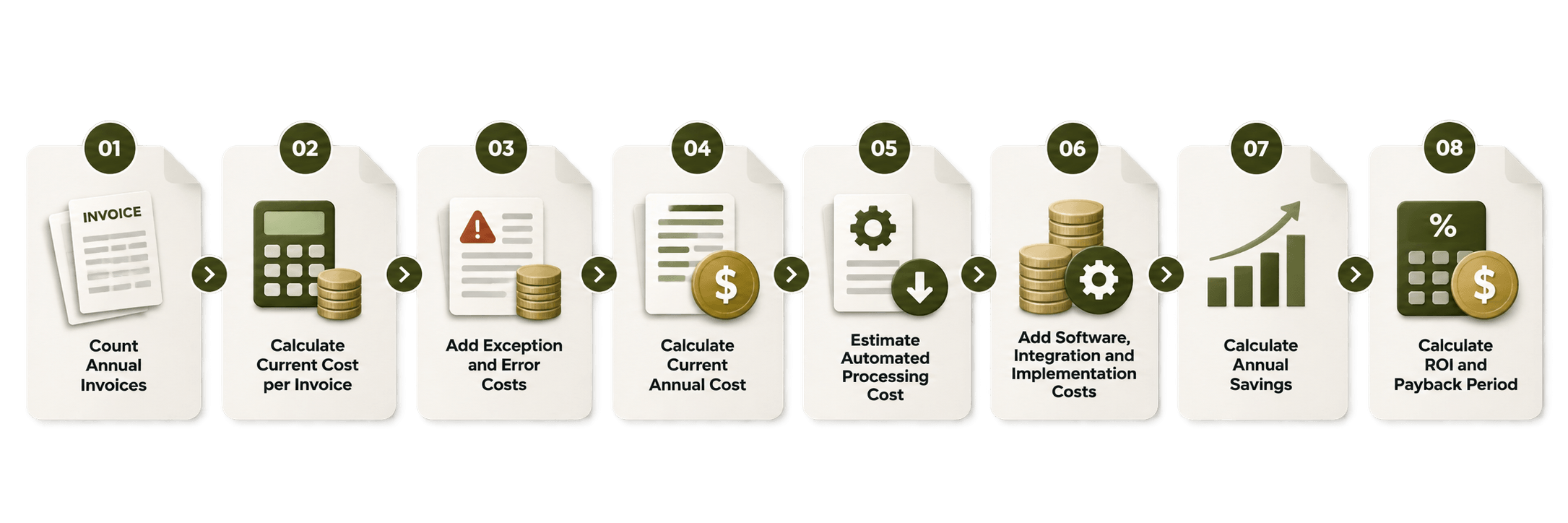
Where possible, use internal company data rather than broad market averages.
What Costs Are Usually Missing From an E-Invoicing Business Case?
Exception handling is one of the most commonly underestimated costs. One failed invoice may need several interactions between Finance, IT, suppliers or customers before it is finally processed. Incorrect references, duplicate invoices, master-data problems, rejected documents and failed routing can all create extra work. Approval delays also have cost when Finance repeatedly needs to follow up with managers or departments.
Integration maintenance should be included as well. ERP upgrades, API changes, new mappings, new legal entities and additional country rollouts can all create ongoing technical work after the initial project is finished. Supplier and customer support is another area that is easy to miss. Teams may spend considerable time answering questions about missing invoices, rejected documents, delivery status or incorrect data.
These hidden costs often decide whether the ROI still looks attractive after the solution goes live.
What Should Finance Look for in an E-Invoicing Solution?
Finance should compare providers against the cost areas that actually affect their business. ERP integration and API capability can influence setup and maintenance cost. Structured invoice automation and validation can reduce manual processing and exception rates. Peppol, EDI and multi-country connectivity may reduce the number of separate channels and solutions that need to be maintained.
Monitoring and automated status handling can also reduce the time employees spend investigating failed or missing invoices.
HubBroker supports ERP integration, e-invoicing, Peppol, EDI, APIs, data mapping, transformation, validation, workflow automation, monitoring and multi-country connectivity. Finance teams should compare these capabilities with their own invoice volumes, exception rates, ERP landscape and rollout plans rather than relying only on generic percentage-saving claims.
Building an e-invoicing ROI business case?
HubBroker can help map your current invoice process, identify where automation may create measurable savings, and define implementation and operating costs that should be included in the ROI calculation.
Talk to HubBroker about evaluating your European e-invoicing setup and building a more realistic business case.
