

Which integration platform can connect my ERP to Danish retail chains that require EDIFACT orders and invoices?
You've landed a listing with a Danish retail chain. Then the supplier onboarding pack arrives: orders by EDI, invoices by EDI, GLN numbers on every document, and a test cycle before your first delivery.
Your ERP can create a sales order and post an invoice. It cannot, on its own, receive an EDIFACT ORDERS message or send a retailer-compliant INVOIC. That gap is where EDI integration for Danish retailers comes in, and where the choice of integration platform decides how fast you go live.
Why Danish Retail Chains Insist on EDIFACT
Large Danish retailers process orders and invoices from thousands of suppliers. Manual handling does not scale for them, so they set the format and the supplier adapts.
What Retailers Typically Require From Suppliers
Most retail onboarding covers the full order-to-invoice cycle: receive the order, confirm it, announce the delivery, then invoice. GS1 Denmark's own EDI service describes the same chain, from order and order confirmation through delivery note to invoice.
Each chain publishes its own guideline. The message set, mandatory fields and identifiers differ between buyers, even when all of them use EDIFACT.
What Happens When a Supplier Can't Comply
The consequences are practical, not theoretical. Coop Danmark states on its supplier pages that EDI invoices must meet its current EDI guidelines, and that invoices that don't will be rejected.
A rejected invoice means a delayed payment, a correction cycle and staff time spent on rework. Repeat it across hundreds of deliveries and it becomes a cash-flow problem.
The EDIFACT Messages You Will Actually Exchange
Retail EDI in Europe is usually based on EANCOM, the GS1 subset of UN/EDIFACT built for retail and consumer goods.
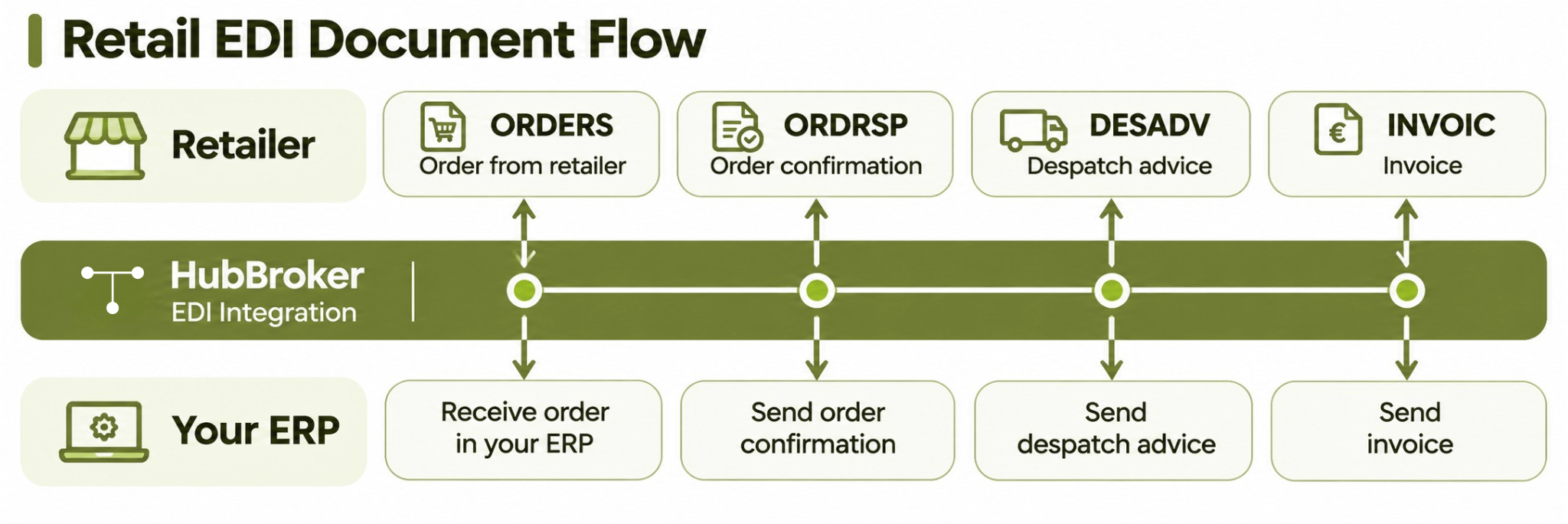
ORDERS and ORDRSP: Inbound Orders
The retailer sends an ORDERS message. Your platform translates it into a sales order in your ERP. Many chains also expect an ORDRSP back, confirming quantities, prices and delivery dates.
DESADV and INVOIC: Outbound Documents
When goods ship, a DESADV (despatch advice) tells the retailer what is on its way. After delivery, you send the INVOIC. Both must match the order references exactly, or the retailer's matching fails.
GS1 Identifiers: Where Most Onboardings Break
Retail EDI depends on GS1 keys. GLN identifies your company, the buyer and every delivery location. GTIN identifies each product. If your ERP master data lacks these, or holds them in the wrong place, documents fail validation before they reach the buyer.
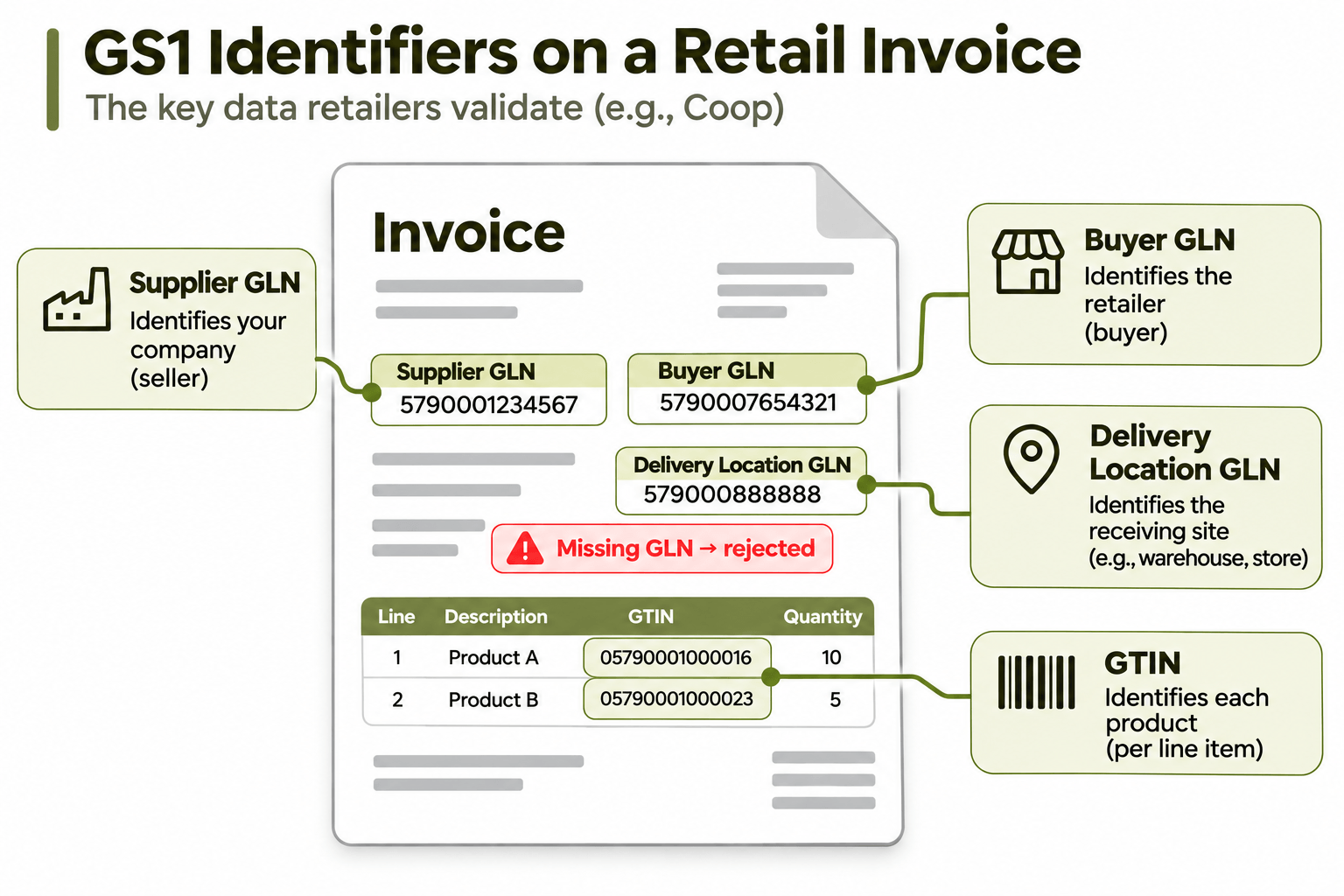
Clean master data is the first workstream in any retail EDI project, not an afterthought.
Why Your ERP Can't Do This Alone
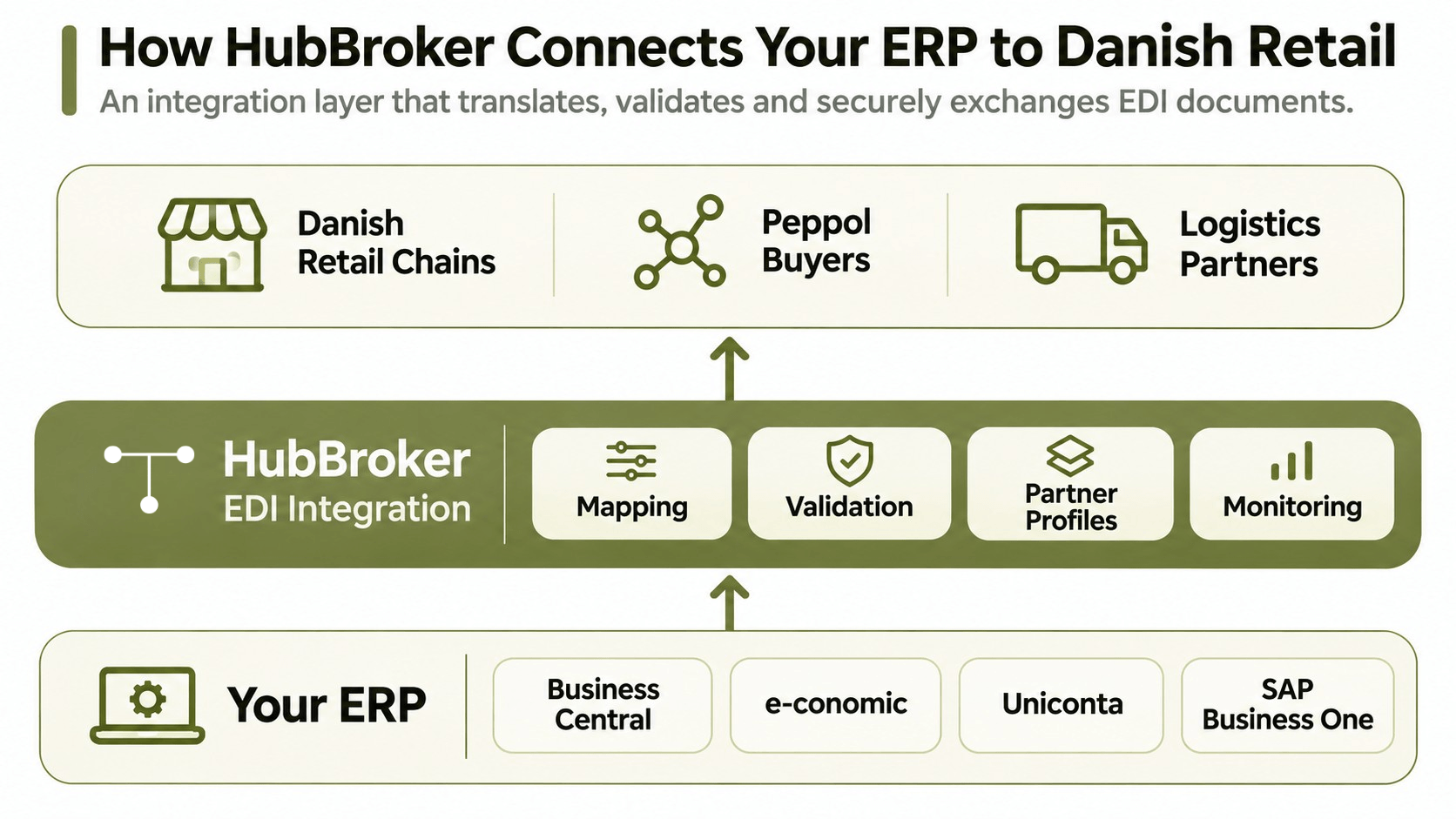
ERPs such as Business Central, e-conomic, Uniconta and SAP Business One manage your business data well. They are not built to speak each retailer's EDIFACT dialect.
Mapping, Partner Variants and Transport
Three jobs sit between your ERP and the retailer:
Mapping: translating ERP fields into EDIFACT segments, and back again for inbound orders.
Partner variants: handling the differences between one chain's guideline and the next.
Transport: delivering the files over the agreed channel, such as AS2, SFTP or a VAN.
If you run Business Central, an EDI connector for Dynamics 365 Business Central handles this layer while your sales, shipment and posting processes stay as they are.
What to Look for in an Integration Platform
The right platform answers the question in the title. Use these criteria to compare options.
Pre-Built ERP Connectors
A native connector to your ERP cuts weeks from the project. Check that it covers both directions: orders inbound and invoices outbound.
Retailer-Specific Mapping and Test Cycles
Ask how the vendor handles a new retailer guideline. Reusable partner profiles mean your second and third chains go live faster than the first. Ask who runs the test cycle with the retailer, too.
Monitoring and Error Handling
You need to see which documents were sent, accepted or rejected, and fix one failed invoice without stopping the rest. A platform built for EDI integration should validate documents before they leave and track acknowledgements after.
EDIFACT and Peppol on One Platform
Retail chains use EDIFACT. Public-sector buyers and a growing number of private buyers use Peppol e-invoicing. If you sell to both, one platform for both formats avoids running two providers.
How HubBroker Connects Your ERP to Danish Retail
HubBroker delivers EDI integration for Danish retailers as a layer on top of your existing ERP. You keep your system; we handle the translation, partner setup and transport.
The process follows six steps: connect your ERP, configure the retailer's document flows, map and transform data, set up the trading partner connection, test the full flow, then go live with monitoring.
Danish food producer LEPO A/S runs e-conomic, which did not support GLN-based invoice delivery out of the box. HubBroker built order import and GLN-based invoice sending around it, and the LEPO case study reports two trading partners onboarded in about 40 days.
FAQ
Do I need EDI to supply Danish supermarket chains?
In most cases, yes. Large chains expect suppliers to receive orders and send invoices by EDI. Check the supplier requirements of each chain you sell to.
Which EDIFACT version do Danish retailers use?
It depends on the retailer. Each chain's EDI guideline specifies the EANCOM or EDIFACT version and the message set. Always build to the buyer's current guideline.
Can Business Central or e-conomic send EDIFACT invoices directly?
Not as standard. Both need an integration layer to map invoice data into EDIFACT and deliver it over the retailer's agreed channel.
How long does supplier EDI onboarding take?
It depends on your master data quality, the number of messages and the retailer's test schedule. Clean GLN and GTIN data shortens the timeline more than anything else.
Is EDIFACT the same as Peppol or NemHandel?
No. EDIFACT is a message standard used in retail supply chains. Peppol is an e-invoicing network and document format set. In Denmark, Peppol and NemHandel are mainly associated with invoicing public-sector buyers.
Ready to Map Your Retailer's EDI Requirements?
Send us your retailer's EDI guideline and tell us which ERP you run. We'll walk through what your integration needs, from master data to go-live, in a short call. Book a demo or contact our integration team.
