
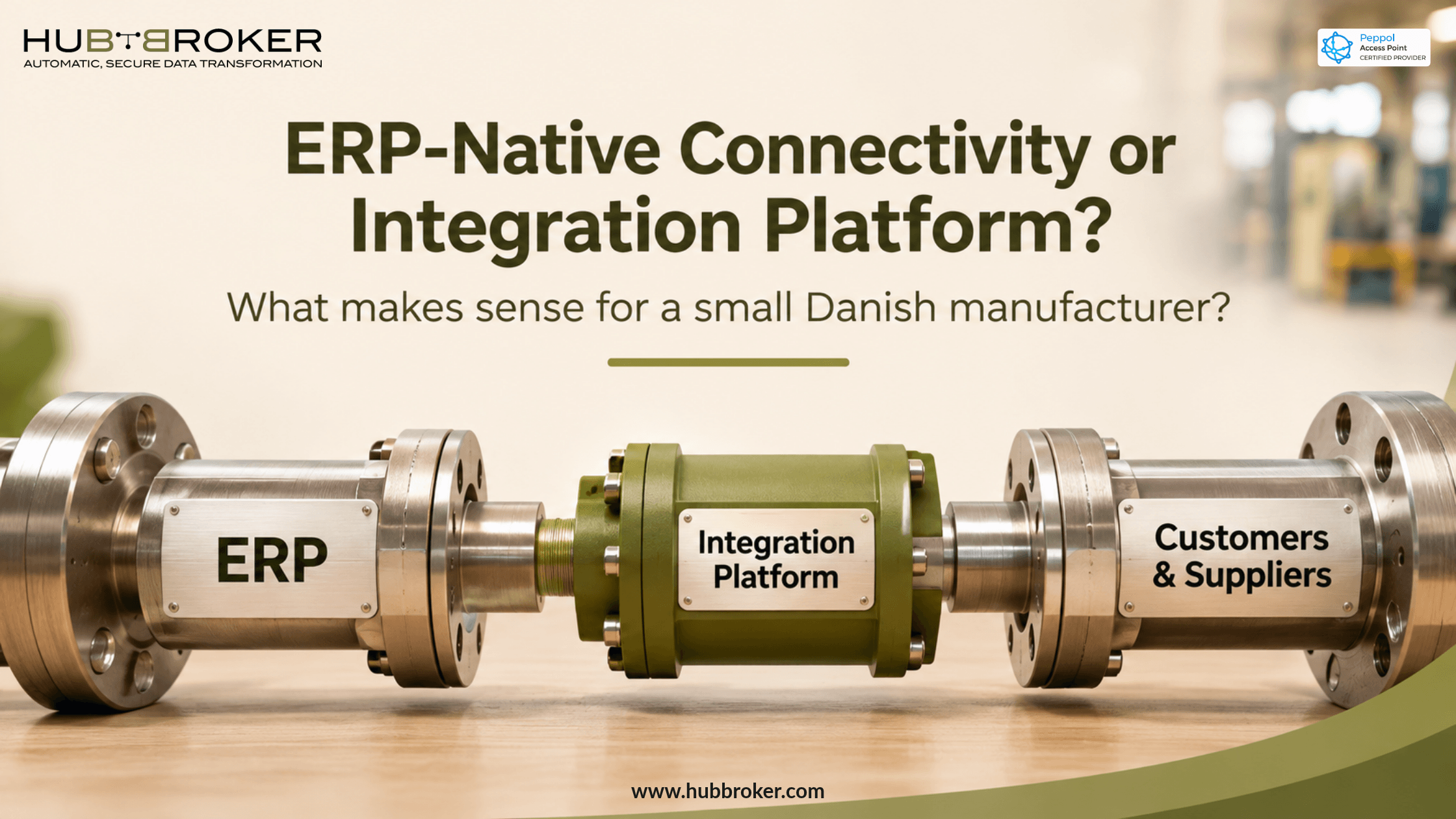
Does a small Danish manufacturer actually need an integration platform, or is ERP-native connectivity enough?
A small Danish manufacturer doesn't need another software platform just because its customers ask for electronic documents. If the ERP already handles orders, invoices and everyday connections, adding more technology may simply mean another bill to maintain.
So, does a small Danish manufacturer actually need an integration platform?
It depends less on company size than on the work involved in connecting systems. The real test is whether existing connections still handle customer requirements without manual fixes.
When ERP-native connectivity is enough for a small manufacturer
Many Danish manufacturers run purchasing, stock, sales and accounting through Microsoft Dynamics 365 Business Central, Uniconta or e-conomic. These systems can offer built-in connections or extensions for commonly used services.
For a business with one ERP, mainly Danish customers and a modest number of electronic invoices, that may be all it needs.
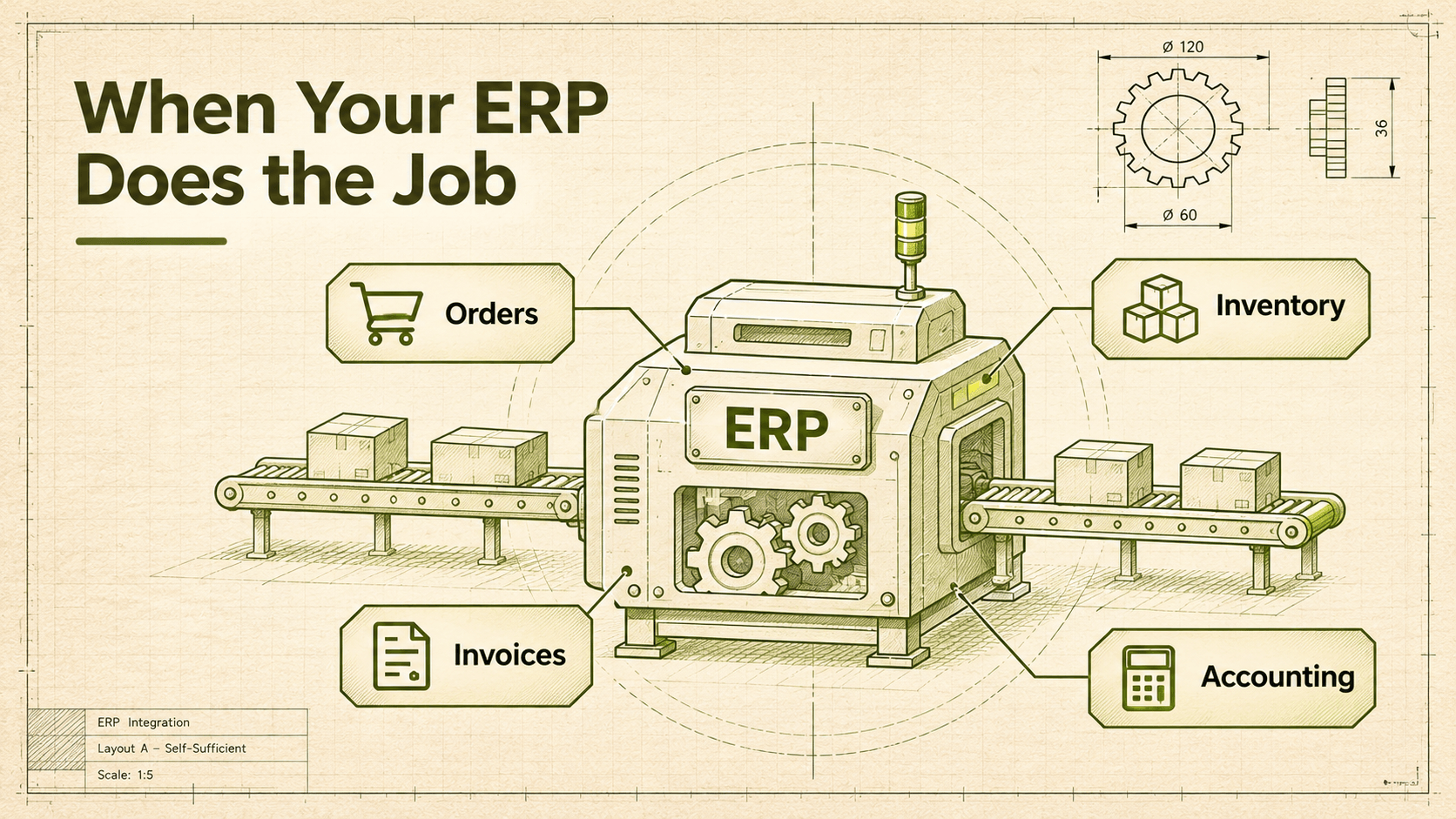
Staff can work inside familiar software, with fewer support contacts. ERP-native connections make sense when customers accept the formats already supported, documents move reliably and errors don't regularly land on someone's desk. Before buying anything, ask the ERP provider what is included. A feature described as “EDI support” may not cover every customer's preferred format.
Is Your ERP Connectivity Enough?Find out whether your existing ERP can handle your EDI, e-invoicing, and partner integrations, or if an integration platform would simplify your workflows. |
Where manufacturing integrations become more complicated
Invoices are only part of the picture. Manufacturers also exchange purchase orders, order confirmations, delivery notes, product details and stock updates. Customers may want different formats.
Imagine a Danish components supplier receiving EDIFACT orders from a German retailer. The ERP can record the sale perfectly well, but it may need an extension to read the incoming order and another connection to return the required documents.
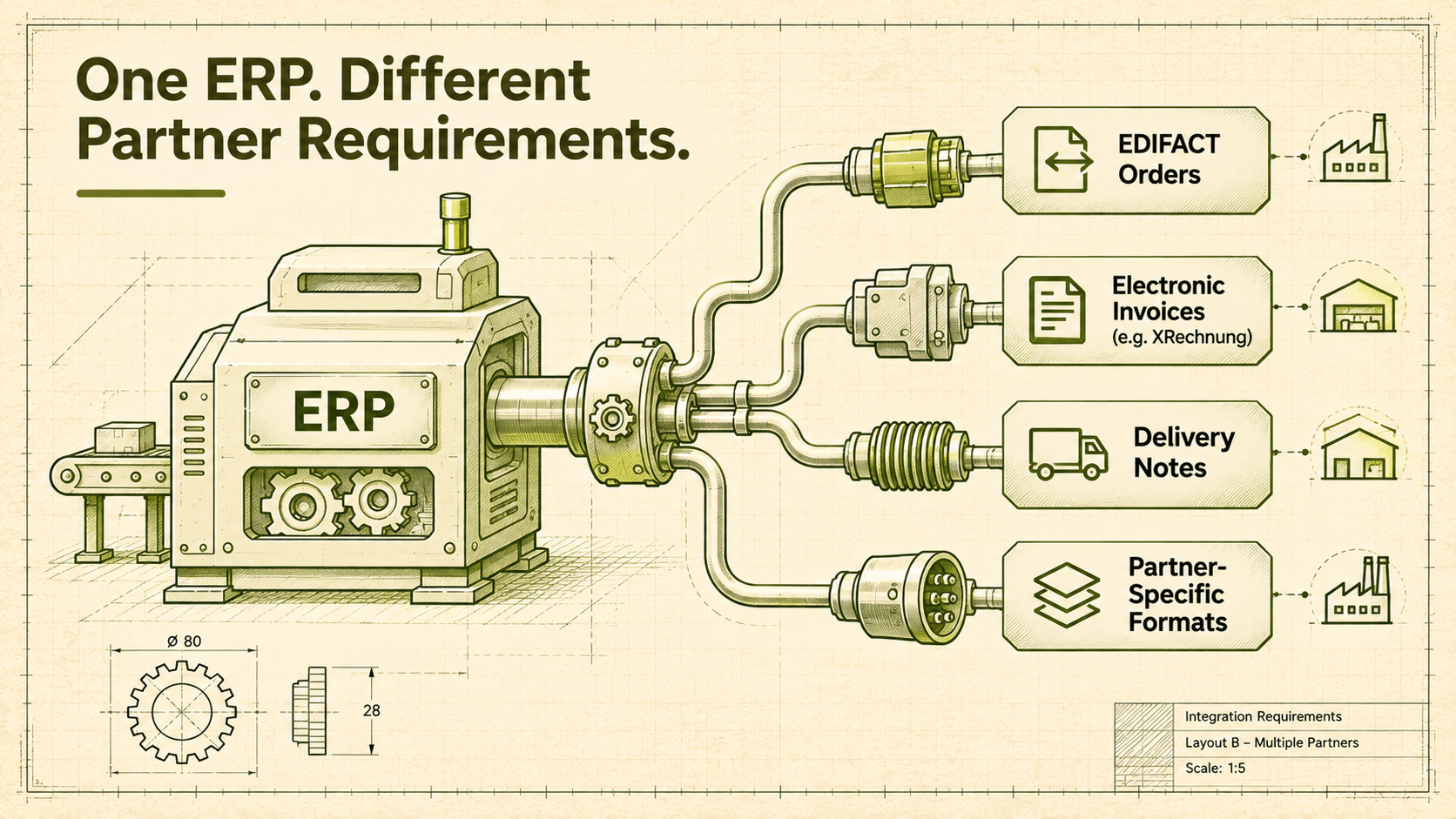
The trouble often starts with the second or third partner that has different specifications. Someone must maintain the mappings, investigate rejected files and keep connections working when requirements change. One custom link might be reasonable. Building and supporting a separate link for every customer can become a significant expense, especially after staff changes.
Danish e-invoicing requirements do not automatically justify another platform
Denmark requires electronic invoicing when supplying public authorities through NemHandel, which supports structured formats such as OIOUBL and Peppol BIS.
The Danish Bookkeeping Act also brings digital bookkeeping requirements and electronic invoicing capabilities into focus. That doesn't mean every private business must send all domestic B2B invoices electronically under a general Danish mandate.
For smaller manufacturers, that distinction matters. If the existing bookkeeping or ERP solution supports the relevant invoice requirements, there may be no reason to add a separate platform. International customers can change the calculation. They may request EDIFACT, a particular invoice format or a specific communication channel. Those are integration needs, not proof of ERP non-compliance.
How to decide whether existing ERP connections are sufficient
Start with actual documents, not a sales presentation. Review what comes in, what goes out and how much work employees do when a transfer fails.
What to check | When ERP may be enough | When to investigate a platform |
|---|---|---|
Customer orders | Standard supported orders | Different EDI specifications |
Supplier messages | Few regular suppliers | Many partner-specific formats |
Invoices | Supported electronic formats | Several country-specific formats |
Delivery notes | Simple existing workflow | Automated partner messages needed |
File exchange | ERP supports required channel | Extra protocols are required |
Error handling | Failures are rare and clear | Staff repeatedly trace failures |
New connections | Extensions are easy to maintain | Each partner needs custom work |
Then make four practical checks.
✔ First, list mandatory customer and supplier requirements, including formats and delivery methods. Don't confuse requests that are convenient with those required to keep trading.
✔ Second, ask your ERP provider which requirements work without custom code. Check who maintains mappings, monitors failures and pays for updates.
✔ Third, count the monthly hours spent re-entering orders, correcting files and chasing missing messages. Those hours are part of the real integration cost.
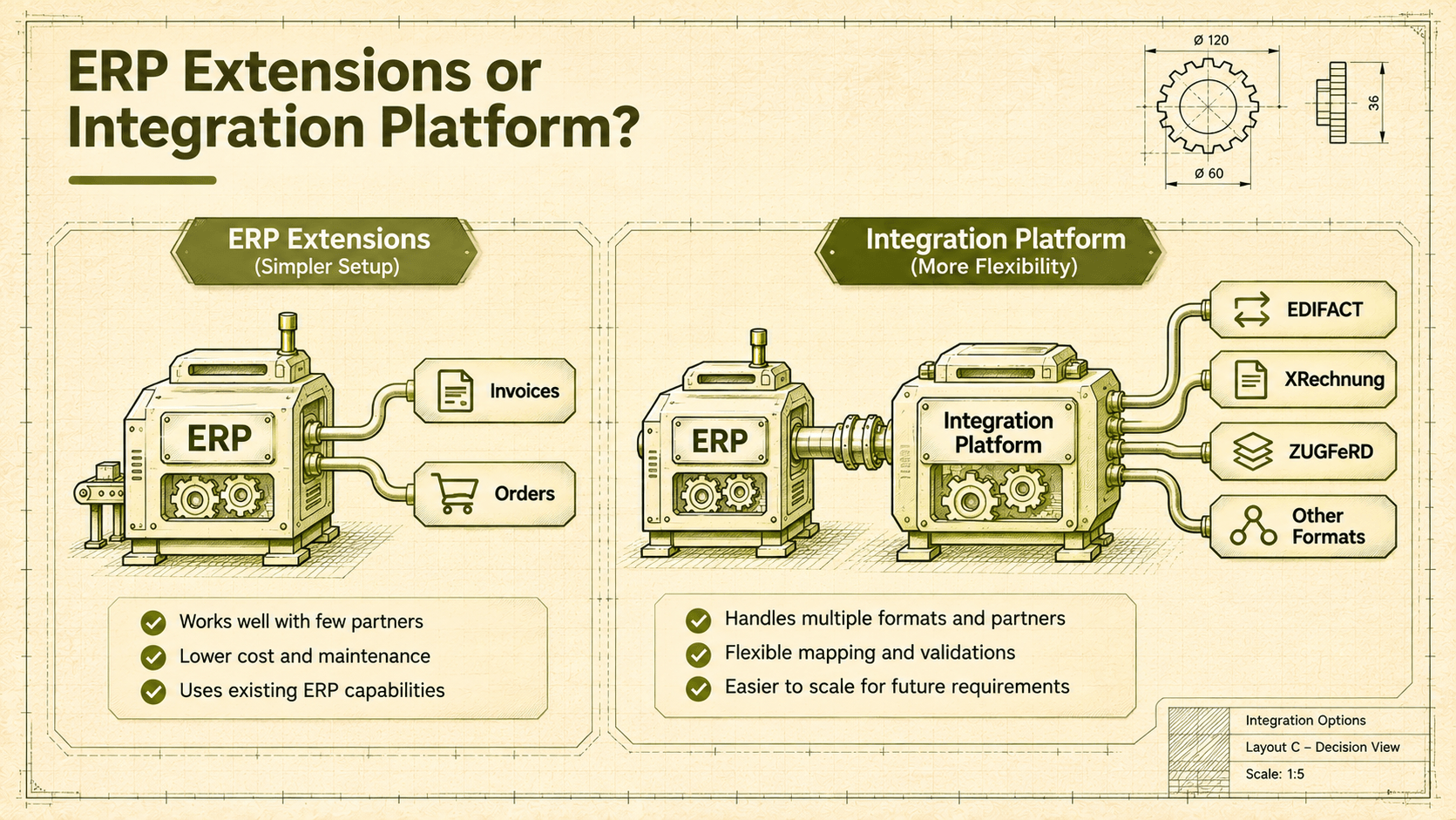
Finally, compare the full two-year cost of ERP extensions and custom work with a separate platform. Include support, maintenance and likely new partners. If the current setup works reliably, keep it.
Connecting Danish manufacturing systems through HubBroker
HubBroker can connect a manufacturer's existing ERP to customers, suppliers and other systems without requiring an ERP replacement. Its EDI and integration services support document mapping, format conversion and automated exchange of trading documents, including orders and invoices. Peppol connectivity can support relevant electronic invoicing flows. This approach is worth examining when several retailers or overseas customers each have different requirements. Instead of creating every connection separately, the manufacturer can assess which exchanges belong in a shared integration layer.
HubBroker can review existing connections, partner formats and document flows to identify where its iPaaS would help. The sensible decision is based on actual gaps, not company size. Keep ERP-native connectivity where it works;
Connect HubBroker where maintaining those connections starts costing too much time or money.
