
How Czech Businesses Can Choose the Right E-Invoicing Provider
A supplier in Brno sends a PDF invoice, but its customer in Prague wants structured XML. Both methods can work, although checking different customer requests by hand soon becomes a headache. Choosing a Czech Republic e-invoicing provider should reduce that work, not create another system nobody understands. Before paying for software, look at the rules, the formats your customers accept, and how documents leave your accounting system. The best choice is one that handles today's invoices and can adapt when requirements change.
Is Electronic Invoicing Mandatory for Czech Businesses in 2026?
The Czech Republic does not have a general rule requiring structured electronic invoices for domestic business-to-business sales in 2026. Companies can agree with customers to exchange invoices electronically, including in formats that suit their working arrangements. Suppliers also do not automatically have to issue structured invoices simply because they sell to a public body.
There is an important difference on the receiving side. Public contracting authorities must accept and process qualifying electronic invoices that follow European standard EN 16931 for covered public procurement. Suppliers dealing with municipalities, ministries, or other public buyers may therefore find structured invoicing useful, even where issuing it is not compulsory. Ask any provider claiming that all Czech invoices must be electronic to show the exact rule. A public buyer's duty to receive a qualifying invoice is not the same as an obligation for every supplier to send one.
Which Invoice Formats Should a Czech Provider Support?
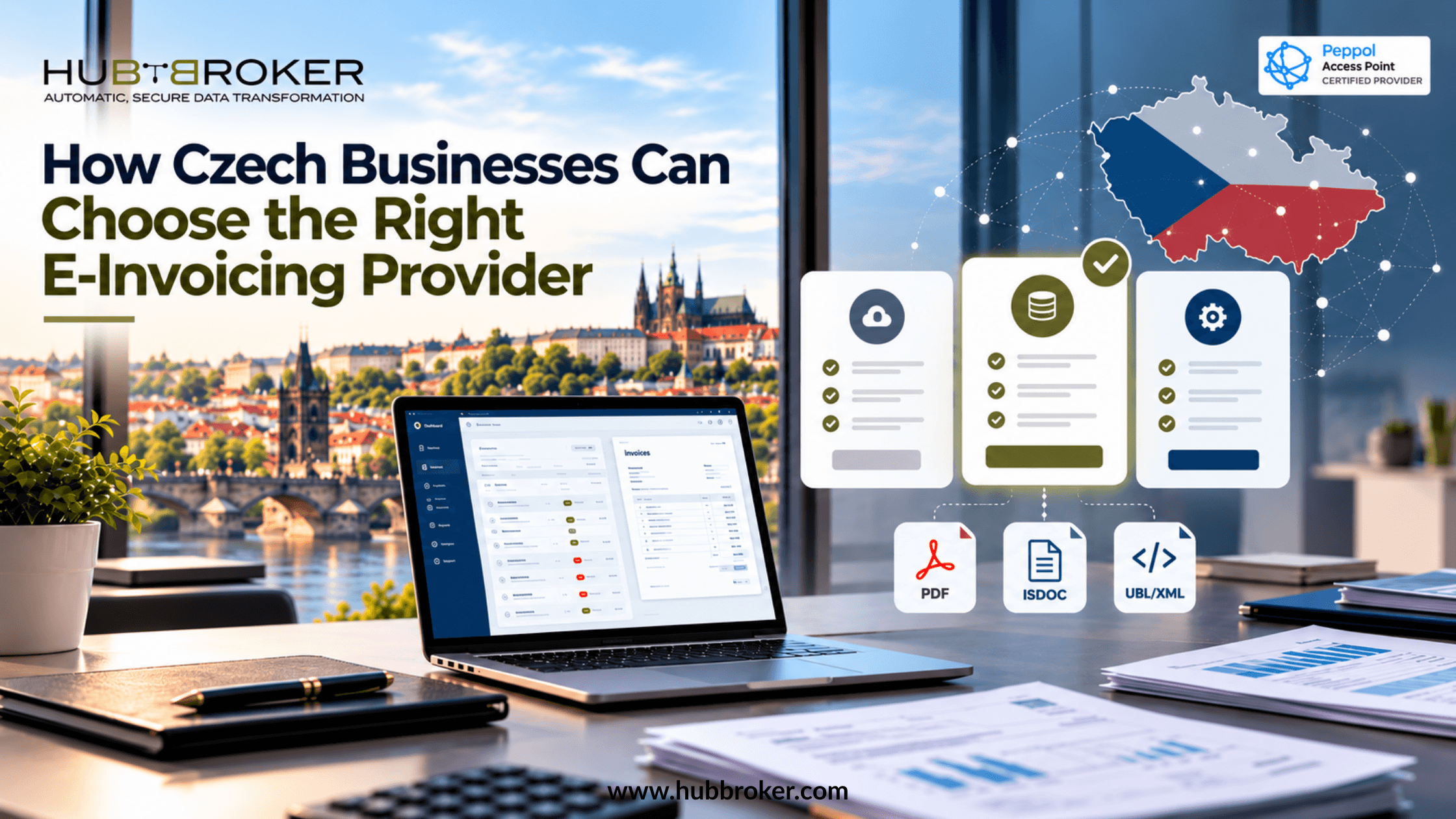
A PDF is convenient for people to read. Structured invoice data, however, can be processed directly by compatible software. Czech businesses may use ISDOC, a local structured format, as well as European formats such as UBL and UN/CEFACT CII.
The Czech Ministry of Finance recognizes ISDOC and ISDOCX version 5.2 or higher in its invoicing guidance. EN 16931 is also worth checking for public contracts and international trading partners. Ask which versions a provider actually supports. Can it convert data between formats? Will it warn you when a customer identifier or other field is missing? A logo saying “UBL supported” tells you little until a customer successfully receives and processes a sample invoice.
Provider Selection Checklist for Czech Accounting and ERP Teams
Bring these six checks to vendor meetings. Ask for working examples rather than quick promises.
List invoice routes. Record Czech customers, public buyers, foreign partners, and their preferred formats.
Check ERP connections. See whether invoices move directly from your accounting software without spreadsheet exports.
Test structured files. Ask for ISDOC and EN 16931 examples that a receiving system can process.
Review failed deliveries. Find out how employees see missing fields, wrong identifiers, and rejected documents.
Check record access. Discuss document search, retention, permissions, and exports if you change providers.
Calculate full costs. Include setup, mapping work, invoice volumes, support, updates, and new partner connections.
Use the same sample invoices when comparing shortlisted products. That makes differences in usability easier to spot. Ask someone from accounts payable or sales administration to join the test; those employees will handle problems long after the demonstration ends.
What Should a Provider Demonstration Really Prove?
Follow one invoice from the ERP until the buyer receives it. Watch whether tax values, customer details, currency, and payment information reach the finished file correctly. Then deliberately enter a wrong identifier and see what happens. Finance staff should understand the warning without asking a developer to translate it.
Area | Evidence to request | Warning sign |
|---|---|---|
ERP integration | Working invoice flow | Manual export needed |
File formats | Customer-tested samples | Versions not supported |
Delivery tracking | Full status history | Only says “sent” |
Error handling | Clear correction steps | Codes without explanation |
Security | Defined user permissions | Access rules unclear |
Support | Written response terms | No escalation contact |
Total costs | Itemized service proposal | Hidden mapping charges |
Get the promises in writing. That way, your team can compare what each provider includes and spot services that would cost extra. Also ask who owns a failed invoice: your finance team, the provider, or the receiving partner. Without an agreed answer, small problems can sit unresolved.
How Can Czech Companies Prepare for Future European Changes?
Domestic Czech B2B e-invoicing may remain voluntary, but European requirements are developing. The EU's VAT in the Digital Age reforms schedule new digital reporting for intra-EU transactions from July 2030. If you sell across borders, ask whether the solution can adapt to new reporting needs without replacing your accounting process.
Start with the customers and systems you already use most. Have a qualified adviser confirm tax duties, and ask providers to separate functions available today from planned features. A sensible choice fixes everyday invoice problems first while leaving space for future European changes. Check how invoices are archived and whether your team can retrieve old documents during customer disputes or audits.
