
Belgium Nine Months In: What Peppol-Based E-Invoicing Compliance Looks Like in Practice
On paper, Belgium e-invoicing is simple: structured invoices, sent over Peppol, between VAT-registered businesses. In a finance team, it is a daily question of who has a Peppol ID, which invoices bounce, and what happens to the PDF that used to be enough.
This post covers how Belgium e-invoicing works in practice after the first nine months: what the rules require, what the enforcement phase changed, and what finance and IT teams should have in place before year-end.
The Belgian mandate in brief
What is required, and who is in scope
As of 1 January 2026, companies established in Belgium and registered for VAT, except those fully exempt, have to issue their B2B invoices via the Peppol network. The required format is Peppol BIS Billing 3.0 (UBL 2.1), compliant with the EN 16931 standard. Receiving matters as much as sending: both sides of a domestic transaction must be able to handle structured invoices. The Belgian e-invoicing requirements page on our site summarises scope and deadlines.
Cross-border trade follows different rules. Cross-border invoices are out of scope until the EU's ViDA digital reporting requirements take effect on 1 July 2030. Foreign businesses with only a Belgian VAT number and no establishment are generally outside the B2B scope too, but they should check their own position.
Why Peppol is the backbone
Belgium's model is decentralised interchange, not clearance: invoices travel directly between the parties' access points over the Peppol network. No central platform sits in the middle. If you want to see how this differs from models where a tax authority joins the flow, our explainer on the Peppol 4-corner and 5-corner models covers it.
What the first nine months have shown
From tolerance period to enforcement
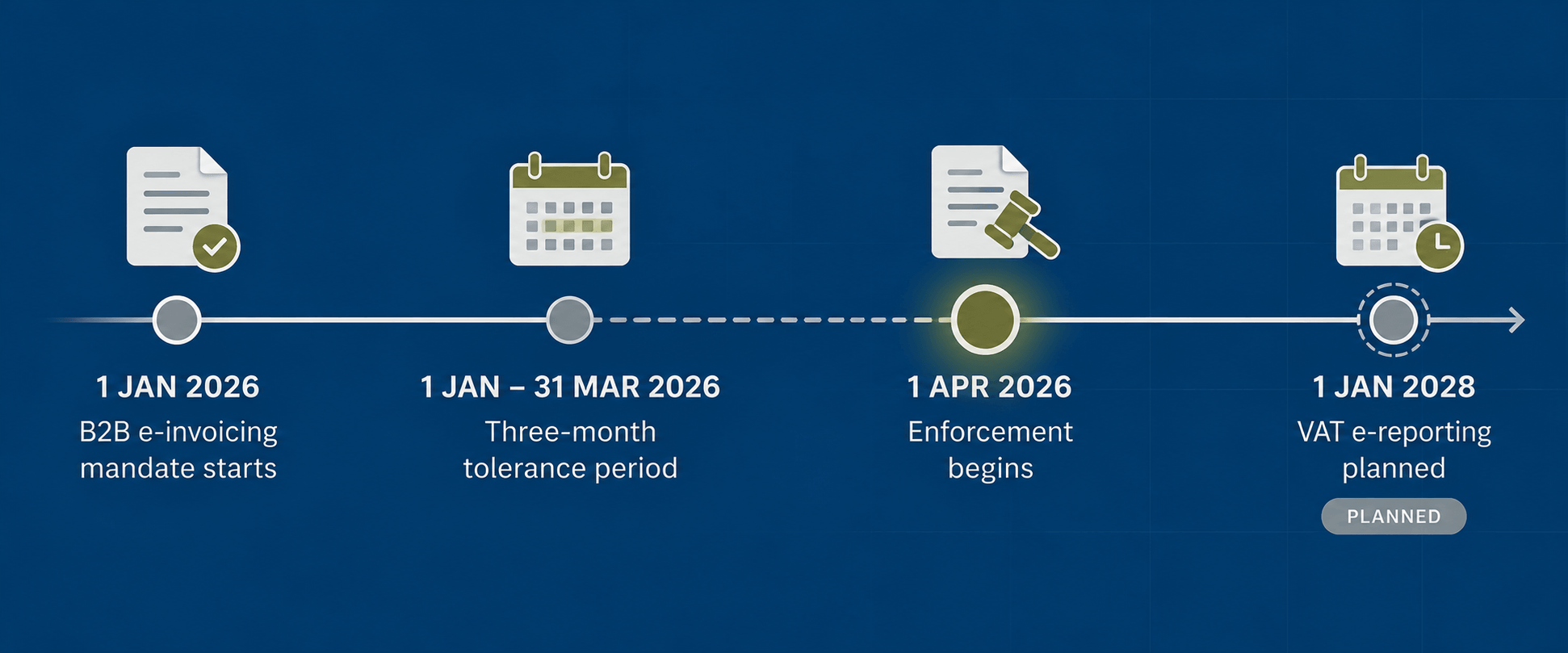
FPS Finance announced a three-month tolerance period on 2 December 2025: from 1 January 2026 until the end of March 2026, no penalties would be imposed, provided businesses could show "timely and reasonable" preparation. It was conditional, not a postponement. On 27 March 2026, FPS Finance confirmed the tolerance would not be extended.
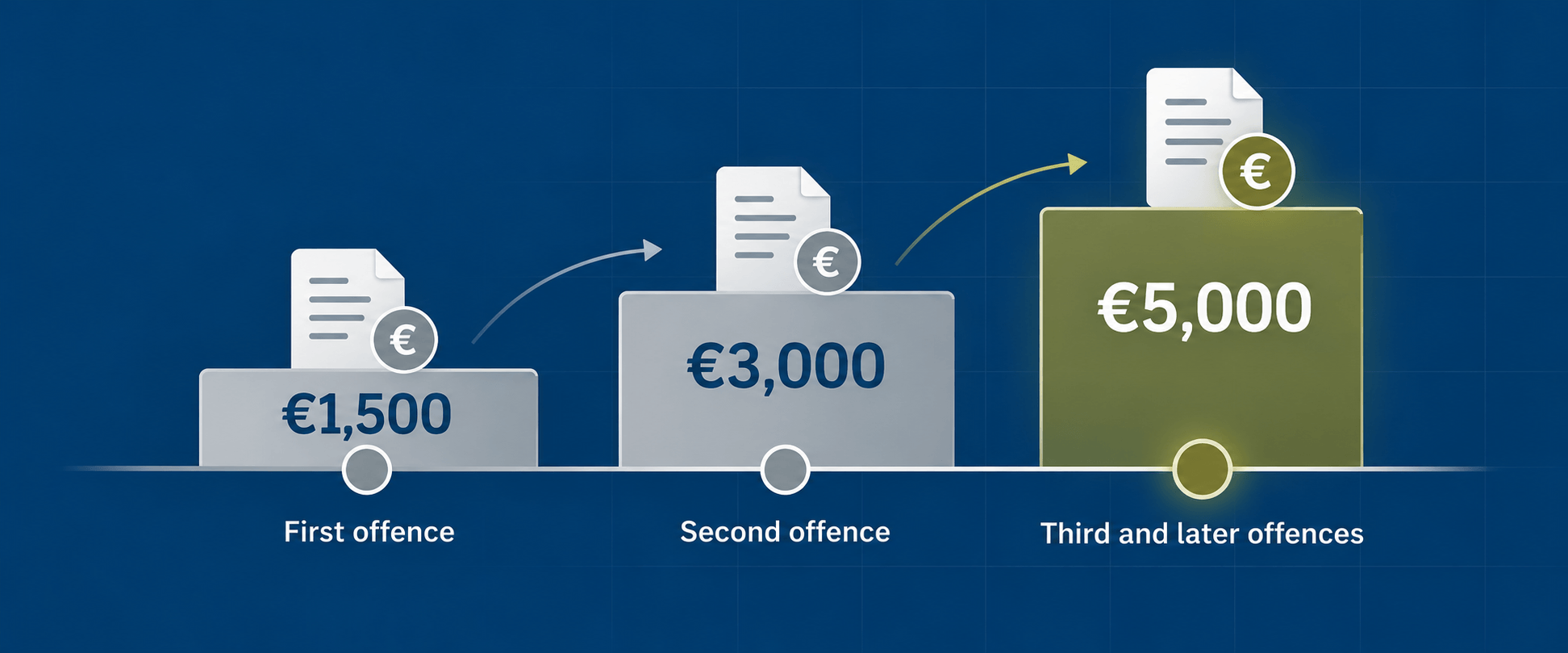
Penalties have been enforced since 1 April 2026. The technical readiness fines are graduated: €1,500 for a first offence, €3,000 for a second, and €5,000 for the third and later ones. The legal basis is the Royal Decree of 8 July 2025.
Two points are easy to miss. The receiving side can be fined as well. And once the obligation applies, a business needs a structured electronic invoice to support its VAT deduction claim. For finance teams, that turns a technical gap into a cash and audit question.
Where companies have struggled
The pre-deadline build-up was slow. In early December 2025, about 515,000 of the more than 1.2 million VAT-registered businesses required to comply had registered on Peppol, according to FPS Finance. The practical friction points follow from that:
Peppol identity. Each business needs a Peppol participant ID, normally based on its company number (KBO/BCE), registered with an Access Point. A customer or supplier without one cannot be reached.
PDF habits. Paper and PDF invoices no longer count as valid invoices between Belgian VAT-liable businesses. A PDF can still travel as a readable copy, but the electronic invoice must be strictly identical to it: same number, same date, same amounts, same VAT.
Partner coverage. One compliant company cannot fix a chain. Every customer and supplier you trade with has to be reachable.
What has worked well
Companies in a better position treat Belgium e-invoicing as a data-quality project rather than a file-format project. Invoice data comes from the ERP, is validated before sending, and gets a delivery status back. Because Peppol is the same network everywhere, the same setup also serves other Peppol-based markets.
What compliance looks like inside the finance and IT stack
Outbound: creating and sending Peppol BIS invoices
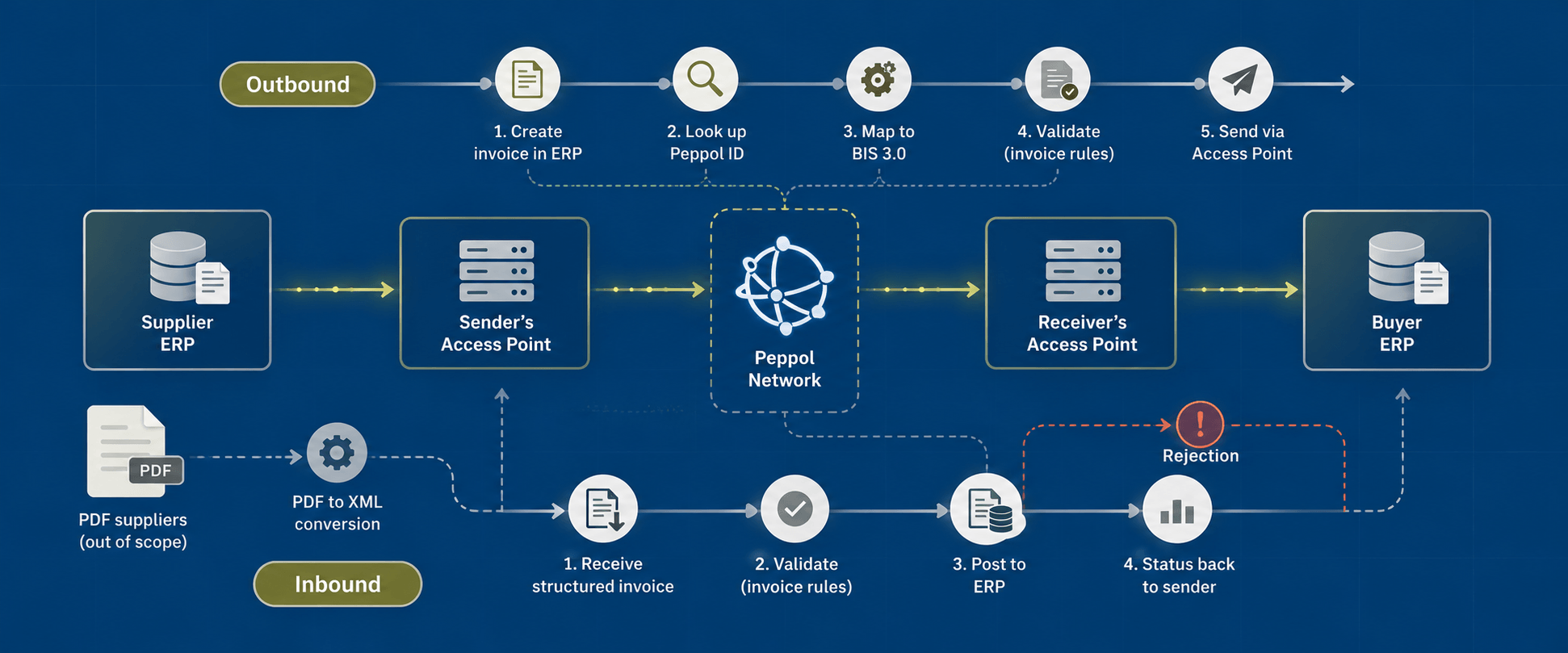
The outbound flow has five steps: the invoice is created in the ERP, the buyer's Peppol ID is looked up, the data is mapped to Peppol BIS Billing 3.0, the invoice is validated against syntax and business rules, and it is sent through the sender's Access Point to the buyer's Access Point. Most rejections trace back to missing buyer references, wrong identifiers or VAT mismatches, which is why validation before sending matters more than the sending itself.
Inbound: receiving, validating and routing structured invoices
Inbound is where many teams were least prepared. A structured invoice arrives as data, so accounts payable can post it without re-keying. The ERP connection has to be solid: if posting fails, the invoice is received but not processed. A good ERP integration handles matching, coding and routing automatically.
Suppliers outside the mandate, such as foreign vendors, will keep sending PDFs. A PDF to XML invoice conversion step turns these into structured data, so AP runs one process instead of two.
Error handling, rejections and status feedback
Define who owns a rejected outbound invoice, how fast it is corrected, and how the customer is informed. Track delivery status per invoice. Since every unresolved failure can become an enforcement risk, status visibility belongs in the finance process, not only in IT monitoring.
Choosing your connection model
ERP-native, Access Point provider or iPaaS
Most businesses reach Peppol in one of three ways: a Peppol function built into the ERP or accounting software, a standalone Access Point provider, or an integration platform that connects the ERP, Peppol and other document flows in one place. The first is quick for simple cases. The last pays off when you also run EDI, handle PDF suppliers, or operate in several countries. A certified Peppol Access Point is the common requirement in all three.
Questions to ask any provider
Do you validate against Peppol BIS and Belgian rules before sending?
How does the inbound flow reach my ERP, and what happens when posting fails?
Can I see delivery status and rejections per invoice?
How are PDF invoices from out-of-scope suppliers handled?
What does onboarding involve, and who owns Peppol ID registration?
Practical checklist for the next quarter
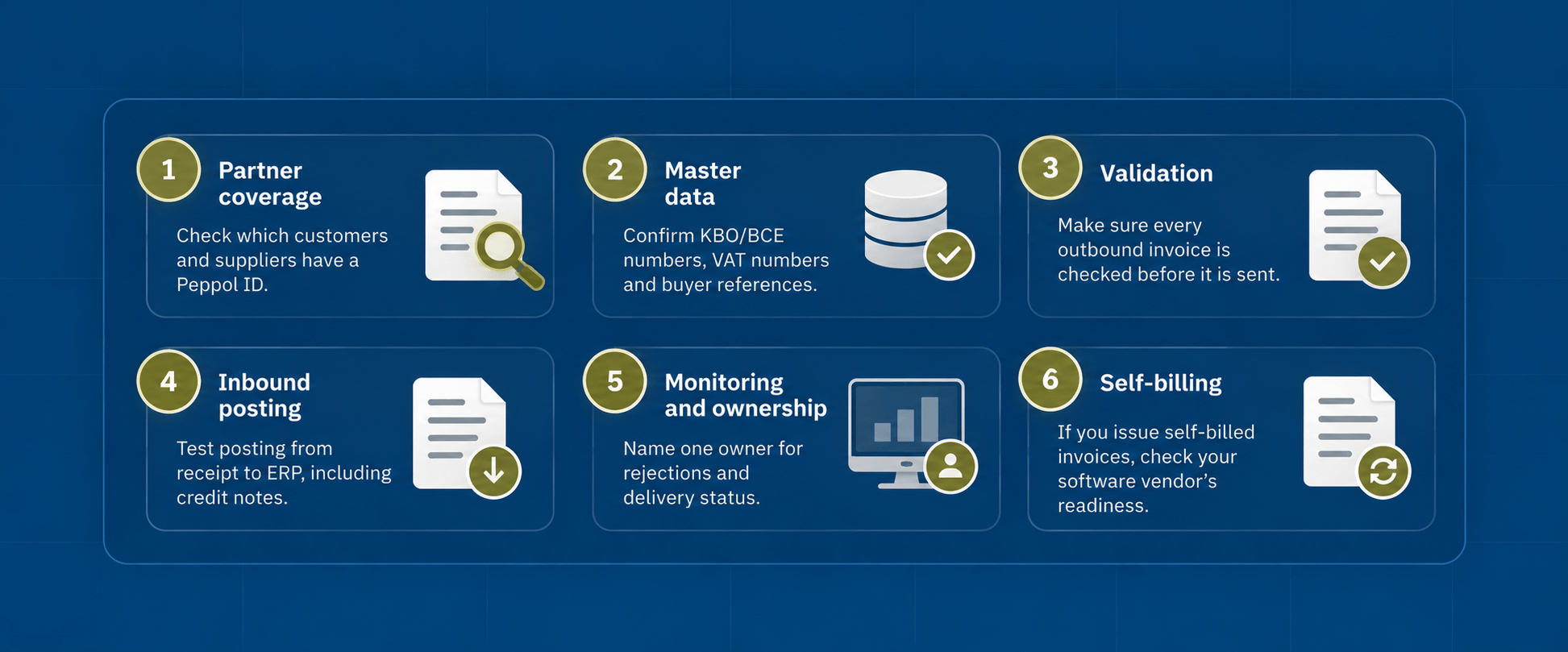
Partner coverage: check which customers and suppliers have a Peppol ID, and chase the gaps.
Master data: confirm KBO/BCE numbers, VAT numbers and buyer references in the ERP.
Validation: make sure every outbound invoice is checked before it is sent.
Inbound processing: test posting from receipt to ERP, including credit notes.
Monitoring and ownership: name one owner for rejections and delivery status.
Self-billing: if you issue self-billed invoices, check your software vendor's readiness. A targeted tolerance applied only until 30 June 2026.
Looking ahead: e-reporting and wider EU alignment
Belgium's reform runs in two stages. Following mandatory B2B e-invoicing from 1 January 2026, the government approved a draft bill for near real-time VAT e-reporting, expected to apply from 1 January 2028. A clean Peppol setup now is the foundation for that step, and for ViDA later. For companies trading across borders, such as Danish exporters selling into Belgium and Germany, see how one Peppol connection can cover several mandates.
FAQ
Is a PDF still a valid B2B invoice in Belgium? Not between in-scope Belgian businesses. A PDF may be shared as a readable copy, but the structured electronic invoice is the legally required document.
Do I need my own Peppol Access Point? You need a connection to one, but not your own. An access point is a Peppol service provider, often built into your invoicing or accounting software.
What happens if my customer cannot receive Peppol invoices? The tolerance period ended on 31 March 2026, so there is no general fallback. Ask the customer for their Peppol ID and check it in the Peppol Directory. Remember the receiving side can be fined too.
Does the mandate apply to invoices to consumers? No. For transactions with non-VAT-registered entities, no structured e-invoice obligation applies. Even consumer-only businesses should be able to receive supplier e-invoices.
Is Belgium e-invoicing required for cross-border invoices? Not under the current rules. Cross-border structured invoicing needs both parties' agreement until the ViDA requirements arrive.
What comes after e-invoicing? Near real-time VAT e-reporting, currently planned for 1 January 2028. Treat the date as subject to final legislation.
Next step
If you want a second opinion on your Belgian setup, from Peppol ID registration to inbound posting in your ERP, talk to our integration team. We will review the current state with you and tell you what is missing.
