
Amazon returns refunds data sync ERP
A customer in Germany buys three products from Amazon. The order goes into ERP, warehouse ships all three items, stock goes down, and finance records the revenue and VAT. Eight days later, customer returns one product. Amazon refunds that item, but ERP still shows three products sold and full revenue.
This is where Amazon returns refunds data sync ERP becomes important. The original order flow worked fine, but the reverse process did not. Finance now sees one amount, warehouse has a returned item, and ERP is showing something different.
Amazon Refunded the Customer, but Why Is ERP Still Showing Full Sale?
An Amazon refund is a new business event. ERP should not simply receive a negative copy of the original order. It needs to know what changed, which order line was affected, and whether stock also needs to be updated.
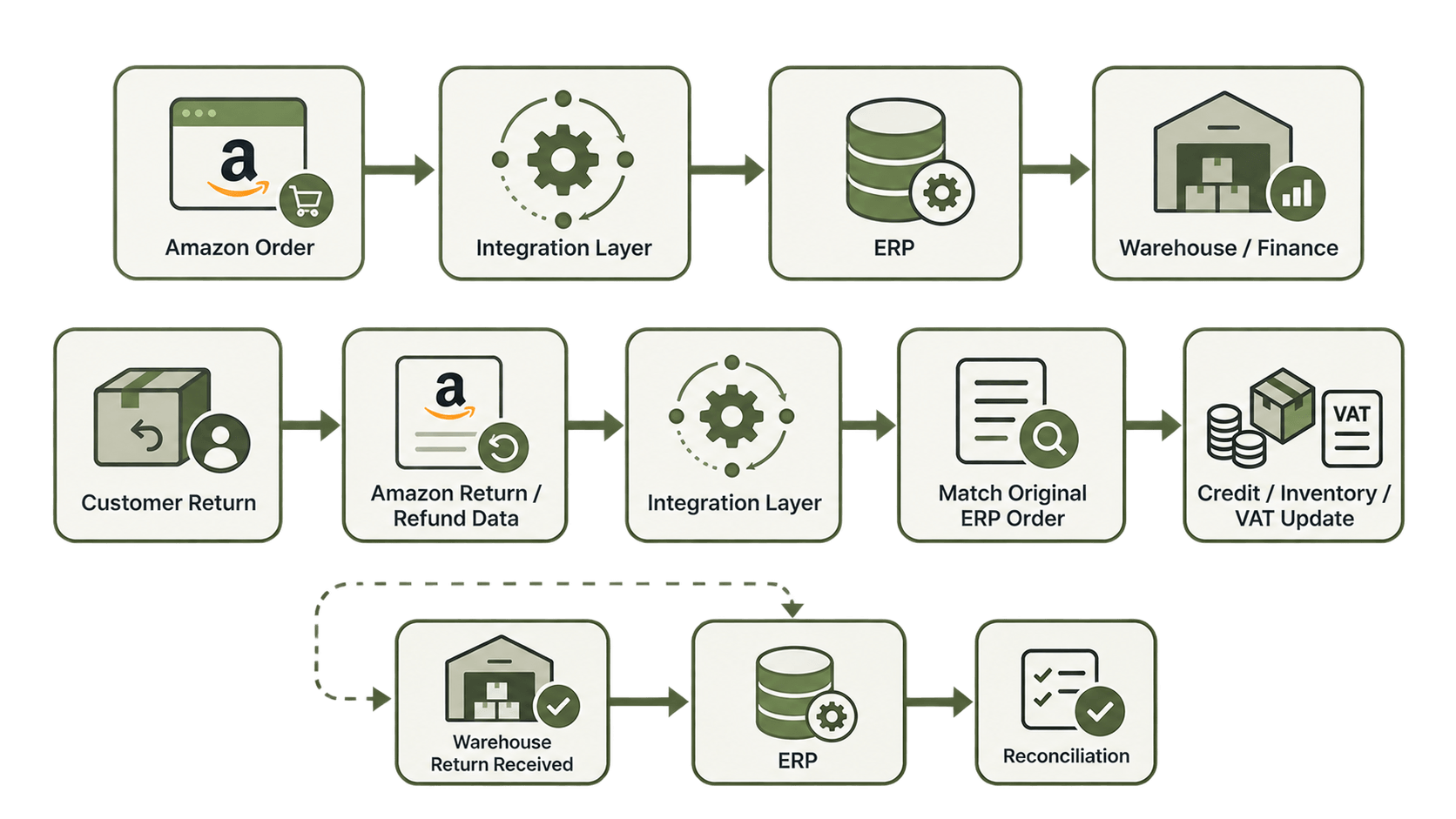
Returns are normal part of ecommerce in Europe. In 2025, 78% of EU internet users bought goods or services online. EU consumer rules also generally give customers 14 days to withdraw from many online purchases, although some exceptions apply.
Customer Returned One Item From Three. What Should ERP Update?
The customer keeps two products and sends one back. The return flow should look something like:
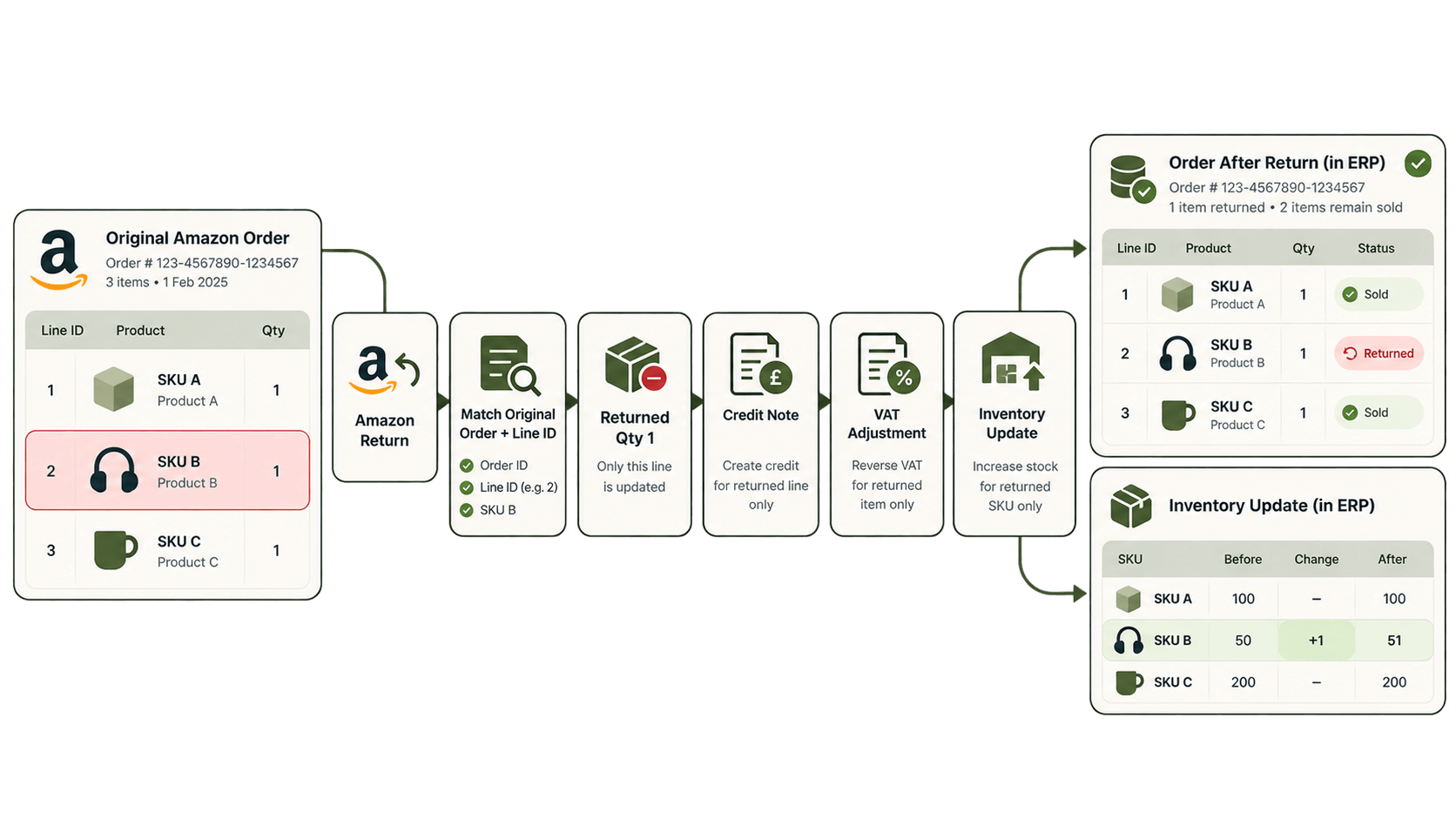
ERP should reverse only the returned SKU and quantity. It may create a credit note for that line, adjust VAT, update refund status, and increase stock where appropriate. If the integration reverses the complete order, the two valid sales also disappear. Revenue, VAT and stock will then be wrong.
This is why line-level matching is important for partial returns.
What Changes When Amazon Gives a Full Refund?
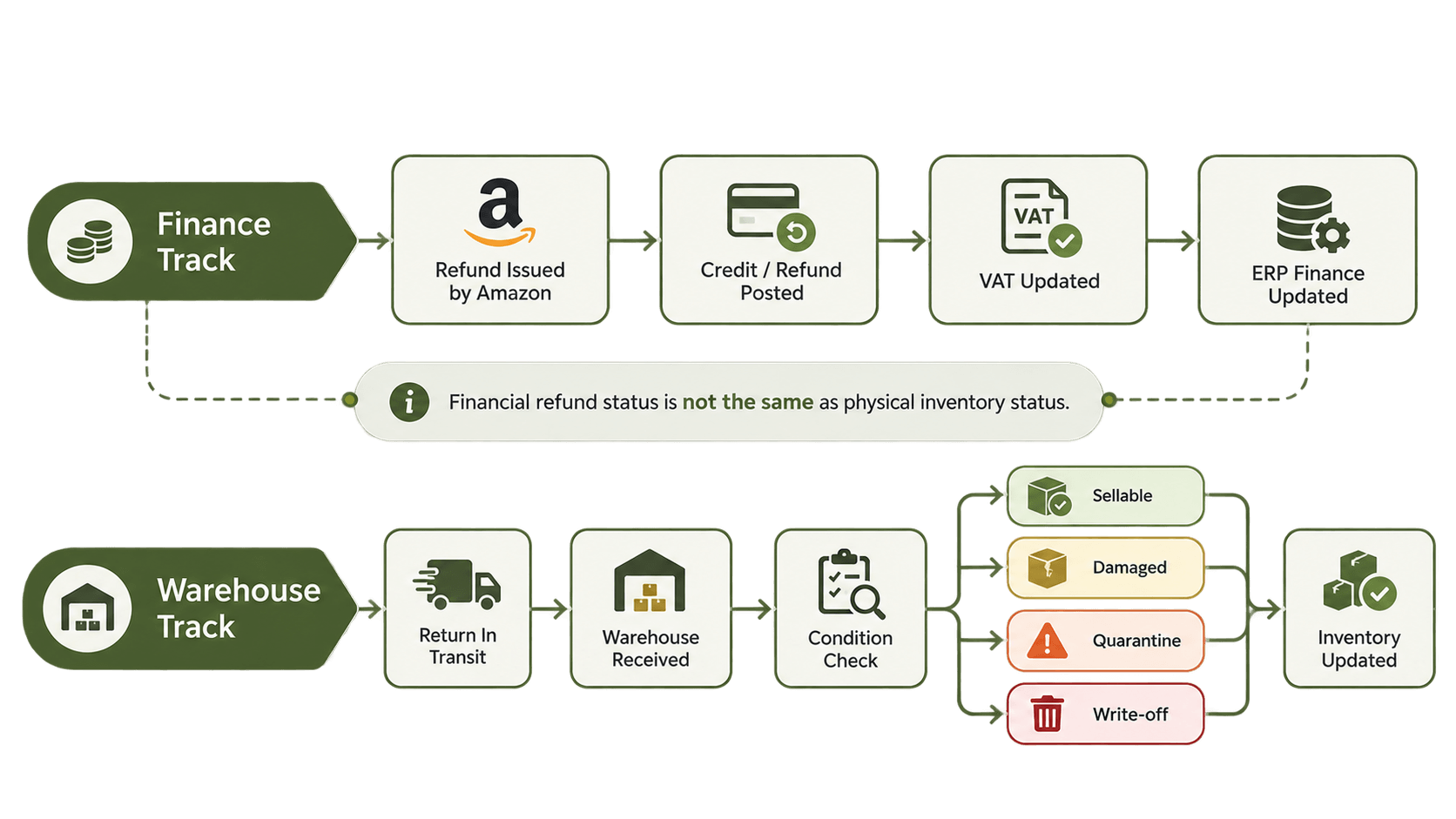
A full refund can affect several parts of the ERP transaction. This can include sales value, VAT, payment status, credit note, inventory treatment and reconciliation reference. But stock should not always increase immediately. The product may still be travelling back, damaged, missing, or handled inside an Amazon fulfilment location. So financial refund status is not same as physical inventory status.
Finance may already need to record the refund while warehouse is still waiting for the actual product. Keeping these two events separate gives much cleaner data.
Refund Happened Before Warehouse Received the Product
Amazon may show that refund has been completed while warehouse has not yet received the returned item. If ERP treats refund as proof that goods are physically back in stock, available inventory becomes higher than the real warehouse quantity. A better setup keeps two separate events.
First, the refund event updates finance. Later, warehouse confirms the physical return and updates inventory. At that point, the returned item may be marked as sellable, damaged, quarantine stock or write-off depending on its condition. This avoids mixing financial reversal with warehouse movement.
Which Amazon Return Fields Should Reach ERP?
Useful return data includes much more than only refund amount.
Return Data | Why ERP Needs It |
|---|---|
Amazon order ID + line ID | Match original transaction |
SKU + returned quantity | Reverse correct product |
Refund amount + date | Finance posting |
VAT amount | Tax correction |
Return reason + status | Operations tracking |
Marketplace | Country mapping |
Shipping refund + Amazon fees | Reconciliation |
Adjustment amount | Settlement difference |
Fulfilment method | Route stock correctly |
With these fields, integration can create proper business events instead of sending one generic negative order into ERP.
Amazon Refund and ERP Credit Note Do Not Match — Where Should Finance Check?
Finance should compare the original order, refund lines, VAT, shipping refund, Amazon fees, adjustments and settlement reference. The amount refunded to customer and the final seller settlement are not always the same number. Amazon fees or later adjustments can create differences. If all these amounts reach ERP as one value, finance team may need to open reports and spreadsheets just to understand what happened.
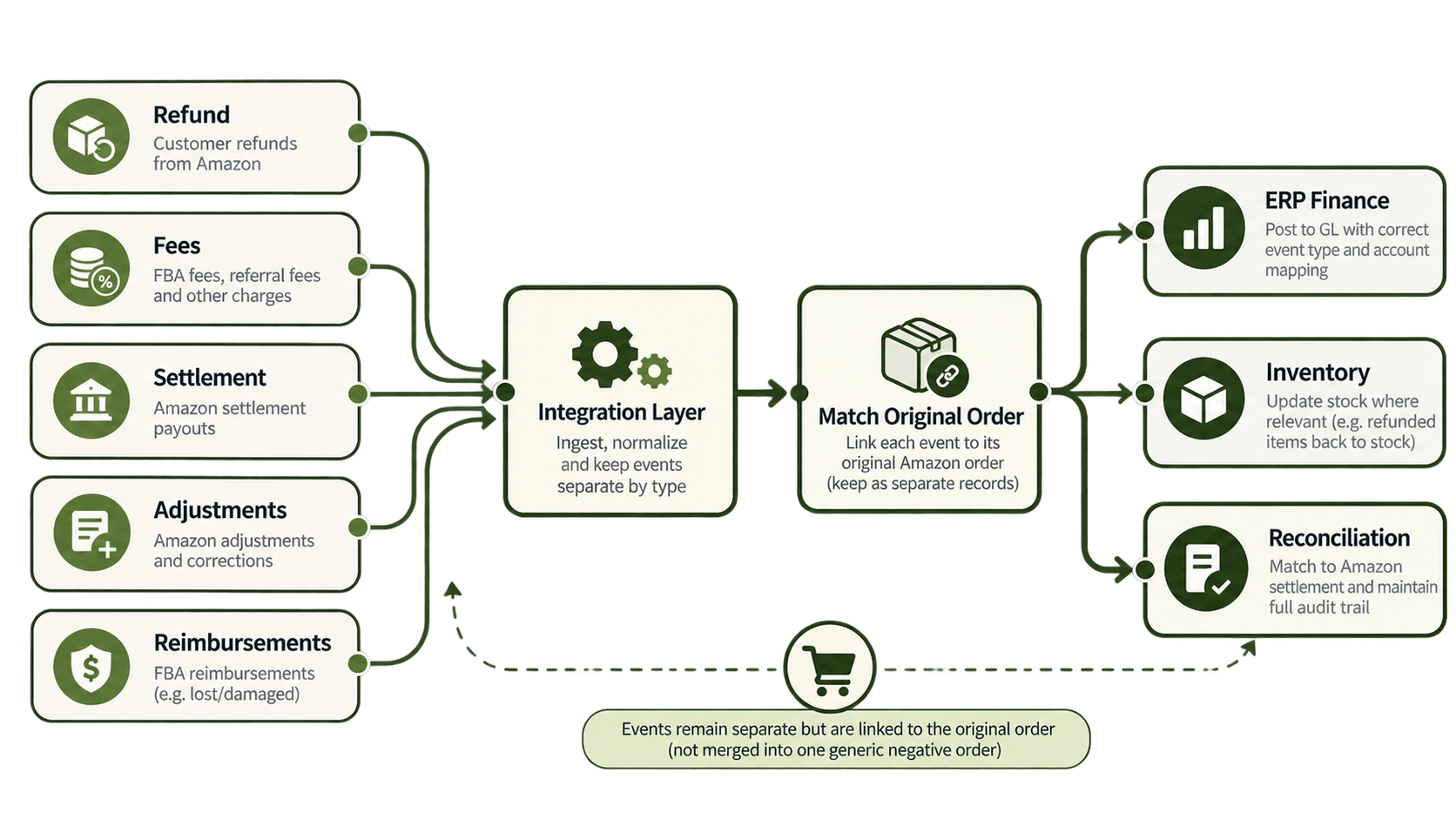
For sellers handling thousands of Amazon orders, this is not really practical. It is much easier when the integration keeps refund, fee, settlement and adjustment data separate but connected to the original order.
Selling on Amazon Germany, France and Poland With One ERP
A company may sell through several Amazon marketplaces but still use one ERP for finance and inventory. Stock may sit in Germany, while a French return moves through another fulfilment point. Polish orders may also have different marketplace references, currencies or tax details. A central integration process can apply marketplace, VAT, warehouse, currency and return rules while still matching everything back to one original ERP order.
Separate manual process for each marketplace usually creates more mismatch and more work for finance team.
What About Amazon Reimbursements for Lost or Damaged Stock?
Amazon reimbursement is not the same as a customer refund. A customer refund reverses part or all of the sale to buyer. A reimbursement may compensate the seller for inventory that Amazon lost or damaged while handling it. ERP should record reimbursement as a separate transaction type with its own reference.
Mixing reimbursements with customer returns makes revenue, stock and settlement reporting difficult to understand. Finance should be able to see clearly whether money relates to a customer refund, Amazon fee, stock reimbursement or another adjustment.
Make the Reverse Journey as Controlled as the Sale
A good Amazon integration should handle the order going forward and the return coming back.
HubBroker can connect Amazon return, refund, adjustment and settlement events with ERP, finance and warehouse processes. The integration can match returned lines with the original order, keep financial and inventory events separate, and give teams better visibility when values do not match.
If your finance team is still manually matching Amazon refunds with ERP credit notes, VAT corrections, stock movements and settlement data, the reverse process needs same level of automation as the original sale.
