
What Is the Difference Between an EDI VAN and an Integration Platform
A purchase order can reach your network but never appear in the ERP. An invoice may be delivered correctly, yet fail validation or sit unnoticed because a required field is missing. Meanwhile, the VAN shows the document as successfully transmitted.
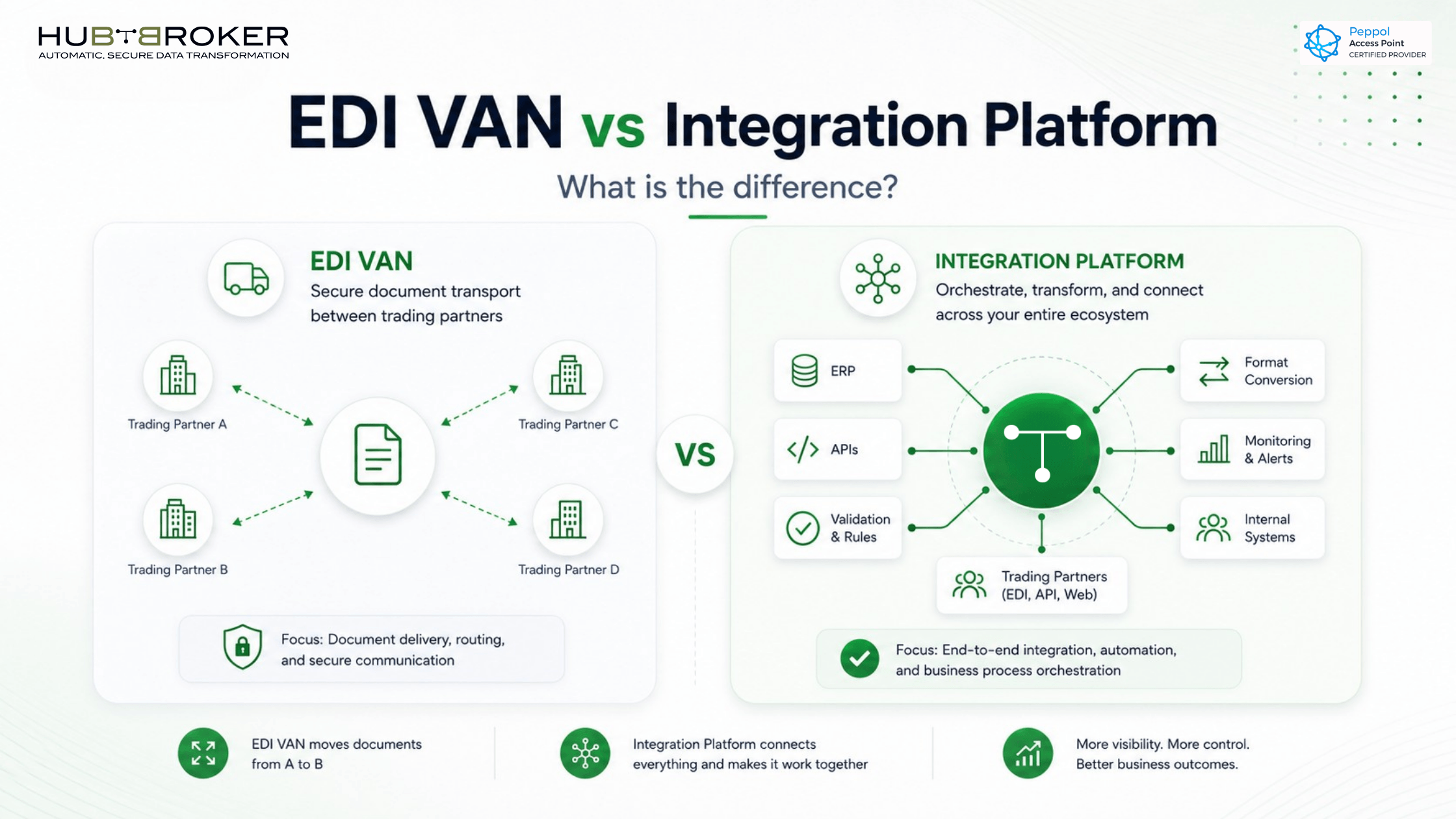
So, what is the difference between an EDI VAN and an integration platform? A VAN mainly transports business documents between trading partners. An integration platform manages the wider process, including data mapping, validation, ERP connectivity, workflows and error monitoring.
Understanding this difference matters when your business is handling more partners, applications and document requirements than before.
What Is an EDI VAN and What Does It Actually Handle?
An EDI VAN, or Value-Added Network, provides a managed network for exchanging electronic business documents. It works a little like a secure digital postal service between your company and its trading partners.
The VAN receives documents from one organisation, routes them to the correct recipient and provides confirmation that the file was delivered. These documents may include:
Purchase orders
Invoices
Order confirmations
Dispatch advice
Inventory updates
Shipping documents
A VAN can be a reliable choice when the main requirement is exchanging structured documents with customers and suppliers.
However, successful delivery does not always mean successful processing. The VAN may confirm that an invoice reached your organisation, but it may not know whether the invoice entered your ERP correctly, passed business validation or was rejected by an internal workflow.
That part often need another integration layer.
What Is an EDI Integration Platform?
An EDI integration platform connects external document exchange with the systems your teams already use.
Instead of focusing mainly on document transport, the platform manages how data moves between trading partners, ERP systems, warehouse platforms, eCommerce stores, marketplaces and finance applications.
For example, an integration platform can:
Receive an EDIFACT purchase order from a customer
Validate required fields and business rules
Convert the order into the ERP’s required format
Create the sales order inside the ERP
Return an order confirmation to the customer
Record processing errors and document statuses
This creates visibility beyond “sent” or “received.” IT and operations teams can see whether the document was mapped, validated and processed by the destination system.
An integration platform can also use different delivery channels. These may include direct EDI connections, APIs, file transfer, an existing VAN or a certified Peppol Access Point.
What Is the Difference Between an EDI VAN and an Integration Platform?
The main difference is scope.
An EDI VAN transports documents between businesses. An integration platform connects those documents with applications, data rules and internal workflows.
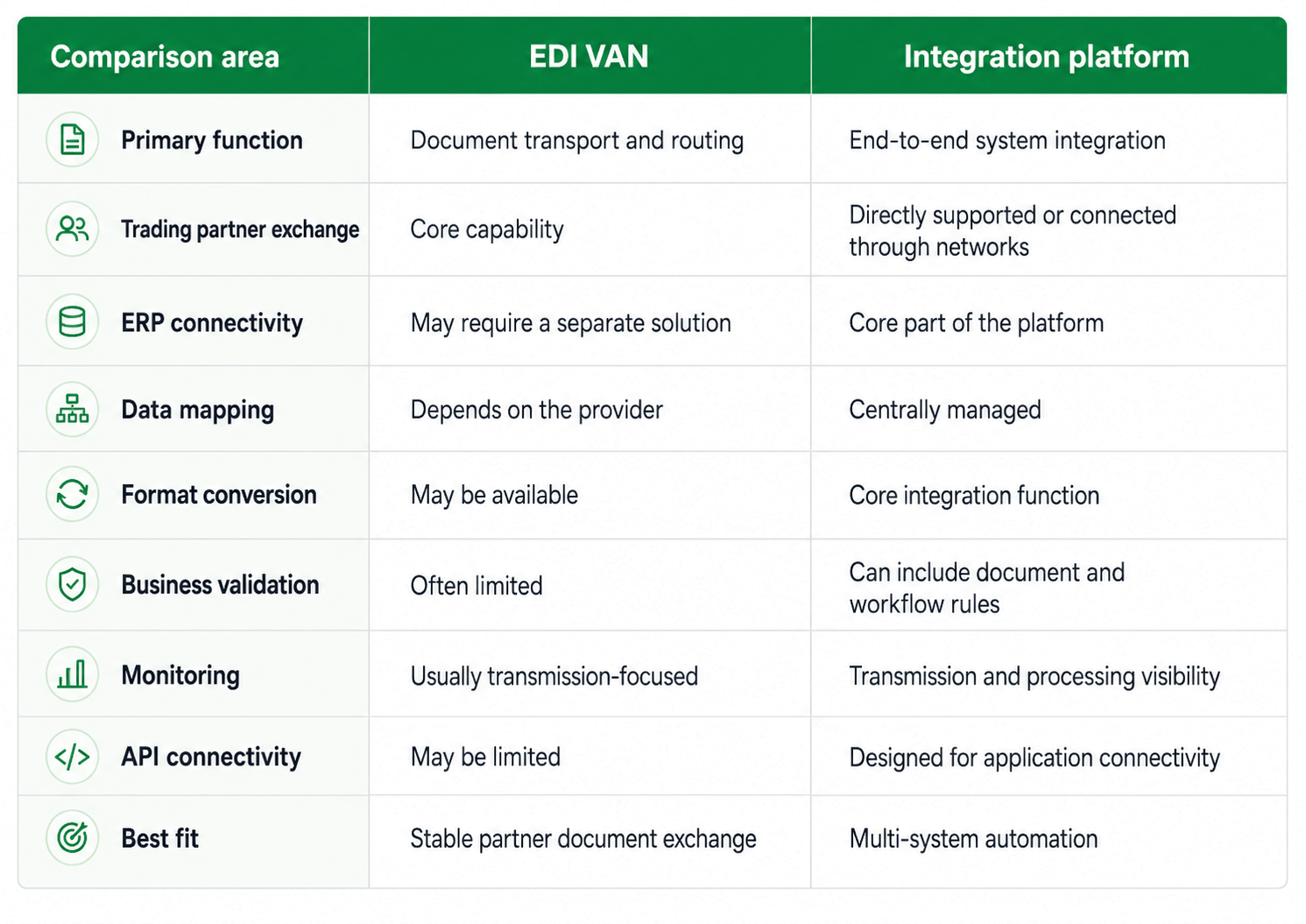
This does not mean a VAN is an old or unsuitable technology. A VAN can remain an important part of an EDI setup.
The problem comes when a business expects the VAN to manage the entire process, including ERP integration, application errors and business workflow automation. Not every VAN is designed to handle these areas.
Where Can a VAN-Only Setup Create Operational Gaps?
A VAN-only architecture may work well when document flows are simple and the company already has strong internal integration capabilities.
Gaps often appear as the business adds more systems and partners.
An invoice may be delivered to the VAN mailbox but fail before entering accounts payable. A purchase order may use an unexpected product identifier, causing the ERP import to stop. The sender believes the document was delivered successfully, while the receiving team cannot find it inside their system.
Teams then have to check several places:
VAN transmission logs
Mapping software
File-transfer folders
ERP import queues
Email notifications
Partner acknowledgements
This can make a basic processing issue difficult to locate. Finance sees a missing invoice, operations sees a delayed order and IT has to investigate each separate connection.
An integration platform reduces this gap by monitoring the document across the complete flow, not only during transmission.
What Does This Mean for Your ERP and Existing Systems?
Choosing an integration platform does not mean replacing your ERP.
The platform works as a connection layer around what the business already runs. HubBroker can connect ERP, WMS, eCommerce, marketplaces and trading partner networks through one integration environment.
Through ERP EDI integration, internal ERP data can be mapped into EDIFACT, XML, JSON or another partner-required format. Incoming documents can also be converted into the structure expected by the ERP.
This means employees continue working in their normal finance, order-management or warehouse systems. They do not have to move every process into a separate EDI portal.
Existing VAN connections can also remain in place. The VAN handles document transport, while the integration platform manages mapping, ERP processing, validation and monitoring.
This combined setup can be useful when your customers require different communication methods. One partner may use a VAN, another may use AS2, while public-sector or regulated invoice flows may use Peppol.
The integration layer brings these different channels into the same operational process.
Should You Use a VAN, an Integration Platform or Both?
A VAN may be enough when you have stable trading relationships, limited document types and an existing method for integrating documents with your ERP.
An integration platform becomes more useful when:
Several internal systems must exchange data
New partners are added regularly
Each partner uses different document formats
EDI, APIs and e-invoicing must work together
Teams need central error and status monitoring
Manual file handling is delaying order or invoice processing
Many companies do not need to make a strict choice between one or the other. They can retain a VAN for established partner communication and use an integration platform to manage the broader system workflow.
The right question is not only, “Was the document delivered?”
It is also, “Was the document accepted, validated and processed correctly by the ERP?”
To review whether your current VAN setup covers the complete process from partner delivery to ERP processing, book a short HubBroker consultation.
