Your Suppliers Are Going Digital on Different Timelines Your AP Team Pays for It
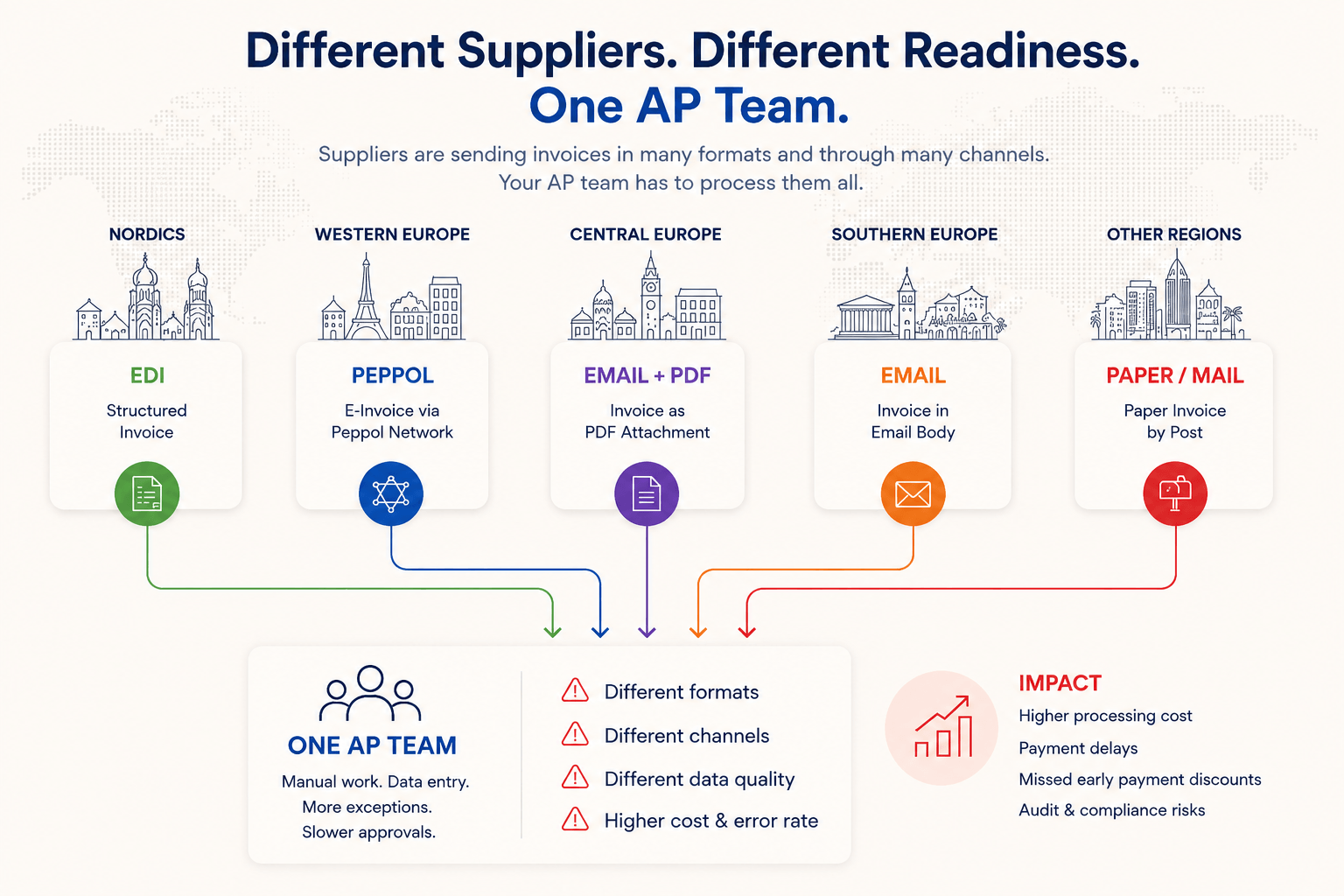
You have suppliers in five countries. One of them is now legally required to send you structured e-invoices. Two more will be next year. The rest are still emailing PDFs, and a handful still post paper.
Nobody planned it this way. It happened because governments across Europe set their own mandate dates, and your supplier base didn't coordinate. Supply chain e-invoicing is the problem that sits in the middle of all of it and right now, the people absorbing the gap are your AP clerks, manually.
What supply chain e-invoicing actually means (and what it doesn't)
It does not mean emailing a PDF. A PDF is a picture of an invoice. Your system can't read it, match it, or post it without someone retyping the numbers.
Supply chain e-invoicing means invoices moving as structured, machine-readable data between your suppliers, your buyers, and your ERP linked to the purchase order and the goods receipt, validated before it lands, and traceable end to end.
The distinction matters because a lot of companies believe they've already solved this. They've digitised the delivery method. They haven't digitised the data.
Why this is a finance problem and an operations problem at the same time
The finance view
Every invoice that arrives unstructured is a manual three-way match. That means longer approval cycles, more exceptions, more accrual guesswork at month-end, and an audit trail assembled from email threads. Early payment discounts get missed because approval takes eleven days instead of two. And when a tax authority asks for a specific invoice, someone goes looking.
The supply chain view
You own supplier onboarding, and supplier onboarding is where e-invoicing quietly becomes expensive. Every new format is a new mapping. Every mandate is a new compliance conversation with a supplier who may not understand it yet. Disputes over quantity or price take longer to resolve because the data was retyped somewhere along the way, and now nobody's sure which version is right.
Both teams are solving the same problem from opposite ends. Usually without a shared plan.
The mandate map is uneven and that's the real cost
Across Europe, e-invoicing obligations are landing at different times with different scopes. France, Germany, Belgium, and Poland are all on separate tracks with separate thresholds and separate technical requirements. The Gulf markets are moving too, on their own models.
Here's what that means practically: being compliant in one country tells you nothing about your exposure in the next one.
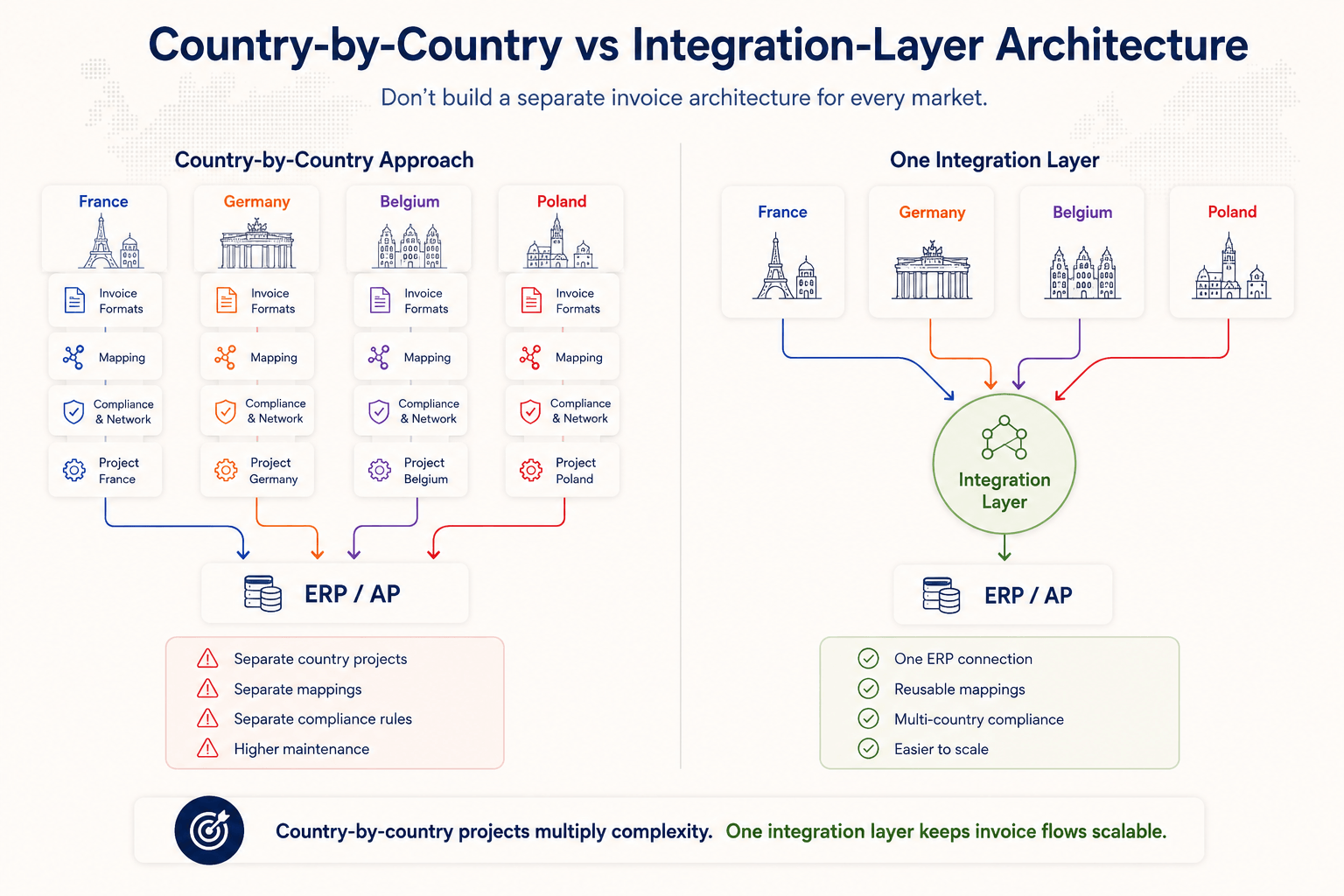
Companies that solved e-invoicing for Denmark and assumed the rest of Europe would follow the same pattern are now running four parallel projects. That's not four times the compliance work. It's four times the compliance work plus the integration work of making four different outputs land correctly in one ERP.
Where supply chain e-invoicing projects go wrong
Assuming the ERP handles it
Most ERPs can produce an invoice. Fewer can produce a country-specific, schema-valid e-invoice, transmit it through the required network, and process what comes back. That's usually a module you don't have, or a version upgrade you didn't budget for.
Solving country by country
Each individual project looks manageable. Five of them running at once, with different vendors and different data models, is how you end up with an invoice architecture nobody fully understands.
Ignoring the long tail
Roughly the bottom 60% of your supplier list by spend will not implement structured invoicing to accommodate you. They're too small, and they have no mandate obligation. If your plan requires them to change, your plan fails at the tail.
What a workable setup looks like
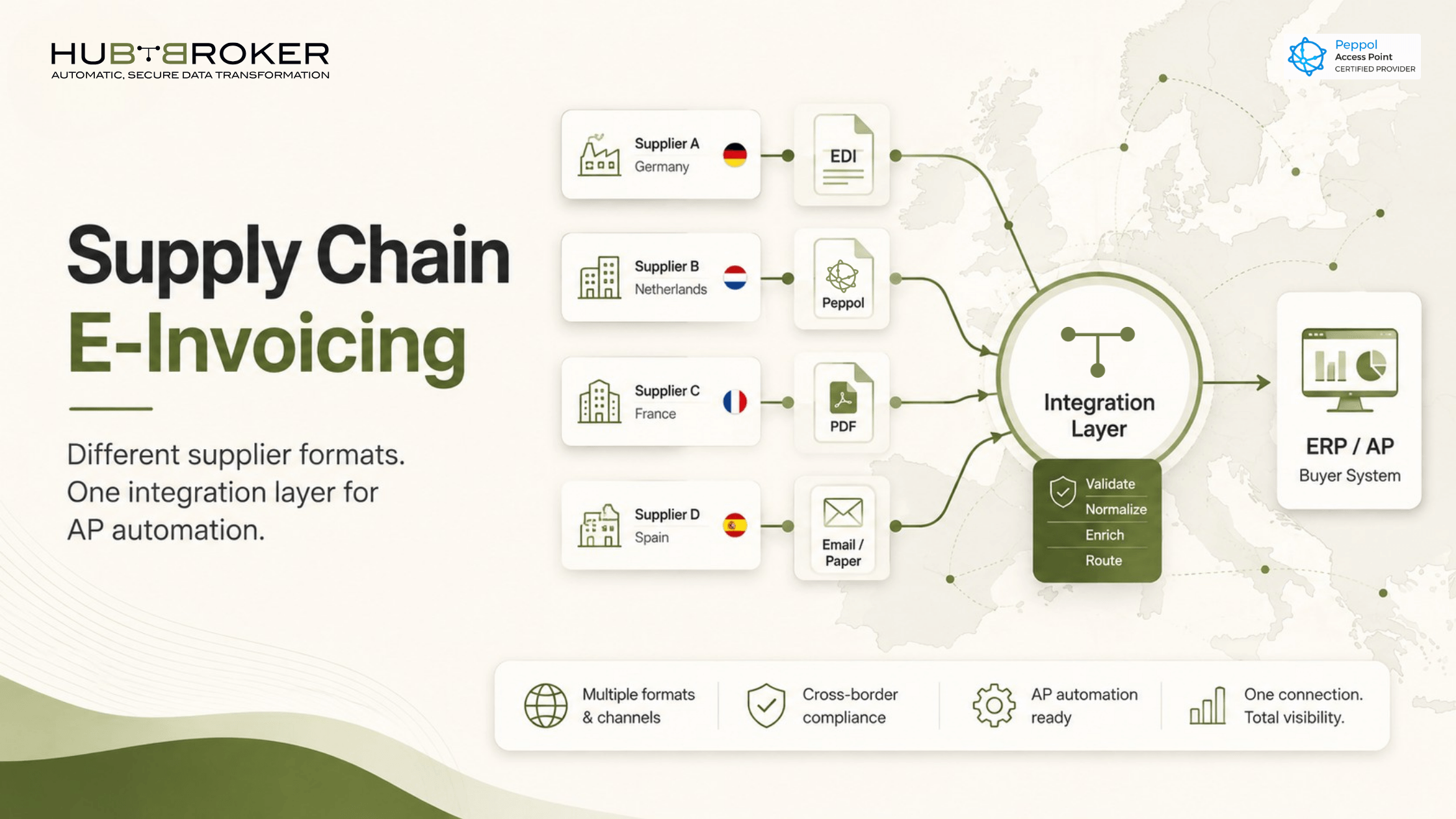
The version that holds up treats e-invoicing as an integration layer sitting on top of the ERP you already run not a replacement for it.
That layer accepts invoices however they arrive. EDI from your larger trading partners. Peppol for regulated markets and public-sector buyers. PDF-to-XML conversion for the long tail that will keep emailing documents regardless of what any government says. It validates everything, normalises it into one format, and passes it into your existing ERP through a single connection.
Your finance team sees one clean inbound flow instead of five. Your suppliers change nothing. And when the next country announces a mandate, you configure a channel rather than starting a project.
This is how companies like Orkla, Fujitsu, Atea and Eriks handle cross-border invoice volume across multiple entities and systems one integration layer, many endpoints.
Frequently asked questions
Is supply chain e-invoicing the same as EDI? Related, not identical. EDI is the established method for structured B2B document exchange between trading partners. E-invoicing mandates add government requirements on top specific formats, specific networks, sometimes real-time reporting to a tax authority. Most companies need both.
Do we need to replace our ERP? No. Replacing a working ERP to solve an invoicing requirement is the most expensive available option. An integration layer handles format translation, validation, and network connectivity while the ERP stays as it is.
What about suppliers too small to send structured invoices? They keep sending PDFs. Intelligent document processing extracts and validates the data on your side, so it enters your ERP structured even though it didn't arrive that way.
How does this affect three-way matching? It improves it. Structured line-item data can be matched against the PO and goods receipt automatically, so exceptions get flagged instead of discovered late.
Who is accountable if a government platform rejects an invoice? Legally, the issuing company. Practically, your provider should validate against the target schema before transmission and surface rejections with a reason you can act on not a silent failure you find at month-end.
Where to start
Before choosing anything, get one thing on paper: your supplier list, the country each one invoices from, the format they send today, and the mandate date that applies to them. Most companies find the gap is larger than expected.
If you want a second pair of eyes on that map, get in touch. We'll look at your supplier mix and format spread and tell you where the exposure actually sits.
