
How Much Does Peppol Cost Per Month?
If you're preparing for e-invoicing compliance, one question comes up before any other: How much does Peppol actually cost per month?
The honest answer is it depends on your provider, your invoice volume, and how deeply you want it connected to your ERP. This guide breaks down real cost ranges, what drives the price up or down, and how to pick a plan that won't surprise you later.
Is Peppol free to use?
Peppol itself is a network, not a paid service. The network is public and open, so there's no toll for using it. But you can't connect to that network on your own. You need software or a certified Access Point Provider to actually send and receive documents, and that's where the real cost sits.
How much does a Peppol Access Point cost per month?
Pricing varies widely between providers, and most fall into one of two models:
Pricing Model | How It Works | Typical Monthly Range |
|---|---|---|
Subscription (flat fee) | Fixed monthly fee, often with a document cap. | €5–€60/month for basic send/receive |
Pay-per-document | You pay per invoice sent or received. | From roughly €0.18–€0.50 per document |
Enterprise / ERP-integrated | Bundled with API, automation and dedicated support. | €100+/month, scales with volume |
Entry-level plans built for freelancers or very low volumes can start under €10/month, while combined send-and-receive plans from some providers run around €60 a year for the lightest usage tier. On the other end, providers targeting high-volume enterprises structure pricing around implementation and monthly subscription fees layered on top of transaction costs.
Cost comparison: Basic vs API vs Full ERP Integration
Factor | Basic Web Portal | API Access | Full ERP Integration |
|---|---|---|---|
Setup effort | Low | Medium | Higher (one-time) |
Manual work | High (manual entry) | Low | Minimal |
Ideal for | Freelancers, low volume | Growing businesses | Mid-size to enterprise |
Monthly cost feel | Lowest | Moderate | Higher, but scales well |
What factors affect Peppol e-invoicing cost?
Beyond the base subscription, several variables quietly shape your actual monthly bill:
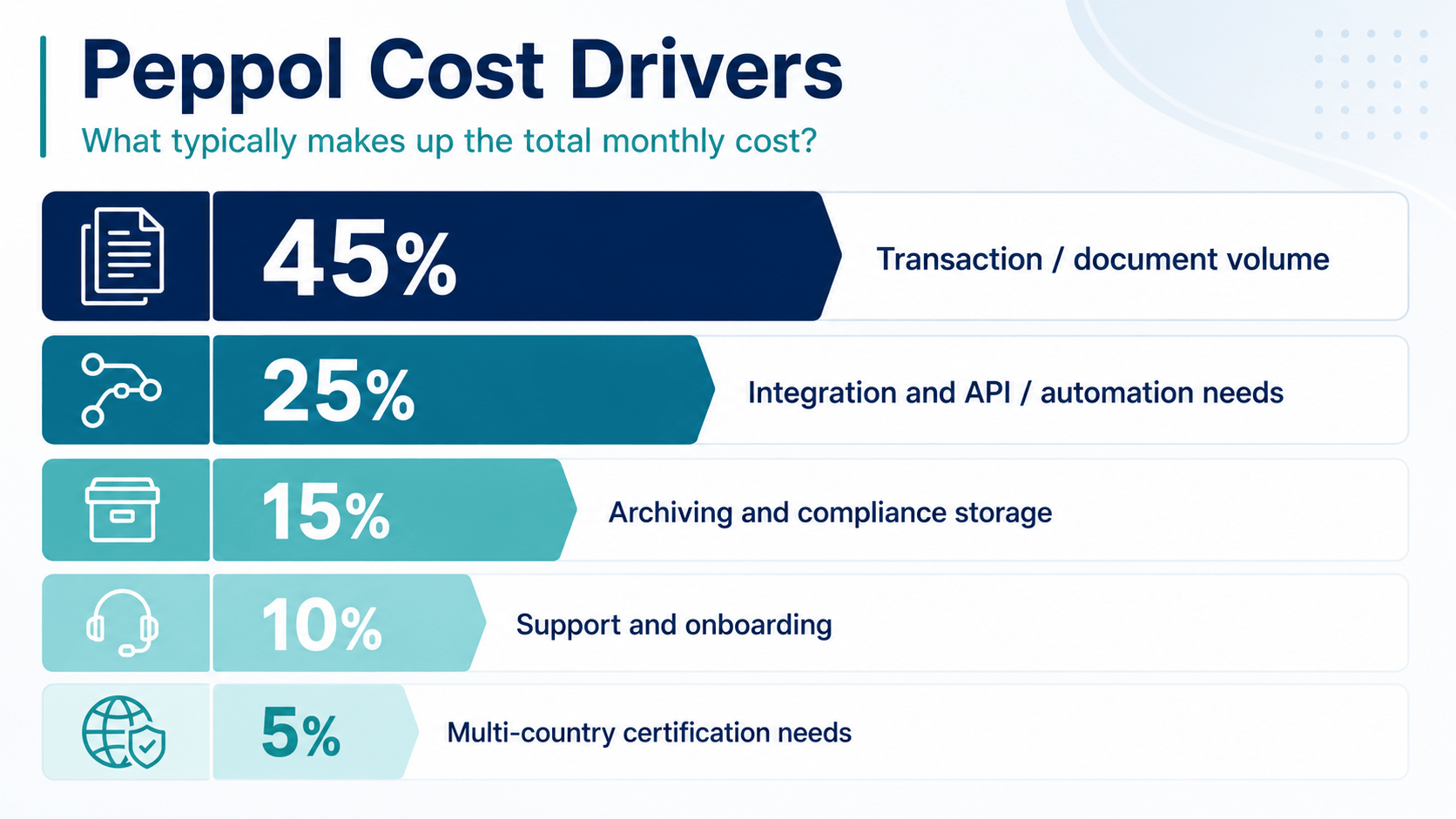
Invoice volume — pay-per-document plans get expensive fast once volume climbs, while flat subscriptions plateau.
API access — sending XML directly or converting PDFs to Peppol format via automation usually requires a higher-tier plan.
ERP/accounting integration — connecting Peppol to your existing finance system is rarely included in entry-level pricing.
Document retention — regulations require invoices to be archived for several years, and long-term storage isn't always bundled in.
Multi-country compliance — if you trade across borders, you may need a provider certified across multiple Peppol Authorities.
Support level — email-only support versus dedicated onboarding assistance changes the price tier.
Implementation fees — some providers charge a one-time setup cost separate from the recurring monthly fee.
Quick reference: Peppol cost factors at a glance
Factor | In Short |
|---|---|
Volume | Pay-per-invoice add-on |
API access | Higher-tier requirement |
ERP integration | Setup + monthly fee |
Archiving | Compliance storage cost |
Multi-country | Extra certification |
Support tier | Email vs dedicated support |
Implementation | One-time setup fee |
Contract length | Monthly vs annual pricing |
Why businesses choose HubBroker for Peppol e-invoicing
Picking a provider isn't just about the lowest monthly number it’s about what happens when your invoice volume grows or your ERP changes. Here's why businesses depend on HubBroker instead of a bare-bones Access Point:
✔ Peppol e-invoicing built directly into your existing ERP workflow, not a separate portal to log into.
✔ Transparent monthly pricing with no surprise per-document charges as volume grows.
✔ EDI heritage means format conversion and legacy trading partner connections are already handled.
✔ Certified Access Point coverage across Europe, so cross-border compliance isn't an extra project.
✔ Automated PDF-to-Peppol and structured invoice handling without manual re-keying.
✔ Dedicated onboarding and support instead of a self-service setup you're left to figure out alone.
✔ One platform for EDI, Peppol and ERP integration, so you're not stitching together three separate tools.
Cost Factor | Indicative Market Benchmark |
|---|---|
Peppol registration and participant setup | €0–€750 one time |
Access Point or platform subscription | €20–€150 per month |
Sending and receiving e-invoices | €0.05–€0.50 per document |
ERP or accounting-system integration | €1,000–€15,000+ one time |
Invoice mapping and format conversion | €500–€3,000 per document type |
Country-specific compliance configuration | €500–€5,000 per country |
Testing, validation and production go-live | €500–€3,000 one time |
Support, monitoring and compliant archiving | €25–€500+ per month |
If you're budgeting for e-invoicing compliance , the smartest move is matching your provider to your actual volume and integration needs not just the sticker price on a pricing page.
👉 Book a free demo to know how peppol einvoice process works & get your custom einvoicing implementation cost
