
EDI for Food and Beverage Manufacturers: The Benefits Change With Every Sales Channel
Most food and beverage manufacturers don't sell through one route to market. There's the grocery chain with its own EDI specification. The foodservice wholesaler that orders by the case and pays by the kilo. The exporter customer in Germany or Poland who needs a structured invoice in a national format. Each one wants the same product and a different set of documents.
So when someone asks what the benefits of EDI are for a food business, the honest answer is that it depends on which channel you're being judged in. A setup built around one large domestic retailer rarely survives contact with the second and third channel. That's usually the point where deductions start appearing and someone in finance starts keeping a spreadsheet of them.
Here's what actually changes, and where the value sits.
Why food and beverage EDI is harder than general manufacturing
A few structural things make this category different. They're not edge cases.
Shelf life compresses the timing window
A despatch advice that arrives after the lorry does is a problem in any industry. In chilled and fresh goods it's a compliance failure, because the receiving warehouse is booking dock slots against the document, not the delivery. Short-life products get tighter windows and less tolerance, and the scoring is automated.
Batch and expiry data has to travel inside the document
Under Regulation (EC) No 178/2002, Article 18, food businesses must be able to identify who supplied them and who they supplied, and make that information available to authorities on request. In practice that means lot codes and best-before dates need to sit in the despatch advice and the delivery note, not in a separate quality system somebody has to cross-reference by hand. If your documents can't carry the field, you have a traceability gap on every pallet you ship.
Catch weight breaks fixed-quantity assumptions
Meat, fish, cheese and other variable-weight products are ordered as units and invoiced by actual weight. That requires both a quantity and a weight on the same line, plus a tolerance rule the customer agrees to. General-purpose order-to-invoice mappings tend to assume one number per line, which is why catch weight is where manual workarounds usually creep back in.
Promotional and display packs multiply item data
A seasonal display pack for one retailer is a different GTIN, a different packaging hierarchy and a different labelling spec from the standard case of the same product. Multiply that by a promotional calendar and a portfolio of accounts, and item setup becomes the largest recurring data job in the business.
What changes channel by channel
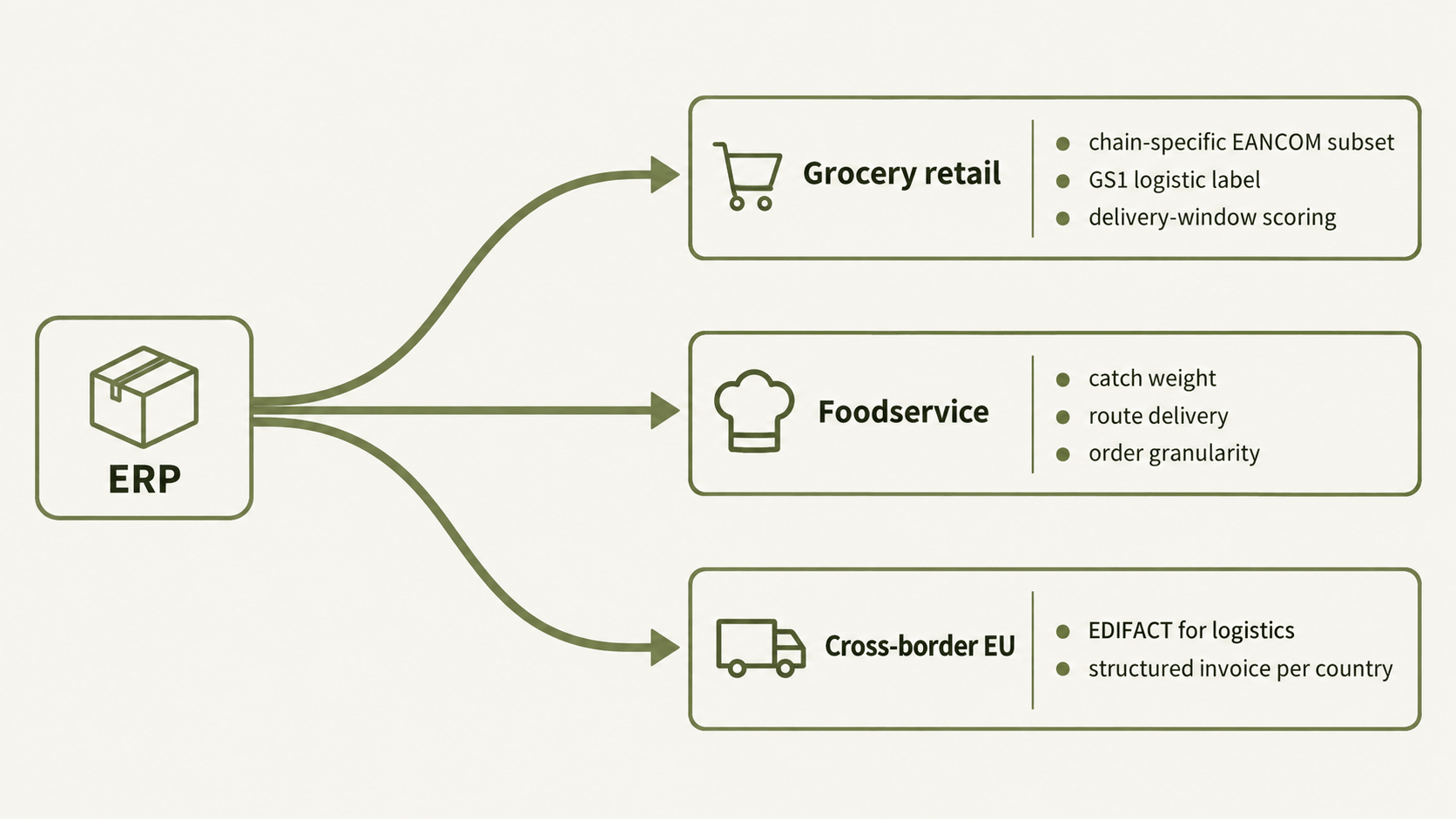
Grocery retail. The message set is familiar orders, order response, despatch advice, invoice and much of European grocery runs on the GS1 EANCOM subset of EDIFACT. The difficulty isn't the message type; it's that each chain publishes its own implementation guide, with its own mandatory fields, its own GS1 logistic label spec and its own delivery-window scoring. A label that passes one chain's validation can fail the next.
Foodservice and wholesale. Order granularity is different, catch weight is common, and route-based delivery changes what advance shipping information the customer needs. A configuration built for pallet-to-dock retail delivery doesn't port across cleanly.
Discount and private label. Item data depth is the pressure point. Packaging specification, allergen data and pack configuration all have to be right before the first order arrives, because there's little appetite for corrections afterwards.
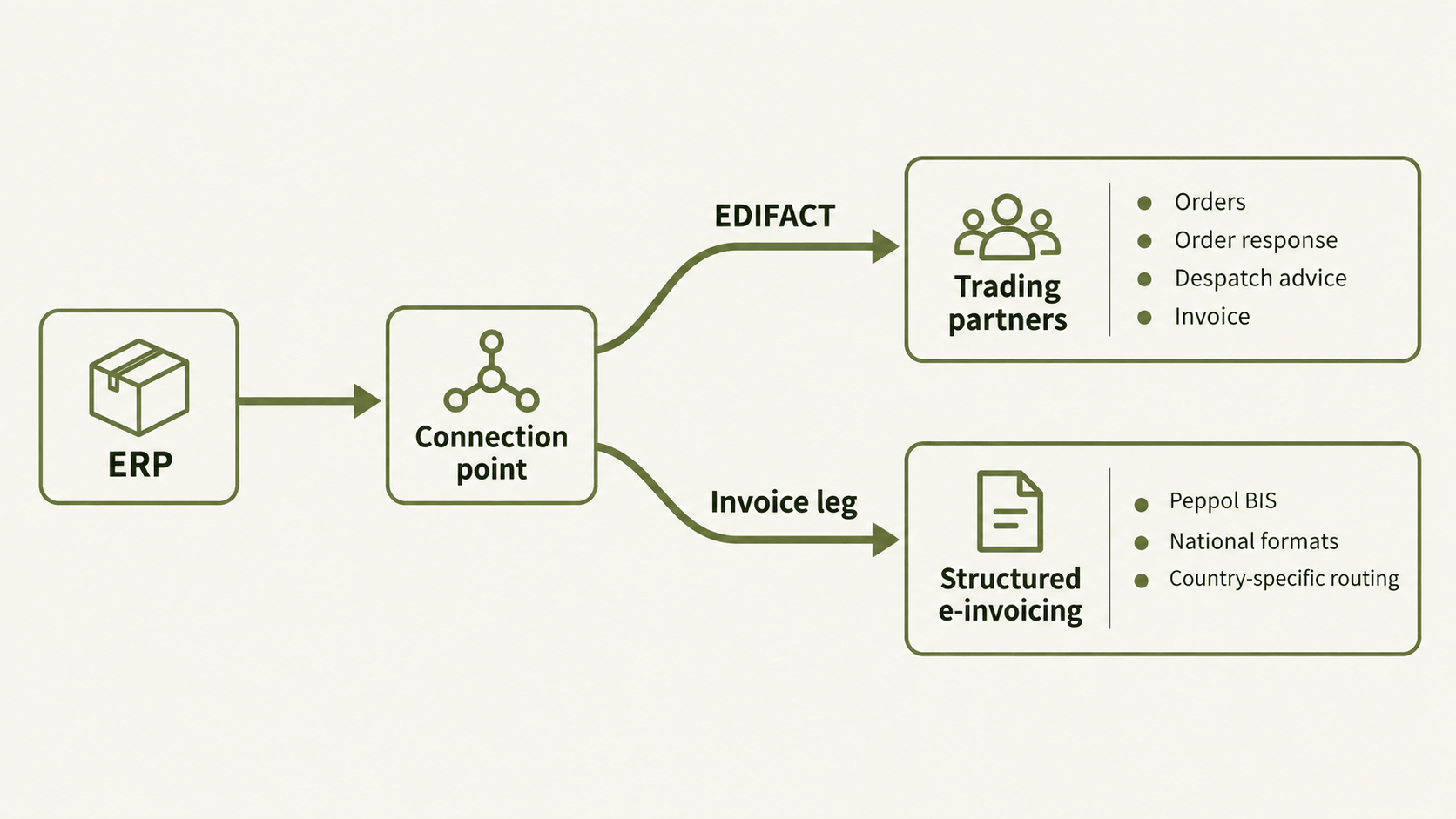
Cross-border EU. This is where two standards run in parallel. Logistics documents stay on EDIFACT with the trading partner, while the invoice leg increasingly has to go out as structured e-invoicing under a national mandate Peppol BIS in much of Europe, national formats and platforms elsewhere. Selling into three countries can mean three different invoice obligations sitting on top of one order flow.
The benefits that actually move numbers
Once the channel picture is right, the returns are specific rather than general.
Fewer deductions. Validating a document against the customer's rules before it leaves means rejections and retailer deductions drop, and finance stops reconciling them after the fact.
Faster order-to-cash. When orders land directly in the ERP and invoices go out automatically on despatch confirmation, the invoice date moves closer to the delivery date. On short payment terms, that's working capital.
Traceability that survives a withdrawal. If lot and expiry data is already in the documents, a customer-side trace request is a query, not a two-day exercise across three systems.
New customers without new headcount. Reusing existing mappings and partner profiles means the fourth grocery chain takes less setup effort than the first, rather than the same effort again.
Where EDI meets your ERP
None of this requires replacing the ERP. EDI integration works as a layer between your existing system and your trading partners: orders arrive as orders, invoices leave as invoices, and the format translation happens in between. Item data, pricing and batch information come from the ERP directly, so there's no re-entry step where errors can enter.
The invoice leg is worth treating as its own question. Peppol e-invoicing and national e-invoicing obligations don't run on the same rails as EDIFACT, but they can run through the same connection point which matters if half your customers are on Peppol and the other half aren't. We've written about that split in more detail in the context of SAP Business Network and Peppol.
Exception handling belongs in the same place. If a failed document surfaces in a portal nobody opens, it surfaces when the customer calls.
FAQ
Is EDI worth it with only a handful of customers? It depends less on customer count than on document volume and how strict those customers are. Two demanding grocery accounts can generate more manual work and deduction risk than a dozen small ones.
How is EDI different from Peppol e-invoicing? EDI covers the full trading document set orders, order responses, despatch advices, invoices usually bilaterally with each partner. Peppol is a network for structured document exchange, used mostly for invoices, where one connection reaches many recipients. Food manufacturers commonly need both.
Do we have to replace our ERP? No. Integration sits on top of what you already run and connects it outward.
Can EDIFACT carry batch and expiry data? Yes the despatch advice message has segments for batch number and best-before date. Whether your customer requires them, and in which segment, is set out in their implementation guide.
What about selling into several EU countries? Order and logistics flows can stay on EDIFACT with each partner while the invoice leg is routed to meet each country's requirement. The important thing is that both run through one setup rather than one per market.
If you're weighing up a second or third sales channel and want to know what it would ask of your current setup, get in touch happy to look at it with you.
