
e-conomic XRechnung: Why Your German Customers Will Reject PDFs in 2027
On 1 January 2027, German accounts payable departments change how they work. Larger German companies must start issuing structured e-invoices, and most are rebuilding their invoice intake around structured data at the same time.
If you invoice German customers from e-conomic, that change reaches you. Not necessarily as a legal obligation, but as a request from your customer's finance team: send XRechnung or ZUGFeRD, not a PDF.
Here is what the rules say, where Danish companies actually stand, and how to get e-conomic XRechnung-ready without changing your accounting system.
What Germany's 2027 E-Invoicing Rules Require
The timeline: receiving since 2025, issuing from 2027 or 2028
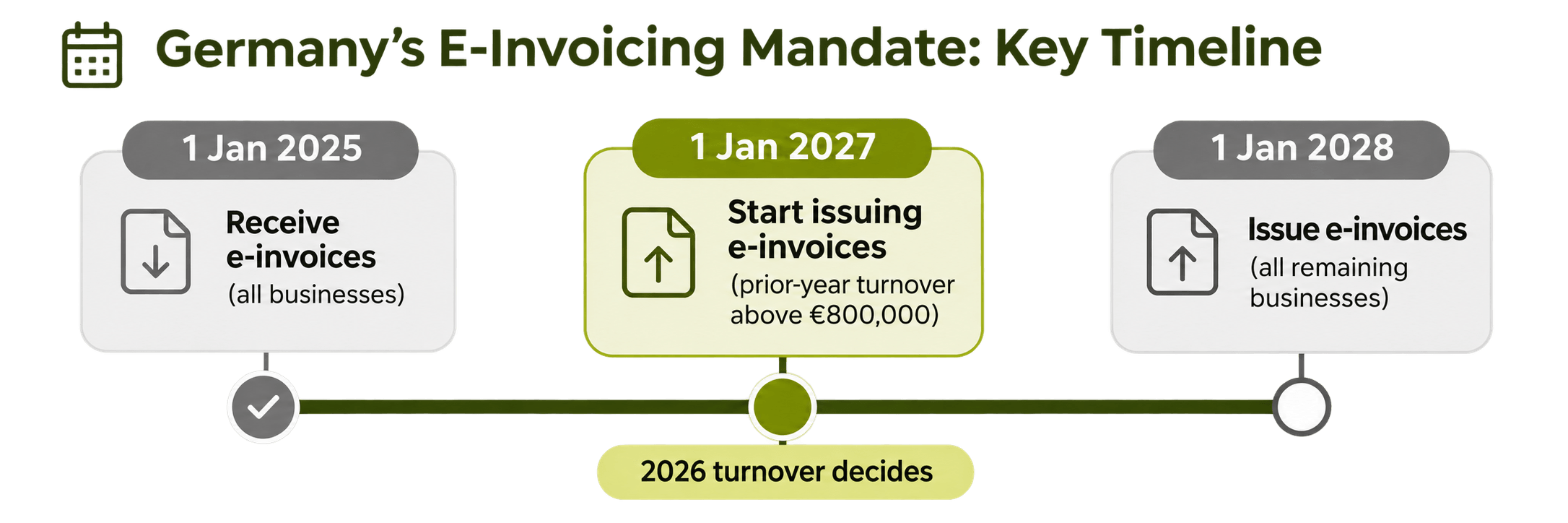
Germany's mandate comes from the Wachstumschancengesetz (Growth Opportunities Act) and runs in three steps:
1 January 2025: every business established in Germany must be able to receive structured e-invoices.
1 January 2027: businesses with prior-year turnover above €800,000 must issue them for domestic B2B transactions.
1 January 2028: all remaining businesses must issue them.
A company's 2026 turnover decides whether it starts in 2027 or 2028. Many German finance teams will only confirm their deadline after year end, so expect format requests to land in your inbox in Q1.
Why a PDF no longer counts as an e-invoice
Under the new rules, an e-invoice must be structured, machine-readable and compliant with the European standard EN 16931. A PDF sent by email is an "other invoice", however tidy it looks. During the transition it is allowed only with the recipient's consent.
Our Germany e-invoicing overview covers deadlines, exemptions and archiving rules in more detail.
Does the Mandate Apply to Danish e-conomic Users?
Danish finance teams tend to get this wrong in both directions: either "it doesn't affect us" or "we must be fully compliant by January".
Suppliers invoicing from Denmark
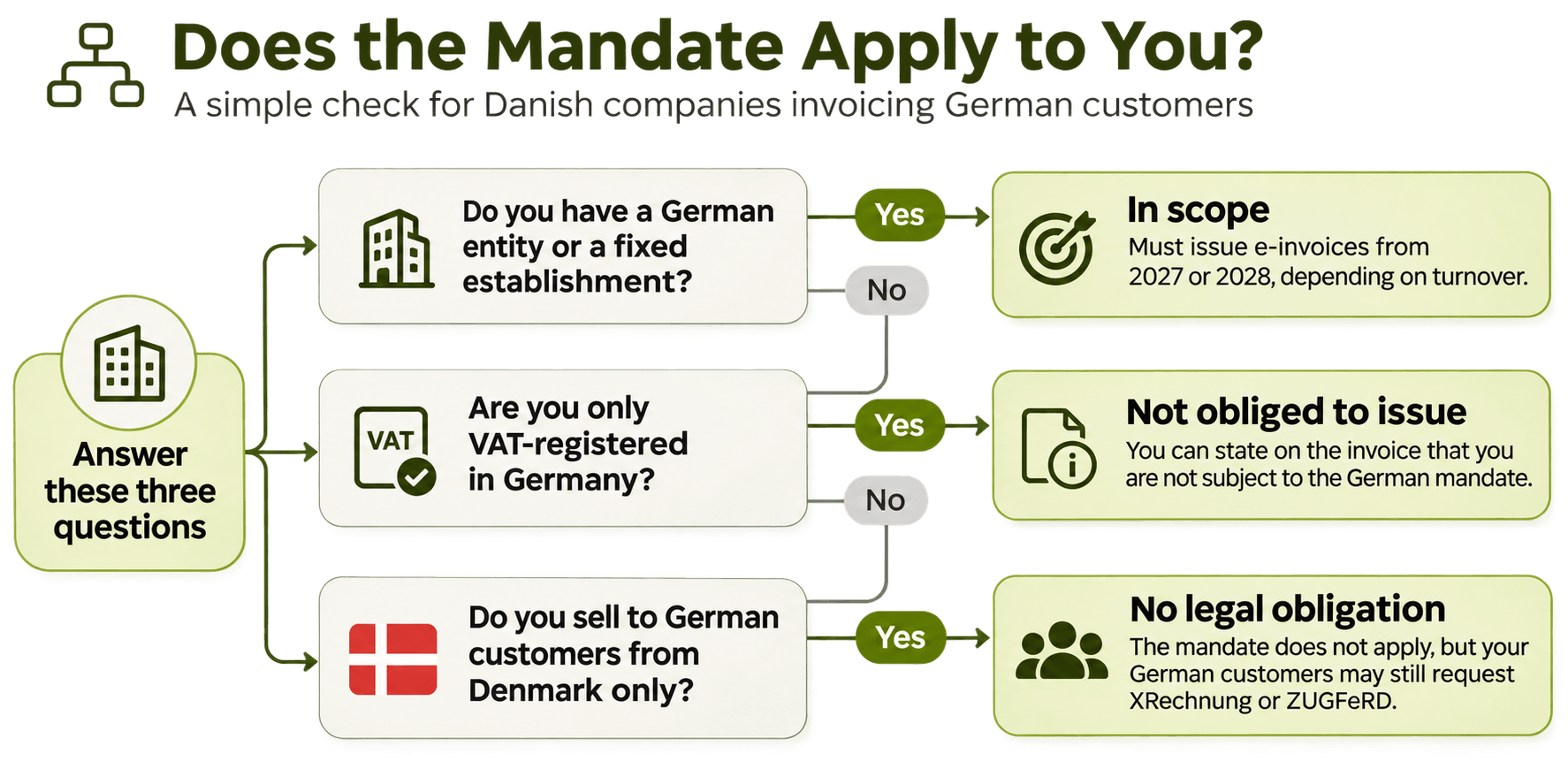
The obligation covers domestic B2B transactions between businesses established in Germany. If your Danish company invoices German customers without a German establishment, the issuing obligation does not apply to you. Foreign businesses that are VAT-registered in Germany without a fixed establishment can state this on their invoices.
Your customer's processes are a different matter. Once a German buyer's AP runs on structured data, your PDF becomes the exception that someone handles manually. That means slower approval, slower payment and, eventually, a procurement conversation.
The same pattern applies to Danish companies trading in France, where the legal scope is narrow but the commercial pressure is broad.
When it does apply: a German subsidiary or fixed establishment
If your group has a German subsidiary or fixed establishment, that entity is in scope. It must already be able to receive e-invoices, and its prior-year turnover decides whether it issues from 2027 or 2028.
XRechnung, ZUGFeRD and Peppol: What Your German Customer Will Ask For
XRechnung vs ZUGFeRD
XRechnung is Germany's national specification of EN 16931: a pure XML file in UBL or CII syntax, with no visual layer. Public-sector buyers usually require it, together with a Leitweg-ID that identifies the receiving authority.
ZUGFeRD is a hybrid: a PDF/A-3 invoice with the XML embedded. People can read it and systems can process it. For B2B, ZUGFeRD from version 2.0.1 with the EN 16931 profile or higher meets the requirement. Factur-X, its French twin, is technically identical.
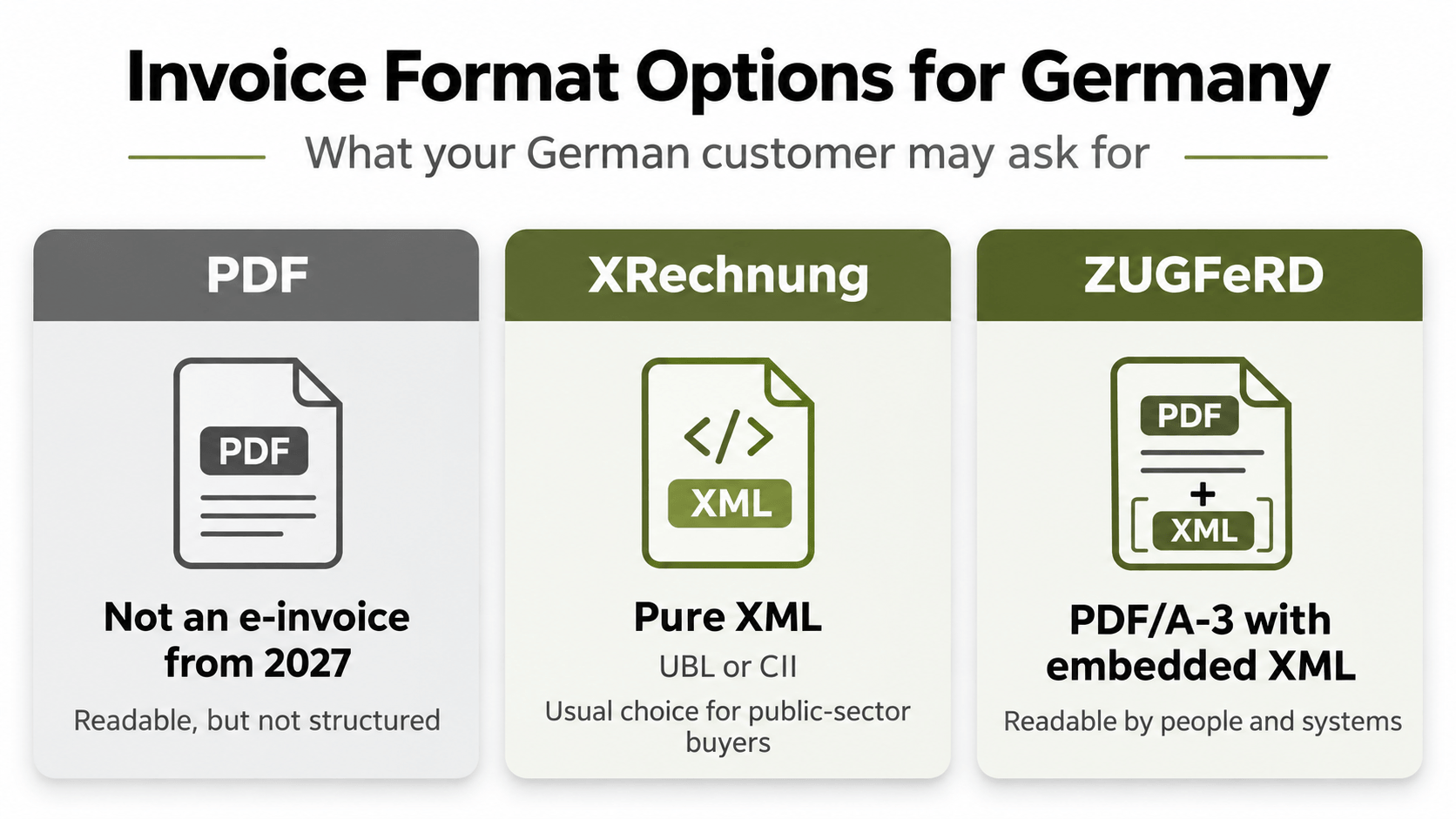
Both formats are accepted for B2B. The right choice is whichever your customer's AP system processes best, so ask.
Peppol as the delivery route
Germany has no central exchange platform. Invoices travel by email, EDI, portal or Peppol. Peppol is not mandatory for B2B, but it is a common channel and widely used for public-sector invoicing. A Peppol Access Point connection lets you reach every registered German buyer through one setup instead of one integration per customer.
Getting e-conomic XRechnung-Ready Without Changing ERP
Start with what e-conomic produces today
e-conomic runs Danish bookkeeping well. Before planning anything, check exactly which structured formats your e-conomic setup can output and through which channels. If XRechnung or ZUGFeRD with German business-rule validation isn't on that list, the gap sits between e-conomic and your customer, not inside your accounting.
Add an integration layer
HubBroker connects to e-conomic through its API and picks up booked invoices. It maps them to XRechnung or ZUGFeRD, validates them against EN 16931 and the German business rules, and delivers them by Peppol, email or EDI. Delivery status flows back, so your team sees a rejected invoice before the customer chases it.
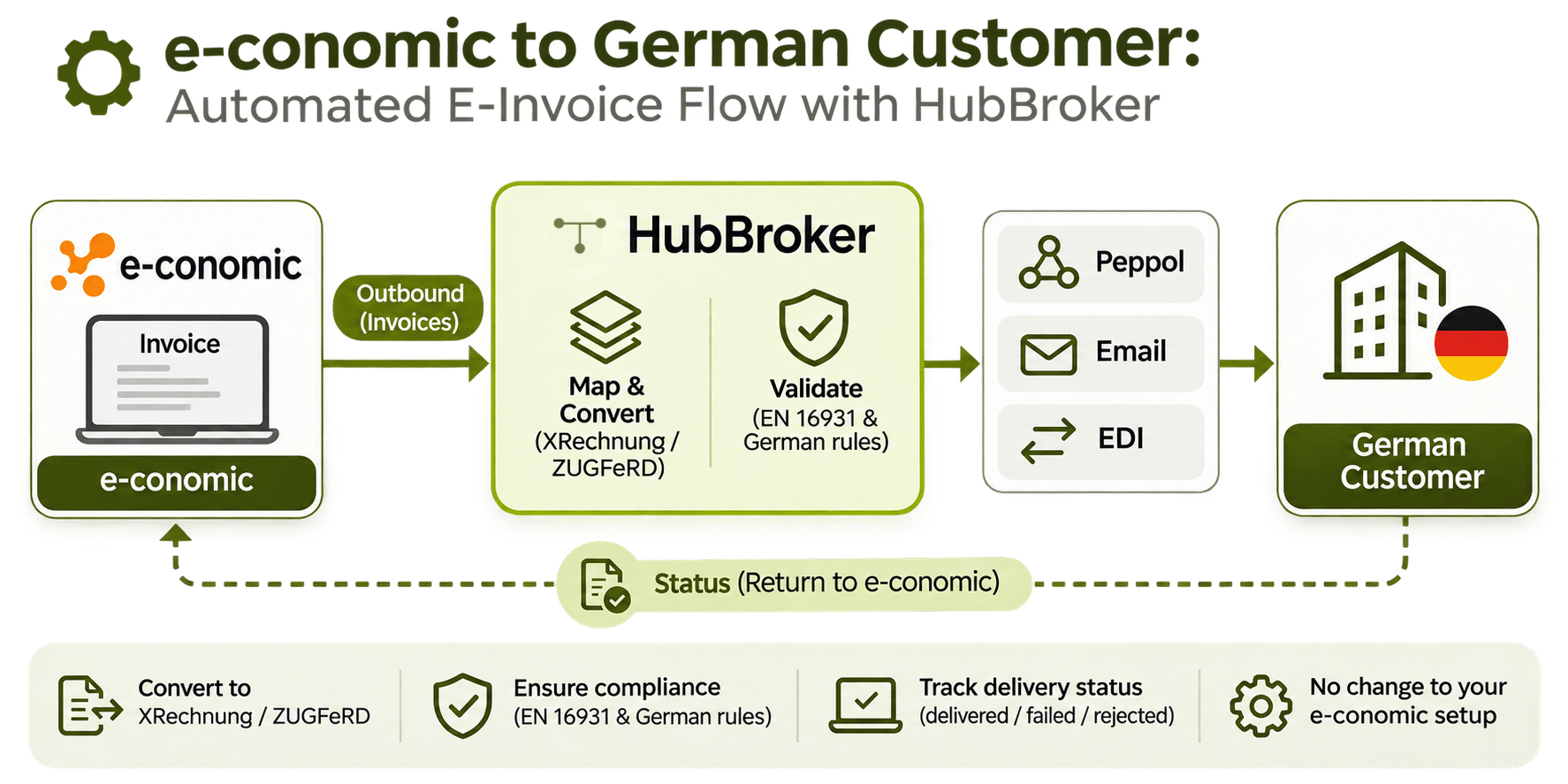
Your finance team keeps invoicing in e-conomic exactly as today. See how the HubBroker e-conomic integration works.
A short readiness checklist for 2026–2027
Confirm with your tax adviser whether any group entity is established in Germany.
Rank your German customers by invoice volume and ask the top ten which format and channel they want from 2027.
Clean customer master data in e-conomic: VAT IDs, buyer references and, for public buyers, Leitweg-IDs.
Decide how invoices will leave e-conomic in the requested format.
Run a live test with one customer before your first 2027 invoice run.
FAQ: e-conomic XRechnung
Does e-conomic support XRechnung natively? Where e-conomic's own output does not cover XRechnung with German validation rules, an integration layer can generate it from your booked invoice data.
Do I need XRechnung if my German customer still accepts PDFs? Legally, not if you invoice from Denmark without a German establishment. Commercially, a customer that accepts PDFs today may stop once its own AP process runs on structured data.
XRechnung or ZUGFeRD: which should I send? Both are accepted for German B2B invoices. Public-sector buyers usually require XRechnung. For private customers, ask which format their system processes.
What changes if we open a German entity? That entity is in scope. It must be able to receive e-invoices now and issue them from 2027 or 2028, depending on its prior-year turnover.
Can we send XRechnung via Peppol? Peppol is one of the accepted channels, provided your customer is registered on Peppol and accepts the document type you send.
Not Sure Where Your German Invoicing Stands?
Most of the uncertainty clears up in a short conversation. Talk to our integration team about your e-conomic setup and which German customers matter most, and we'll show you what the path to XRechnung looks like.
