

D365 F&O and EDI: Order-to-Cash Integration Priorities for 2027
Order-to-cash in Microsoft Dynamics 365 Finance & Operations is only as fast as the documents that feed it. A sales order that arrives late, an advance shipping notice the retailer rejects, or an invoice that fails a national format check all end the same way: cash arrives later than planned.
In 2027 that risk increases. E-invoicing mandates reach the invoicing step of the process, and trading partners expect clean, structured data at every stage. For ERP consultants, D365 F&O EDI integration is moving from a technical side project to a requirement that affects revenue directly.
This post sets out five priorities to plan for now.
Why D365 F&O EDI integration moves up the 2027 agenda
E-invoicing mandates reach the invoice step
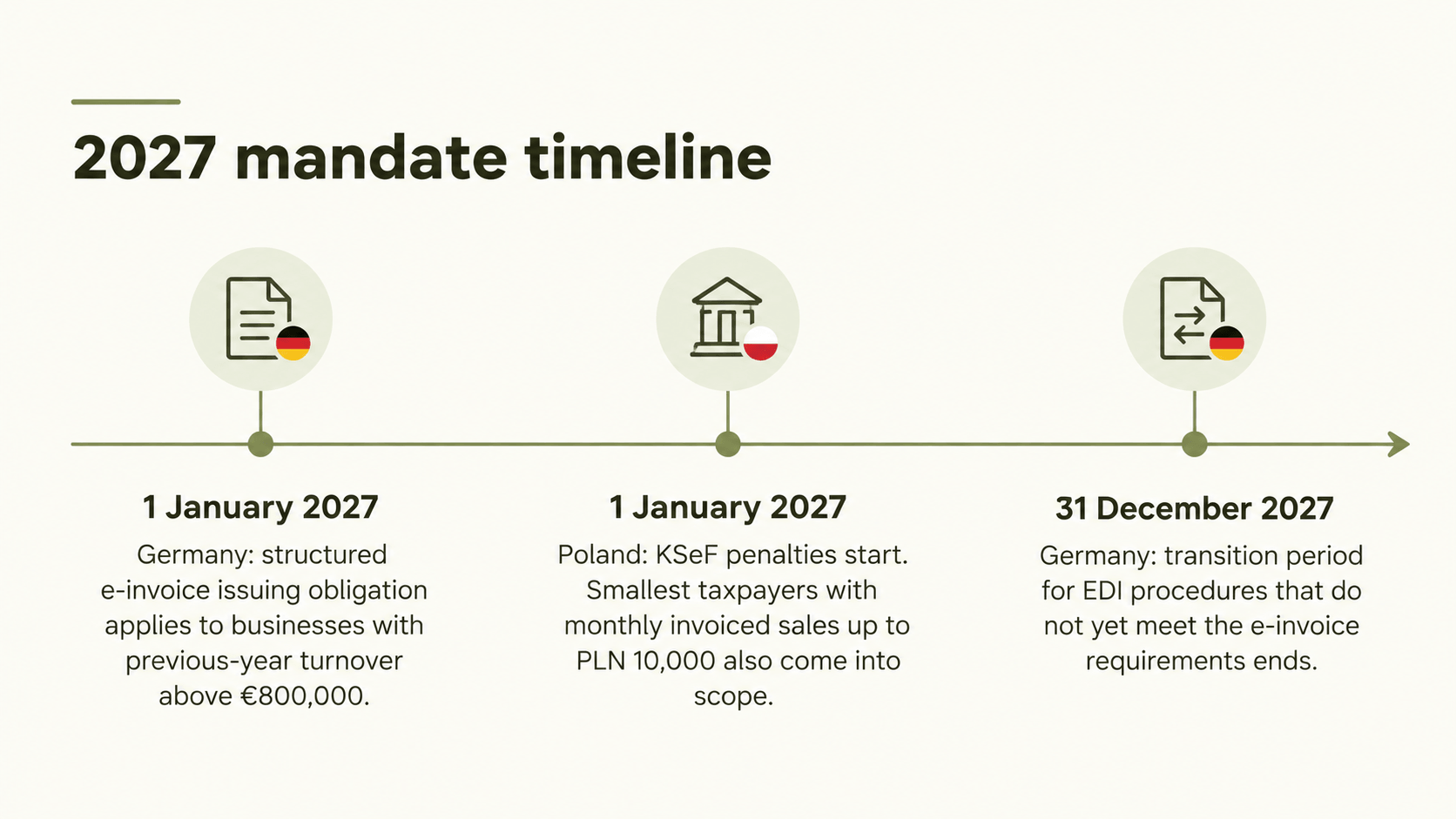
Germany is the clearest example. From 1 January 2027, businesses with a previous-year turnover above €800,000 must issue structured e-invoices for domestic B2B sales. Invoices sent through existing EDI procedures in formats that do not meet the e-invoice standard are allowed only until 31 December 2027, and only with the recipient's consent. After that, EDI invoices must meet the same structured requirements. Our Germany E-Rechnung guide covers the full timeline.
Poland's KSeF has been mandatory since 2026, with penalties applying from 1 January 2027. For F&O customers with Polish entities, invoice output must already run through the national platform.
Trading partners raise the bar
Retailers and distributors increasingly reject documents that miss mandatory fields, use the wrong product identifiers or arrive outside agreed time windows. Each rejection creates manual rework and delays payment.
Priority 1: Map the full order-to-cash document flow
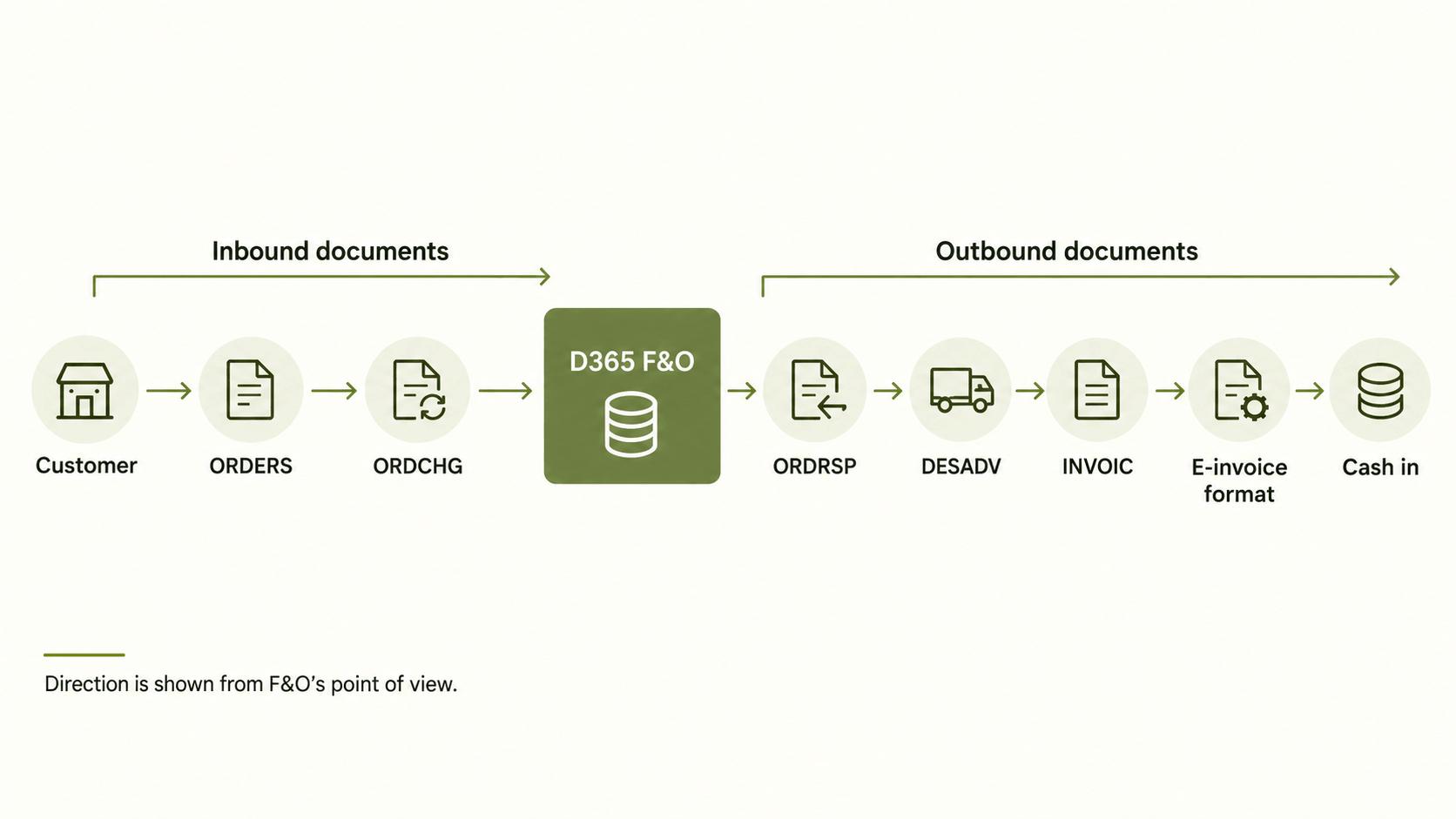
Many F&O projects start with sales order import and stop there. Map every document the process depends on. Direction is shown from F&O's point of view.
Inbound documents
Purchase orders (ORDERS) and order changes (ORDCHG) from customers. Check how each partner's item references, delivery locations and price conditions map to F&O sales order fields, and which legal entity should receive the order.
Outbound documents
Order responses (ORDRSP), dispatch advice (DESADV) and invoices (INVOIC), plus any country-specific e-invoice format. The outbound flow is where most chargebacks and payment delays start, so give it the same attention as order import.
Priority 2: Keep F&O clean and put translation in the integration layer
Why per-partner customisations do not scale
Building partner-specific logic in X++ works for the first two or three trading partners. After that, every new partner, format update or mandate change becomes an ERP development task, with regression testing and release cycles attached.
Data entities, DMF and an integration platform
F&O's data entities and Data Management Framework handle the movement of business data in and out of the ERP. Partner-level work, such as EDIFACT or X12 translation, AS2 or SFTP transport, partner profiles and acknowledgements, fits better in a dedicated integration layer. F&O then exchanges one consistent internal structure, and the integration platform handles each partner's requirements.
Priority 3: Treat e-invoicing as part of the EDI estate
One pipeline for EDIFACT, Peppol and national formats
Microsoft's Electronic invoicing service for Finance and Supply Chain Management transforms invoice data through Electronic reporting configurations and is available for cloud deployments only. Decide early which flows run through that service and which run through your EDI platform, so customers do not end up with two disconnected invoice pipelines.
A single outbound invoice flow that can produce EDIFACT, Peppol BIS and national formats from the same F&O data reduces both build effort and maintenance. Our e-invoicing formats comparison explains where UBL, XRechnung, Factur-X and FatturaPA apply.
Priority 4: Build exception handling and visibility
A rejected order or failed invoice should not depend on someone checking an inbox. Define who sees each exception type, where they see it and what the agreed response is. Typical cases include unknown item references, price mismatches between order and price list, incomplete dispatch advice and invoices rejected by validation rules.
Visibility should cover the full chain from partner message to F&O transaction, so finance and operations teams can trace one document without asking IT.
Priority 5: Speed up trading partner onboarding
Every new retailer or distributor is new revenue that waits on integration. Reusable mappings and partner profiles shorten onboarding because each new connection starts from an existing flow rather than a blank specification. Plan for onboarding as a repeatable process, not a series of individual projects.
A 2027 readiness checklist for ERP consultants
List every inbound and outbound order-to-cash document per trading partner and per legal entity.
Identify which customers fall under the German issuing obligation from 2027 and which EDI invoice flows need to meet the structured standard by 2028.
Confirm how Polish entities submit invoices to KSeF.
Decide which invoice flows run through Microsoft's Electronic invoicing service and which through an EDI platform.
Remove partner-specific logic from X++ where an integration layer can carry it.
Agree exception owners and response times for rejected documents.
Frequently asked questions
Does D365 F&O support EDI out of the box?
F&O provides data entities, the Data Management Framework and an Electronic invoicing service. Trading-partner EDI, including message translation, partner-specific mapping and transport protocols, is normally delivered through an ISV solution or an integration platform.
What is the difference between EDI and Peppol for F&O users?
EDI usually refers to direct, partner-specific document exchange in formats such as EDIFACT. Peppol is a network with standardised document formats, widely used for e-invoicing. Many F&O customers need both.
Can existing EDI invoices continue in Germany after 2027?
Invoices sent through EDI in formats that do not meet the e-invoice standard are allowed only until the end of 2027, with the recipient's consent. After that, EDI invoices need to meet the structured e-invoice requirements. Check each flow with your tax adviser.
Does D365 F&O EDI integration require changes to the ERP?
Not necessarily. With an integration layer handling translation and transport, F&O exchanges data through standard entities, and partner requirements are managed outside the ERP core.
Which order-to-cash documents should be prioritised first?
Start with the documents that block payment: invoices and the dispatch advice that customers match them against. Then cover order import and order responses.
Plan 2027 without rebuilding F&O
HubBroker connects Microsoft Dynamics 365 Finance & Operations with trading partners, Peppol and national e-invoicing formats through one integration layer, so the ERP core stays as it is. See how our D365 F&O EDI integration works, or explore the wider EDI integration platform.
