
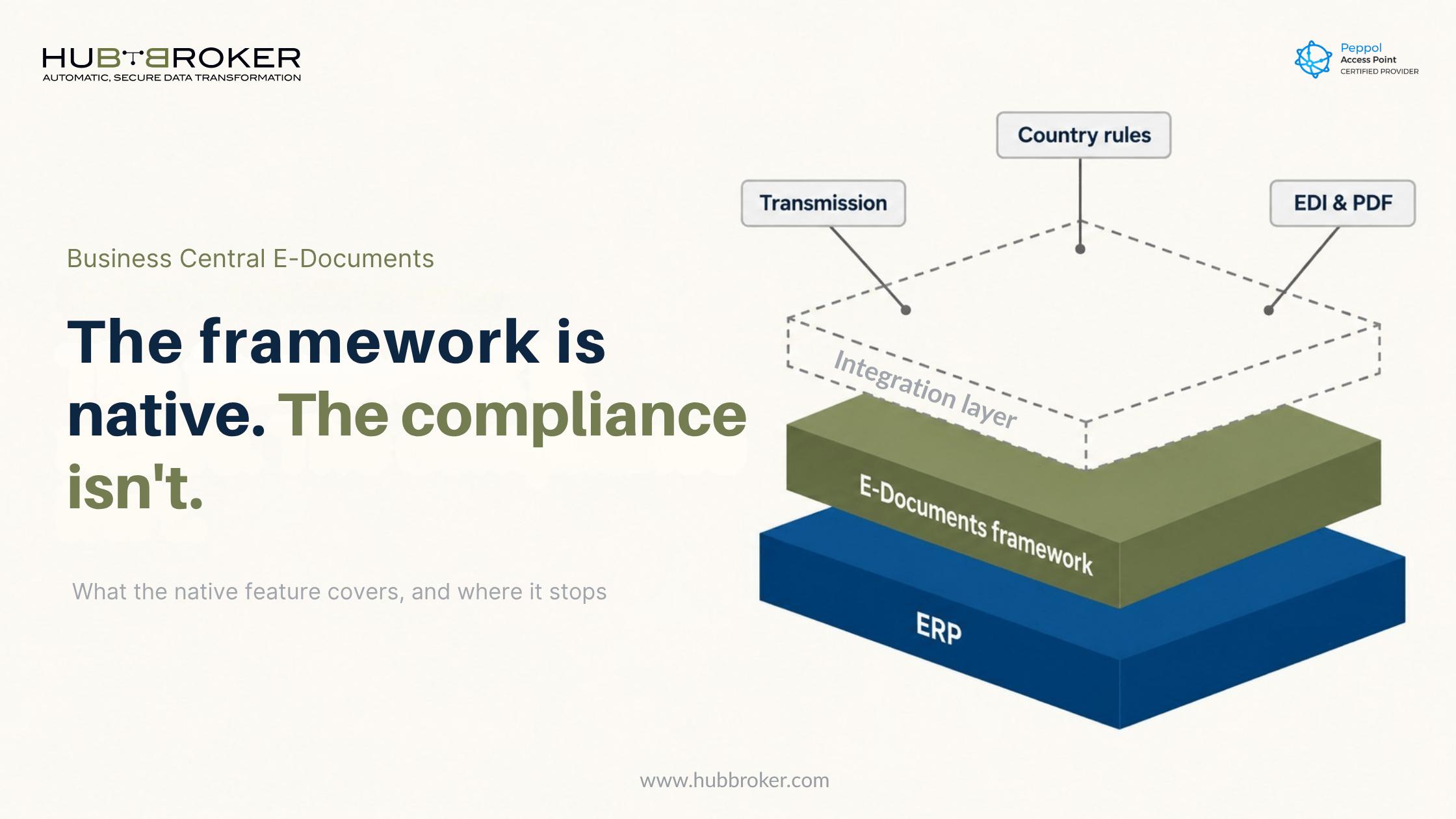
Business Central E-Documents: What the Native Feature Covers and Where It Stops
A client asks: "Business Central already does e-invoicing, right?" The honest answer is yes, in part.
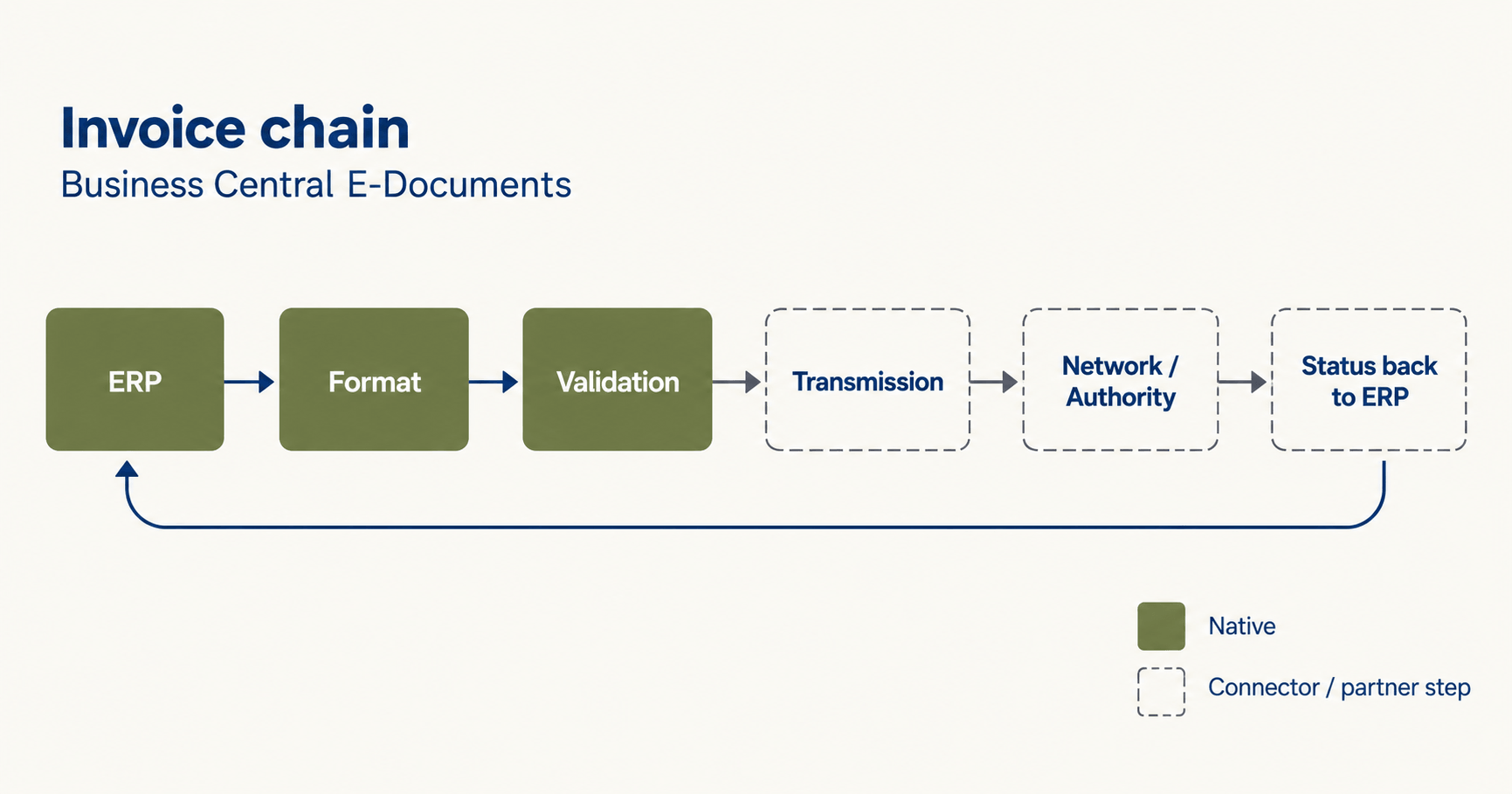
Business Central E-Documents gives you a solid framework for creating, sending and receiving structured invoices. What it doesn't give you out of the box is the full chain a mandate demands: transmission, country rules for every market your client trades in, and a way to handle partners who don't send structured data at all.
This guide maps what the native feature covers, where it stops, and how to scope the gap before it lands on your project plan.
What Business Central E-Documents actually is
A framework, not a finished compliance product
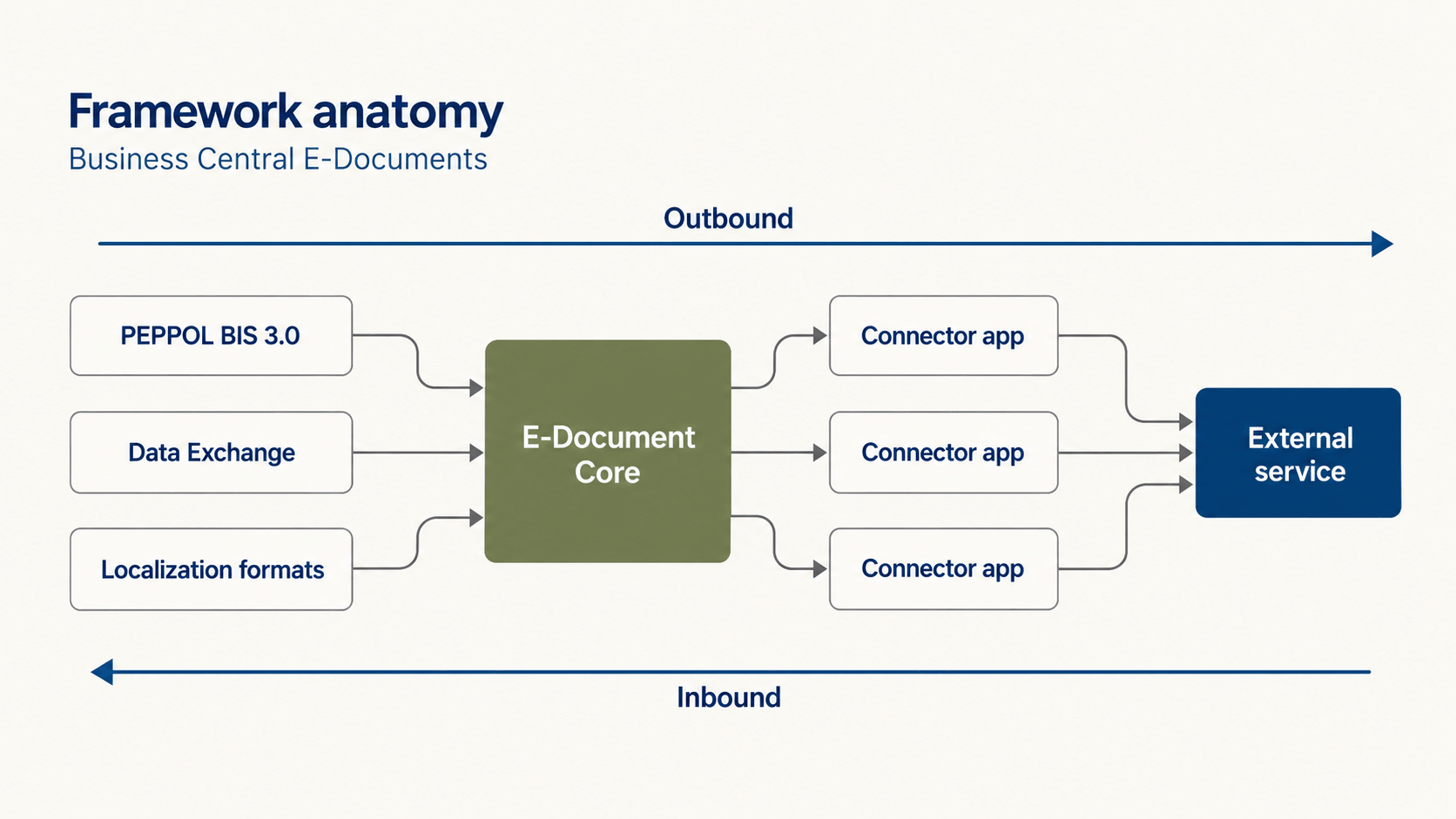
Business Central E-Documents is delivered through the E-Document Core app. Microsoft built it as an interface-driven framework. The core defines how documents are formatted, sent and received. Separate connector apps handle communication with external services.
That design is deliberate. Microsoft states that the module includes only a few formats for specific localizations and is meant to be extended by ISVs and localization partners.
Inbound and outbound inside standard processes
Outbound, posted sales, service and purchase documents are converted to a structured format and handed to a configured service. Inbound, received e-documents become purchase invoices, credit memos or journal lines.
Recent releases added a purchase draft page, so AP can review and map lines before posting, and the option to link an inbound e-document to a purchase invoice that already exists.
What the native feature covers
PEPPOL BIS 3.0 and Data Exchange formats
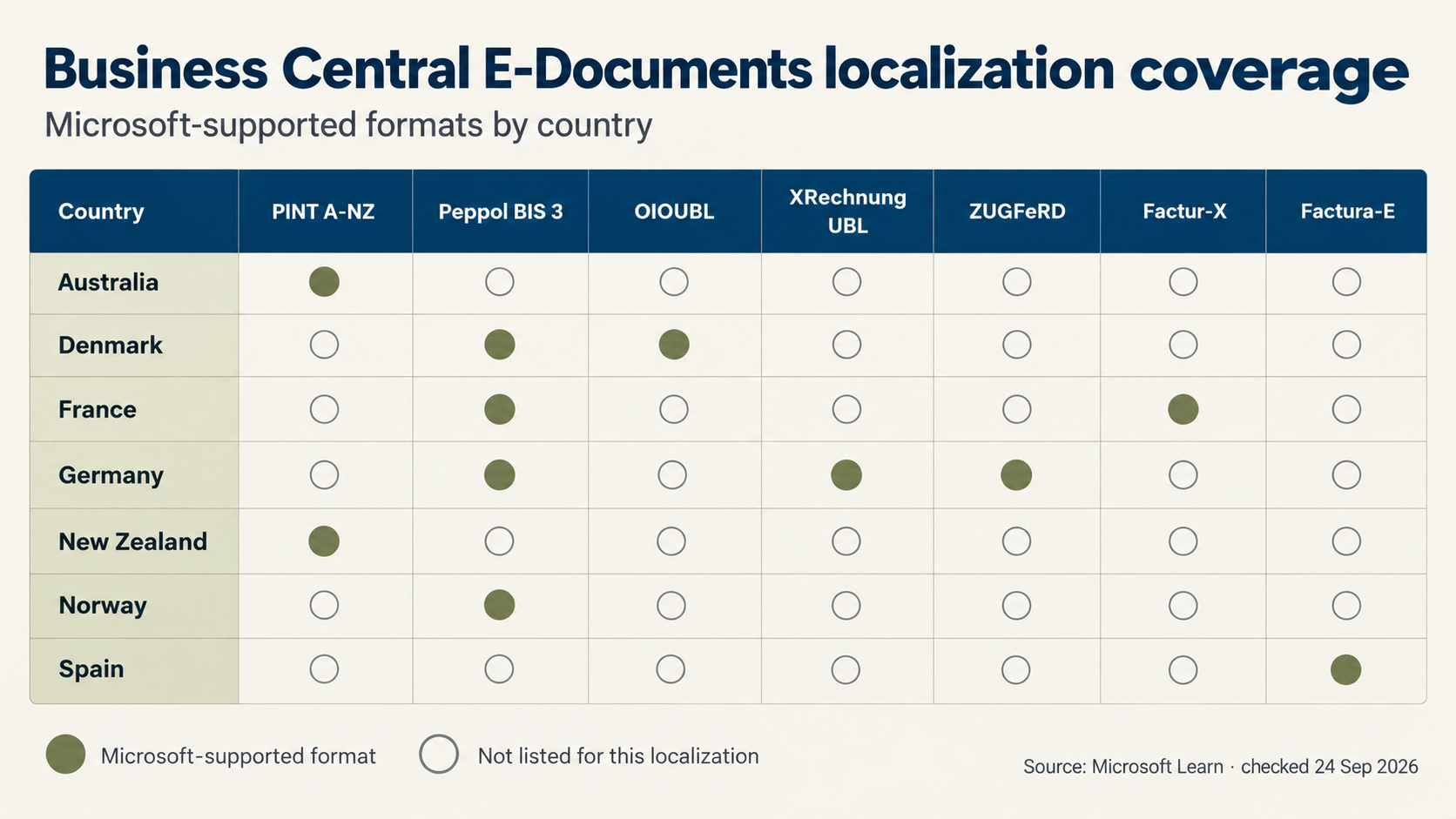
The baseline is PEPPOL BIS 3.0 as a code-based format, plus the Data Exchange framework for custom mappings. Localization apps add national formats.
Microsoft's localization list includes Peppol BIS 3 and OIOUBL for Denmark; Peppol BIS 3, XRechnung (UBL only) and ZUGFeRD for Germany; Peppol BIS 3 for Norway; and Factura-E for Spain. France now has a localization supporting Peppol BIS 3 and Factur-X.
Service integrations
On the E-Document Service page, you select a service integration. Microsoft lists connectors for Avalara, Pagero and Continia, among others. Each one is a third-party service your client contracts separately.
Clearance model support
For clearance countries, a service can be flagged as a clearance service. A workflow then routes the invoice to the tax authority first and to the customer second. Microsoft notes you can't use the clearance model until a dedicated service integration is chosen.
Where it stops
Transmission is always someone else's job
Business Central E-Documents builds the file. Delivering it needs a connector to an access point or platform, or custom AL development. For France, Microsoft states it does not operate as a certified platform itself. Companies exchange invoices and lifecycle messages through certified providers via E-Document connectors.
Country coverage follows Microsoft's roadmap
If a legal entity trades in a market without a Microsoft E-Documents localization, you're choosing between Marketplace apps and custom work. Microsoft's FAQ notes that e-invoicing for Italy, Mexico and India runs on older features outside the E-Documents framework, with migration planned.
Check the syntax too. The German localization supports XRechnung in UBL only, so a buyer expecting CII needs another route.
EDI partners and non-invoice documents
The framework centres on e-invoices. Retail and manufacturing clients often exchange orders, order responses, dispatch advices and price catalogues over EDIFACT, each with partner-specific rules. That workload sits outside what E-Documents is built for.
PDF-only suppliers
Many suppliers will keep sending PDFs. Business Central supports purchase drafts created from PDF sources. Test extraction against the client's real supplier mix before you commit to an automation rate.
Multi-entity and multi-ERP estates
E-Document services are configured per company. A group running Business Central in some entities and another ERP elsewhere needs something that works across both.
How to scope the gap on a client project
Five questions settle most of the scope:
Which countries does each legal entity issue to and receive from, and does Microsoft ship a localization for each?
Which format and syntax does each buyer or authority expect, and does the localization produce exactly that?
Who transmits: which access point or platform, and is there a connector for it on the E-Document Service page?
What share of inbound invoices arrives as PDF, and who owns exceptions?
Which non-invoice documents move over EDI, and does the client want one monitoring view across e-invoicing and EDI?
Where an integration layer fits
If the answers point beyond the native feature, you don't need to replace Business Central or tear up the E-Document setup. An integration layer sits alongside it.
HubBroker connects Business Central through a connector or API. The same platform handles Peppol connectivity, PDF to XML invoice conversion and EDI integration. The ERP remains the system of record.
For the finance-side view, read our guide to Dynamics 365 e-invoicing compliance gaps. For Italy, see connecting Business Central to SDI.
FAQ
Is Business Central E-Documents enough for Peppol compliance?
It generates and imports PEPPOL BIS 3.0 documents. Sending and receiving on the Peppol network requires a connection to an access point through a service integration. Country-specific rules may add further requirements.
Does Business Central E-Documents support KSeF or German B2B e-invoicing?
For Germany, yes. From version 26.3, the German localization supports XRechnung (UBL only), Peppol BIS 3 and ZUGFeRD. Poland is not in Microsoft's E-Documents localization list at the time of writing, so KSeF support depends on partner apps or custom development.
Do I need a separate access point?
Yes. E-Documents relies on a connected service provider for network transmission. Microsoft does not operate one.
Can Business Central E-Documents handle inbound PDF invoices?
Partly. PDF sources can create purchase drafts for review. Accuracy depends on supplier layouts, so pilot with real documents. For high PDF volumes, a dedicated e-invoicing or conversion service usually sits in front of Business Central.
How does Business Central E-Documents handle France?
The French localization supports Peppol BIS 3 and Factur-X, plus e-reporting. Invoices go through a certified platform via an E-Document connector, because Microsoft does not act as one.
Scoping a Business Central E-Documents project and finding gaps the native feature doesn't cover? Talk to our integration team about where a layer fits alongside your client's setup.
