
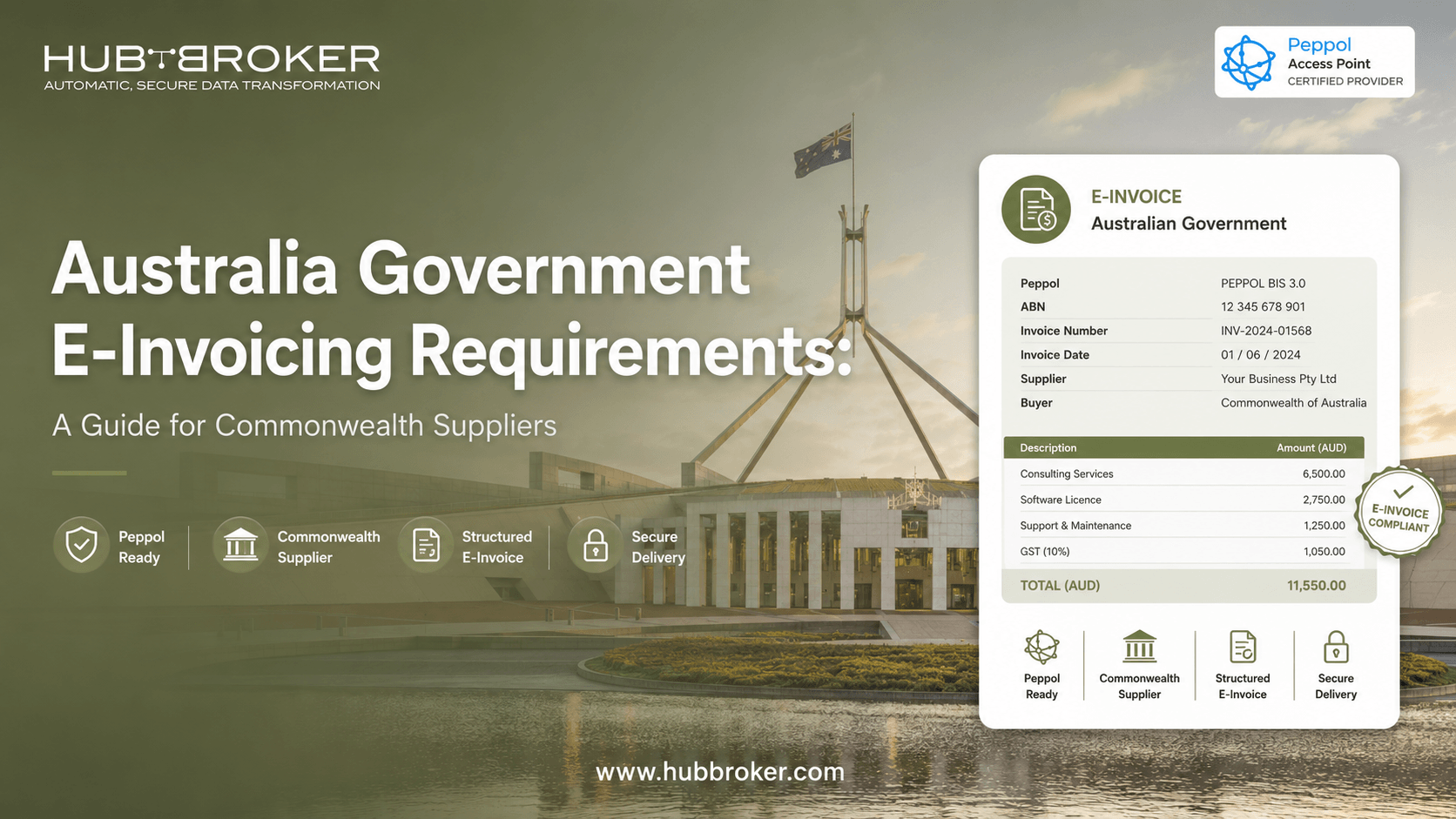
Australia Government E-Invoicing Requirements: A Guide for Commonwealth Suppliers
Supplying goods or services to an Australian Government agency involves more than completing the work and emailing a PDF invoice. Many Commonwealth entities are now using structured electronic invoices to make payment process faster, safer and more accurate.
For suppliers, understanding Australia government e-invoicing can help reduce invoice mistakes, avoid payment delays and improve cash flow. It can also make your business more ready for future digital procurement requirements.
Is E-Invoicing Mandatory in Australia?
E-invoicing is not currently mandatory for every Australian business. However, Commonwealth suppliers should always check their contract and the invoice instructions provided by the government agency. Some Australian Government organisations are already able to receive eInvoices through the Peppol network. When both the government organisation and supplier have Peppol e-invoicing capability, they can agree to use e-invoicing as the preferred method.
This means the actual requirement may depend on:
The Commonwealth entity you supply
Your contract terms
Whether the agency can receive Peppol eInvoices
Whether both parties have agreed to use e-invoicing
Suppliers should not assume that sending a PDF by email is always accepted. Check the purchase order, contract and agency payment instructions before sending your invoice.
What Is Peppol E-Invoicing in Australia?
Peppol is the main framework used for e-invoicing in Australia. It allows invoice data to move securely between the supplier’s accounting or ERP system and the buyer’s system. An eInvoice is not only a PDF attached to an email. It is a structured digital invoice that can be received and processed automatically by the buyer’s financial software.
The Australian Taxation Office acts as the Australian Peppol Authority. It manages local requirements and approves service providers that connect businesses to the Peppol network. The ATO does not receive or view the invoices exchanged between suppliers and buyers.
How Quickly Does the Australian Government Pay EInvoices?
One of the main benefits for Commonwealth suppliers is faster payment. Under the Australian Government’s Supplier Pay On-Time or Pay Interest Policy, eligible Peppol eInvoices generally have a maximum payment term of five calendar days. Other correctly prepared invoices generally have a maximum payment term of 20 calendar days, unless a shorter term is already agreed.
The five-day period applies when:
The Commonwealth entity and supplier both use Peppol
Both parties have agreed to use e-invoicing
Goods or services were delivered properly
The agency received a correctly prepared invoice
The payment period normally begins after the agency confirms satisfactory delivery and receives the correct invoice. Disputed, incomplete or incorrect invoices may not qualify for the faster payment period.
What Information Should a Commonwealth Supplier Include in an EInvoice?
Your invoice must contain the information required by your contract and the receiving agency. Missing or incorrect details can cause the invoice to fail validation or be sent for manual checking.
Common details may include:
Supplier name and Australian Business Number
Government agency details
Purchase order or contract reference
Invoice number and invoice date
Description of goods or services
GST and total payment amount
Payment and bank details
Agency contact or delivery reference
It is important to match the purchase order details as closely as possible. Even a small difference in the supplier name, order number or invoice amount can delay the processing.
How Do I Send an EInvoice to the Australian Government?
The first step is checking whether your accounting or ERP software already supports Peppol. Many modern accounting systems have e-invoicing features available directly or through an integration provider. If your current system does not support it, you can connect through an accredited Peppol Access Point or use an e-invoicing-ready product. Suppliers who only send and receive invoices do not need to become accredited Peppol providers themselves.
A normal setup includes:
➡ Connecting your accounting or ERP system to a Peppol provider.
➡ Registering your business on the Peppol network.
➡ Confirming that the government agency can receive eInvoices.
➡ Mapping invoice data to the required Australian format.
➡ Sending a test invoice before starting live transactions.
The exact setup may be different depending on your ERP system, accounting software and the number of invoices your business sends.
What Are the Benefits of E-Invoicing for Government Suppliers?
E-invoicing can make the full invoice process more predictable. Invoice data goes directly from one system to another, so there is less manual data entry and less chances of mistakes. Common benefits include fewer typing errors, reduced invoice fraud risk, faster validation and better invoice tracking. It also removes the need to create PDF files and send them through email. For businesses supplying several government agencies, one Peppol connection can provide a standard way to exchange invoices with different Peppol-enabled customers.
This means the supplier does not need to create a separate technical connection for every government organisation. However, each agency may still have different purchase order, contract and payment requirements.
Common Problems That Can Delay Government EInvoices
Using Peppol does not mean every invoice will be paid automatically within five days. The invoice still needs to be correct and meet the agency’s contract requirements.
Common problems may include:
Missing purchase order number
Incorrect supplier ABN
Wrong government agency details
Incorrect GST calculation
Invoice amount not matching the purchase order
Missing contract reference
Duplicate invoice number
Incorrect payment information
Suppliers should check the invoice before sending it. It is also important to make sure that purchase order details inside the ERP or accounting system are correct.
Get Ready for Australia Government E-Invoicing
Commonwealth suppliers should start by reviewing their government contracts, checking their software capability and confirming the invoice method accepted by each agency. HubBroker’s e-invoicing solution connects ERP, accounting and business systems to the Peppol network. It helps businesses create, validate, send and receive structured invoices without changing their complete finance process. The solution can also help businesses reduce manual work, improve invoice accuracy and track invoice status directly from their existing systems.
Contact HubBropker to reduce invoice problems, support faster government payments and make your business more ready for wider e-invoicing adoption across Australia.
