

Platform Type
Online marketplace

Online marketplace
Walmart Marketplace RESTAPIs (no EDI)
Orders, acknowledgements, shipments, inventory, prices
Seller-fulfilled and Walmart Fulfillment Services (WFS)
ERP and warehouse
Walmart Marketplace lets approved third-party sellers list products on Walmart's online stores alongside Walmart's own range. Sellers own their listings, set prices and fulfil orders themselves or through Walmart Fulfillment Services.
Walmart measures seller performance on prompt order acknowledgement, on-time shipping and accurate inventory, so manual processing quickly becomes a risk. Marketplace selling is separate from supplying Walmart as a vendor. Marketplace sellers integrate through RESTAPIs; Walmart's traditional supplier programmes use EDI. This page covers Walmart Marketplace
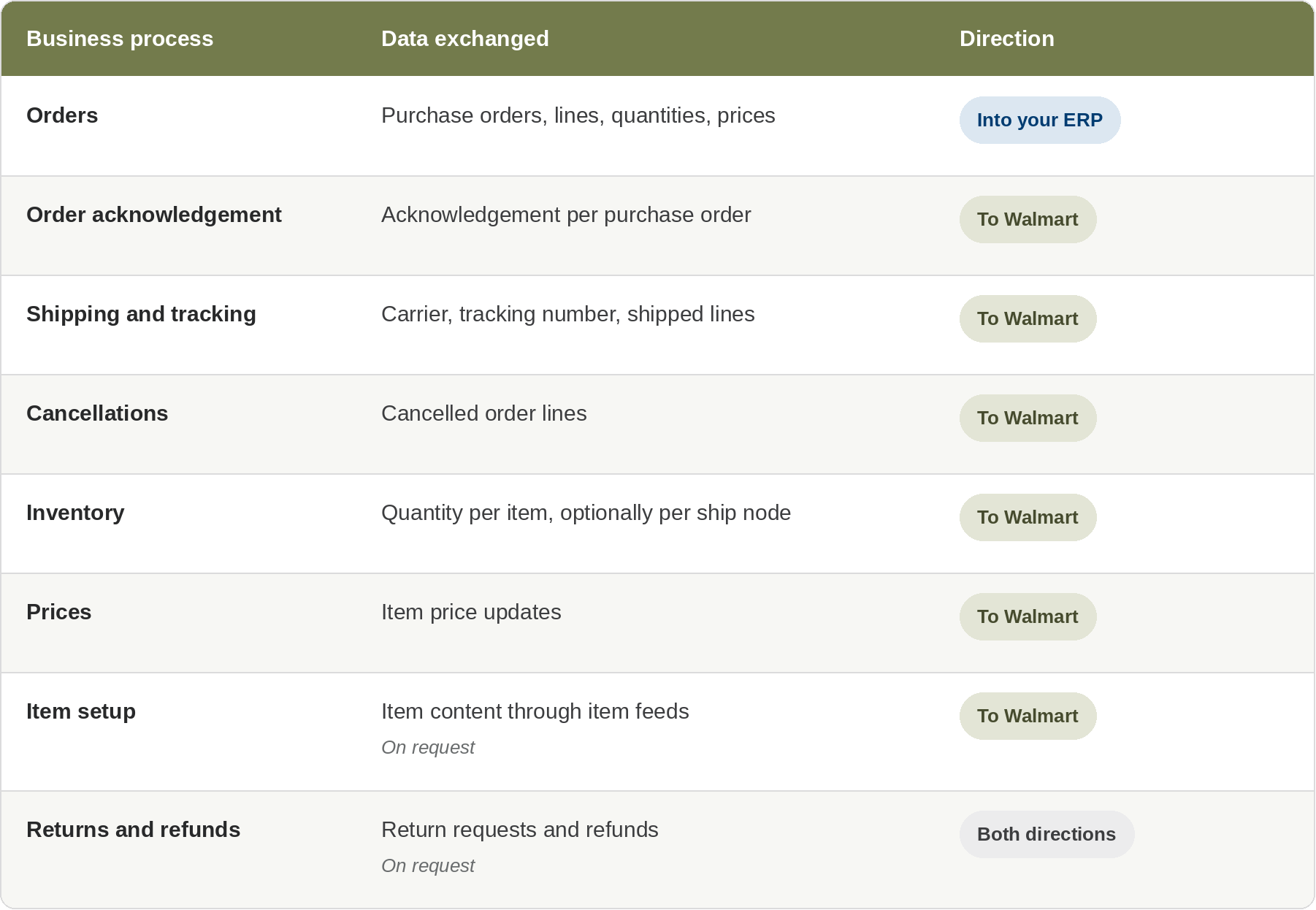
Orders move from Walmart into your ERP, and acknowledgements, shipments, stock and prices move back.
A customer places an order, and Walmart creates a purchase order.
HubBroker retrieves new purchase orders through the Walmart Orders API.
Each order is validated, acknowledged to Walmart and mapped to your ERP.
The sales order is created in your ERP or sent to your warehouse.
When items ship, carrier and tracking details are posted to Walmart for each order line
Approved Walmart Marketplace sellers whose order volume has outgrown manual processing.
Multichannel brands selling the same SKUs on Walmart, Amazon and their own webshop.
Sellers shipping from several warehouses that need line-level shipping updates.
Businesses combining own fulfilment with WFS that want all sales recorded in one ERP.
HubBroker connects Walmart Marketplace to the ERP you already use, including Microsoft Dynamics 365 Business Central, Microsoft Dynamics 365 Finance & Operations, e-conomic and Uniconta. Each connection is configured for your item structure, warehouses and carriers.
Acknowledgement without delay: Orders are acknowledged as soon as they are retrieved and validated, including at weekends.
Accurate availability: Inventory from your ERP keeps Walmart quantities aligned with stock you can ship.
Tracking at line level: Each order line is confirmed with its own carrier and tracking number, so split shipments are handled correctly.
One ERP for every channel: Walmart orders sit alongside your other channels, so finance and fulfilment work from one set of records.
Visible exceptions: Rejected API calls, unknown items or missing tracking data are flagged for action.
Seller account: An approved Walmart Marketplace seller account with API access. Walmart sets its own seller eligibility rules.
API access: Walmart Marketplace RESTAPIs for orders, inventory, prices, items and returns, limited to the API scopes you grant to HubBroker in Seller Center.
Bulk updates: Walmart feeds for larger item, inventory and price updates.
ERP access: Your ERP's connector orAPI.
Data mapping: Walmart items mapped to ERP items, ship nodes to warehouses, and carriers to your shipping methods.
HubBroker connects Walmart Marketplace to your ERP through HubBroker iPaaS. We configure the API connection, map items, ship nodes and carriers, and automate order retrieval, acknowledgement, shipping updates, inventory and prices.
Every transaction is validated and logged, and e-mail notifications flag exceptions before they affect your seller performance. When Walmart updates its API versions, mappings are adjusted accordingly.

No. Marketplace sellers integrate through Walmart's RESTAPIs. EDI applies to suppliers selling to Walmart in its retail or drop-ship supplier programmes, which is a separate integration
Yes. HubBroker acknowledges each purchase order once it has been retrieved and validated, so acknowledgement does not depend on office hours.
Yes. Walmart's InventoryAPI supports quantities per ship node. If you ship from several locations, stock is published per node.
WFS orders are fulfilled by Walmart. They can be brought into your ERP for sales and finance records on request.
API access granted from your Seller Center, limited to the scopes the integration needs, such as orders, inventory and pricing. You can review or revoke it at any time.
Yes. Orders are created in Business Central, and shipments, stock and prices are returned to Walmart.
Not for sellers, who integrate through SP-API. Amazon vendors can use EDI orAmazon's vendorAPIs, depending on their setup with Amazon.
45B 1260 Bredgade , København K Capital Region, Denmark
D-1010, The First, B/H ITC Narmada, Ahmedabad, Gujarat, 380015, India


