
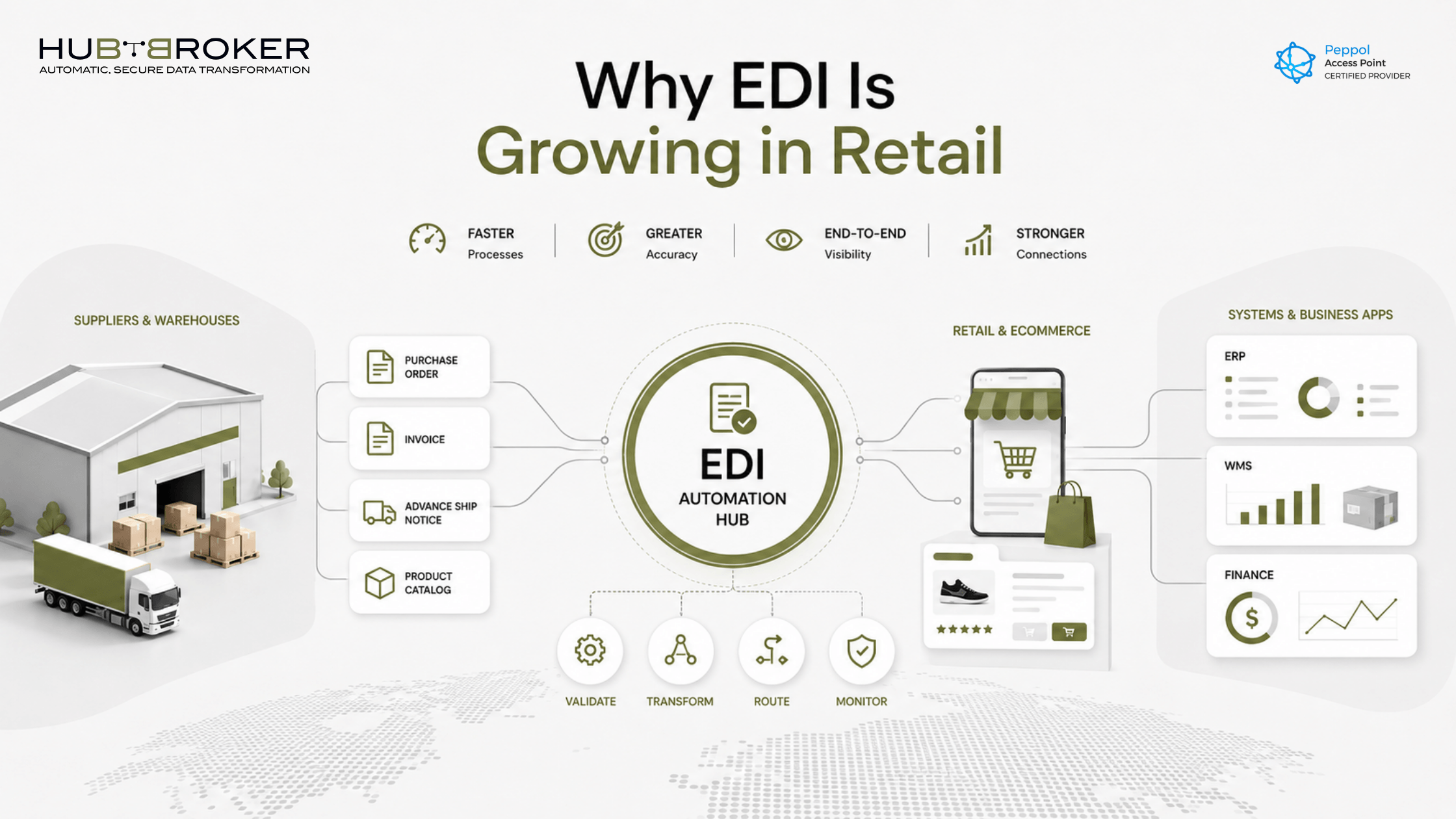
Why the Need for EDI Is Growing in the Retail Industry
Retail has changed. A few years ago, many businesses could manage supplier orders, invoices, and delivery updates through emails, spreadsheets, and PDF documents. It was not perfect, but it worked.
Today, that same process creates delays.
Retailers now deal with online stores, physical outlets, marketplaces, warehouses, logistics partners, and suppliers across different countries. Every order, invoice, delivery note, and stock update needs to move quickly and accurately. This is one of the main reasons the need for EDI in the retail industry is growing.
EDI, or Electronic Data Interchange, allows businesses to exchange structured documents such as purchase orders, invoices, and advance shipping notices electronically between systems.
Why Retailers Are Looking at EDI More Seriously
Retail teams are under pressure to move faster without adding more manual work. Customers expect products to be available, deliveries to be accurate, and orders to be processed without delays.
But behind the scenes, many retail businesses still depend on people copying data from emails, supplier portals, PDFs, or spreadsheets into ERP, finance, or warehouse systems.
That creates common problems:
Wrong product codes
Missing order references
Delayed invoice matching
Stock mismatch
Slow supplier response
Manual rework for finance and operations teams
As order volumes grow, these problems become harder to control. EDI helps by moving business documents directly between systems in a structured format.
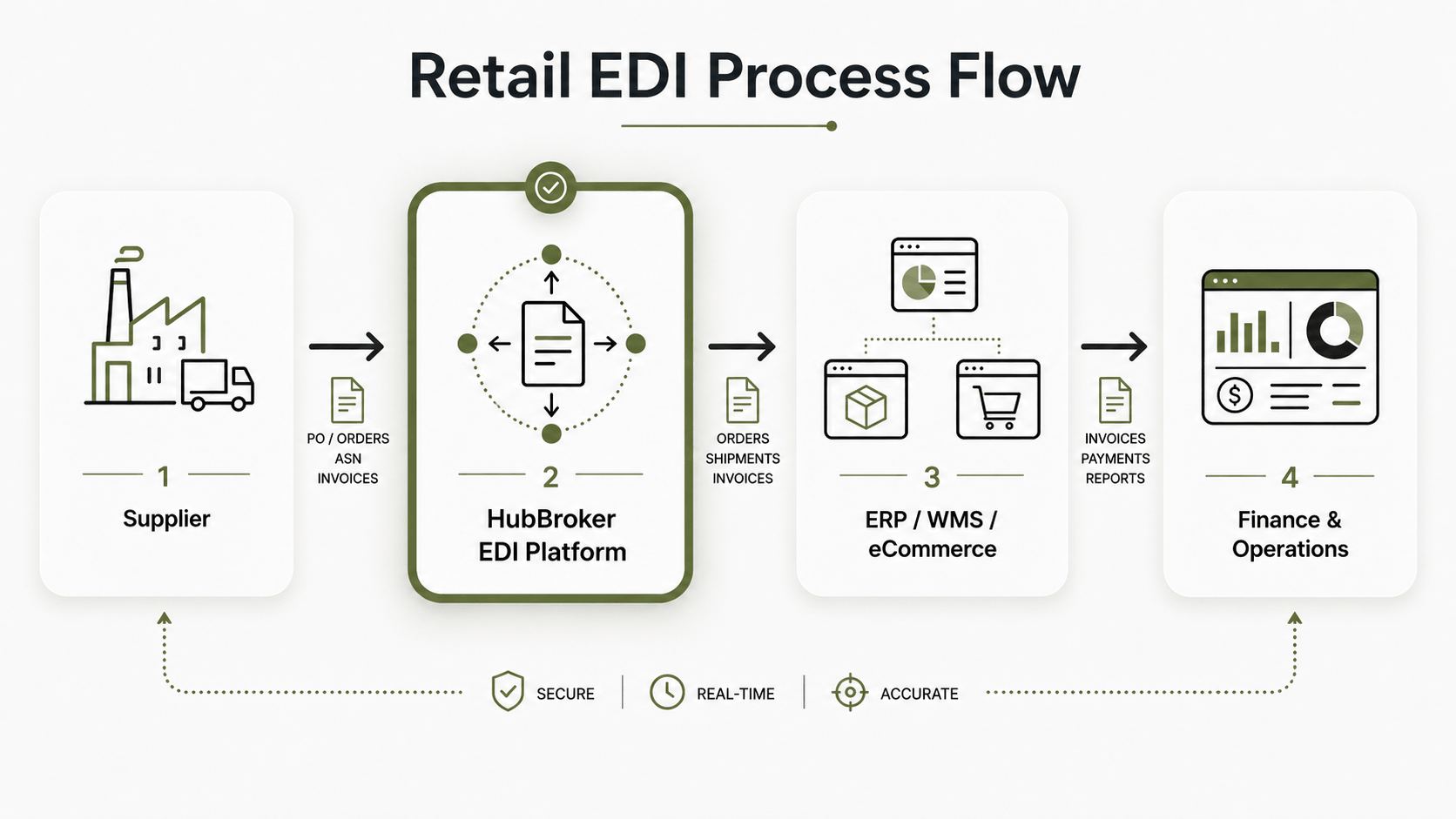
Retail Is No Longer a Simple Store-and-Supplier Model
Modern retail is more connected than ever. A single business may sell through its own website, marketplaces, physical stores, distributors, and B2B customer portals.
At the same time, it may receive products from local suppliers, international suppliers, fulfilment centres, and third-party logistics providers.
This creates a lot of document movement.
A typical retail flow may include:
Purchase orders
Order confirmations
Invoices
Credit notes
Delivery notes
Inventory updates
Advance shipping notices
An advance shipping notice, often used in EDI, gives the receiver information about an upcoming delivery, including shipment details and goods being sent.
When these documents arrive in different formats, teams spend too much time checking, correcting, and entering data manually. EDI reduces that dependency.
Ready to simplify retail document automation? Contact HubBroker today.
Manual Order and Invoice Handling Is Becoming Too Slow
Manual processing may feel manageable when a business handles a limited number of suppliers. But in retail, volumes can rise quickly.
One missing field in an invoice can delay payment. One wrong product code can affect stock availability. One late delivery update can create customer service issues.
This is where retail EDI integration becomes valuable.
Instead of receiving a PDF invoice by email and typing it into the ERP, the invoice can arrive as structured data. Instead of checking shipment updates manually, delivery information can move automatically into the right system.
The result is not just speed. It is better control.
Where EDI Creates the Most Value in Retail
EDI is useful because it supports the daily document flows that retail businesses depend on.
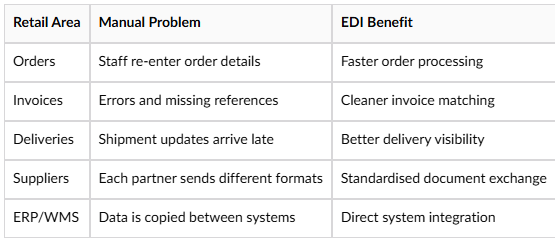
For business buyers, the real value is simple: fewer errors, less manual work, faster document flow, and better visibility.
Why the Demand for EDI Is Growing Now
1. Retailers Need Faster Order Processing
Retail moves quickly. When an order is delayed at the data-entry stage, everything after it is affected.
EDI helps purchase orders, confirmations, and dispatch details move faster between retailers and suppliers. This helps teams respond earlier and avoid unnecessary delays.
2. Supplier Networks Are More Complex
Many retailers no longer work with a small group of local suppliers. They may work with suppliers across different systems, countries, document formats, and compliance requirements.
EDI creates a repeatable way to connect suppliers instead of building a separate manual process for each one.
3. Inventory Accuracy Matters More
Retailers cannot make good decisions with outdated stock data. If the ERP, warehouse, and eCommerce platform show different numbers, teams lose control.
EDI helps improve data movement between suppliers, warehouses, and retail systems so inventory information is cleaner and more reliable.
4. Invoice Errors Affect Cash Flow
Retail finance teams often deal with invoice disputes, missing purchase order numbers, incorrect quantities, and price mismatches.
With EDI invoice automation, invoice data can be validated before it enters the finance process. This reduces rework and helps teams process invoices with more confidence.
5. Businesses Want Better Visibility
Retailers need to know what was sent, received, accepted, rejected, or corrected. Without this visibility, teams waste time searching through emails and asking partners for updates.
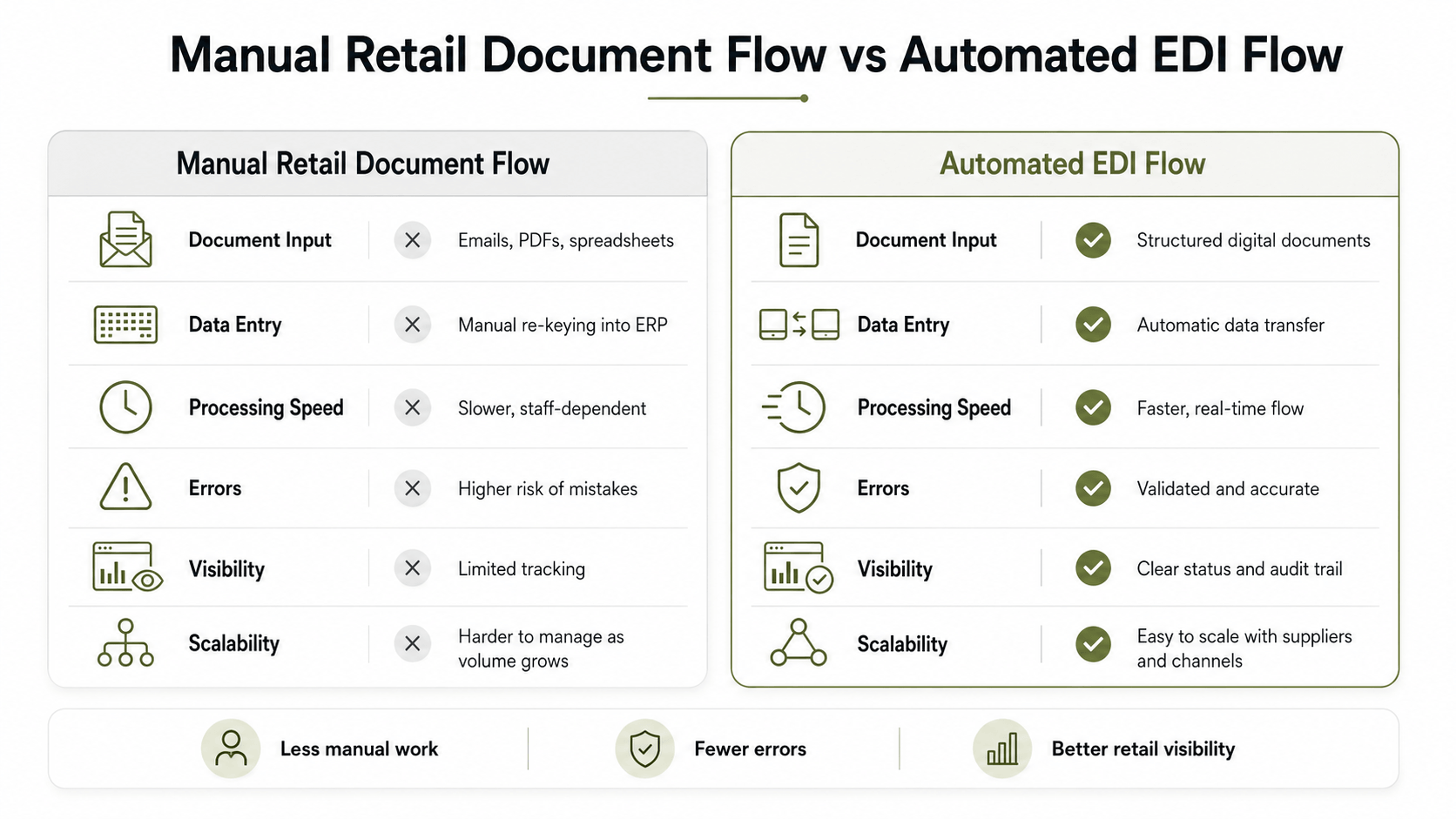
How HubBroker Helps Retail Businesses With EDI Integration
HubBroker helps retail businesses connect document flows across suppliers, customers, logistics partners, ERP systems, WMS platforms, marketplaces, and eCommerce systems.
With HubBroker, retailers can manage:
Order automation
Invoice automation
Supplier EDI integration
Format conversion, including EDIFACT, X12, XML, JSON, and CSV
ERP, WMS, and eCommerce system connectivity
Validation before documents reach the ERP
Monitoring and audit history
Peppol and e-invoicing support where required
HubBroker’s platform is built to support retail and eCommerce workflows, including order, invoice, inventory, and marketplace processes.
FAQ
What is EDI in the retail industry?
EDI in retail means exchanging business documents such as orders, invoices, delivery notes, and shipping updates electronically between retailers, suppliers, logistics, and ERP systems.
Why do retailers need EDI?
Retailers need EDI to reduce manual data entry, process orders faster, improve invoice accuracy, and keep supplier and inventory data more reliable.
Does EDI replace my ERP?
No. EDI does not replace your ERP. It connects with your ERP so business documents can move in and out automatically.
Which retail documents can be automated with EDI?
Common EDI documents include purchase orders, order confirmations, invoices, credit notes, delivery notes, advance shipping notices, and inventory updates.
Can HubBroker support retail EDI integration?
Yes. HubBroker supports EDI integration, document validation, ERP and eCommerce connectivity, partner onboarding, monitoring, and Peppol/e-invoicing support for retail businesses.
Ready to Reduce Manual Retail Document Work?
If your retail team is still handling orders, invoices, supplier documents, and delivery updates manually, now is the right time to review your EDI setup.
HubBroker can help you connect your suppliers, ERP, warehouse, eCommerce, and finance systems with a cleaner automated document flow.
Fill out the Contact Us form and share your current retail integration challenge. HubBroker’s team can help you understand the best next step for your business.
Ready to simplify retail document automation? Contact HubBroker today.
