
UK E Invoicing 2026 Peppol B2B and B2G Preparation Guide
The UK is entering a new phase of digital transformation. With the government confirming a mandatory e-invoicing mandate from April 2029, businesses must prepare for a major shift in how invoices are exchanged and processed. This transition is not limited to replacing paper invoices it introduces structured data exchange, automation, and standardized communication across systems. It reflects a broader global move toward real-time, transparent financial ecosystems.
For organizations operating in or trading with the UK, this is not just a compliance requirement it’s a strategic change in financial operations. It will impact finance teams, IT infrastructure, and trading partner relationships.
What Is the UK Peppol E-Invoice Mandate?
The UK government has announced mandatory electronic invoicing for VAT transactions from 1 April 2029, requiring businesses to shift to structured digital formats and automated systems to improve compliance, accuracy, and efficiency across invoicing processes.
B2B (Business-to-Business)
B2G (Business-to-Government) transactions
This means:
Paper invoices and PDFs will no longer be considered valid VAT invoices
Businesses must issue and receive structured e-invoices
Invoice exchange will be fully digital and automated
Real-time or near real-time validation mechanisms may be introduced
Businesses must enable system-to-system invoice transmission
Manual invoice handling processes will be significantly reduced
Compliance will require alignment with approved digital standards
Why the UK Is Moving to E-Invoicing
The mandate is part of the UK’s broader digital tax transformation strategy, building on initiatives like Making Tax Digital (MTD).
Key objectives include:
Improving VAT compliance and reducing errors
Increasing automation and operational efficiency
Enhancing transparency in financial transactions
Aligning with global and European e-invoicing standards
Reducing invoice fraud and tax evasion risks
Enabling better visibility into transaction data
Supporting cross-border interoperability
Lowering administrative and operational costs
Prepare for UK E-Invoicing in 2026
Get ready for Peppol B2B and B2G invoice exchange with HubBroker’s compliant e-invoicing, automation, and ERP integration solutions.
Contact Us to Know More
Will Peppol Be the Core Framework?
While not officially mandated yet, Peppol is strongly expected to be the backbone of the UK e-invoicing ecosystem.
Reasons include:
The UK is adopting a decentralized (4-corner) model
Peppol is already used across the UK public sector
It enables secure, standardized, and cross-border exchange
Built-in compliance with EN 16931 standards
Strong adoption across Europe ensures interoperability
Eliminates complex bilateral integrations
Supports scalability for future regulatory changes
Understanding the UK’s Decentralized Model
Unlike countries such as Italy or Poland, the UK will not use a centralized clearance system (initially).
Instead:
Businesses exchange invoices via certified service providers
No real-time reporting to HMRC in the first phase
Government defines standards but does not control invoice flow
Businesses rely on certified access points to ensure secure and standardized invoice delivery
Interoperability across different service providers enables smooth partner-to-partner communication
Flexibility allows businesses to choose providers that best fit their technical and operational needs
The model supports cross-border invoicing without requiring separate country-specific integrations
Current landscape snapshot:
The UK already processes large volumes of B2G invoices digitally, with NHS suppliers widely using Peppol. Adoption is steadily increasing, indicating strong readiness for a decentralized exchange model supported by certified service providers.
Key Technical Requirements
Businesses should expect the following:
Structured invoice format compliant with EN 16931
Fully machine-readable invoice data
Interoperable exchange via Peppol or certified providers
Secure transmission protocols and encryption
Unique invoice identification and validation rules
Compatibility with ERP and accounting systems
Maintenance of audit trails and digital records
What About B2G E-Invoicing Today?
The UK already has a foundation:
Public sector bodies must accept structured e-invoices
NHS suppliers already use Peppol BIS 3.0
Crown Commercial Service frameworks support adoption
Many government suppliers are already Peppol-enabled
Digital procurement initiatives are accelerating adoption
Early adopters benefit from faster payment cycles
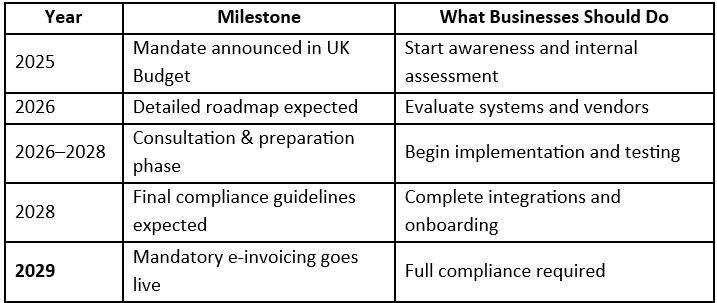
Timeline: What Happens Next?
Impact on Businesses
Operational Impact
Replace manual invoicing with automated workflows
Integrate ERP and financial systems
Compliance Impact
Ensure structured and accurate invoice data
Align with VAT and regulatory standards
Strategic Impact
Enable faster payments and improved cash flow
Strengthen digital capabilities and competitiveness
Challenges to Prepare For
Businesses should start addressing:
ERP and system integration
Data standardization
Supplier and partner onboarding
Change management and training
Managing multi-country compliance requirements
Ensuring data security and privacy standards
Handling legacy systems and migration complexities
How HubBroker Helps You Stay Ahead
As a certified Peppol Access Point provider, HubBroker enables seamless compliance with the UK e invoicing mandate by offering secure, scalable, and fully compliant solutions for B2B and B2G transactions, ensuring smooth integration, faster processing, and future ready digital invoicing capabilities for businesses.
With HubBroker, you can:
Send and receive Peppol-compliant invoices globally
Integrate easily with ERP systems like Business Central
Automate invoice processing using APIs and IDP
Ensure compliance with EN 16931 and evolving UK standards
Onboard suppliers and partners quickly
Scale operations for high transaction volumes
Monitor invoice flows with real-time visibility