

UAE E-Invoicing 2027: What PINT AE Requires From Your ERP on 1 January
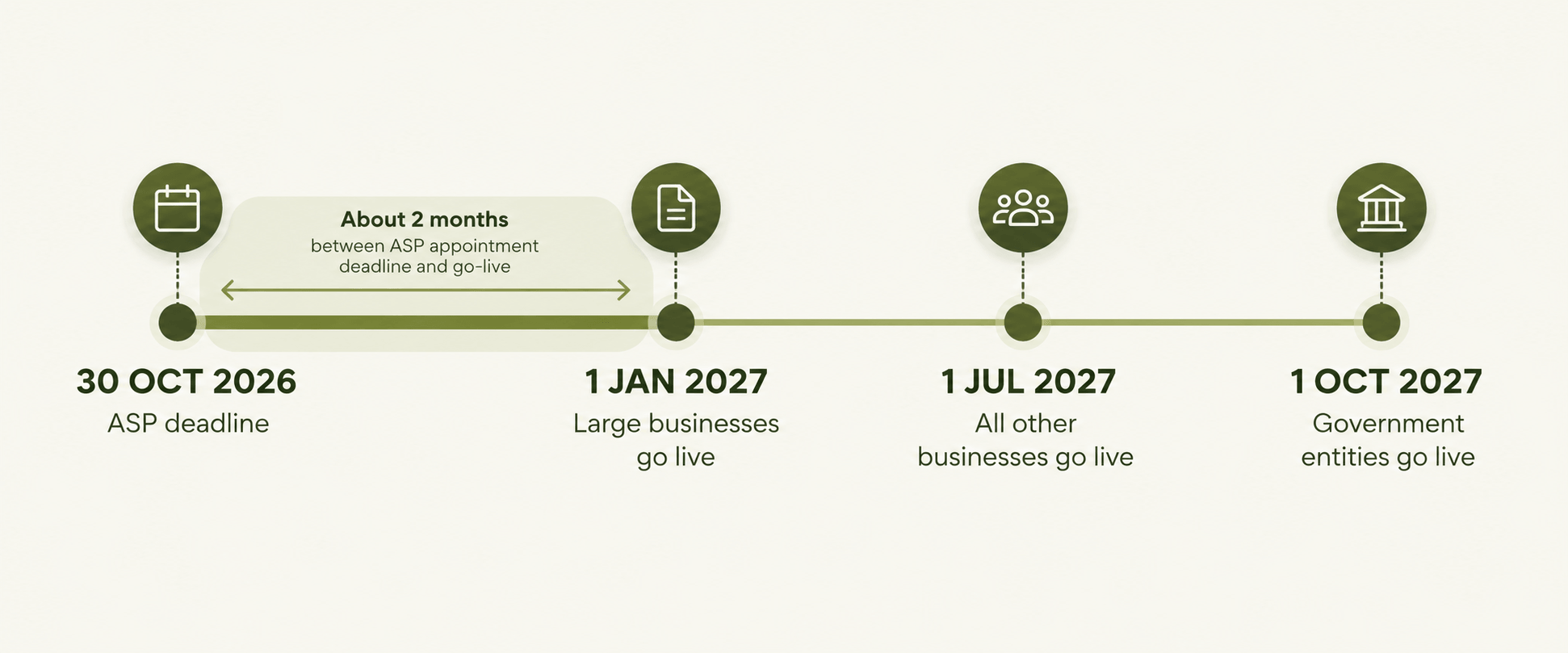
Large UAE businesses must appoint an Accredited Service Provider (ASP) and issue structured e-invoices from 1 January 2027. The Ministry of Finance moved the ASP appointment deadline for businesses with revenue of AED 50 million or more from 31 July 2026 to 30 October 2026. The go-live date of 1 January 2027 has not moved. The extension shortened your runway to go-live.
A missed deadline carries a cost. Failing to implement UAE e-invoicing or appoint an ASP on time costs AED 5,000 per month of delay. This post explains what PINT AE requires from your ERP data and what to do next.
UAE e-invoicing 2027: who must act, and when
Phase 1: revenue of AED 50 million or more
Businesses at or above this threshold appoint an ASP by 30 October 2026 and go live on 1 January 2027. Your ASP exchanges invoices on your behalf and reports the data to the tax authority.
Later phases and scope
Mandatory e-invoicing starts on 1 January 2027 for large businesses, 1 July 2027 for all other businesses and 1 October 2027 for government entities. The scope is wider than many finance teams expect. The mandate applies to any person conducting business transactions in the UAE, regardless of VAT registration status.
Check the exclusions before you rule an entity out. HubBroker's UAE e-invoicing country page tracks the phases.
What PINT AE is, and what it is not
A data standard, not an invoice layout
PINT AE is the UAE's national implementation of the international PINT standard. It defines the data your invoice must carry, not how the PDF looks. The Ministry of Finance is explicit that unstructured formats do not qualify as e-invoices under the mandate.
The five-corner model
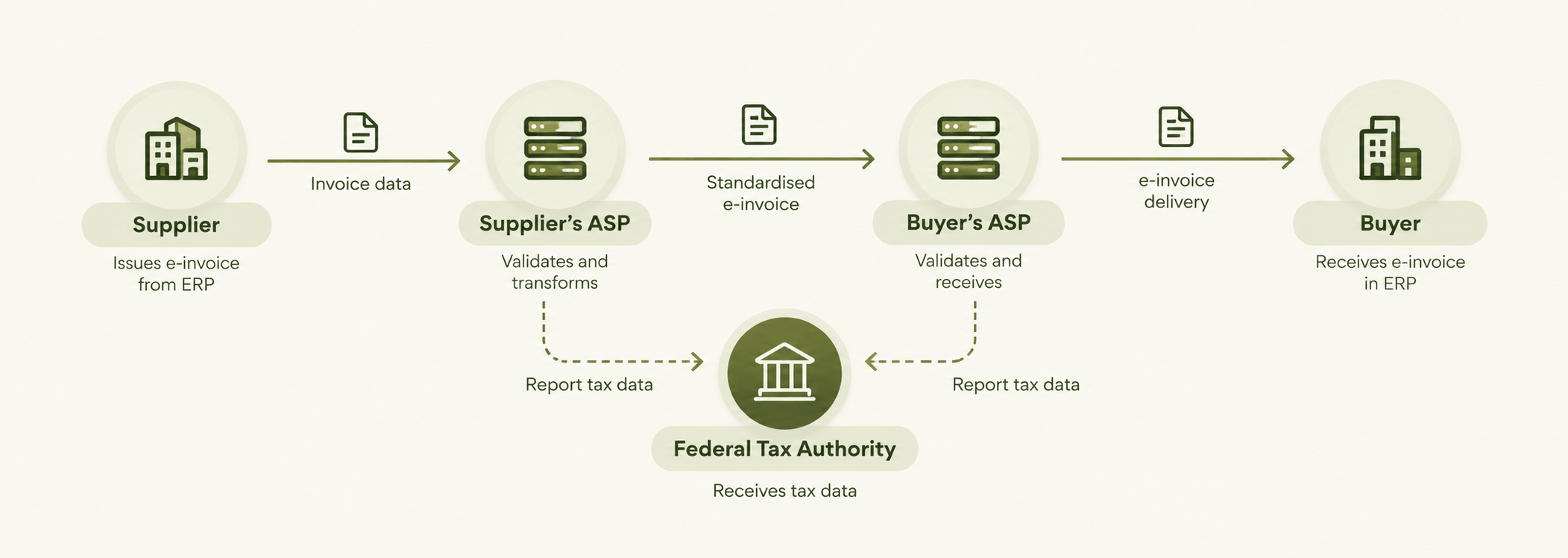
The UAE uses a Peppol-based five-corner model. Supplier, supplier's ASP, buyer's ASP and buyer form the standard exchange. The Federal Tax Authority is the fifth corner and receives the tax data.
Our guide to the Peppol 4-corner and 5-corner models explains the difference. HubBroker's Peppol e-invoicing solution covers the connectivity side.
What PINT AE requires in your invoice data
Document types
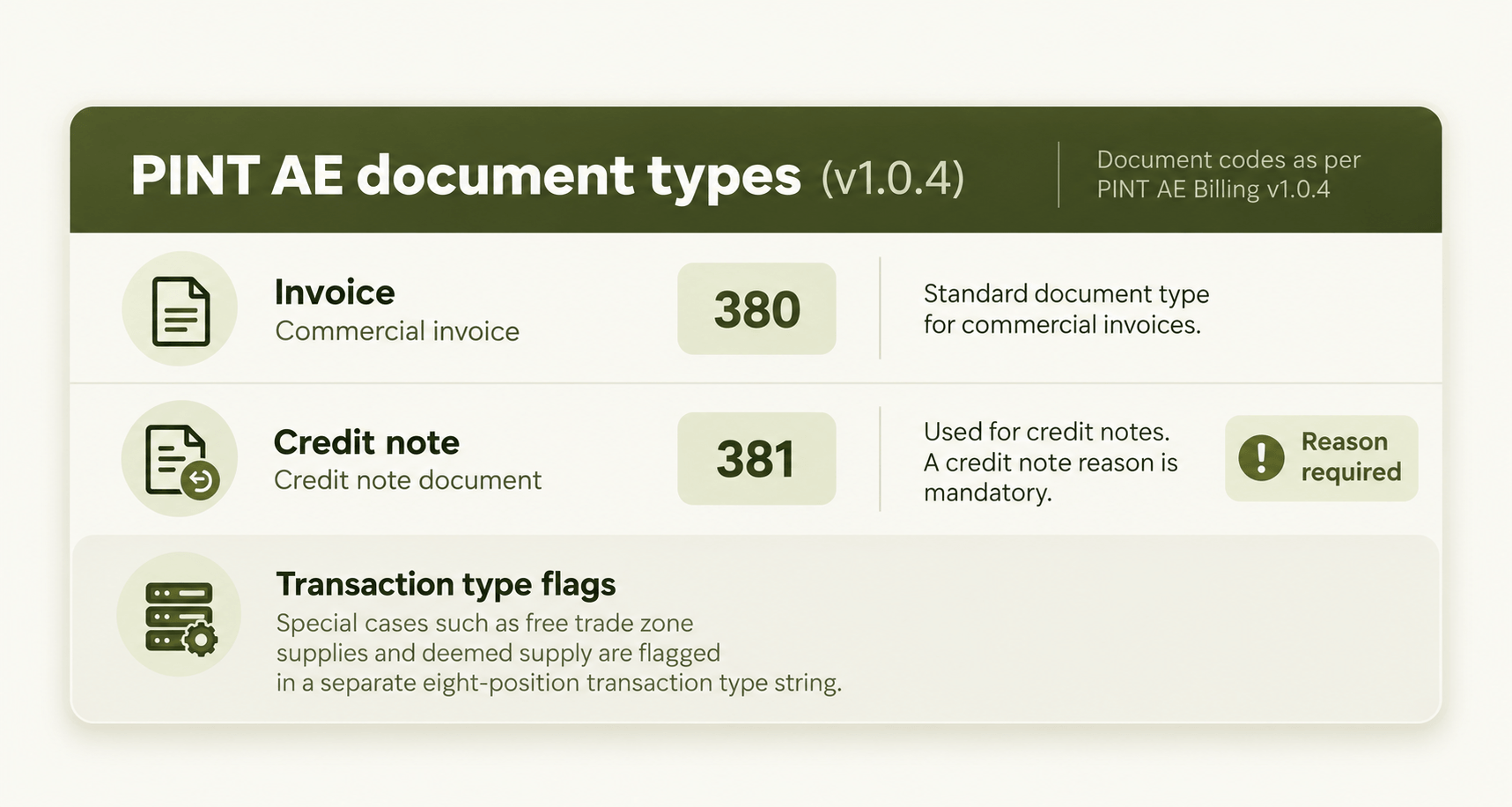
PINT AE covers commercial invoices, out-of-scope invoices, credit notes, self-billed invoices and self-billed credit notes. Your ERP must assign the right type code to each document.
Mandatory fields and business rules
Business rules decide whether a structured XML invoice is compliant with PINT AE. A filled-in field is not enough if it breaks a rule. Two examples:
The seller VAT identifier must be present, with narrow exceptions for certain credit note types.
A credit note reason is mandatory. The specification changed its cardinality from optional to required.
Human-readable copy
The XML is the legal document. The Ministry also published a file that classifies which fields must be visible on the human-readable version, such as a PDF. Your PDF layout needs to follow it, but the PDF does not replace the XML.
Where ERP integrations break
Master data
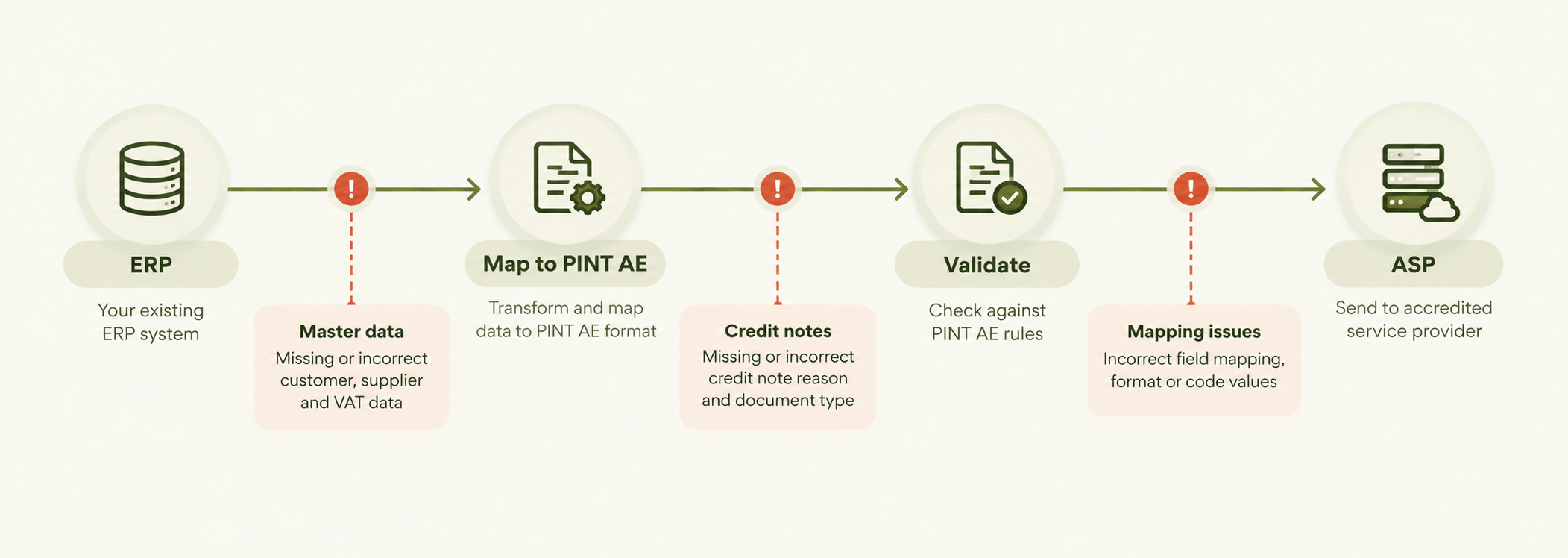
Missing tax registration numbers, buyer references and VAT category codes cause rejections before the network sees the invoice. Fix them in the ERP, not in the mapping.
Credit notes
Credit notes carry their own type codes and a mandatory reason. Many ERP credit note flows capture neither in structured form.
Mapping
Your ERP does not produce PINT AE XML out of the box. Fields must be mapped, validated and sent through your ASP. Inbound invoices must come back into the ERP as structured data.
HubBroker's ERP integration services sit on top of your existing ERP, so you keep the system you run today. Our e-invoicing implementation roadmap lists the stages from compliance assessment to production monitoring.
A four-step plan before 1 January
Appoint an ASP. The guidelines say a business appoints only one ASP for both sending and receiving e-invoices.
Run a data gap assessment. Compare your invoice data with the PINT AE data dictionary.
Map and validate. Convert ERP output to PINT AE and test rejection scenarios, not only successful invoices.
Test early. The voluntary phase is open, and testing before the deadline avoids doing discovery work under live penalty conditions.
Groups with entities in several countries can compare mandates on our e-invoicing by country overview.
FAQ
Does UAE e-invoicing apply if we are not VAT registered?
Possibly. The mandate does not depend on VAT registration status, but exclusions exist. Check each entity.
Can we send a PDF instead of XML?
No. A PDF is not a valid e-invoice under the mandate. Only structured PINT AE XML qualifies.
What happens if we miss 30 October 2026?
A penalty of AED 5,000 per month of delay applies. Appoint an ASP now and start data work in parallel.
Do we need more than one ASP?
No. One ASP handles both sending and receiving.
Does PINT AE change how we issue credit notes?
Yes. Credit notes have dedicated type codes and require a reason.
Next step
Unsure whether your ERP data passes PINT AE rules? Book a demo and we will walk through your invoice fields and credit note flows against the specification.
