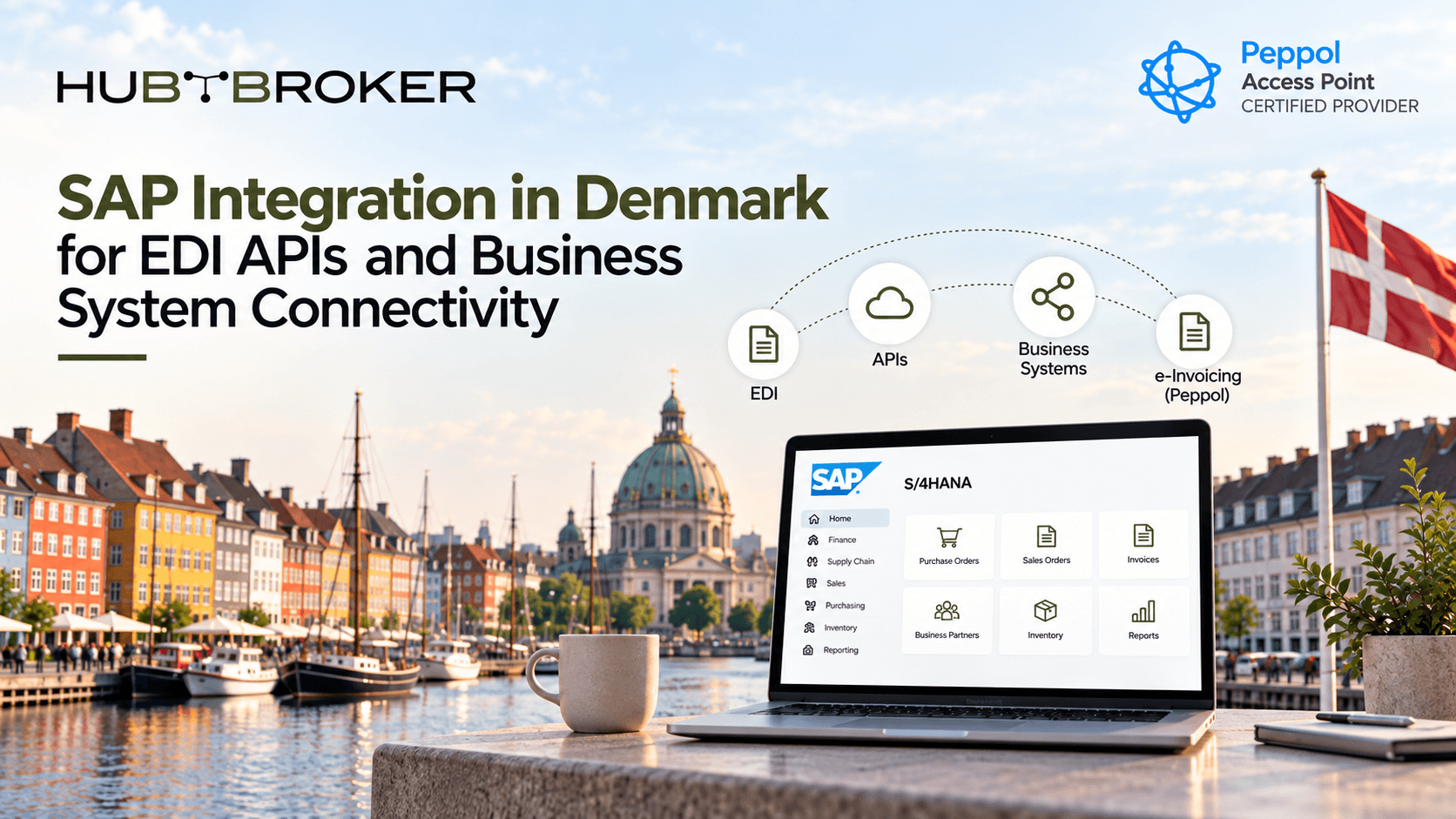
SAP Integration in Denmark for EDI APIs and Business System Connectivity
A wholesaler near Aarhus runs finance, purchasing and stock in SAP. One retailer sends EDI orders, a marketplace wants an API, suppliers send different XML files, and the warehouse has its own system. SAP holds correct data, but staff still check files and re-enter information. This is where sap integration Denmark becomes a business requirement, not only an IT task.
Our SAP works, so why are orders still handled manually?
SAP can be stable while systems around it stay disconnected. A Danish manufacturer may receive a customer Purchase Order through EDI:
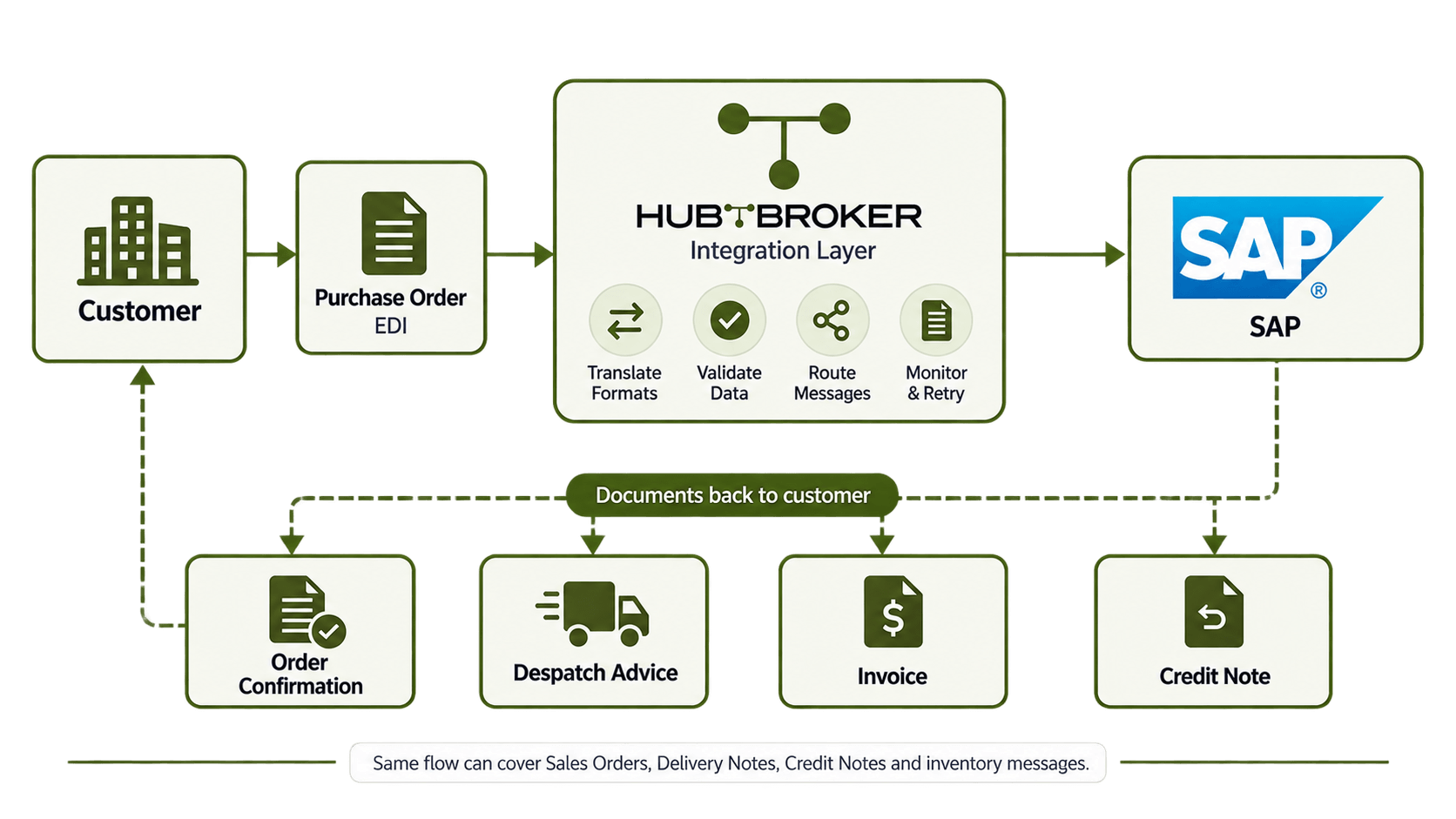
The same flow can cover Sales Orders, Delivery Notes, Credit Notes and inventory messages. Manual typing is reduced, and partner formats do not need to change core SAP.
Supplier sends another format — should SAP change every time?
Usually no. One supplier may send CSV, another XML, another EDI, and newer partners may use APIs.
Supplier Format → Mapping / Validation → SAP Format
An integration layer can transform fields, validate IDs, route data and keep mapping logic outside SAP. When trading partner count grow, this becomes easier to maintain than many custom connections.
We have APIs, so why keep EDI?
EDI is strong for structured partner documents such as orders, confirmations, dispatch messages and invoices. APIs fit e-commerce orders, customer portals, live inventory, shipment tracking and cloud applications. A Danish distributor can use EDI for structured partner documents and APIs for real-time system connections. SAP Integration Suite, SAP BTP or other SAP middleware can sit in this architecture.
Warehouse data is delayed — can SAP update it automatically?
A Danish distribution centre may run a separate warehouse application:
SAP → Warehouse System → Pick / Pack / Ship
Warehouse → Stock / Shipment Update → SAP
Updates can run in real time or on schedule. Failed jobs must be visible and retried safely, otherwise SAP stock and warehouse reality can differ.
The wider flow becomes:
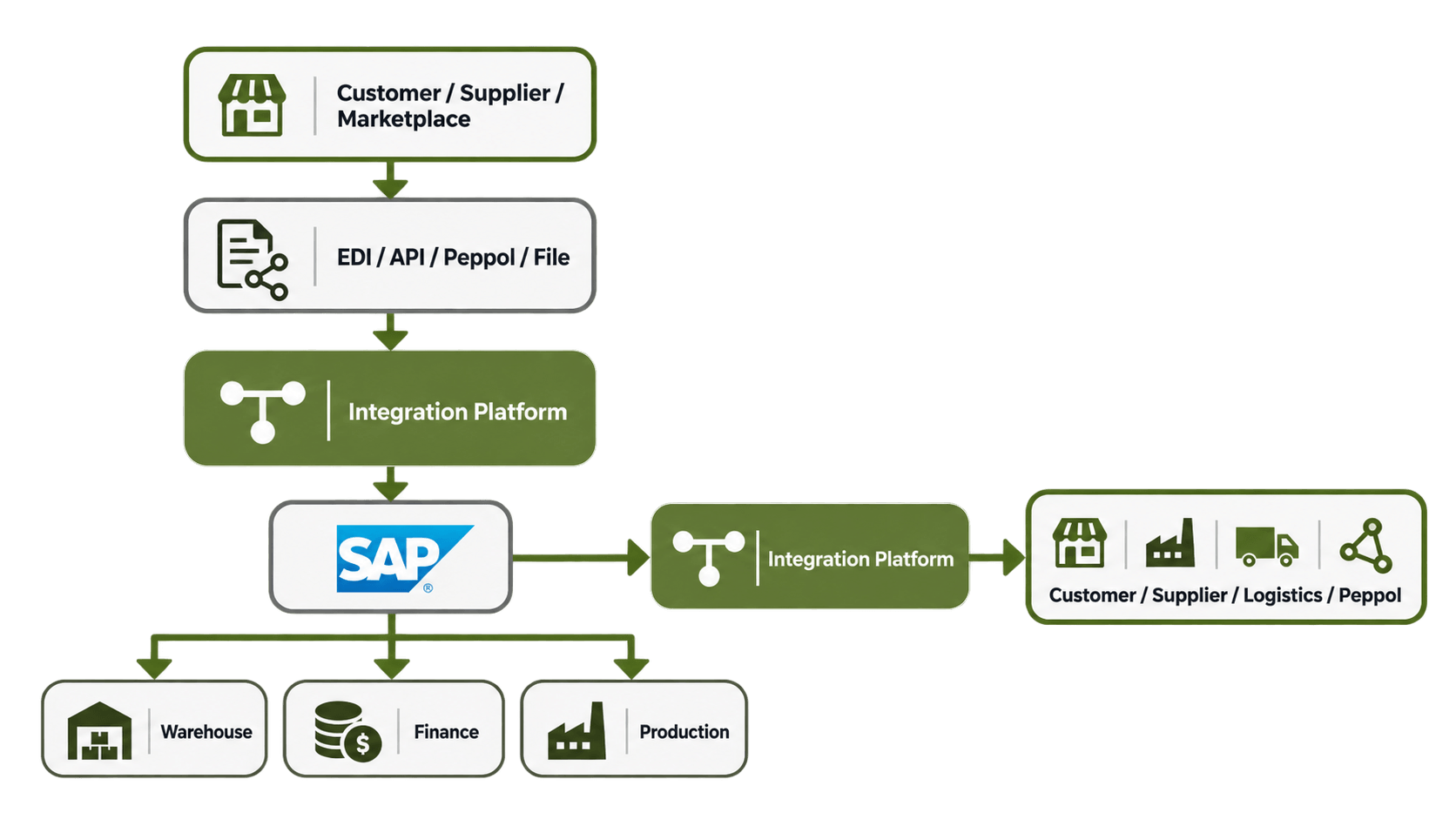
The platform handles transformation, mapping, validation, routing, authentication, monitoring and retry.
Can SAP connect with Peppol and NemHandel in Denmark?
Yes, where the process requires it. NemHandel supports electronic business-document exchange across public and private use. Official guidance says parts are mandatory for trade with the public sector, including e-invoicing rules using OIOUBL and Peppol. Danish Peppol participants can use CVR and GLN identifiers. This does not mean every private B2B invoice has one identical mandate.
A practical flow is:
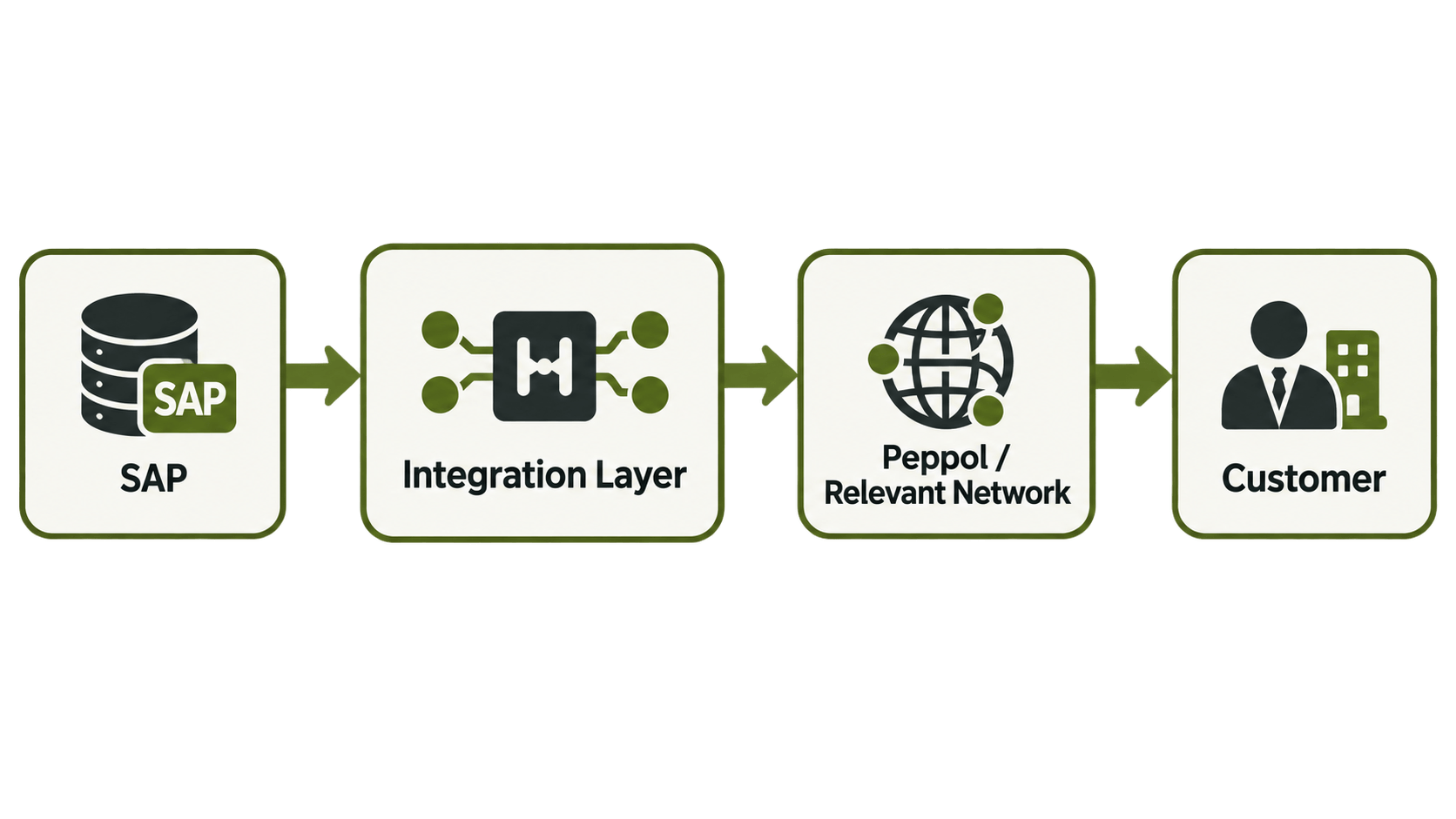
The layer can validate invoice data, identifiers and delivery status before finance assumes it was received.
What do current Danish digital numbers show?
Denmark business indicator | Verified figure | Why it matters |
|---|---|---|
Any ERP/CRM/BI software, 2025 | 73.07% | Connected systems are common |
ERP software, 2025 | 66.25% | ERP is central |
CRM software, 2025 | 42.51% | Customer data needs links |
BI software, 2025 | 41.70% | Data movement matters |
AI use, 2025 | 42.0% | Automation is expanding |
AI/cloud/data analytics combined, 2025 | 82% | Digital stack keeps growing |
Enterprises making e-sales, 2024 | 38.78% | More order channels appear |
Eurostat reports the first four from its 2025 e-business survey; Denmark also recorded 42.0% AI use, while 82% used AI, intermediate/sophisticated cloud or data analytics. E-sales reached 38.78% in 2024.
ERP adoption, 2025, same Eurostat dataset (rounded):
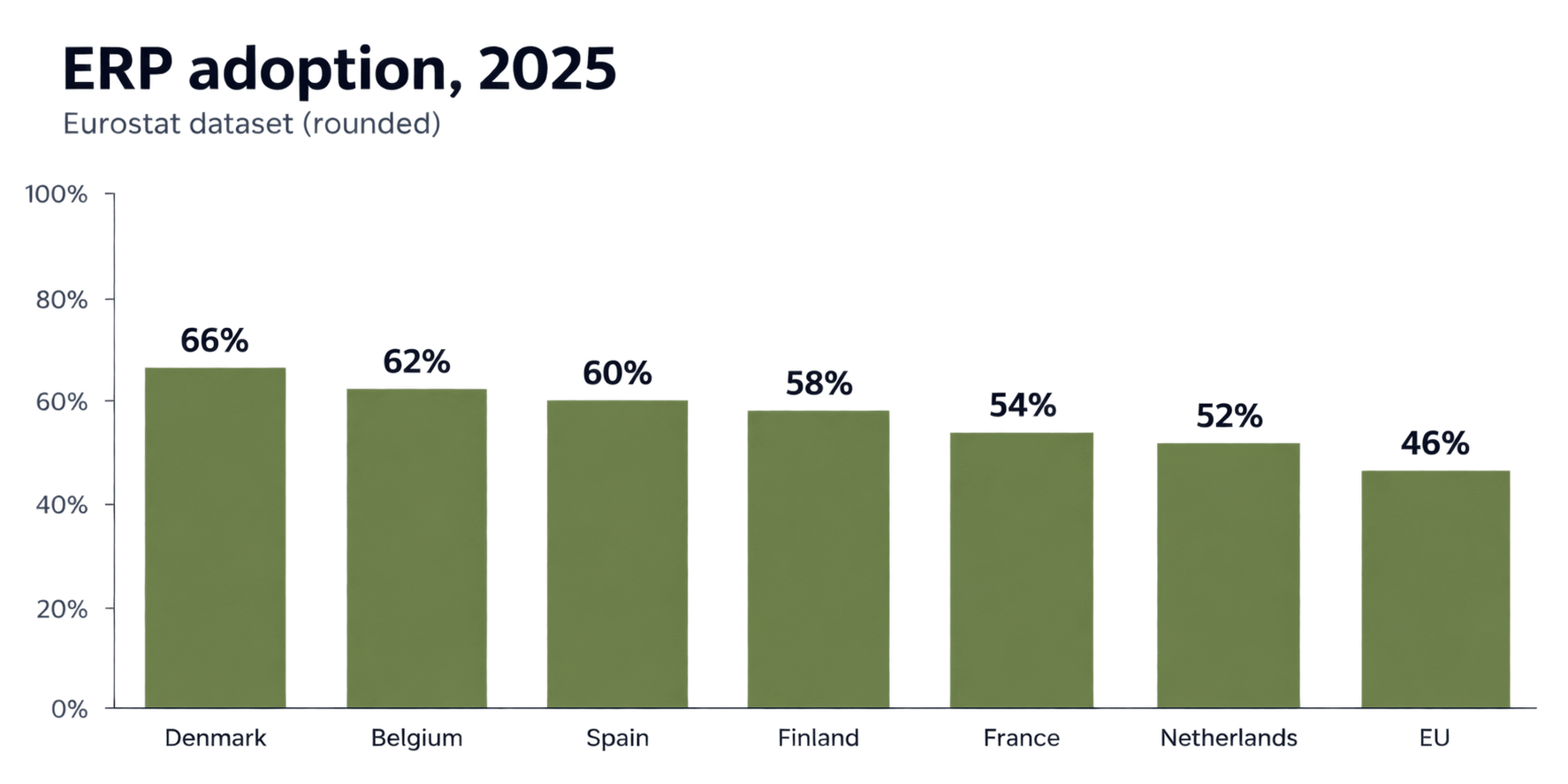
These are directly comparable shares of enterprises using ERP software.
We have 30 partners. Should each get a direct SAP connection?
Requirement | Direct SAP connection | Integration platform |
|---|---|---|
One partner | Can work well | Also suitable |
Many formats | More SAP mappings | Central transformation |
APIs / Peppol | Separate setups | Central connections |
Monitoring | Spread out | Central view |
New partners | More development | Reusable components |
Direct connections can suit simple setups. With many partners, point-to-point links create more places to investigate failures.
Common issues include wrong CVR or GLN, duplicate orders, missing references, partner-code mismatches, API authentication failures, rejected invoices, missing acknowledgements and warehouse updates not reaching SAP. Good integration needs logging, alerts, validation and controlled retry, not only file transfer.
Choosing an SAP integration partner in Denmark
For sap integration Denmark, check support for SAP S/4HANA and your current SAP environment, EDI, REST and SOAP APIs, Peppol, Danish identifiers, partner mapping, monitoring, retry and future Nordic or European onboarding. HubBroker can support EDI, APIs, warehouses, logistics, e-commerce and Peppol while SAP remains the core ERP.
The question is not only, “Can we connect this system?” It is also, “Can we monitor and maintain every connection when our partner network grows?”
Danish companies can discuss SAP integration with HubBroker for EDI, APIs, Peppol and wider business system connectivity.
