
SAP Business One France E-Invoicing: What to Fix Before the 2027 Wave
Your B1 clients in France have been able to receive e-invoices since September. Most of them can’t yet issue one. For many, that deadline is less than eleven months away.
The September 2026 phase covered receiving for everyone and issuing for large companies. The next phase is the one that will hit consultants’ portfolios. SAP Business One France e-invoicing readiness is about to become a support ticket, a scope change and a deadline, all at the same time.
Where the French Mandate Stands Now
What changed in September 2026
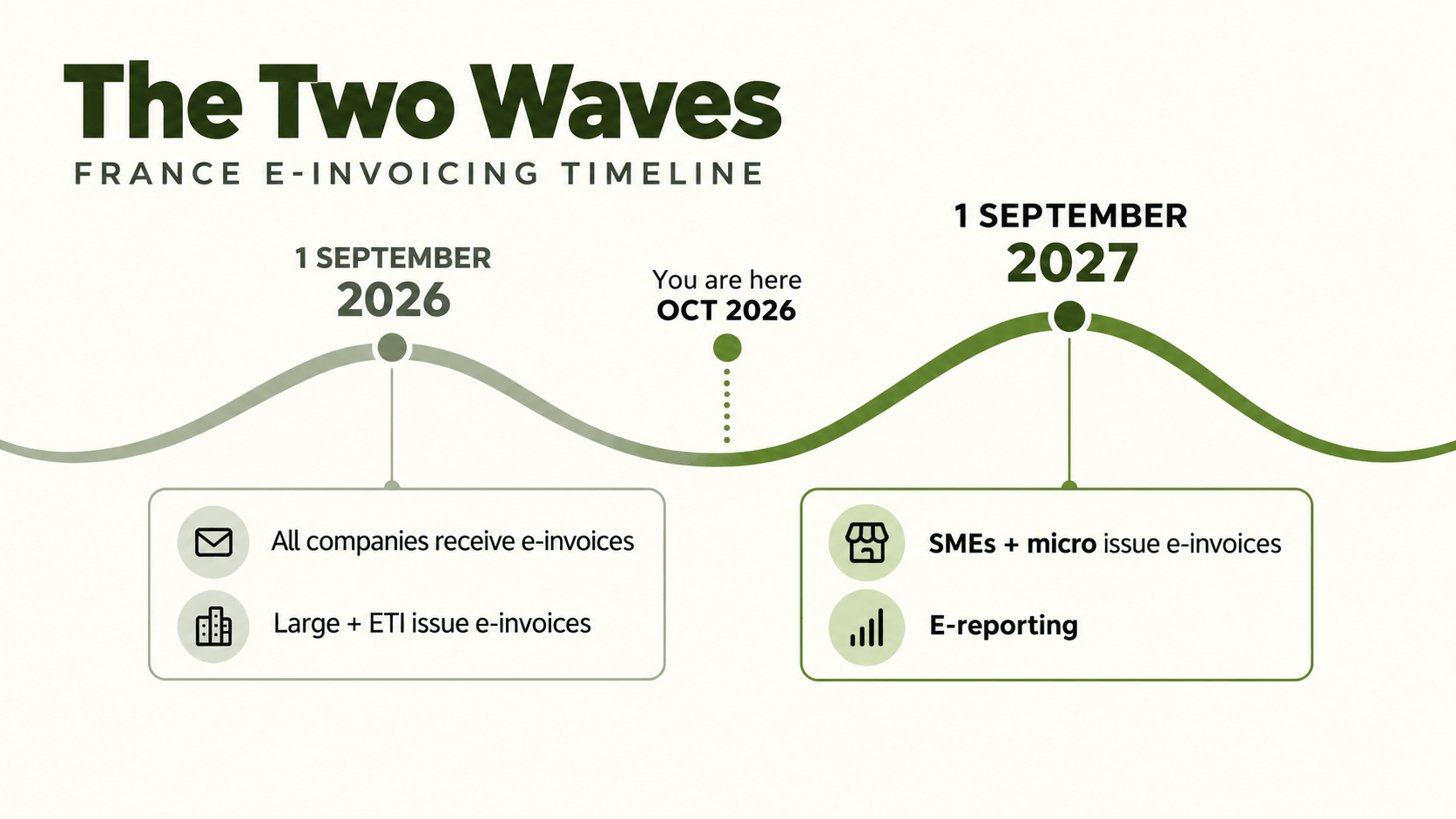
From 1 September 2026, every French company subject to VAT, whatever its size, must be able to receive electronic invoices through an approved platform. Large companies and mid-caps (ETIs) took on the issuing obligation on the same date.
Who the 2027 wave covers
SMEs and micro-companies must issue electronic invoices from 1 September 2027. The same date applies to their e-reporting of transaction and payment data. That is the core SAP Business One customer base.
The model: PA, directory, e-reporting
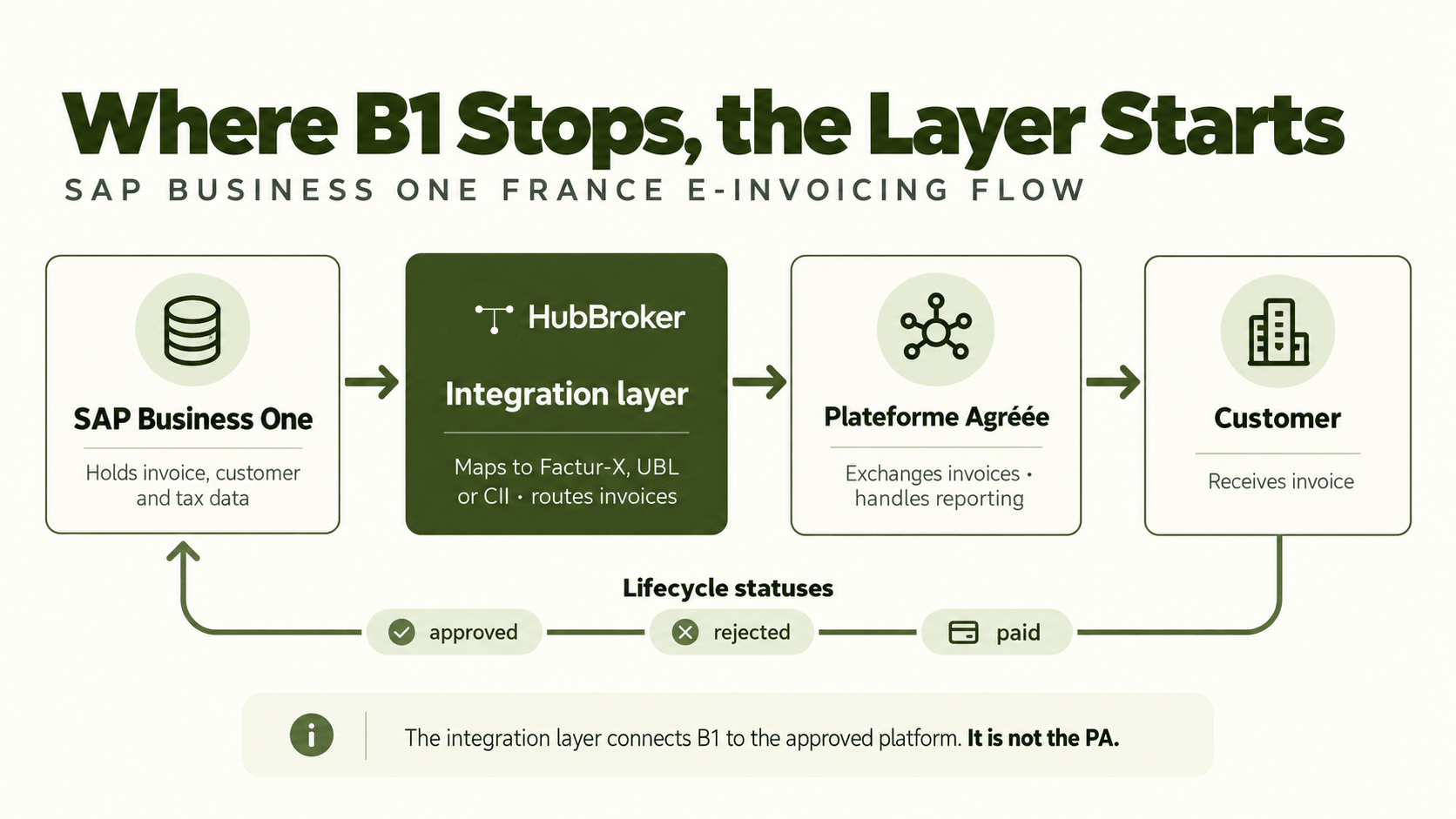
Invoices are exchanged only through approved platforms. The public portal is limited to maintaining the company directory and passing data to the tax authority. The ministry reported that 130 platforms were approved as of July 2026. B1 does not talk to any of them on its own. Something has to sit in between.
Why SAP Business One Is Exposed
Localisation is not connectivity
The French localisation in B1 handles local accounting and tax reporting. Producing a compliant structured invoice, sending it to a Plateforme Agréée and processing lifecycle statuses back is a separate job. Check exactly what your clients’ B1 version and partner add-ons cover. Do not assume either way.
The workflows that break
Crystal layouts emailed as PDF, add-ons that print rather than export, and customisations built around paper all stop being compliant outputs for in-scope B2B transactions.
Six Things to Fix Before September 2027
1. Master data
Customer SIREN/SIRET numbers, VAT IDs and delivery addresses need to be clean and stored in consistent fields. New mandatory invoice mentions apply to SMEs and micro-companies from 1 September 2027. Map each one to a B1 field before go-live.
2. Output formats
Your client needs to decide which structured format the PA will accept from B1, whether Factur-X, UBL or CII. The answer drives the mapping work.
3. Connecting B1 to a Plateforme Agréée
Choose the platform first, then design the connection. An integration layer can transform B1 documents and deliver them to the PA without heavy changes inside B1. See how it connects to SAP Business One.
4. Inbound invoices without rekeying
Receiving is already mandatory. If supplier invoices still land as files that someone types into B1, that is now a cost problem as well as an error risk. Structured inbound flows, plus PDF to XML conversion for anything outside the mandate, close the gap.
5. Lifecycle statuses
Rejected, approved and paid statuses come back from the platform. Decide where they live in B1 and who acts on a rejection.
6. E-reporting
B2C sales, cross-border transactions and payment data fall under e-reporting rather than e-invoicing. Scope these flows separately so they are not discovered in August.
Integration Layer vs. Upgrade or Replace
You have three options: customise B1 deeply, switch ERP, or add an integration layer between B1 and the PA. For most SME clients, the third keeps B1 untouched, isolates format changes from the ERP and reuses one setup across several clients. The same pattern applies across mandates. Our post on SAP Business One and German e-invoicing covers the XRechnung equivalent.
A Practical Readiness Timeline
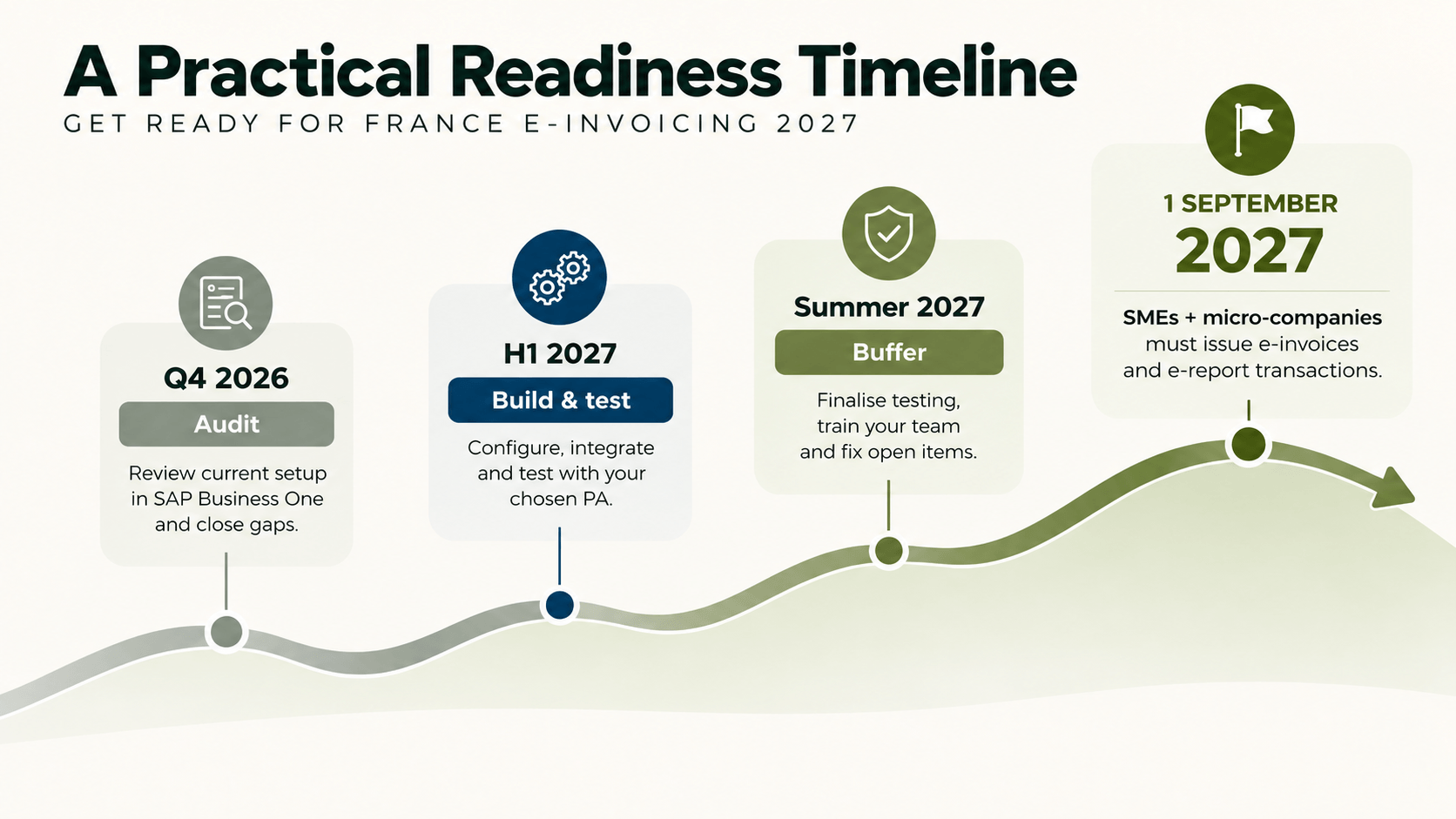
Q4 2026: Audit. Review master data, outputs, add-ons and PA choice.
H1 2027: Build and test. Set up mapping and the PA connection, and test both successful and rejected scenarios.
Summer 2027: Buffer. Run in production with real customers before the deadline.
The tax administration has promised a tolerant approach for good-faith businesses during the initial phase. That is a reason not to panic, but it is not a plan.
FAQ
Does SAP Business One natively support French e-invoicing?
B1 has French localisation. Exchanging invoices through a Plateforme Agréée needs an approved platform plus a connection. Confirm the current coverage with SAP and your add-on vendors.
Do my B1 clients need a Plateforme Agréée?
Yes. Invoices are exchanged only through approved platforms, so every in-scope company needs one, for receiving as well as issuing.
Is Factur-X enough to comply?
It is one accepted format. The PA your client chooses decides which formats and profiles it accepts from B1.
What happens if an SME misses September 2027?
Penalties exist. Early enforcement is lenient for businesses that show good faith, but invoices that don’t comply still create friction with customers.
Can B1 handle e-reporting?
The data is in B1. The reporting runs through the platform. Map B2C and cross-border flows as a separate workstream.
If your firm supports several French B1 clients, it is worth comparing notes before Q1. Explore our partner programme or book a short demo to see the B1 flow end to end.
