
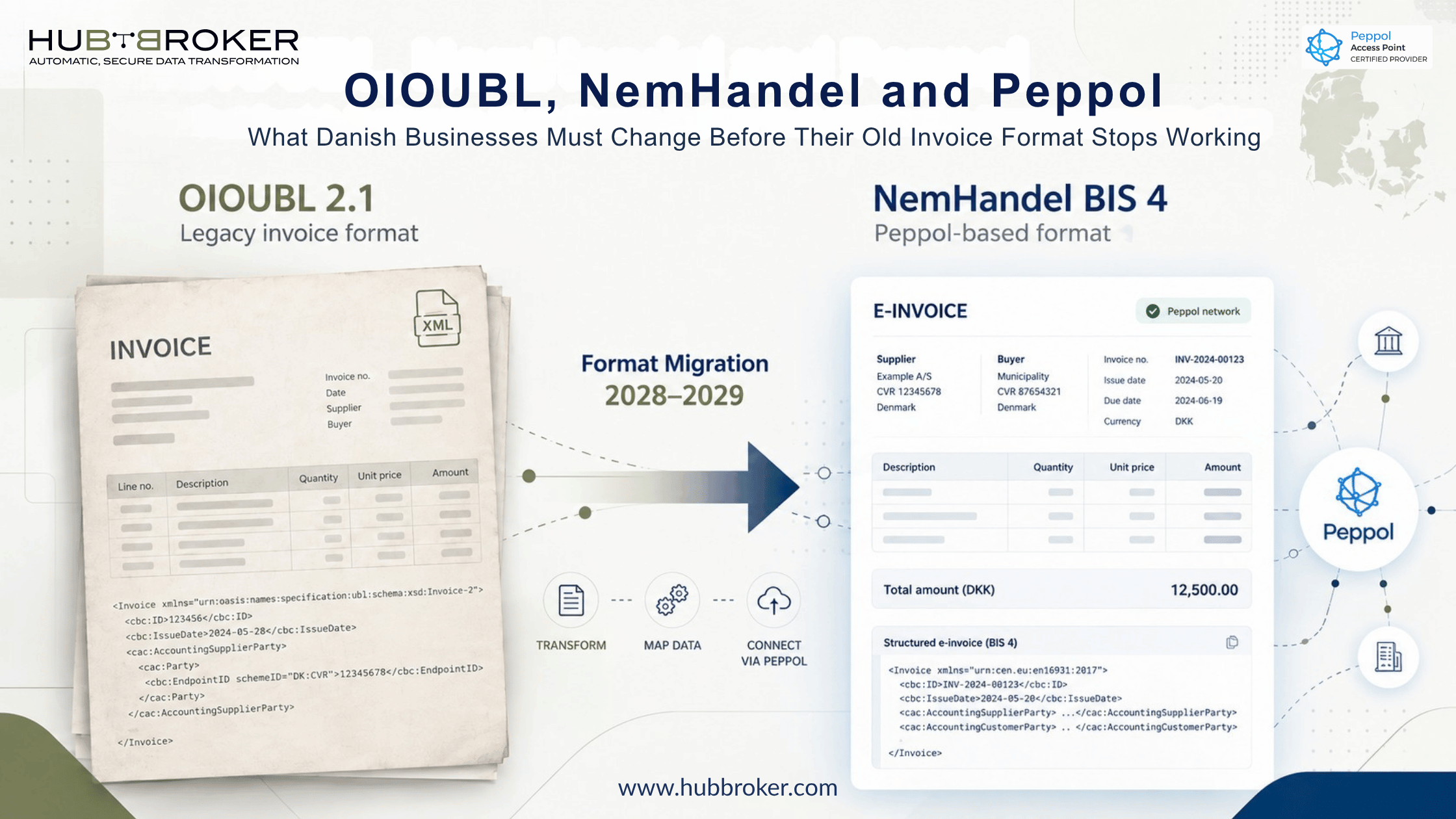
OIOUBL, NemHandel and Peppol: What Danish Businesses Must Change Before Their Old Invoice Format Stops Working
Why Danish e-invoicing is changing now
An invoice that a public buyer cannot process is an invoice that does not get paid on time. For almost twenty years, Danish suppliers avoided that problem by sending OIOUBL over NemHandel. That is now changing. The OIOUBL Peppol Denmark transition will retire the national format and move the whole market to a single Peppol-based standard.
Denmark made e-invoicing to the public sector mandatory in 2005, one of the first countries to do so. Now the Danish Business Authority has set out a plan to phase out OIOUBL by mid-2029. Businesses that plan now can make the change once. Those that wait risk rejected invoices, delayed payments from public buyers and a rushed migration in 2028.
OIOUBL, NemHandel and Peppol in plain terms
What OIOUBL is and why Denmark built its own format
OIOUBL is Denmark's national e-invoice format, based on UBL 2.1. It was introduced together with NemHandel to support mandatory electronic invoicing to public authorities. It predates the European standard EN 16931, so it carries Danish-specific structures that Peppol BIS does not, including support for payment automation.
NemHandel: Denmark's national delivery network
NemHandel is the public infrastructure for exchanging business documents between companies and public authorities, run by Erhvervsstyrelsen. Suppliers to the public sector must invoice through it. The NemHandel registry also acts as a Peppol Service Metadata Publisher (SMP), which is why the two networks can work together.

Where Peppol fits: network, format and Access Points
Peppol is two things: a pan-European delivery network, and a set of document specifications such as Peppol BIS Billing 3.0. Businesses connect to the network through a Peppol Access Point. Denmark was a founding participant in Peppol, and the network built partly on NemHandel experience.
Today the two ecosystems run side by side: OIOUBL for domestic needs, Peppol BIS Billing 3.0 for cross-border exchange. Under bogføringsloven, digital bookkeeping systems in scope must support both. Read more about Peppol e-invoicing with your ERP.
What is changing in Denmark
The move from OIOUBL 2.1 toward OIOUBL 3.0 and Peppol BIS
OIOUBL 3.0 was planned as the next version of the Danish format, aligned more closely with EN 16931. It will not arrive. Erhvervsstyrelsen cancelled OIOUBL 3.0 in early 2026, after service providers raised concerns about maintaining two parallel standards.
Instead, Denmark is going straight to Peppol. In March 2026, Erhvervsstyrelsen published its document strategy for e-invoicing in NemHandel for consultation. It replaces OIOUBL with NemHandel BIS 4: the Peppol BIS 4 specification plus mandatory Danish extensions.
NemHandel's shift onto Peppol-based delivery
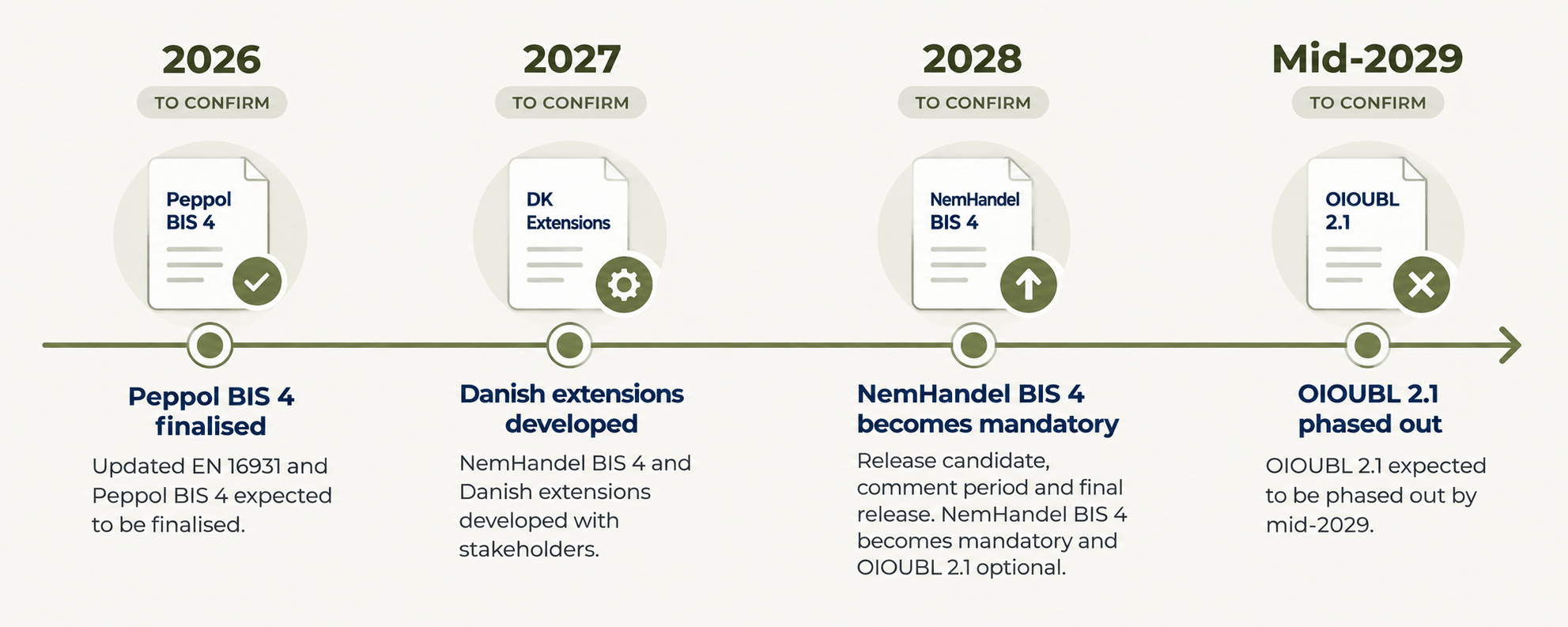
The indicative timeline in the strategy:
2026: Updated EN 16931 and Peppol BIS 4 finalised.
2027: NemHandel BIS 4 and Danish extensions developed with stakeholders.
2028: Release candidate, comment period and final release. NemHandel BIS 4 becomes mandatory and OIOUBL 2.1 optional.
By mid-2029: OIOUBL 2.1 phased out.
NemHandel remains the national infrastructure. What changes is the document format moving across it.
What this means for public-sector (B2G) suppliers
Until the migration is complete, OIOUBL 2.1 and Peppol BIS 3.0 both remain valid for invoices to public authorities. Once it is complete, the bogføringsloven requirement to support OIOUBL is expected to be replaced by a requirement to support NemHandel BIS only. See our Denmark e-invoicing overview for the current rules.
How the rest of the Nordics compare
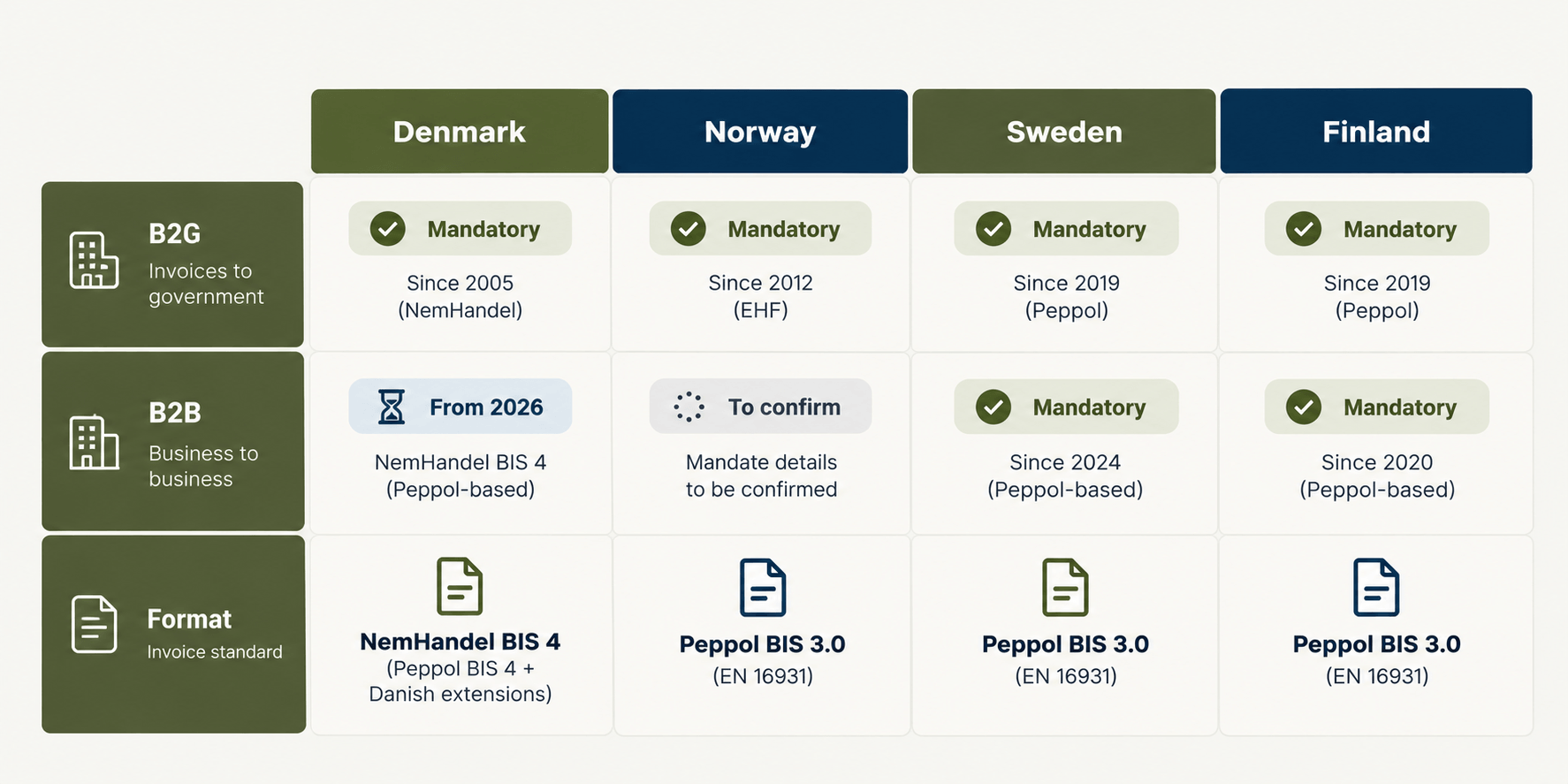
Norway: EHF and the planned B2B requirements
Norway has required e-invoicing to the public sector since 2019, using EHF, which is aligned with Peppol BIS Billing 3.0. The government has moved to make B2B e-invoicing mandatory, with receiving obligations to follow later. See e-invoicing in Norway.
Sweden and Finland: Peppol adoption in public procurement
Sweden has no general B2B mandate, but public-sector suppliers have been required to e-invoice since 2019, and Peppol is widely used. Finland has no general B2B mandate either. Businesses there can require suppliers to send e-invoices, and public-sector suppliers must already do so. Details are on our Finland page.
Why a single Nordic Peppol setup reduces cost
Denmark's move to Peppol BIS 4 brings it closer to Norway, Sweden and Finland. A business that invoices across the Nordics can run one Peppol connection with country-specific rules on top, instead of maintaining separate national channels and formats.
What your business needs to do
Check what your ERP currently sends and receives
List which customers receive OIOUBL, which receive Peppol BIS, and which still get PDF. Do the same for inbound supplier invoices. This shows how much of your invoice flow depends on OIOUBL today.
Plan for parallel formats during the transition
From 2028 there will be a period when some partners use OIOUBL 2.1 and others NemHandel BIS 4. Your setup must handle both without manual work. Ask your ERP or accounting provider for their NemHandel BIS 4 roadmap now, not in 2028.
Choose an Access Point that handles both OIOUBL and Peppol BIS
Your provider should generate OIOUBL and Peppol BIS from the same ERP data, validate each invoice before sending, and choose the format per recipient. It should also be ready to add NemHandel BIS 4 without a new project on your side. HubBroker connects systems such as e-conomic and Microsoft Dynamics 365 Business Central to NemHandel and Peppol.
How HubBroker fits in
HubBroker works as an integration layer on top of the ERP you already use, whether that is Business Central, e-conomic or Uniconta. There is no ERP replacement. HubBroker generates OIOUBL or Peppol BIS invoices from your ERP data, checks routing, and delivers inbound supplier invoices into your ERP. PDF supplier invoices are converted to structured data through Intelligent Document Processing.
When NemHandel BIS 4 arrives, the format change happens in the integration layer, not in your ERP. If you want to see how that would work with your system, book a demo.
FAQ
Is OIOUBL being replaced by Peppol? Yes. Erhvervsstyrelsen plans to replace OIOUBL with NemHandel BIS 4, based on Peppol BIS 4 with Danish extensions. The transition is expected to finish by mid-2029.
Do I still need NemHandel registration? To invoice Danish public authorities, you deliver through NemHandel or the Peppol network. Danish businesses that receive e-invoices are listed in the NemHandel registry. Foreign businesses without a Danish CVR number typically use Peppol.
What is the difference between OIOUBL 3.0 and Peppol BIS 3.0? OIOUBL 3.0 was a planned update of the Danish national format and has been cancelled. Peppol BIS Billing 3.0 is the current European Peppol invoice specification, already accepted in Denmark alongside OIOUBL 2.1.
Does the change affect B2B invoices or only B2G? Both. Denmark has no general B2B e-invoicing mandate, but digital bookkeeping systems in scope must send and receive structured e-invoices in the supported formats. When the format changes to NemHandel BIS 4, that requirement changes with it.
Can e-conomic or Business Central send Peppol invoices? Yes, through an integration. HubBroker connects both systems to NemHandel and Peppol, so invoices are sent in the format each recipient requires.
Do Norwegian customers need EHF? Public-sector buyers in Norway require EHF/Peppol BIS invoices. B2B requirements are being introduced, so check the current start date for your customers.
