
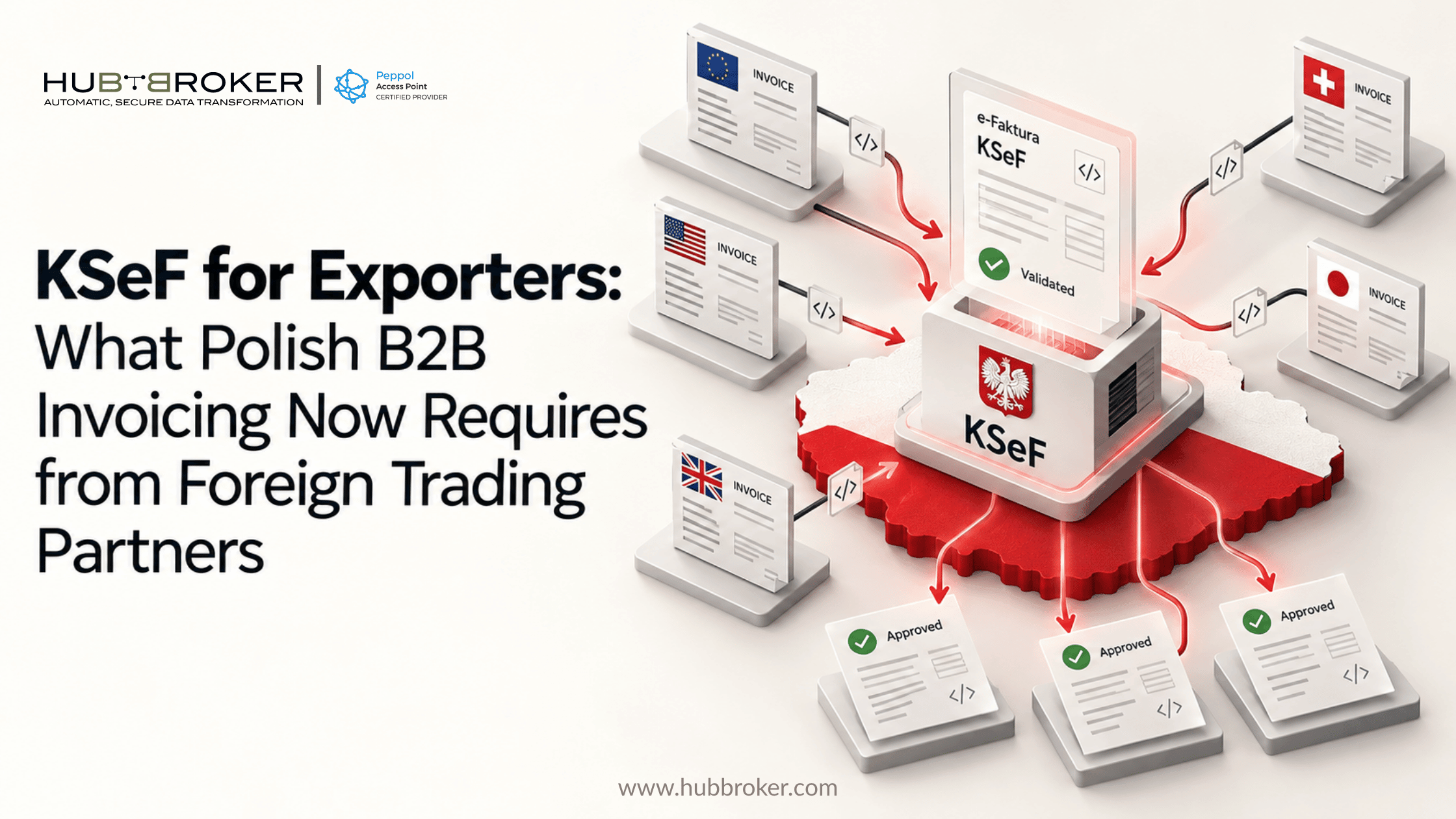
KSeF for Exporters: What Polish B2B Invoicing Now Requires from Foreign Trading Partners
Poland now runs B2B invoicing through a central government platform, and many foreign suppliers are still unsure whether it applies to them. The answer decides whether your invoice is legally valid, how your Polish customer’s AP team processes it, and how quickly you get paid.
This guide explains where KSeF rules for foreign companies apply, what Polish trading partners will expect from you, and how to adjust your invoice flows without replacing your ERP.
What KSeF Is and Why It Matters Beyond Poland
A central clearance model
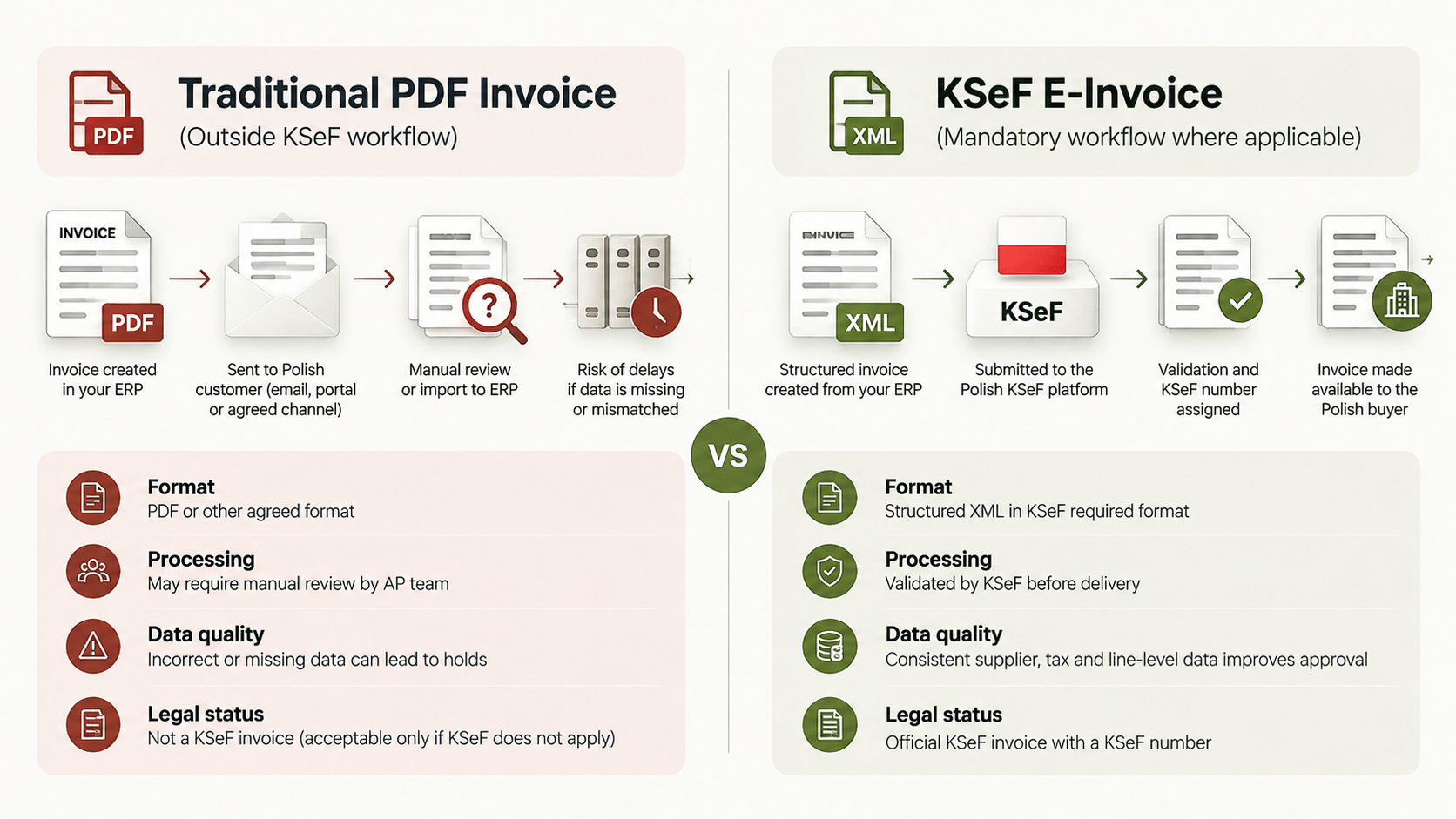
KSeF (Krajowy System e-Faktur) is Poland’s national e-invoicing system. A Polish supplier submits a structured XML invoice to the platform. The platform assigns it a KSeF number, and from then on the invoice exists inside the system. The PDF is not the legal invoice. The structured file in KSeF is.
The phased timeline
The mandate started on two dates. It became mandatory for entities with a registered seat or fixed establishment in Poland from February 1, 2026, for large enterprises with sales exceeding PLN 200 million, and from April 1, 2026, for all other entities falling under this scope. From February 1, 2026, both Polish entities and foreign entities with a fixed establishment in Poland need to be technically capable of receiving invoices through the system, regardless of when they must start issuing them.
Poland is one of several EU countries moving B2B invoicing to structured formats. See the current status by market on our e-invoicing by country page.
Does KSeF Apply to Foreign Companies?
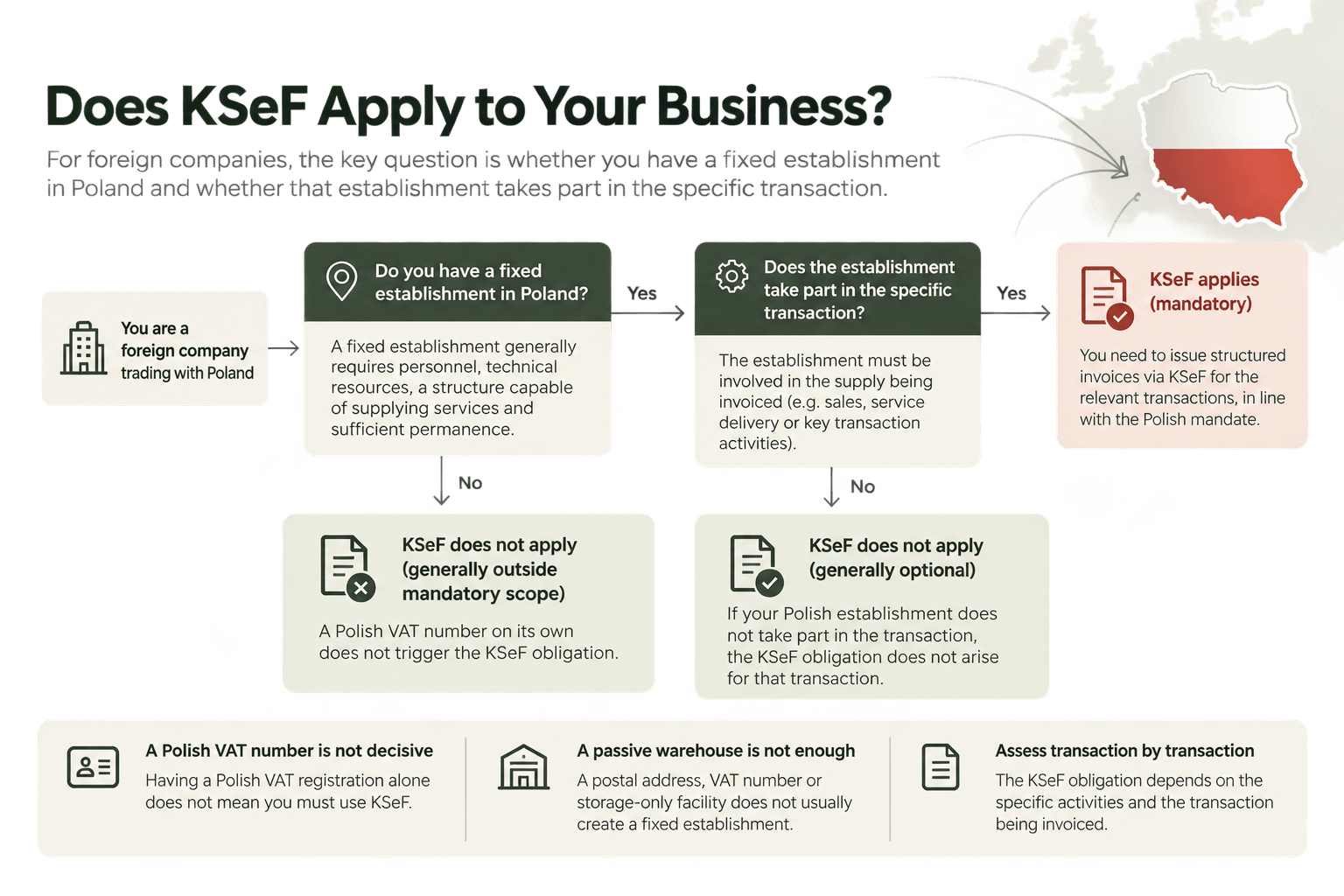
The deciding question is not whether you are registered for VAT in Poland. It is whether you have a fixed establishment there, and whether that establishment takes part in the sale.
Foreign suppliers with a fixed establishment in Poland
The Polish Ministry of Finance’s guidelines confirm that the obligation to issue structured invoices via KSeF applies to taxpayers who have their registered business seat in Poland, or who have a Fixed Establishment in Poland that participates in the supply being invoiced.
Under the guidance, an establishment counts only if three conditions exist together in Poland: personnel and technical resources, a structure capable of supplying services, and sufficient permanence. A postal address, VAT number, or passive warehouse is not enough.
Foreign suppliers without a fixed establishment
On 28 January 2026, the Ministry of Finance clarified that KSeF is not triggered simply by having a Polish VAT number. The guidance also takes a transaction-by-transaction approach. Where a foreign company has an establishment in Poland that does not participate in the transaction, the KSeF obligation does not arise and KSeF remains optional.
Some exporters use KSeF anyway. Even without a formal statutory obligation, some entities opt to issue invoices via KSeF to reduce legal risk and make cooperation with Polish buyers easier.
Foreign buyers receiving invoices from Polish suppliers
If you buy from Poland, your supplier’s invoice is created in KSeF even if you never log in. Sellers must make the structured invoice available in an agreed manner, for example on paper or as a PDF, if the buyer has no registered seat or Fixed Establishment in Poland. Agree the delivery channel in advance, so invoices don’t land in a shared inbox and get lost.
If those PDFs need to go into your ERP without manual keying, PDF to XML invoice conversion turns them into structured data.
What Your Polish Trading Partners Will Expect
Clean, matchable data
Polish AP teams now handle supplier invoices in structured form. Even if you send outside KSeF, the buyer’s process expects accurate tax IDs, legal entity names, PO references and line-level data. Invoices that don’t match the PO are put on hold.
A structured e-invoicing flow from your ERP removes most of these mismatches at the source.
No checking on their side
Polish buyers purchasing from foreign suppliers are not obligated to verify whether the foreign supplier has a Fixed Establishment in Poland. In practice, the responsibility for getting the invoice right stays with you.
Corrections under the same rules
If you issue invoices through KSeF, corrections and credit notes go through KSeF too. A PDF credit note sent outside the system does not reverse a KSeF invoice.
Operational Risks for Exporters
Payment delays
The most common cost is not a fine. It is an invoice held in your customer’s approval queue, either because it cannot be matched or because the AP team expects a KSeF number that doesn’t exist.
Getting your own status wrong
Treating a Polish VAT number as a KSeF trigger is a mistake. So is ignoring an active sales office in Warsaw. Both create risk, and the guidance advises documenting your fixed establishment assessment.
Duplicate and conflicting versions
When the same invoice exists as a KSeF record, a PDF and an email copy, the versions drift apart. Audit questions follow.
How to Prepare Without Replacing Your ERP
Step 1: Map your Polish relationships
List every Polish customer and supplier. For each one, record which entity invoices, which entity receives, and whether a Polish establishment takes part. That map shows you where KSeF applies.
Step 2: Add a structured-invoice layer
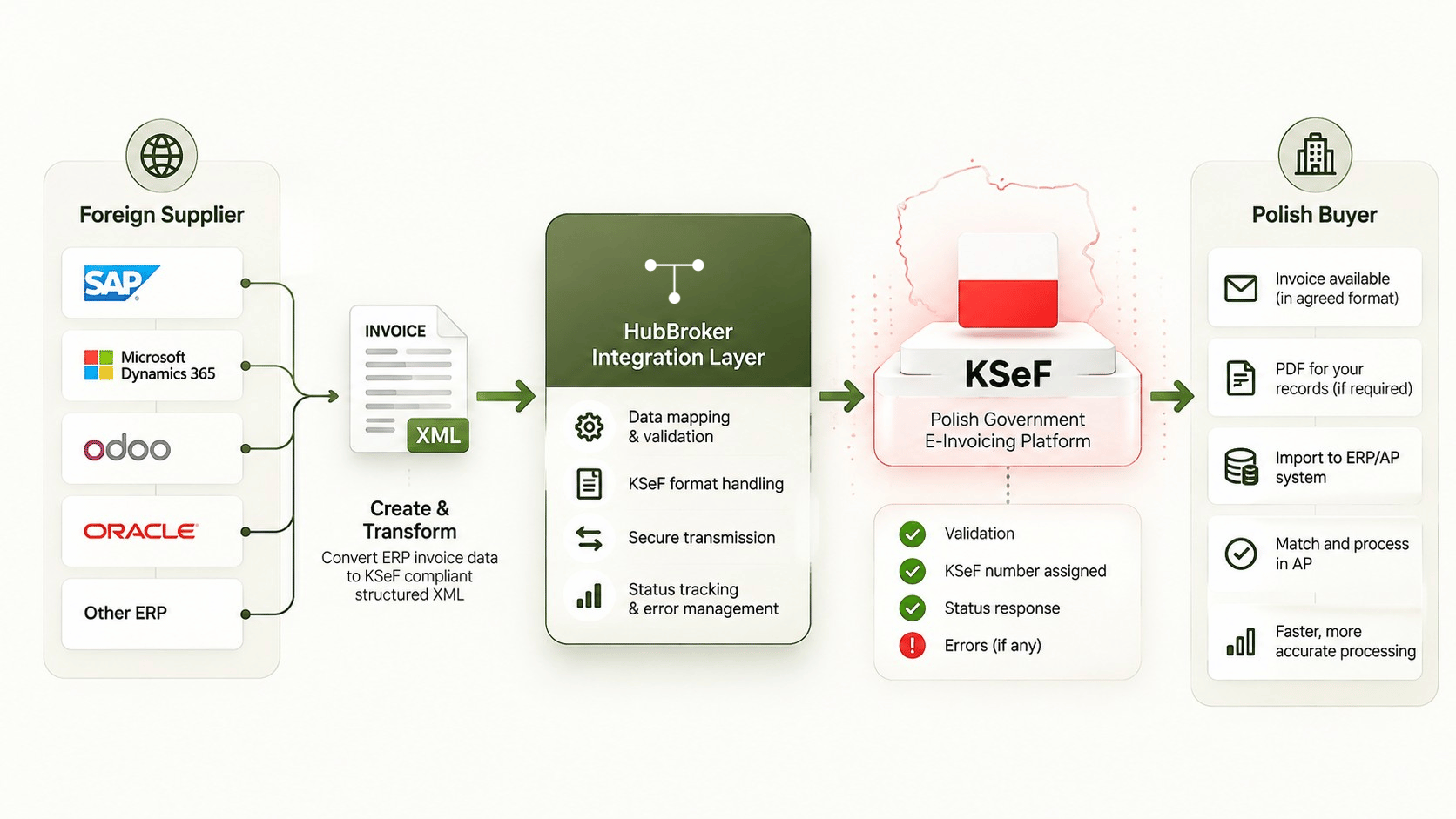
Most ERPs can’t produce KSeF-ready output without extra work. An integration layer sits between your ERP and your trading partners. It converts your invoice data into the required format, routes each invoice through the correct channel, and reports status and errors back to your team.
HubBroker works as that layer. Our ERP integration services connect systems such as Microsoft Dynamics 365 Business Central, Dynamics 365 Finance & Operations and SAP Business One to national e-invoicing systems, without changing how your team works in the ERP.
Step 3: Plan for the next mandate
Poland is one of many countries moving to structured invoicing. A single setup that also covers Peppol reduces rework when Germany, France or Belgium apply to the same customer base.
FAQ
Do all foreign companies need to use KSeF?
No. The obligation depends on having a Polish fixed establishment that takes part in the specific sale. A Polish VAT number on its own does not trigger it.
Can I keep sending PDF invoices to Polish customers?
If KSeF does not apply to you, you can invoice under normal VAT rules. Your customer may still ask for structured data to speed up processing.
I buy from Polish suppliers. Do I need KSeF access?
Not if you have no Polish establishment. Your supplier must make the invoice available to you in an agreed way.
What if my Polish establishment only stores goods?
A storage-only facility generally does not count as a participating establishment. Have the assessment documented by a tax adviser.
Can I use KSeF voluntarily?
Yes. Some foreign suppliers do, so that their invoices fit how their Polish buyers process them.
Get Your Polish Invoice Flows Reviewed
If you trade with Poland and aren’t sure how your invoices fit with KSeF, talk to us. We can review your current ERP output and show how one integration layer covers Poland and your other markets. Book a demo.
