
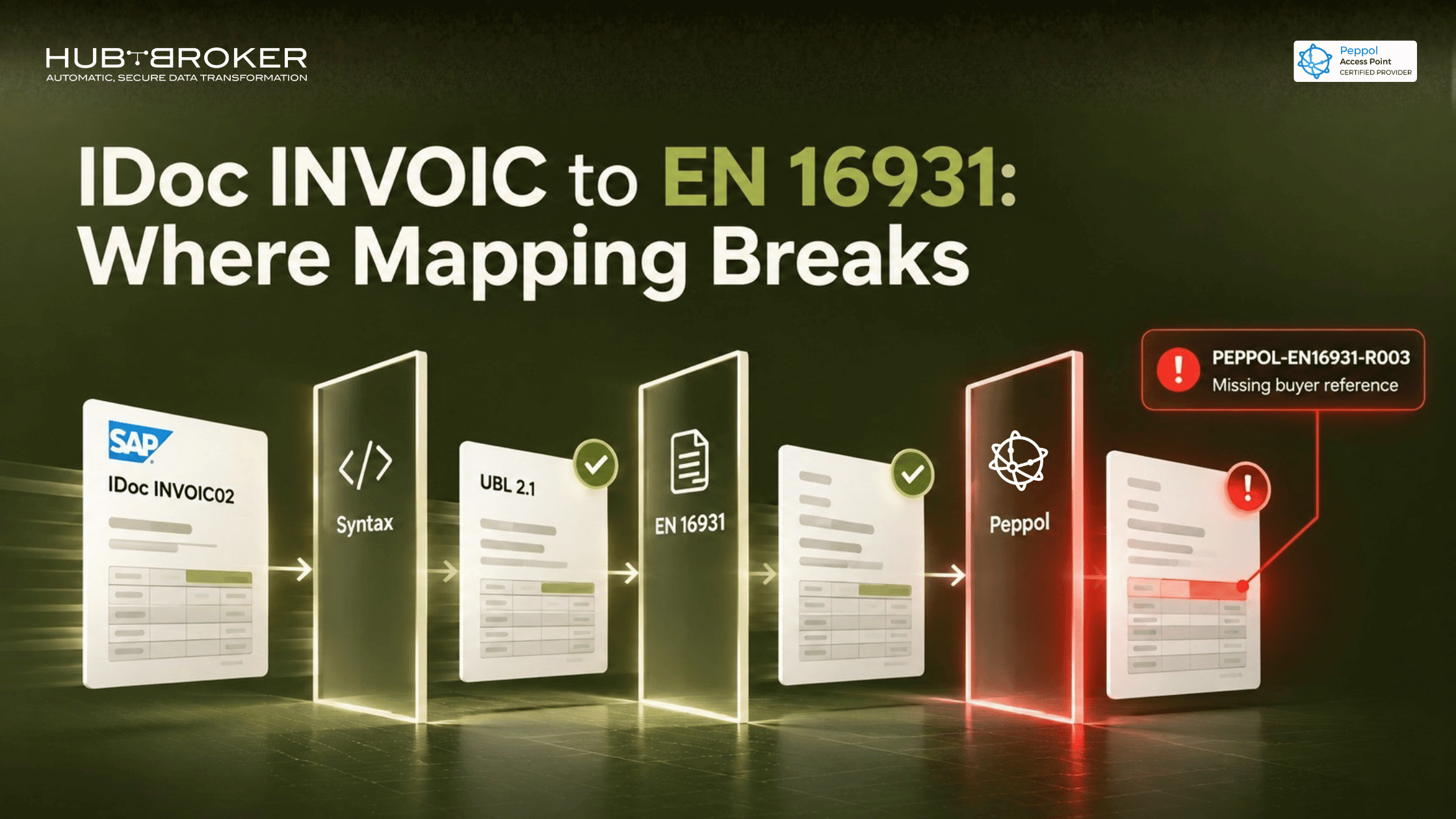
Why IDoc INVOIC to EN 16931 Mapping Breaks at Validation
Your IDoc INVOIC posts cleanly in SAP. The billing document is correct and the output status is green. Then the Access Point rejects the invoice, because validation never checks your IDoc. It checks the EN 16931 invoice you built from it.
This post covers the mapping gaps that break an IDoc INVOIC to EN 16931 conversion, and how to find them before a receiver does.
Why IDoc INVOIC and EN 16931 do not line up
An INVOIC02 IDoc is a transaction container made of control, data and status records. The data records use segments such as E1EDK01 (header), E1EDP01 (line items) and E1EDS01 (totals). EN 16931 is a semantic model. It defines business terms (BT) and groups (BG), then binds them to a syntax such as UBL.
Many EN 16931 terms have no obvious counterpart in the IDoc. Others exist, but in a different shape or at a different level. If you run SAP Business One, our SAP Business One XRechnung guide shows the same pattern in a different ERP.
Three validation layers, not one
A Peppol invoice has to pass three sets of rules:
Syntax: the UBL 2.1 schema.
EN 16931 business rules: the BR-xx rules, such as BR-CO-15.
Peppol BIS and country rules: the PEPPOL-EN16931-Rxxx rules, plus country sets such as DE-R and SE-R.
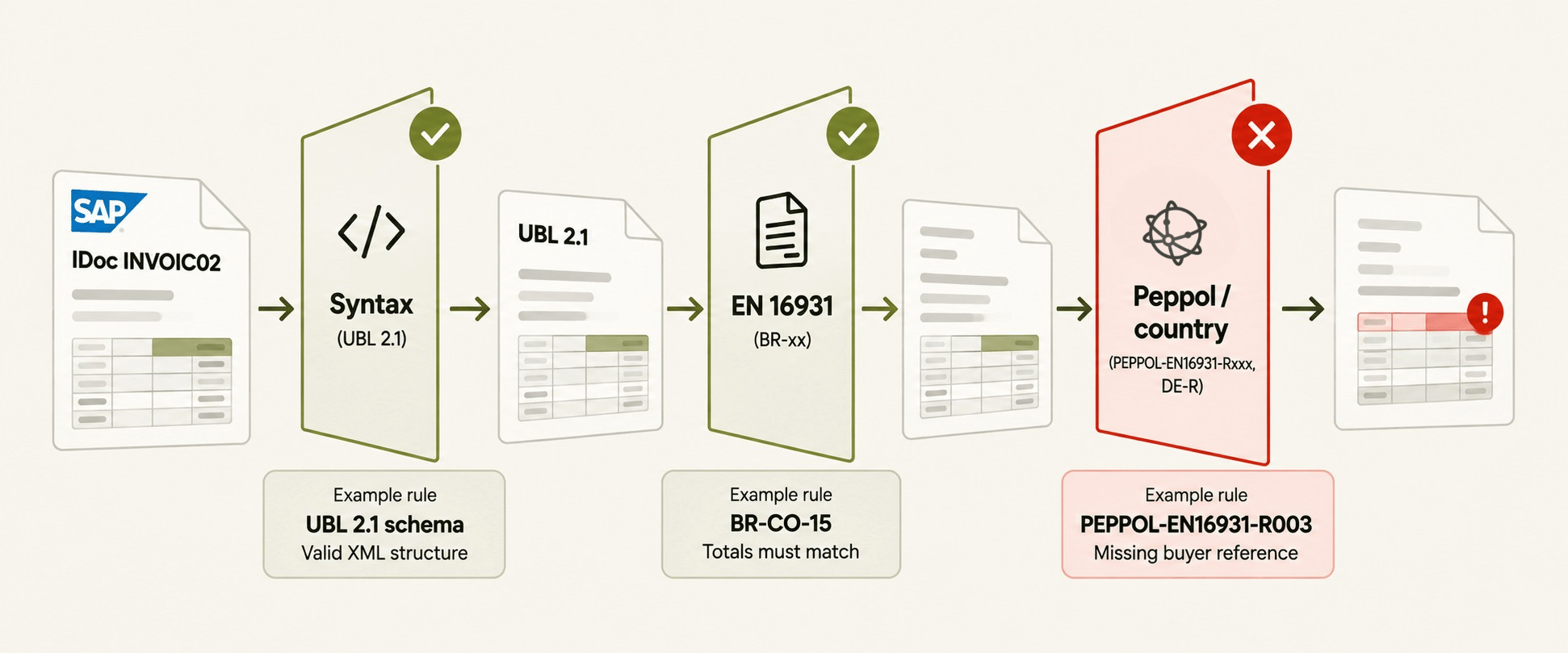
A mapping that satisfies layer one can still fail layers two and three.
The mapping gaps that break validation
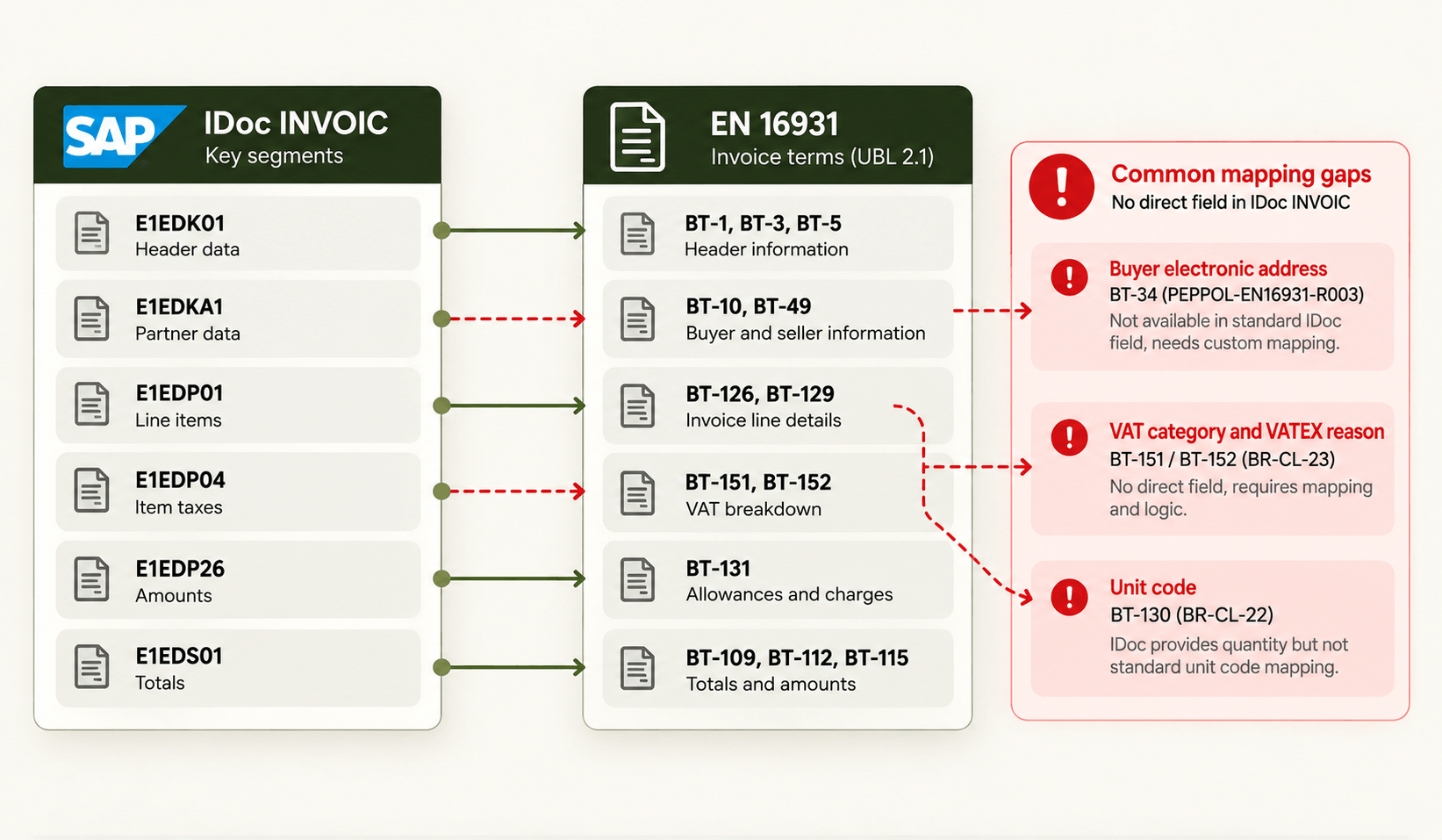
Identifiers that SAP does not hold in the billing document
Peppol BIS Billing 3.0 requires a fixed specification identifier. Rule PEPPOL-EN16931-R004 fixes the CustomizationID to urn:cen.eu:en16931:2017#compliant#urn:fdc:peppol.eu:2017:poacc:billing:3.0. Peppol also requires a buyer electronic address (R010), a seller electronic address (R020), and either a buyer reference or a purchase order reference (R003).
Ask where your landscape stores each of these:
the buyer's Peppol participant ID;
the seller's endpoint ID;
a buyer reference for public-sector buyers.
If the answer is "nowhere", the mapping has nothing to read, and the invoice fails.
VAT category and exemption logic
E1EDP04 carries the item tax code (MWSKZ) and tax amount (MWSBT). EN 16931 needs a VAT category code per breakdown. Under BR-E-10, a breakdown in the "Exempt from VAT" category must carry either a VAT exemption reason code (BT-121) or a reason text (BT-120). Peppol goes further and ties categories to VATEX codes. Category K pairs with VATEX-EU-IC, and category AE pairs with VATEX-EU-AE.
A tax code table maintained for FI posting rarely holds that information. Add the category and the exemption reason to the mapping table, not to the invoice template.
Unit of measure codes
BR-CL-23 requires unit codes to follow UN/ECE Recommendation 20 with the Rec 21 extension. The unit travels in E1EDP01-MENEE. SAP's own knowledge base documents this error for a custom unit of measure that matches none of the expected codes. Custom units are the usual cause.
Totals and rounding
The totals rules are strict:
BR-CO-13: total without VAT (BT-109) equals the sum of line net amounts, less document-level allowances, plus document-level charges.
BR-CO-14: total VAT amount (BT-110) equals the sum of the VAT category tax amounts (BT-117).
BR-CO-15: total with VAT (BT-112) equals total without VAT (BT-109) plus total VAT amount (BT-110).
BR-CO-16: amount due for payment (BT-115) equals total with VAT (BT-112) minus paid amount (BT-113).
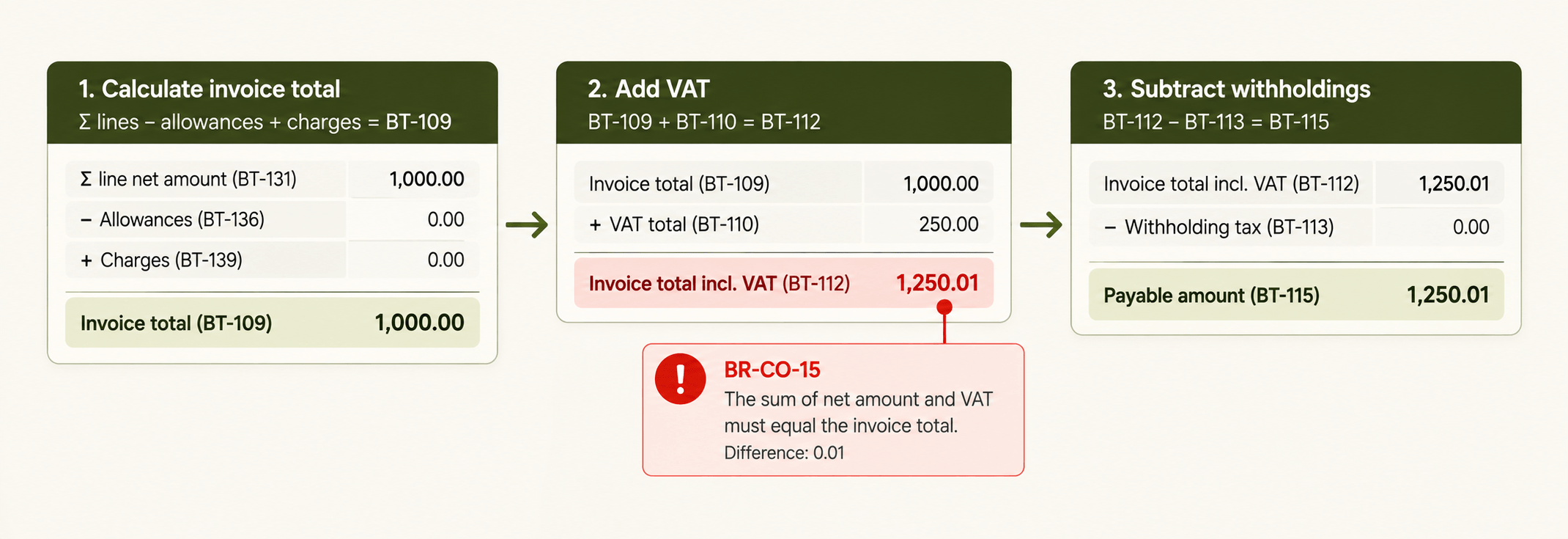
The IDoc carries line amounts (E1EDP26), item taxes (E1EDP04) and summary values (E1EDS01) as separate data. If you take lines from one segment and totals from another, a rounding difference of one cent is enough to fail BR-CO-15.
How to find the gaps before the Access Point does
Validate the target XML, not the IDoc
Run the generated UBL through the EN 16931 and Peppol BIS Schematron artefacts. A visual check of the output proves nothing. The rules are published with each Peppol release, so pin the release you test against.
A pre-validation checklist for SAP teams
Is the buyer's electronic address captured and mapped?
Does every tax code map to a VAT category, and every exempt code to a VATEX reason?
Does every unit of measure resolve to a Rec 20/21 code?
Do header totals reconcile with the sum of lines and tax breakdowns?
Do credit notes carry references that satisfy the same rules?
Fixing these in a user exit or BAdI works, but every correction then sits inside the ERP. A Peppol-based flow with built-in validation, such as HubBroker's Peppol Access Point service, checks outbound documents against BIS and country rules before delivery, so errors surface before the receiver sees them.
Where an integration layer fits
SAP stays your system of record. Mapping, format conversion, validation and transport sit in a layer above it. That layer reads the IDoc your billing process already produces and returns delivery status afterwards. No billing change is needed. HubBroker's e-invoicing solution works this way: one ERP invoice becomes the structure each receiver expects.
FAQ
Which IDoc segments feed EN 16931 mandatory fields? Typically E1EDK01 (header and currency), E1EDKA1 (partners), E1EDK02 (references), E1EDK03 (dates), E1EDP01 (lines and units), E1EDP04 (item taxes), E1EDP26 (amounts) and E1EDS01 (totals). The exact fields depend on your IDoc version and enhancements.
Can I fix these gaps in SAP configuration alone? Partly. Tax codes, units and partner data can be corrected at source. Identifiers such as the CustomizationID, and the VAT category and VATEX logic, usually belong in the mapping.
Is EN 16931 compliance the same as Peppol BIS Billing 3.0 compliance? No. Peppol BIS Billing 3.0 is a CIUS of EN 16931 and adds hundreds of business rules on top of the standard. An EN 16931-valid invoice can still fail Peppol rules.
Which validation errors show up most often? In the sources reviewed, recurring examples are BR-CL-23 (unit code), BR-CO-15 (totals), PEPPOL-EN16931-R003 (buyer or order reference) and R010 (buyer address).
Do I need a separate mapping per country? Core EN 16931 mapping is shared. Country rule sets add checks per supplier country, so test each market you invoice into.
Next step
If you want a second pair of eyes on your IDoc to EN 16931 mapping, send a synthetic or anonymised sample and we will walk through it with you. Get in touch with the HubBroker team.
