
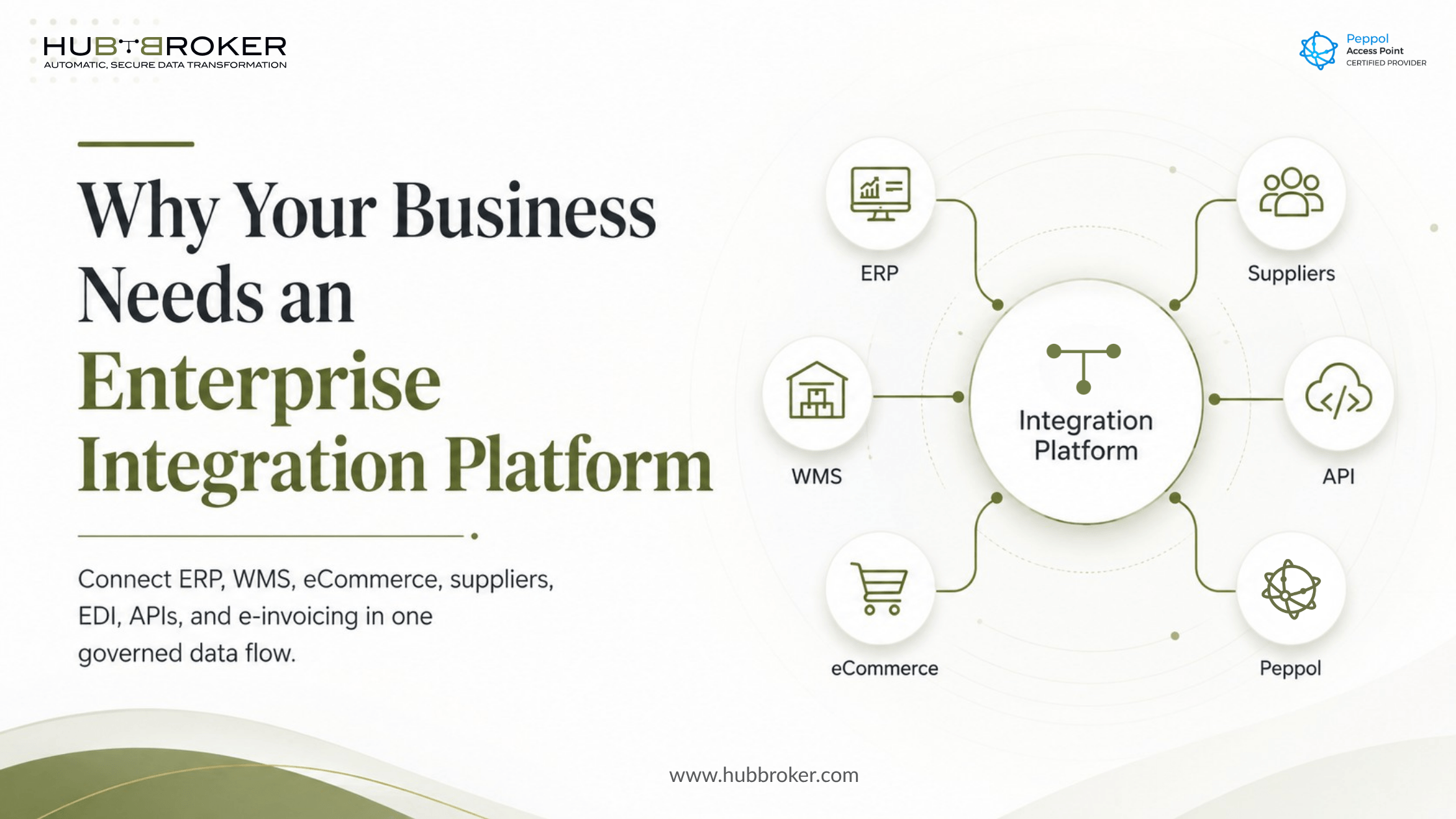
Why Your Business Needs an Enterprise Integration Platform
Businesses lose up to 20–30% of their annual revenue to inefficiencies caused by disconnected systems, manual rekeying, and broken data flows. When your ERP, warehouse system, eCommerce store, and supplier network can't talk to each other, errors pile up and decisions slow down. An enterprise integration platform fixes this by connecting your systems so data moves automatically, accurately, and in real time.
This post breaks down what an enterprise integration platform actually does, the pain points pushing companies to adopt one, the measurable benefits it delivers, and how to choose the right solution. If you're an IT decision maker, supply chain manager, or CTO trying to untangle a growing web of systems, here's what you need to know.
What Is an Enterprise Integration Platform?
An enterprise integration platform is middleware that connects your disparate business systems ERPs, warehouse management systems (WMS), eCommerce platforms, and supplier networks so data flows between them automatically. Instead of building and maintaining dozens of separate connections, you route everything through one central hub.
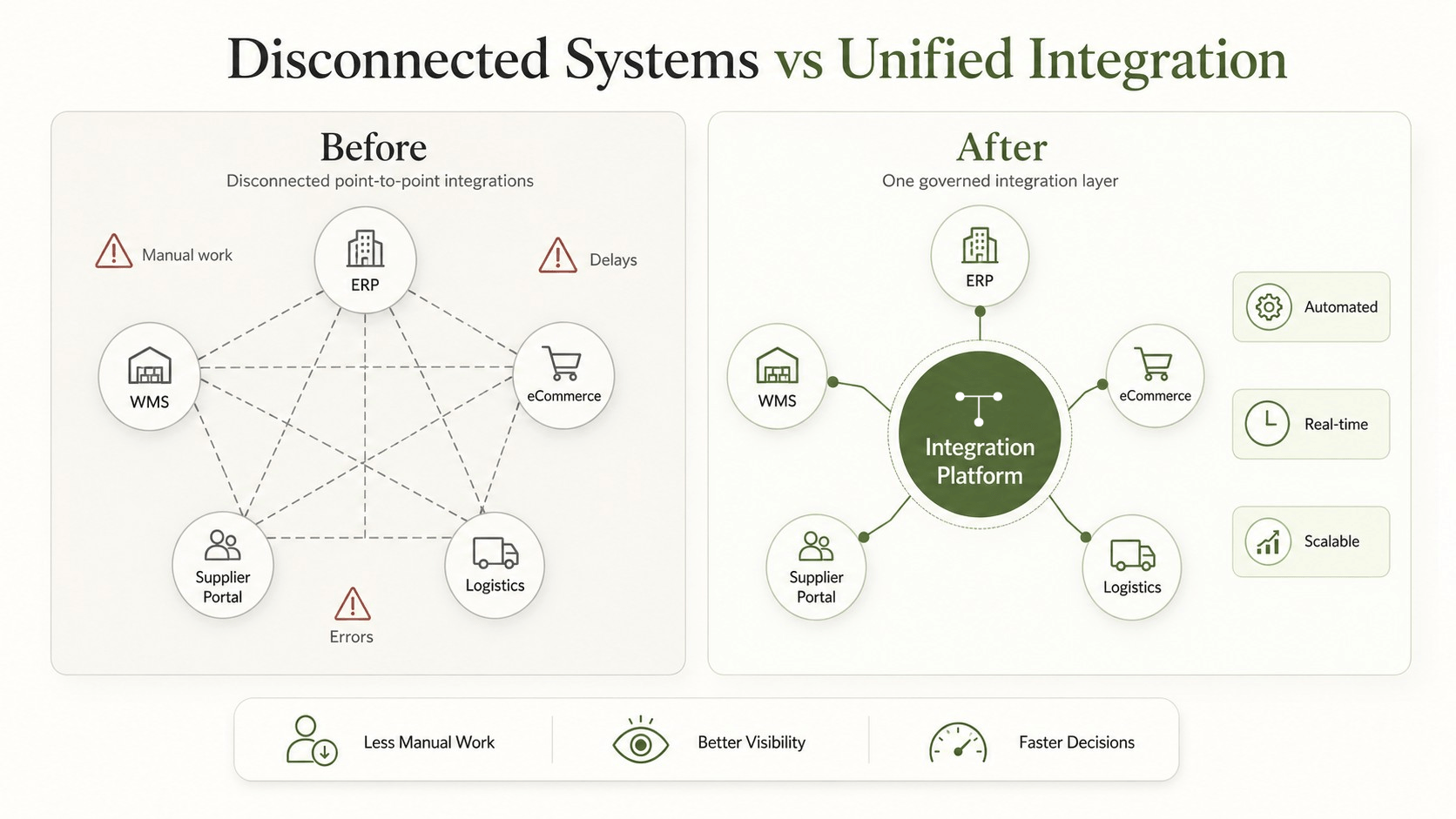
That distinction matters. With point-to-point integrations, each system connects directly to every other system. Add a new partner or platform, and you're building yet another custom link. At scale, this becomes a fragile, unmanageable spider web one change can break several connections at once. An integration platform replaces that chaos with a single, governed layer that's far easier to monitor and expand.
A strong platform supports the formats and protocols your partners actually use, including:
EDI for standardized B2B transactions
API connections for real-time data exchange
XML and JSON for flexible data formatting
Peppol for compliant e-invoicing across Europe
HubBroker is one example of a platform that brings EDI integration, ERP connectivity, and AI-powered document processing together under one roof so you're not stitching together multiple vendors to cover the basics.
The Pain Points Driving Demand
Most companies don't go looking for an integration platform out of curiosity. They reach a breaking point. Here are the frustrations we hear most often from IT and operations leaders.
Data silos: Teams work from separate, unconnected systems with no single source of truth. Sales sees one number, finance sees another, and nobody trusts the data.
Legacy system compatibility: Older ERPs weren't built to communicate natively with modern cloud platforms, marketplaces, or supplier portals leaving critical systems stranded.
Manual data entry: Staff rekey orders, invoices, and dispatch notes by hand. Every keystroke is a chance for error, and every error costs time and money to fix.
Lack of visibility: Without connected systems, there's no real-time view of what's happening across the supply chain or the wider business, making fast, confident decisions nearly impossible.
If two or more of these sound familiar, the cost of doing nothing is likely higher than the cost of fixing it.
Key Benefits of Implementing an Enterprise Integration Platform
So what changes once your systems are connected? The benefits show up as concrete business outcomes, not abstract IT wins.
Improved Data Flow
Orders, invoices, and advance shipping notices (ASNs) move automatically between your partners and internal systems. Data lands where it needs to be, in the right format, without human intervention.
Reduced Manual Processes
Eliminating rekeying and paper-based workflows frees your teams from repetitive admin. That time goes back into higher-value work analysis, planning, and customer service rather than data entry.
Enhanced Visibility
Real-time data across your ERP, suppliers, and logistics partners gives you a single, reliable view of operations. Better visibility means faster, better-informed decisions.
Cost Savings
Fewer errors, less manual labor, and faster processing translate directly to the bottom line. Business process automation at this scale reduces overhead while increasing throughput.
These aren't theoretical gains. Companies like Ammega Group and Orkla House Care Europe have used HubBroker to streamline their integration workflows cutting manual effort and improving data accuracy across their operations. When you connect the right systems, the results are measurable.
How HubBroker's Enterprise Integration Platform Addresses These Needs
HubBroker isn't a new arrival to this space. With 15+ years of experience, 500+ projects delivered, and 100+ global clients across 40+ countries, the platform is built on real-world integration challenges not theory.
Here's how it maps to the needs of IT decision makers, supply chain managers, and CTOs:
ERP EDI integration: Native connections to Microsoft Dynamics 365, SAP, Uniconta, and more, so your core system exchanges data seamlessly with trading partners.
Peppol e-invoicing: Built-in compliance support across Europe, keeping you aligned with evolving e-invoicing mandates.
AI-powered document processing: Intelligent capture that turns PDFs into structured XML and automates invoice handling no manual sorting required.
API integration: Reliable connections linking your ERP with marketplaces, portals, and supplier platforms.
This breadth makes HubBroker a fit across industries, including manufacturing, retail and eCommerce, logistics, and wholesale and distribution. Whether you need a full ERP integration solution or targeted B2B system integration with a handful of partners, the platform scales to match.
How to Choose the Right Enterprise Integration Platform
Not every platform will suit your environment. Before you commit, evaluate options against these four criteria.
ERP compatibility: Does it connect natively with the systems you already run? A platform that requires heavy custom development undermines the whole point.
Format and standard support: Can it handle the EDI, API, XML, and e-invoicing formats your partners use today and the ones they'll adopt tomorrow?
Scalability: Will it grow with your partner network and transaction volumes without a rebuild every time you expand?
Support and expertise: Does the provider offer hands-on implementation help, or are you left alone with a self-serve tool? Experienced guidance often makes the difference between a smooth rollout and a stalled project.
Run each shortlisted vendor through this checklist. The right answer becomes clear quickly.
Connect Your Systems, Accelerate Your Business
Fragmented systems create friction at every turn slower decisions, costly errors, and teams buried in manual work. An enterprise integration platform removes that friction by giving your data a single, reliable path to flow. And the right platform does more than fix today's inefficiencies; it future-proofs your data infrastructure for whatever partners, formats, and volumes come next.
If you're ready to connect your ERP, supply chain, and partner network under one roof, explore HubBroker's enterprise integration services at hubbroker.com and schedule a free consultation to see it in action.
