

Belgium B2B E-invoicing Mandate: What Finance and IT Teams Must Fix Now
Belgium’s B2B e-invoicing mandate is not just a finance update. It is a process change that can quickly expose weak ERP data, manual invoice handling, and disconnected supplier workflows.
From 1 January 2026, B2B invoicing in Belgium became mandatory, with Belgium promoting the Peppol approach for B2B electronic invoice exchange. Peppol allows businesses to exchange procurement documents, including invoices, in machine-readable formats, helping reduce manual data entry and invoice handling errors.
For CFOs, finance directors, IT managers, and ERP teams, the real question is simple: can your business send, receive, validate, and process structured invoices without creating more manual work?
Belgium’s B2B E-invoicing Mandate Is Not Only a Format Change
Many companies still think of e-invoicing as “sending invoices digitally”. But under the Belgium B2B e-invoicing mandate, a simple PDF invoice is not the same as a structured e-invoice.
A PDF may look professional, but it often still needs someone to read it, copy the data, check VAT details, enter invoice lines, and match it inside the ERP system. A structured e-invoice is different. It contains data in a format that business systems can read and process automatically.
That means the invoice is not just a document. It becomes usable data.
This is where the mandate affects daily operations. Your invoicing process needs to support the right format, correct fields, clean master data, validation rules, Peppol connectivity, and ERP integration.
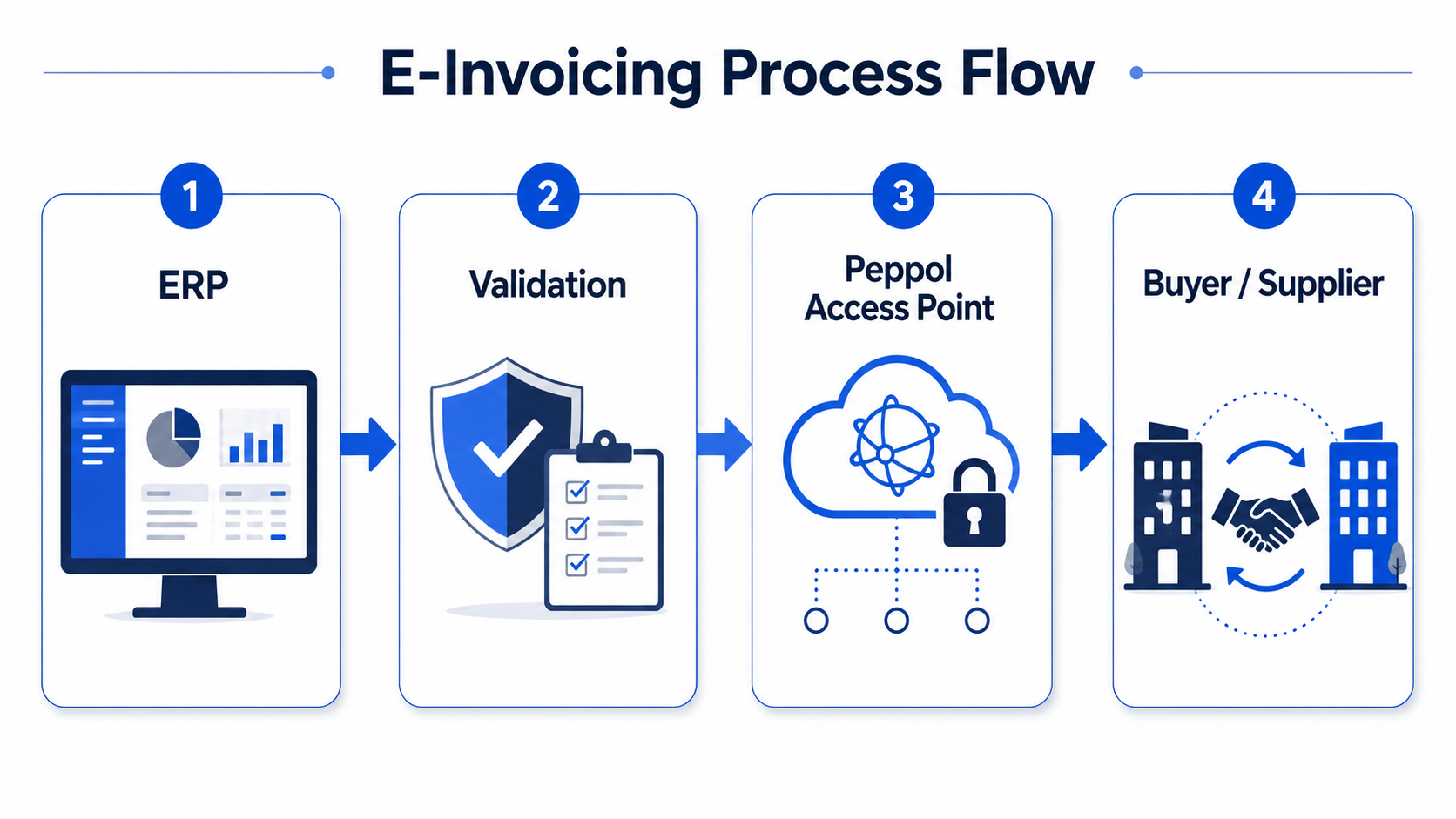
Why CFOs Should Care Before the First Invoice Fails
The mandate may sound technical, but the pain usually lands on finance.
If invoices are not created or received correctly, finance teams may face:
Delayed invoice approvals
Supplier payment issues
Customer invoice rejections
VAT or reference data errors
More manual checking
Poor visibility over invoice status
Extra workload during month-end closing
For CFOs and finance directors, Belgium e-invoicing compliance is not only about meeting a legal requirement. It is about protecting cash flow, keeping invoice cycles clean, and avoiding avoidable delays.
If your team is still depending on email inboxes, PDF attachments, Excel checks, or manual ERP entry, the mandate is a good reason to modernise the process.
Where IT and ERP Teams Need to Pay Attention
For IT and ERP teams, the main challenge is not only connecting to Peppol. The bigger challenge is making the invoice flow work properly inside existing systems.
Can your ERP create structured invoices?
Your ERP or accounting system must be able to generate invoices in the correct structured format. This may involve systems such as Microsoft Dynamics 365, Business Central, SAP, Odoo, e-conomic, Uniconta, or other finance platforms.
The invoice should include the right buyer and supplier details, VAT numbers, invoice lines, tax codes, totals, references, payment terms, and delivery information.
If the ERP data is incomplete, the invoice can fail even if the technical connection is available.
Can your business receive Peppol invoices?
Receiving is just as important as sending. Supplier invoices should not sit in a separate portal where users download and upload files manually.
A better setup is to receive structured invoices, validate the data, route them to the right workflow, and push them into the ERP for approval, matching, and posting.
Is your master data clean enough?
Poor master data is one of the biggest hidden risks.
Before going live, companies should check:
VAT numbers
Peppol IDs
Customer and supplier records
Payment terms
Tax codes
Purchase order references
GL and cost centre rules
Invoice approval routing
If these details are wrong, automation will only move the error faster.
Peppol Connectivity: The Part Many Teams Leave Too Late
Peppol is widely used for electronic document exchange and works through Access Points that route documents between senders and receivers. The network is designed to support secure document exchange in machine-readable formats.
For Belgian B2B e-invoicing, companies should not wait until the last moment to review Peppol connectivity. Choosing the right Peppol Access Point and integration setup matters because it affects how invoices are exchanged, validated, monitored, and connected with your ERP.
A portal-only setup may help with basic compliance, but it may not remove the manual work. For businesses handling higher invoice volumes or multiple trading partners, ERP-connected Peppol automation is usually the better long-term approach.
Belgium E-invoicing Readiness Checklist
Before treating your setup as ready, check these points:
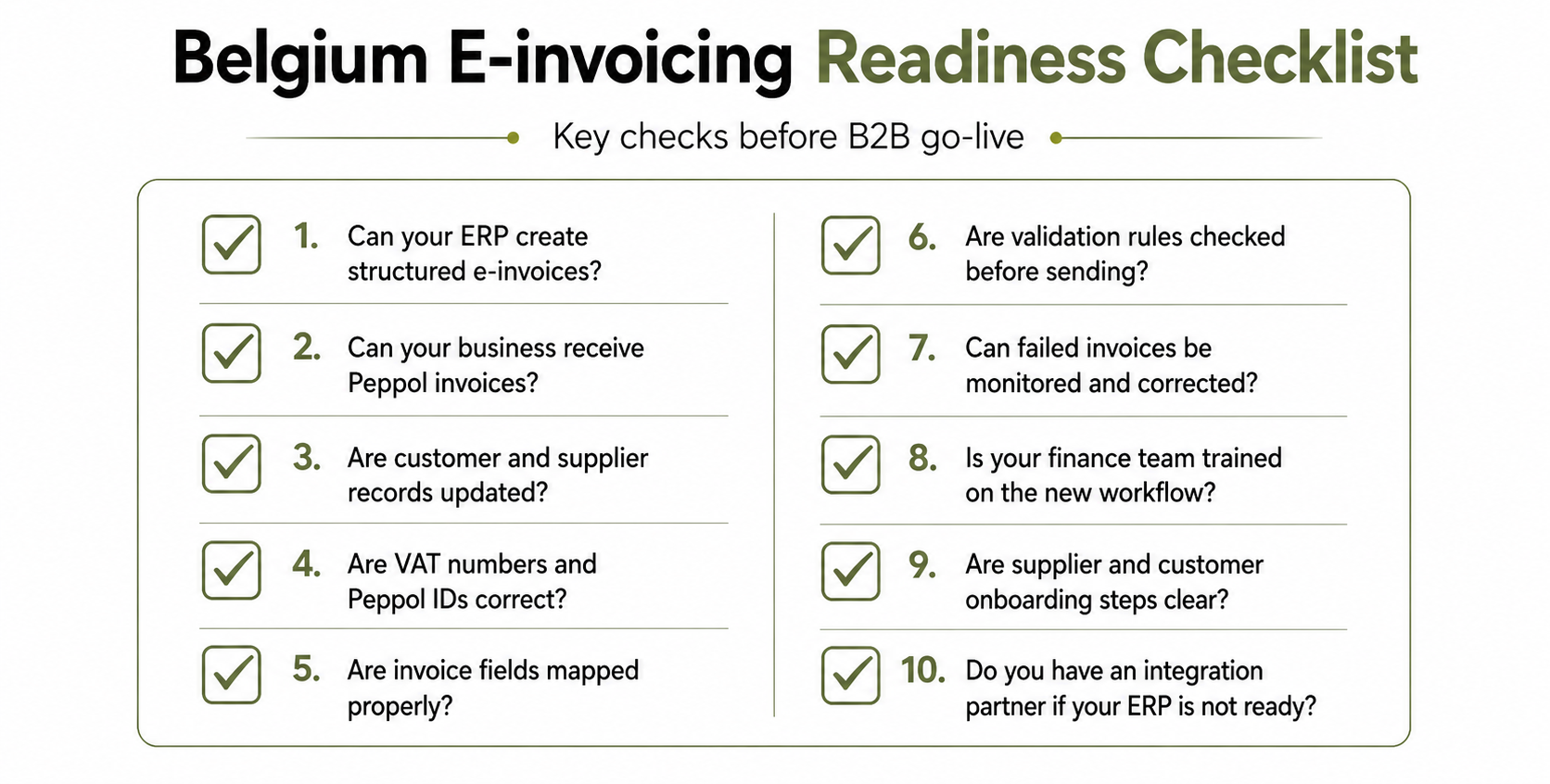
This checklist is useful because Belgium e-invoicing compliance is not one single task. It is a chain of connected steps. If one step fails, the whole invoice process can slow down.
How HubBroker Helps with Belgium B2B E-invoicing
HubBroker helps companies prepare for Belgium B2B e-invoicing by connecting Peppol, ERP systems, accounting platforms, trading partners, and document workflows.
With HubBroker, businesses can manage:
Peppol Access Point connectivity
ERP and accounting system integration
Invoice validation and mapping
PDF, XML, UBL, and EDI document conversion
Supplier and customer document flows
Monitoring dashboards for invoice status
Multi-country e-invoicing support
This is especially useful for companies working across Belgium, Denmark, Germany, France, the Netherlands, and other European markets. The EU’s VAT in the Digital Age reform also shows that structured e-invoicing and digital reporting are becoming a wider European direction, with cross-border e-invoicing requirements planned from 2030.
Instead of solving Belgium as a one-country issue, companies can use this mandate to build a scalable invoice automation setup.
Check Your Belgium E-invoicing Readiness
Compliance Is the Start, Automation Is the Real Win
Belgium’s B2B e-invoicing mandate should not be treated as a quick technical fix.
Yes, businesses need to comply. But the bigger opportunity is to reduce manual invoice work, improve data quality, avoid invoice failures, and give finance teams better control.
If your ERP, Peppol connection, invoice validation, or supplier process is not ready, now is the right time to review it.
Need help checking your Belgium B2B e-invoicing readiness? Contact HubBroker and our team can review your invoice flow, Peppol setup, ERP integration needs, and compliance gaps.
FAQ
What is the Belgium B2B e-invoicing mandate?
The Belgium B2B e-invoicing mandate requires businesses to use structured electronic invoices for B2B invoice exchange. The goal is to move away from manual, document-based invoicing towards system-readable invoice data.
Is a PDF invoice enough for Belgium B2B e-invoicing?
A normal PDF invoice is not the same as a structured e-invoice. A structured invoice contains data that systems can read, validate, and process automatically.
Do Belgian companies need Peppol?
Belgium promotes the Peppol approach for B2B e-invoicing. Many businesses use Peppol to send and receive structured invoices securely through approved Access Points.
What should companies check first?
Start with ERP readiness, Peppol connectivity, invoice validation, master data, supplier/customer records, and monitoring for failed invoices.
Can HubBroker help with Belgium e-invoicing compliance?
Yes. HubBroker can help businesses connect to Peppol, integrate ERP systems, validate invoice data, automate document flows, and manage e-invoicing across Belgium and other countries.
