
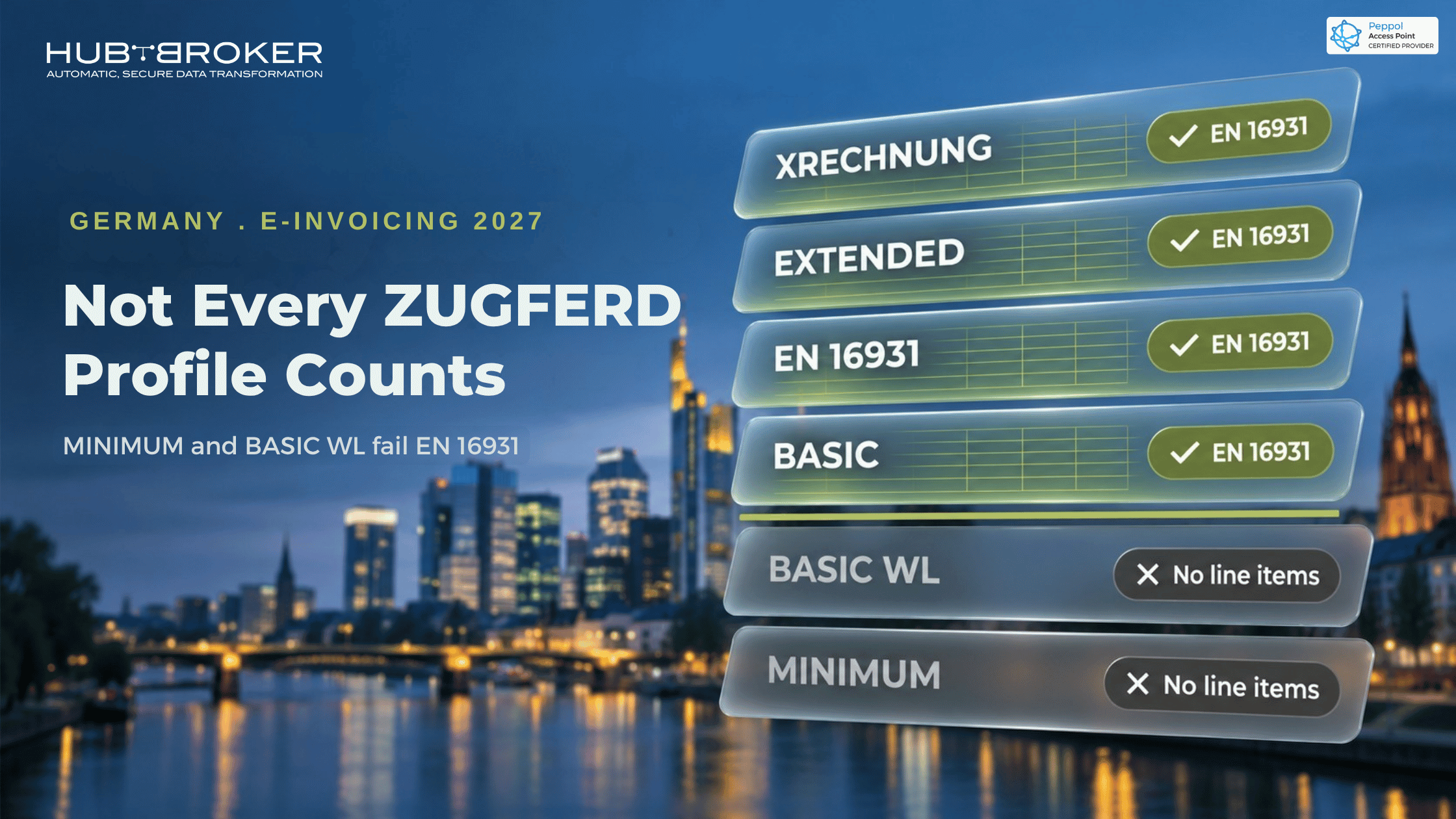
ZUGFeRD Profiles Explained: Why MINIMUM and BASIC WL Will Not Satisfy the 2027 Mandate
Your ERP may already send ZUGFeRD invoices, and your customers may already accept them. That does not mean those invoices will count from 1 January 2027.
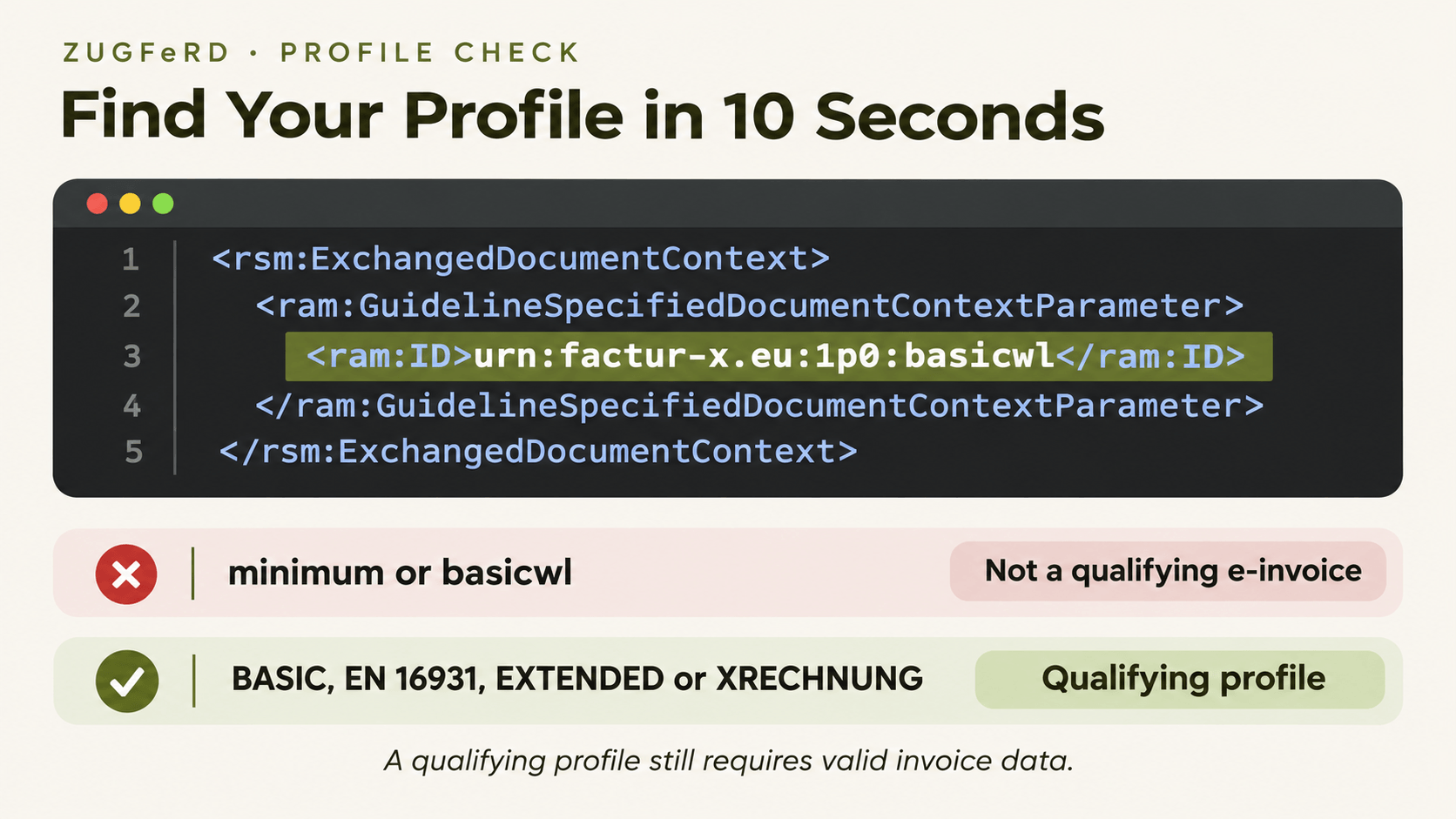
What decides it is one setting most IT teams have never looked at: the ZUGFeRD profile. Two profiles, MINIMUM and BASIC WL, do not count as an e-invoice under German VAT law. If your invoice output runs on either one, your invoices fall short of the mandate even though they look compliant.
This guide explains the ZUGFeRD profiles, where EN 16931 draws the line, and what to check in your ERP before January.
What Changes on 1 January 2027
Who must issue e-invoices
Every German business has had to receive structured e-invoices since January 2025. From 1 January 2027, companies with prior-year turnover above €800,000 must also issue them for domestic B2B transactions. Companies at or below that threshold have until the end of 2027, and from 2028 the obligation applies to everyone. Our Germany e-invoicing overview sets out the full timeline.
Why "we already send ZUGFeRD" is not an answer
During the transition period, almost any invoice format is allowed, so a weak ZUGFeRD profile has never caused a problem. Once the issuing obligation applies to you, it must be a valid e-invoice. A valid e-invoice means a structured format that complies with EN 16931 and holds all mandatory VAT data.
ZUGFeRD Profiles Explained: MINIMUM to EXTENDED
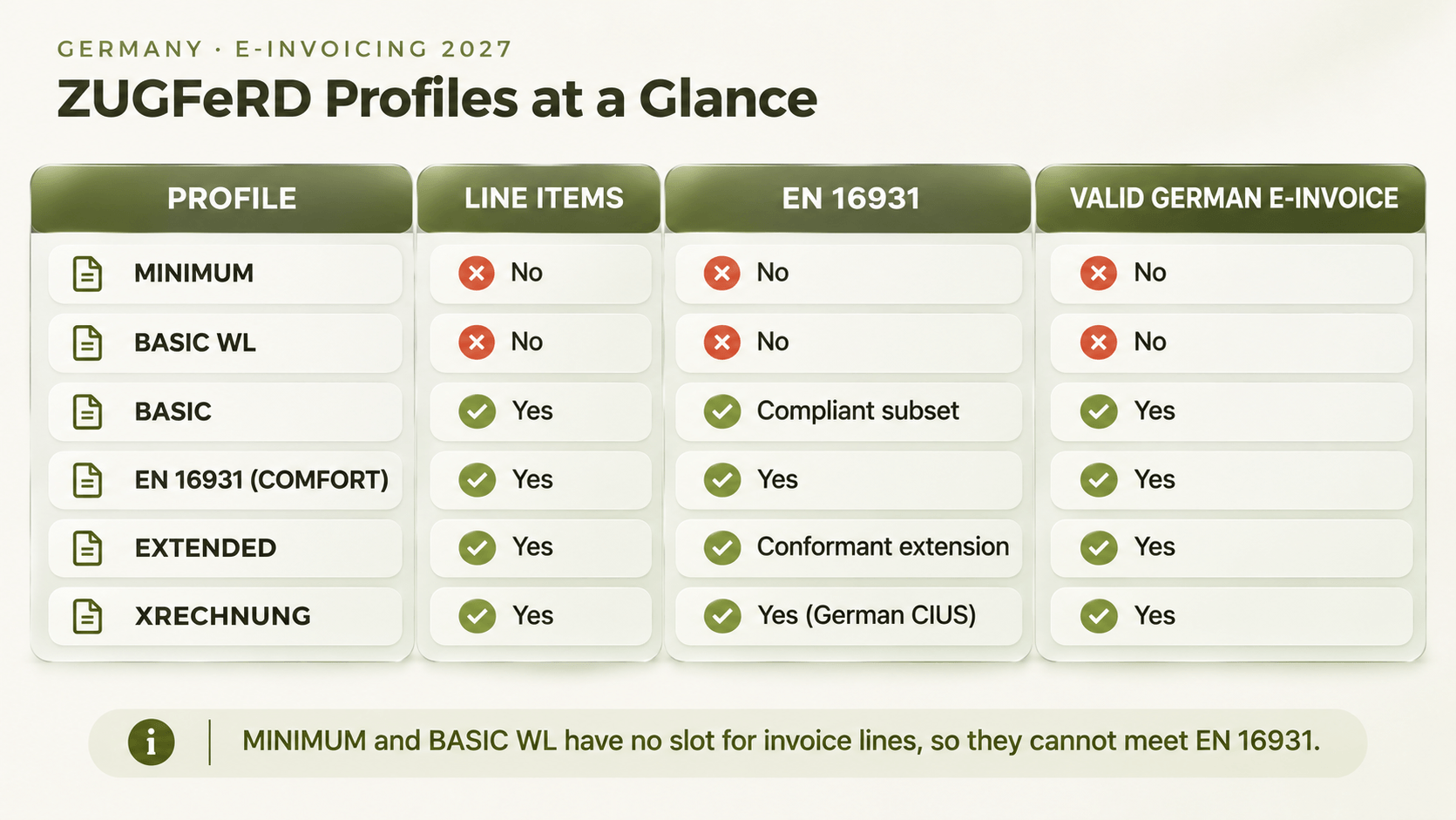
The six profiles at a glance
ZUGFeRD 2.x, which is technically identical to France's Factur-X, defines profiles with increasing levels of detail:
Where EN 16931 draws the line
EN 16931 is the European semantic standard for an electronic invoice. It requires a complete invoice dataset, including invoice lines. MINIMUM carries little more than header data and totals. BASIC WL ("without lines") adds VAT breakdowns and payment details but still has no line items.
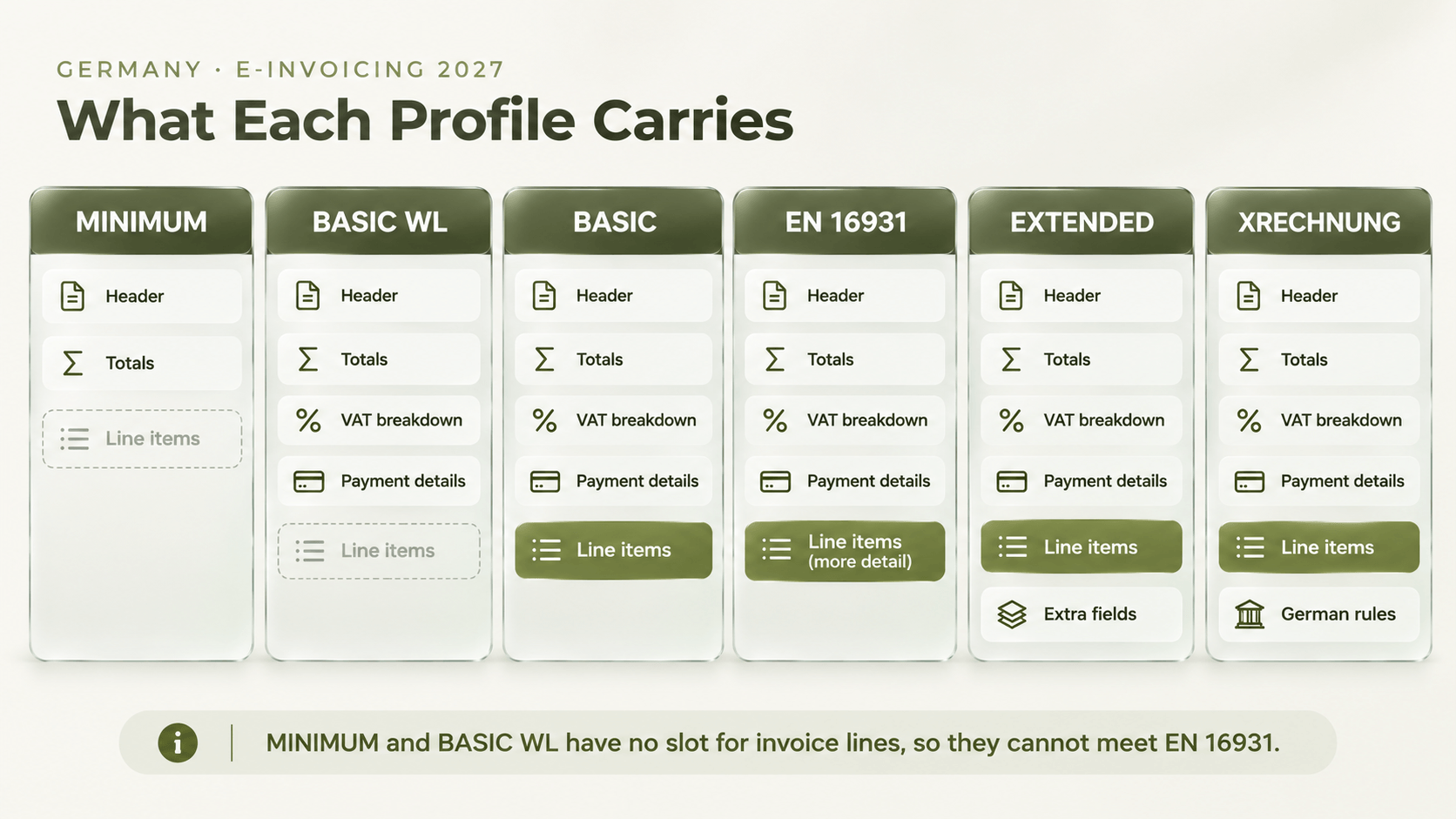
Both profiles were designed as booking aids: a structured summary attached to a PDF that remains the actual invoice. That design is exactly why they fail the German test.
Why MINIMUM and BASIC WL Fail the Mandate
No line items, no complete invoice
German VAT law requires the quantity and description of goods or services on an invoice. In a MINIMUM or BASIC WL file, that information exists only in the PDF. The structured part cannot carry it.
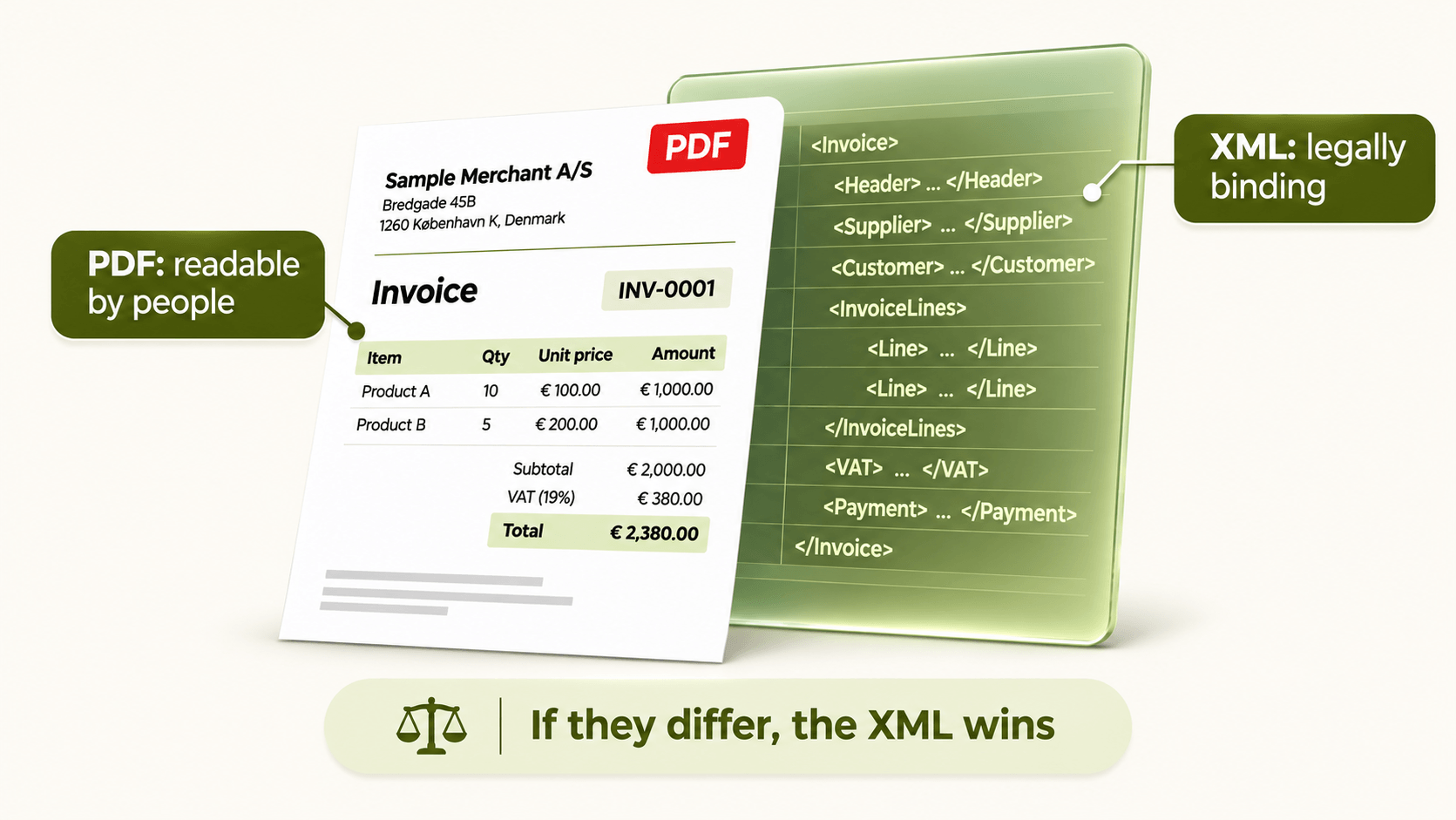
The XML is the invoice, not the PDF
The Federal Ministry of Finance (BMF) has made clear that every mandatory VAT field must be in the structured XML. If the PDF and the XML differ, the XML prevails. A good-looking PDF cannot rescue an incomplete dataset.
The consequence for your customer
An invoice that does not qualify as an e-invoice is not a correct invoice once the obligation applies. That can put your customer's input VAT deduction at risk. Expect customers' AP teams to start rejecting these invoices.
How to Check What Your ERP Actually Sends
Read the profile identifier
Open the XML embedded in one of your outgoing invoices. Look for the GuidelineID (ram: GuidelineSpecifiedDocumentContextParameter/ram: ID). If it ends in minimum or basicwl, you have a problem. The PDF's XMP metadata shows the same information as fx: ConformanceLevel.
Common sources of weak profiles include:
PDF generator defaults
Older ERP add-ons
Invoice templates built years ago for archiving rather than compliance
Validate outbound and inbound files
Run sample invoices through an EN 16931 validator, not just a visual check. Include credit notes, which are where mapping gaps tend to surface. Do the same for inbound invoices: your suppliers face the same deadline.
Our guide to SAP Business One and German e-invoicing covers the master-data gaps that most often break validation.
Choosing Between EN 16931, EXTENDED and XRechnung
For most B2B flows, the EN 16931 profile is the safe default. It is fully compliant and widely supported by receiving systems.
EXTENDED suits industries that need extra fields, such as complex logistics or multi-delivery invoices. Confirm first that your customers can process it.
XRECHNUNG is the right choice for public-sector buyers and for customers who prefer pure XML.
BASIC is legally sufficient, but it leaves less room for the references your customers' AP teams rely on.
Many companies will need more than one format, because their customers decide what they accept.
Fixing Profiles Without Replacing Your ERP
Changing a profile is rarely a single switch. Moving from BASIC WL to EN 16931 means line-level data must be mapped and validated for every invoice type.
You do not need a new ERP for this. HubBroker's e-invoicing solution sits as an integration layer above your existing system. It maps ERP invoice data to EN 16931, ZUGFeRD or XRechnung, validates each invoice before sending, and delivers it in the format each customer requires.
Not sure which profile your invoices use today? Talk to our team about a review of your current outbound invoices.
FAQ
Is a ZUGFeRD BASIC invoice a valid e-invoice in Germany? Yes. BASIC includes line items and is a compliant subset of EN 16931. Only MINIMUM and BASIC WL are excluded.
Can we keep sending MINIMUM during the transition period? Until the issuing obligation applies to you, other invoice formats remain allowed. A MINIMUM file then counts as an ordinary invoice, not an e-invoice. It stops being sufficient on the date your obligation starts.
Is Factur-X accepted in Germany? Yes, in the same EN 16931-compliant profiles. Factur-X and ZUGFeRD 2.x are technically identical.
Does every validation error make an invoice invalid? No. The BMF distinguishes format errors, which mean the file is not an e-invoice, from business-rule errors, which do not automatically invalidate it. Validate before sending to avoid both.
We are below €800,000 turnover. Do we need to act now? Your issuing obligation starts in 2028. But you must already be able to receive e-invoices, and larger customers may ask for EN 16931 invoices sooner.
