
Uniconta OIOUBL Invoices Rejected? The Mapping Fields Danish Finance Teams Get Wrong
A Uniconta OIOUBL invoice that leaves your system is not always one that arrives. When a public customer's system rejects it, the payment clock stops and someone in finance has to work out which field was wrong.
In most cases the format is not the problem. The mapping is: the link between your Uniconta master data and the OIOUBL fields the receiver checks. Fix the mapping once and the same error stops coming back every month.
There is a second source of confusion. Many guides online tell you OIOUBL 3.0 is about to become mandatory. It is not. Here is where things stand and which fields to check first.
Where OIOUBL Stands in Denmark Today
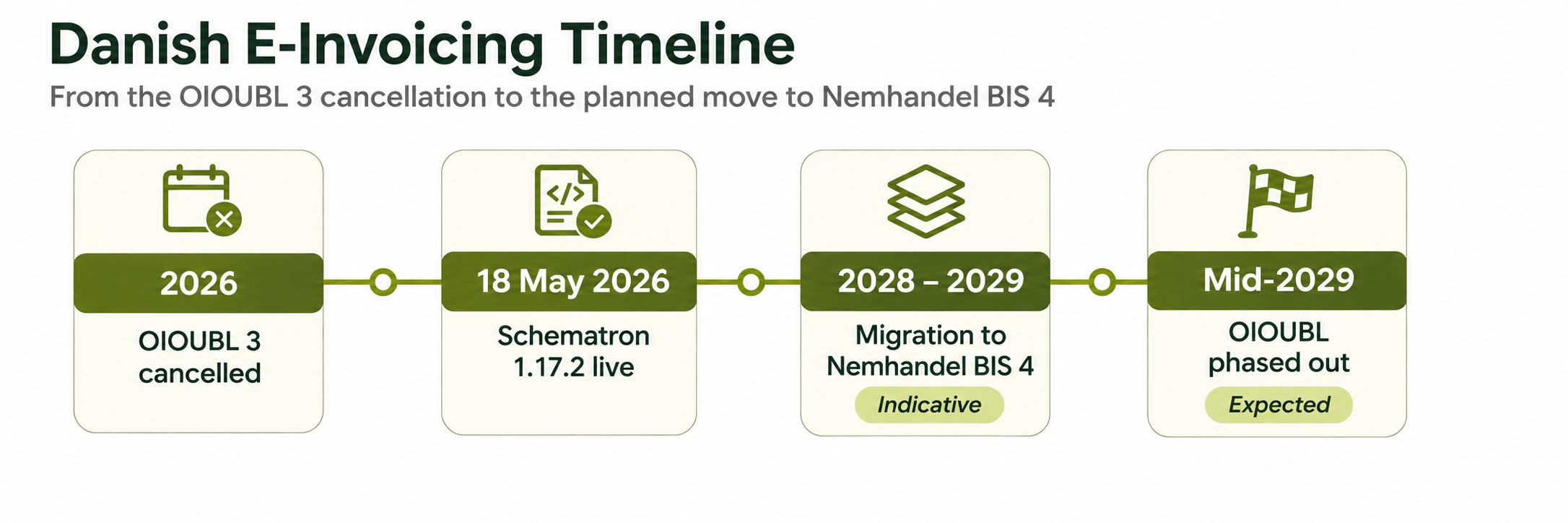
OIOUBL 3.0 was cancelled
Erhvervsstyrelsen cancelled the OIOUBL 3 invoice package in early 2026. OIOUBL 2.1 remains the Danish national format, used alongside Peppol BIS Billing 3.0, and it continues to receive technical updates. If your team put a 3.0 project on the plan, you can take it off.
Validation became stricter in May 2026
Schematron version 1.17.2 for OIOUBL 2.1 has been the validation standard on Nemhandel since 18 May 2026. The main change is a tighter moms check: every VAT category used on an invoice line must also appear in the VAT summary at document level. Amount fields must also carry a valid currency code.
Stricter rules mean an invoice that passed last year can fail today on exactly the same Uniconta data. If rejections started in late May and nothing changed on your side, this is the first thing to check. Our Denmark e-invoicing overview summarises who must comply and which formats apply.
The next change: Nemhandel BIS 4
Erhvervsstyrelsen's strategy for the e-invoice document standard phases out OIOUBL in favour of Nemhandel BIS 4, which is Peppol BIS 4 with Danish extensions. The transition is expected to be complete by mid-2029, and the exact dates are still indicative. Clean master data carries over to the new format, so the work you do now is not wasted.
How Uniconta Produces an OIOUBL Invoice
Uniconta generates the OIOUBL file itself and sends it through Nemhandel or Peppol. According to Uniconta's own documentation, it uses a standard mapping between Uniconta fields and OIOUBL fields for items, moms, payment details and addresses.
That standard mapping can only be as accurate as the data behind it. A missing EAN-nummer on the debtor or a wrong moms code on an item will flow straight into every invoice for that customer. That is why fixing one rejected invoice by hand rarely solves anything: the next invoice is built from the same data and fails in the same way.

Check the setup before you blame the format
Start with three checks in Uniconta:
Company registration. Your company must be registered in Nemhandel. Uniconta handles this under Firma/Firmaoplysninger with the Tilmeld Nemhandel button.
The debtor. The e-faktura field must be set to OIOUBL, and the customer's EAN/GLN must sit in the GLN field. You can validate the debtor directly in Uniconta to confirm the customer is registered in Nemhandel.
The error log. Under Debitor/Rapporter/Fakturaer, the E-faktura fejl field flags invoices that failed to send. The log for all sent OIOUBL files is under Debitor/Vedligeholdelse.
The Mapping Fields That Cause Most Rejections
EAN/GLN and endpoint IDs
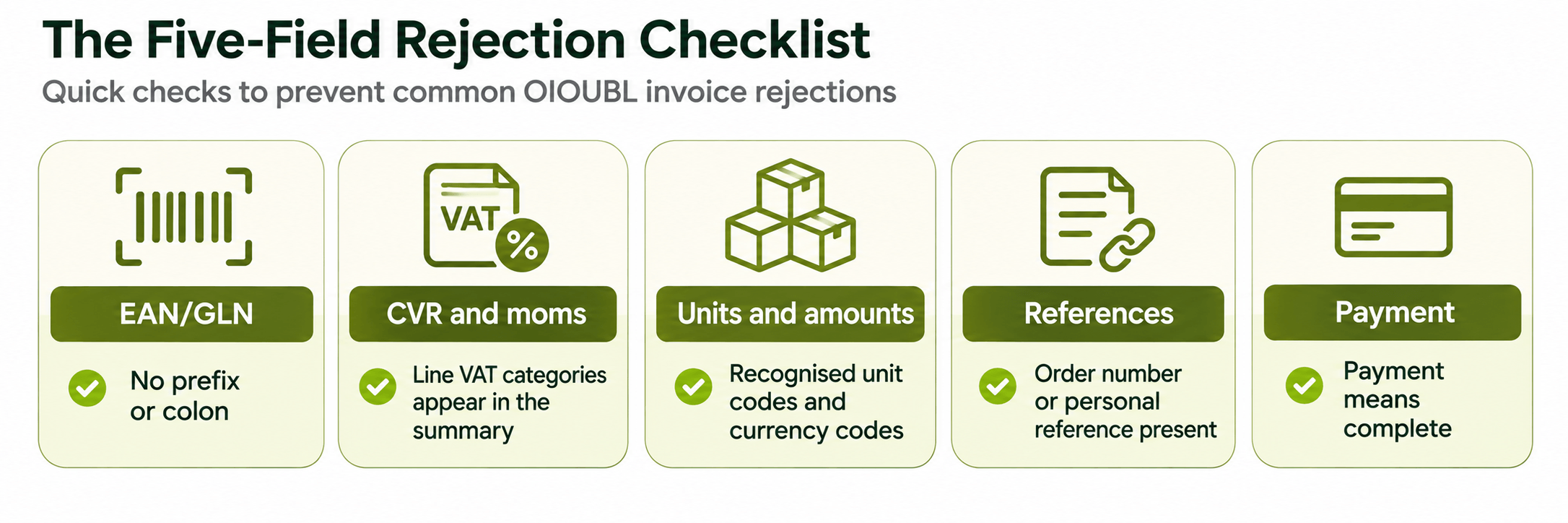
Danish public buyers receive invoices on an EAN-nummer (GLN). If the debtor holds no EAN, an old one, or the EAN of the wrong department, the invoice cannot be routed or is delivered to the wrong place. Ask the customer for the EAN of the receiving unit, which is usually stated on their order.
Uniconta expects the number without prefix or colon. If the customer is registered in Nemhandel on its CVR-nummer instead, leave the GLN field empty.
CVR and moms codes
The seller and buyer CVR-nummer must be correct. Each Uniconta moms code also has to map to the right OIOUBL tax category. Since May 2026 this matters more: a VAT category used on a line but missing from the document-level summary now fails validation. Zero-rated and reverse-charge lines, and lines with allowances or charges, are where most of these errors appear.
Units, amounts and rounding
Units of measure must use recognised unit codes, not free text such as "stk" or "pcs". Line totals, moms amounts and the invoice total must add up under the validation rules, and every amount needs a valid currency code. Small rounding differences between line level and invoice level are a frequent cause of rejection.
Order and contact references
Many public buyers require an order number or a personal reference on every invoice so the invoice reaches the right approver. If your sales team captures this in an email instead of in Uniconta, the reference never reaches the XML. Make it a required field at order entry.
Payment details
Payment means and bank or FI details must be complete and in the expected structure. A missing payment ID will not always block delivery, but it slows down payment matching on the buyer's side. Our guide on what happens when an e-invoice is rejected covers how to read rejection messages and correct the source data. You can also check a file against OIOUBL 2.1 with the free HubBroker XML validator before you send it.
OIOUBL or Peppol BIS 3.0: Which One for Which Customer?
Danish public authorities accept both OIOUBL and Peppol BIS Billing 3.0. In practice:
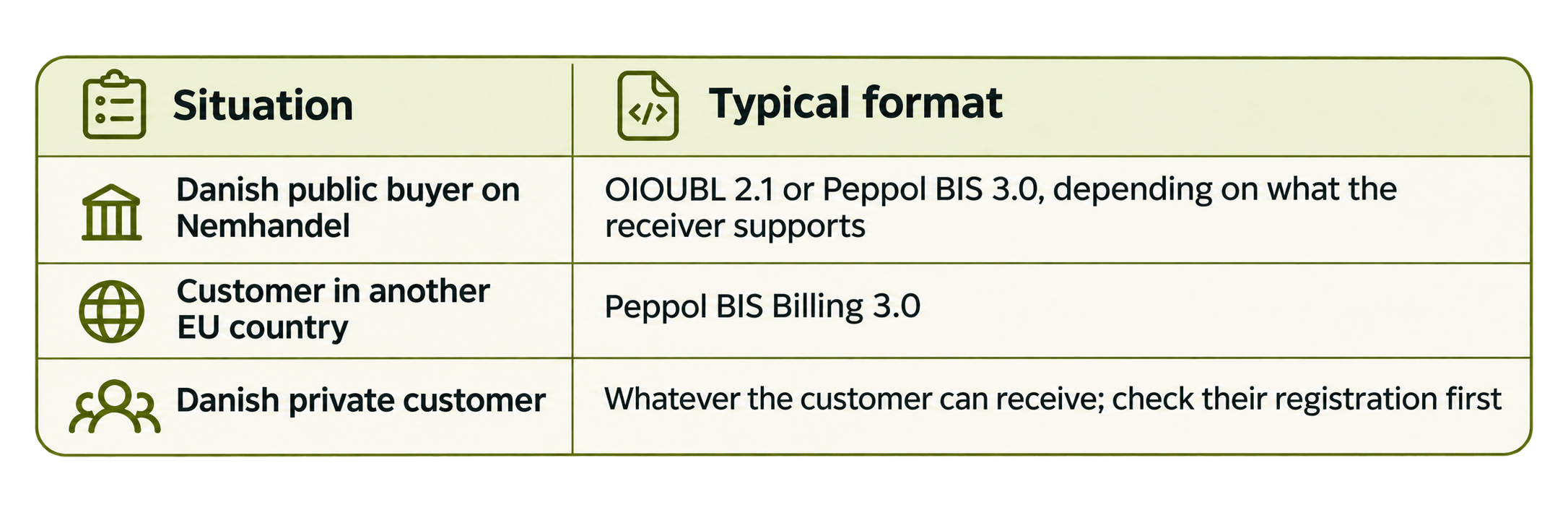
The safe rule is to check what each receiver is registered to accept before you send. A certified Peppol Access Point can look up a receiver's capabilities and route each invoice in the format the receiver supports.
When Uniconta's Standard Setup Is Not Enough
For invoices to Danish public buyers, Uniconta's built-in OIOUBL flow covers the basics. The picture changes when your invoicing goes beyond that:
EDI customers. Retail chains and wholesalers often require EDIFACT or their own XML format rather than OIOUBL.
Customer-specific rules. Some buyers require extra references or field values on top of the standard mapping.
Inbound supplier invoices. Many suppliers still send PDFs, which have to be converted to structured data before they reach Uniconta.
Format change in 2028–2029. The move to Nemhandel BIS 4 will touch every outbound invoice.
HubBroker sits between Uniconta and your trading partners as an integration layer. It converts Uniconta invoices into the format each partner needs, validates them before they leave and delivers inbound invoices into Uniconta. Uniconta stays your system of record, and mapping rules live in one place, so a fix for one customer applies to every future invoice. Read more about the Uniconta integration.
Frequently Asked Questions
Is OIOUBL 3.0 still required?
No. Erhvervsstyrelsen cancelled OIOUBL 3 in early 2026. OIOUBL 2.1 remains the national format until the planned move to Nemhandel BIS 4, which is expected to be complete by mid-2029.
Can Uniconta send OIOUBL invoices directly?
Yes. Uniconta generates the OIOUBL file and sends it through Nemhandel or Peppol once your company is registered and the debtor is set up with OIOUBL and a valid EAN/GLN or CVR registration.
Why does Nemhandel reject my Uniconta invoice?
The most common causes are a missing or wrong EAN-nummer, VAT categories that do not match the document-level summary, invalid unit or currency codes, rounding differences and a missing order or personal reference.
Do I need OIOUBL or Peppol BIS for Danish public customers?
Public authorities accept both. Check what each receiving unit is registered for before you send.
Does bogføringsloven require e-invoicing capability?
Yes, for digital bookkeeping systems in scope. For systems that are not registered with Erhvervsstyrelsen, bekendtgørelse nr. 205 af 29. februar 2024, § 5, requires the system to send and receive e-invoices and credit notes automatically via Nemhandel in OIOUBL format and in Peppol BIS format. Erhvervsstyrelsen's guidance is clear that a PDF does not count as an electronic invoice.
Check Your Mapping Before the Next Rejection
If the same errors keep coming back across customers, or you also invoice EDI customers or receive PDF supplier invoices, book a walkthrough with our integration team. Bring one rejected invoice and we will show you where it breaks and how the flow from Uniconta to Nemhandel, Peppol or EDI would look.
