
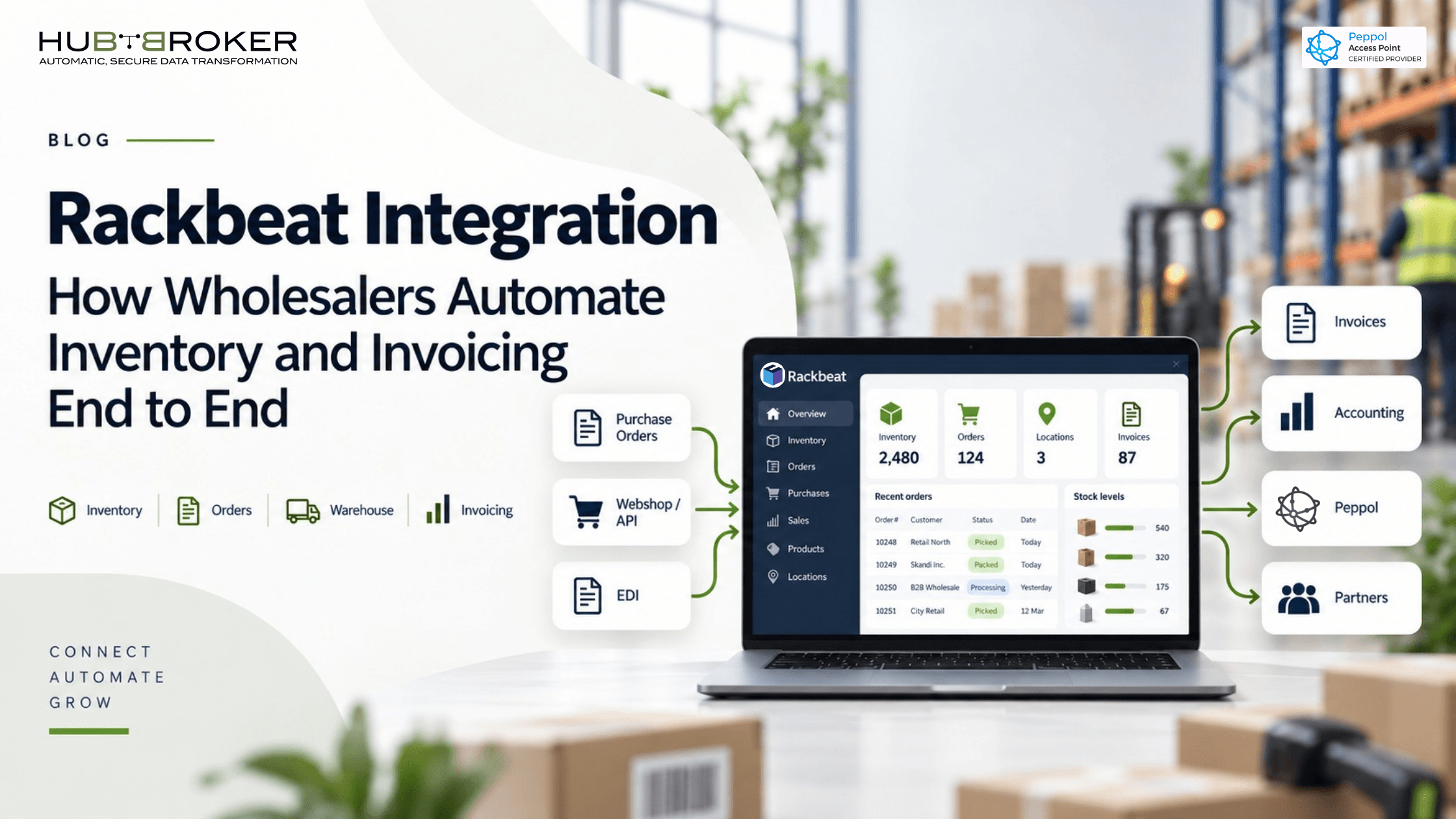
Rackbeat Integration: How Wholesalers Automate Inventory and Invoicing End to End
Most wholesalers who move to Rackbeat solve the problem they set out to solve. Stock is visible, locations are tracked, pick lists stop being guesswork.
Then the second problem shows up. It sits at the edges of the system, where your business meets everyone else's.
A customer sends a purchase order as a PDF. A retailer wants EDIFACT. A public-sector buyer expects a structured e-invoice. A supplier confirms an order by email, and someone on your team types the numbers into Rackbeat by hand.
That is the gap a Rackbeat integration closes. Not by changing how your warehouse works, but by connecting Rackbeat to the partners, channels and formats around it.
What Rackbeat does well, and where wholesalers hit the wall
Rackbeat as the inventory and order core
Rackbeat is a cloud inventory and order management system built for small and mid-sized businesses. It handles stock levels across multiple warehouses and locations, barcode-based counting, purchase orders, bills of material, picking and packing, and invoicing in multiple currencies. It is available in English, Danish and Norwegian, and it is built on an open API.
For a wholesaler running a few hundred SKUs and a growing customer list, that is a capable core.
The manual layer that remains
The open API is the point, though. Rackbeat is designed to be connected, and the value of Rackbeat depends heavily on what you connect it to.
Rackbeat's own integration range covers accounting systems, webshops, POS and shipping. What it does not cover on its own is the part of wholesale that involves trading partners: the retailer who transmits orders over EDI, the industrial customer whose AP system rejects anything that is not structured XML, the buyer who requires a Peppol identifier.
So a predictable pattern sets in. Orders arrive in three or four channels and get rekeyed. Invoices are produced correctly in Rackbeat, then exported, reformatted and emailed. Price changes are sent to twelve customers as twelve spreadsheets.
None of these tasks is difficult. Together, they consume a person.
What a Rackbeat integration actually connects
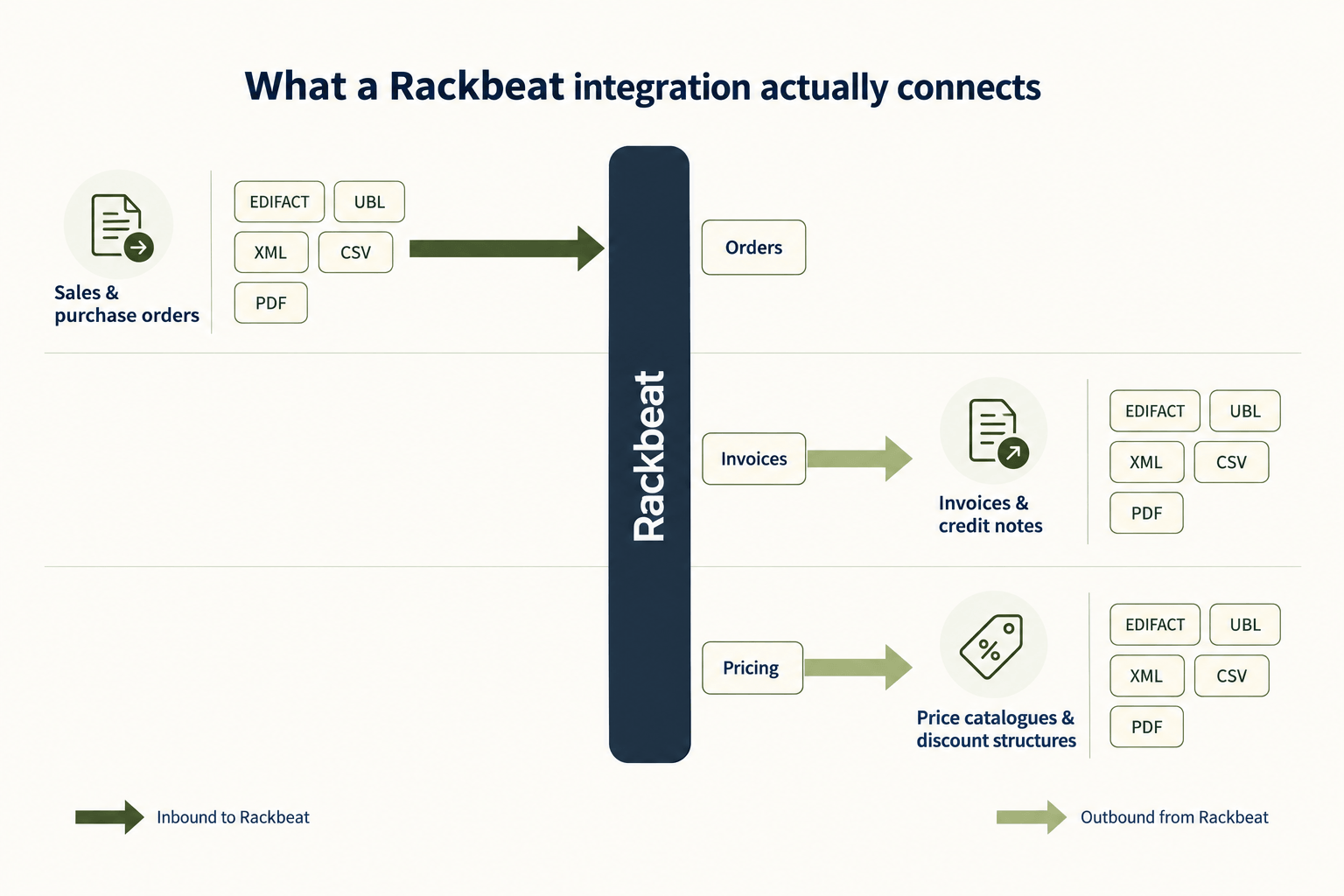
A useful way to think about a Rackbeat integration is by direction of travel.
Inbound: sales and purchase orders
Customer purchase orders arrive from retailers, marketplaces and webshops in whatever format that partner uses. An integration layer validates each one, matches it to the right customer account and SKUs, and creates the sales order directly in Rackbeat with the correct quantities, delivery details and references.
The same works on the supply side. Supplier confirmations and goods receipts update Rackbeat purchase orders, so incoming stock reflects reality rather than what someone remembered to enter.
Outbound: invoices and credit notes
Rackbeat produces the invoice. The integration layer converts it into whatever each partner requires and delivers it there.
That conversion matters more than it sounds. One customer accepts a PDF. Another requires UBL. A public-sector buyer in Denmark or Norway will not accept anything outside the structured formats their systems validate against. Handling that per customer, by hand, is where AR teams lose their week.
Format conversion sits alongside PDF to XML invoice conversion for inbound documents that arrive as PDFs in the first place.
Outbound: price catalogues and discount structures
Wholesale pricing is rarely one list. It is customer-specific pricing, discount groups, and currencies that vary by market.
Exporting product and price data from Rackbeat to each trading partner automatically keeps their systems aligned with yours, which removes a large share of invoice disputes before they happen. A dispute over a line price is almost always a dispute about whose price list is current.
Rackbeat integration in a wholesale workflow
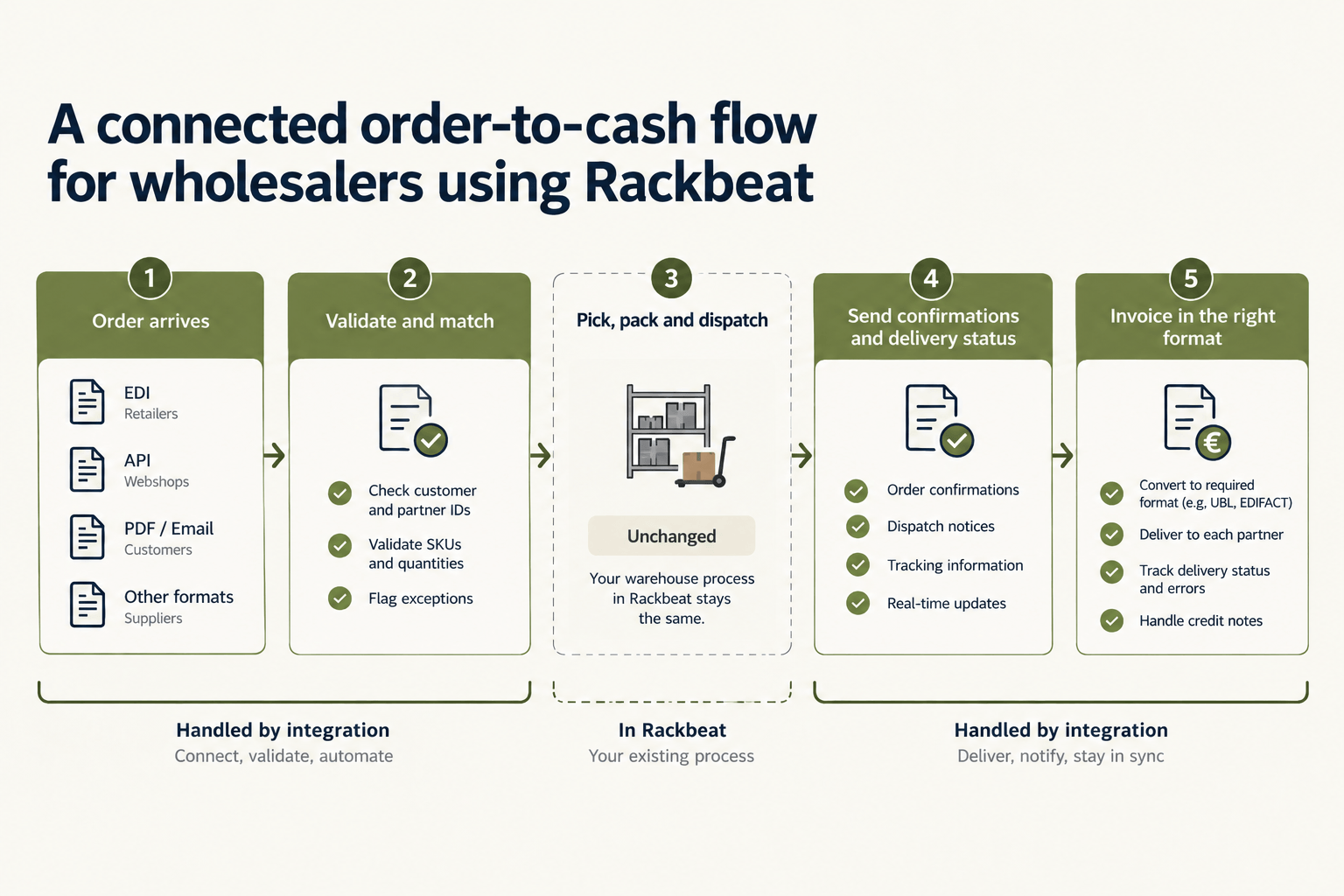
A typical order-to-cash flow, end to end:
Order arrives. A customer's purchase order comes in over EDI, API or a webshop channel.
Order is validated and matched. Trading partner IDs, customer accounts, SKUs and units are checked against Rackbeat master data. Anything that does not match is flagged rather than silently guessed.
Sales order is created in Rackbeat. The warehouse picks, packs and dispatches as normal. Nothing about the warehouse process changes.
Status flows back out. Stock availability, order confirmations and dispatch notices go to the customer automatically.
Invoice goes out in the right format. Rackbeat invoice data is converted to the partner's required format and delivered, with delivery status and errors tracked centrally.
The warehouse keeps working the way it works. The integration handles translation at the edges.
Rackbeat integration and e-invoicing compliance
Structured formats are replacing PDF attachments
E-invoicing requirements across Europe are moving in one direction: away from PDF attachments and toward structured, machine-readable invoices.
For a wholesaler, the practical question is narrow. When a customer or a public authority requires a structured e-invoice, can you produce one from Rackbeat without manual work?
If the answer is no, the cost is not a fine. It is slower payment, rejected invoices and customers who quietly prefer suppliers who can comply.
Connecting Rackbeat through a certified Peppol Access Point means the same invoice data reaches Peppol-registered buyers in the format their systems validate against, without your finance team touching a separate portal.
Why timing matters for Nordic wholesalers
National e-invoicing requirements across the EU are arriving on staggered timelines through the rest of this decade. Denmark, Norway and neighbouring markets each have their own scope and dates.
The useful response is not to track every deadline. It is to make sure your invoice data can be produced in structured form on demand, so a new requirement becomes a configuration question instead of a project.
EDI, API or Peppol: choosing per partner
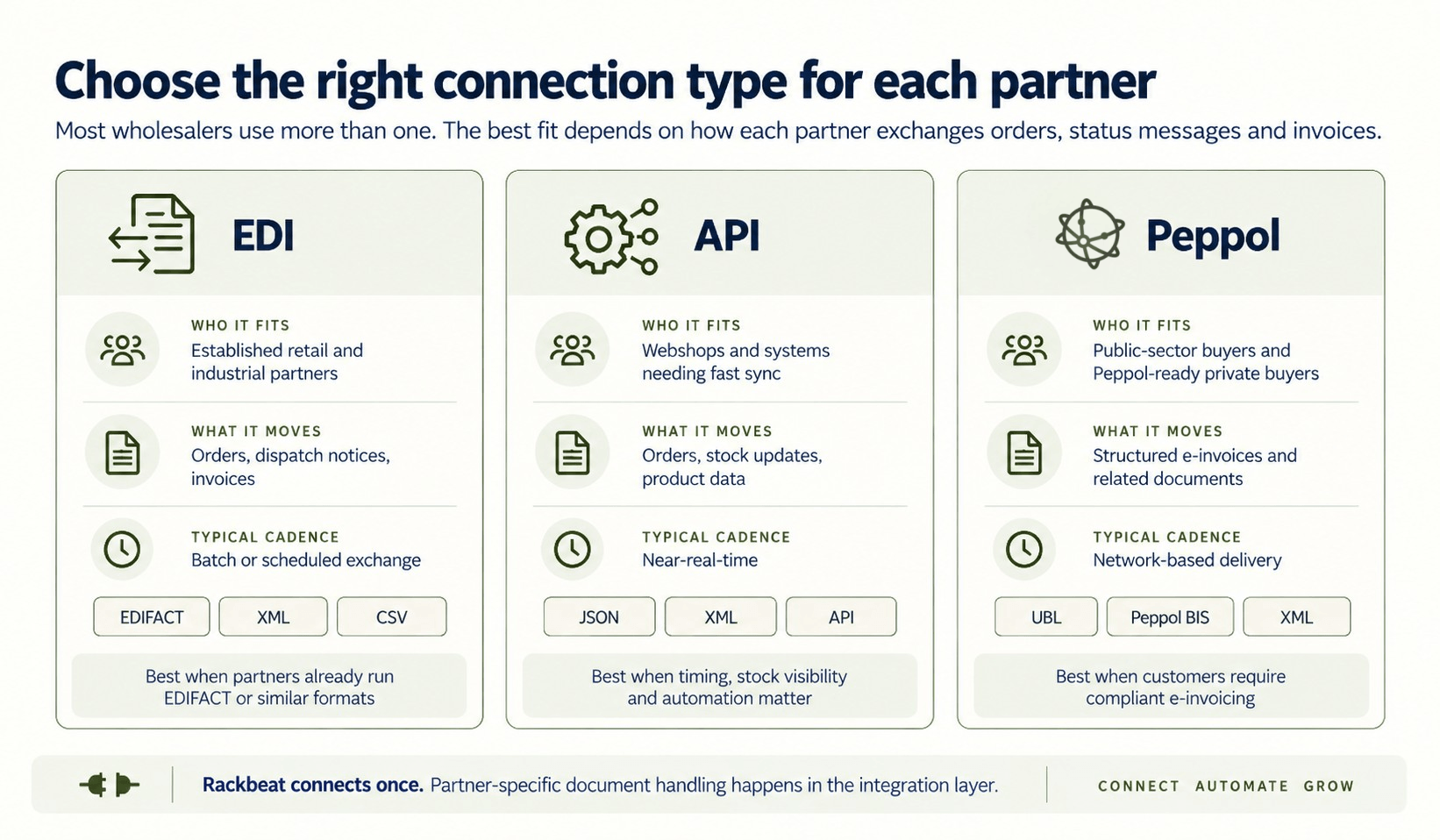
There is no single correct connection type. There is a correct connection type per partner.
EDI suits established retail and industrial customers who already run EDIFACT or similar and expect suppliers to meet them there. EDI integration covers orders, dispatch notices and invoices in a batch-oriented flow.
API suits webshops and systems where near-real-time stock and order sync matters, which is why ERP API integration tends to underpin e-commerce channels.
Peppol suits public-sector buyers and any private buyer already on the network, since one connection reaches all of them.
Most wholesalers end up running all three. The point of an integration platform is that Rackbeat connects once, and the partner-specific handling happens above it. Our comparison of API, EDI and Peppol for e-invoicing goes into the trade-offs in more depth.
What to check before you start
A short list that saves time later:
Item identifiers. Can your products be matched across systems on product number, SKU or EAN/GTIN? Mismatched item numbers are the single most common cause of failed order imports.
Master data ownership. Decide which system is the source of truth for customers, products and stock. If Rackbeat owns stock, stock changes belong in Rackbeat.
Partner format inventory. List every customer and supplier, and what each one sends and expects. This list drives scope more than anything else.
Volume and timing. Ten orders a day and a thousand orders a day lead to different designs.
Accounting system. Rackbeat connects to accounting systems including Visma e-conomic and others; confirm where invoices are posted before mapping anything.
Frequently Asked Questions
What is a Rackbeat integration?
A Rackbeat integration connects Rackbeat with other systems webshops, ERP and accounting platforms, WMS, and trading partners over EDI or Peppol so orders, invoices, stock levels and product data move between them automatically instead of being entered by hand.
Does Rackbeat integrate with accounting systems on its own?
Yes. Rackbeat provides integrations to accounting platforms, webshops, POS and shipping systems, some delivered by Rackbeat and some by third parties. What those standard connections do not cover is structured document exchange with trading partners, which is where an EDI and e-invoicing layer comes in.
Can Rackbeat send e-invoices to trading partners?
Rackbeat holds the invoice data. Delivering it as a compliant e-invoice to a specific buyer requires conversion into that buyer's required format and transmission over the right channel, which is handled by an e-invoicing layer connected to Rackbeat.
Which formats can outbound invoices be converted to?
Common targets for Rackbeat users include UBL and Peppol BIS for e-invoicing, EDIFACT for retail and industrial partners, and XML, CSV or Excel for partners with their own specifications. The right set depends on your partner list.
How long does a Rackbeat integration take to set up?
It depends on how many partners and document types are in scope, and on how clean your item and customer data is. A single channel with one document type is a short project. A multi-partner EDI rollout is a phased one. Data quality drives the timeline more than technology does.
Do we need to change how we work in Rackbeat?
No. A well-designed integration follows how your team already uses Rackbeat for stock, locations, orders and fulfilment. The integration adapts to your process rather than the other way round.
See your own order flow mapped
If you are running Rackbeat and want to know what an integration would actually cover, the quickest starting point is a look at your current order and invoice flow which partners send what, in which format, and where the manual steps are.
Talk to our integration team or book a demo and we will walk through it with you.
