
Peppol PINT Explained: The Specification Taking Peppol Beyond Europe
Your company is on Peppol. Invoices to buyers in Belgium, Norway or the Netherlands go out without a problem. Then a customer in Singapore, Japan or the UAE asks for an e-invoice over the same network, and the invoice your ERP produces for Europe is not one they can accept.
The reason is Peppol PINT, the Peppol International Invoice. It is the specification that lets Peppol work outside Europe's tax rules, and it is changing how international groups plan their e-invoicing. This article explains what Peppol PINT is, how it works, where it is used today and what it means for your ERP.
What Is Peppol PINT?
Peppol PINT is OpenPeppol's international invoice model: a shared core of invoice data and rules that every country on the network can use, with a local layer on top for national tax requirements.
From BIS Billing 3.0 to an international model
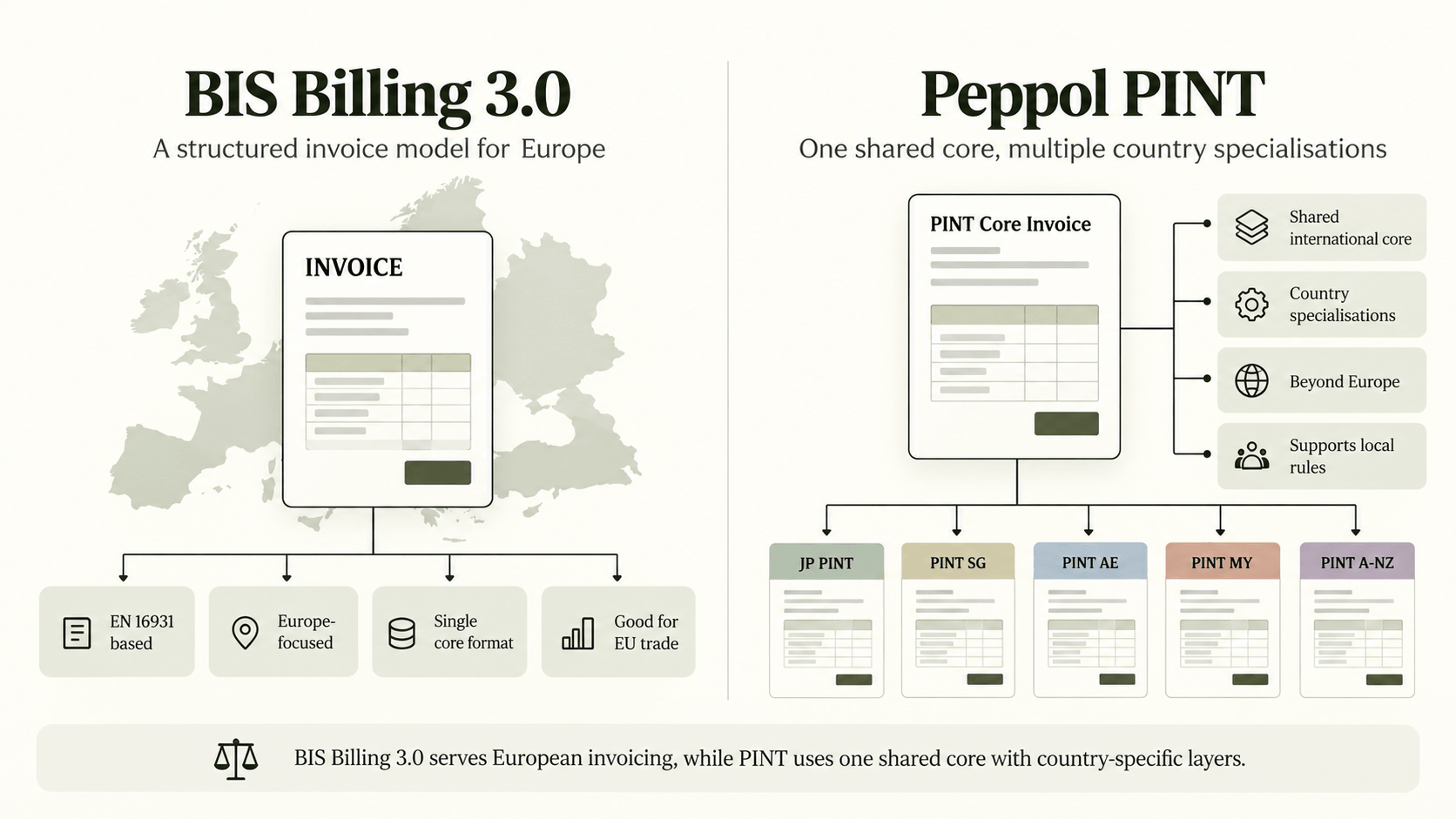
For most of Peppol's history, the invoice format was Peppol BIS Billing 3.0. It implements the European standard EN 16931, which makes it a strong fit inside the EU.
Outside Europe, it needed workarounds. Singapore and Australia/New Zealand each received their own extensions to cover non-EU tax rules. Every new country meant another extension, and less interoperability across the network.
A shared core with local specialisations
Peppol PINT reverses that logic. It starts with one core specification, and each jurisdiction adds a specialisation for its own rules. Current specialisations include Australia/New Zealand (PINT A-NZ), Japan (JP PINT), Malaysia (PINT MY), Singapore (PINT SG) and the United Arab Emirates (PINT AE).
Because every specialisation shares the same core, a sender works from one base model instead of one unrelated format per country. If you are new to how the network itself operates, our Peppol e-invoicing page covers Access Points, participant IDs and receiver lookup.
Why Peppol Needed a Specification Beyond Europe
Peppol began as European public procurement infrastructure. As countries in Asia-Pacific and the Middle East adopted it, the network faced a choice: keep adding country extensions to a European format, or build an international model.
OpenPeppol chose the second route. After a multi-year development process, including a proof of concept with the four Asia-Pacific Peppol Authorities, Peppol PINT became available on the network from 1 July 2023.
Two decisions from that rollout matter for businesses today:
PINT is optional by default. It becomes mandatory in a country only when that country's Peppol Authority decides so.
BIS Billing 3.0 and PINT run side by side. European trade on BIS Billing 3.0 continues as before.
How Peppol PINT Works
Layered validation
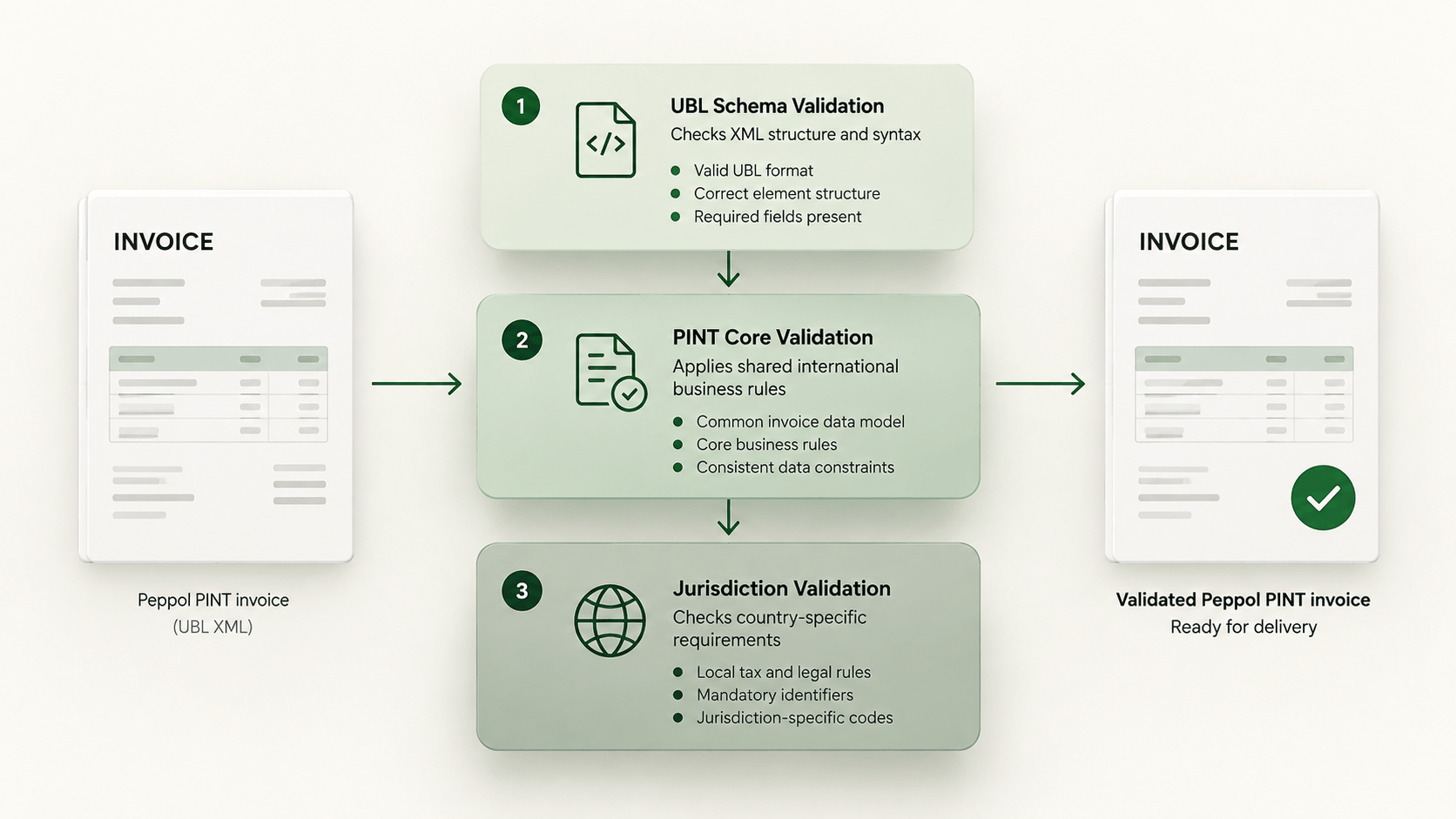
A Peppol PINT invoice is validated in layers. First comes the UBL schema, then the shared PINT rules that apply everywhere, then the jurisdiction's own rules.
An invoice that passes the shared layer is structurally readable in any PINT country. The jurisdiction layer adds local tax and legal requirements. For finance teams, this makes rejections easier to diagnose: a missing core field is a different problem from a missing local tax identifier.
Customisation IDs: the label on every invoice
Each Peppol PINT invoice carries a customisation ID that tells the receiving Access Point which specialisation it follows. For the UAE, the identifier must start withurn:peppol:pint:billing-1@ae-1, or urn:peppol:pint:selfbilling-1@ae-1 for self-billing. An invoice without it fails validation outright.
Receivers publish which document types they accept, so the sender must produce the variant the buyer is registered for.
Where Peppol PINT Is Used Today
Asia-Pacific
Japan moved early: its Peppol Authority had already published three PINT-based invoice specifications when PINT went live in 2023. Australia and New Zealand share a joint specialisation (PINT A-NZ), and Malaysia and Singapore have their own.
In Singapore, PINT SG is replacing the earlier Singapore BIS Billing 3.0 format on the national InvoiceNow network, and the tax authority is extending its InvoiceNow requirement to GST-registered businesses in phases. Whether PINT is required or optional varies by country, so check the national rules for each market you invoice.
The UAE and PINT AE
The UAE is the most demanding Peppol PINT case so far. Its e-invoicing system uses PINT AE on a Peppol-based 5-corner model. Alongside the invoice exchange, a Tax Data Document with the VAT-relevant data goes to the Federal Tax Authority, and both the sender's and the receiver's service providers report. Tax Registration Numbers are mandatory for supplier and customer.
See our UAE e-invoicing overview for the phased timeline, and Peppol 4-corner vs 5-corner model for how the fifth corner changes the flow.
What about Europe?
Inside the EU, BIS Billing 3.0 remains the working format, and both profiles run side by side on the network. OpenPeppol has also published PINT EU, a European specialisation that lets EU invoices follow the international model.
OpenPeppol has not announced a date for PINT to replace BIS Billing 3.0 in Europe, and some countries name BIS Billing 3.0 directly in national legislation, which would shape any timeline. Companies that trade only within Europe do not need to change format today.
What Peppol PINT Means for Your Business
For groups that invoice across regions, Peppol PINT has four practical consequences:
One base model, several outputs. ERP invoice data is mapped once to the PINT core, then extended per destination country.
Stricter master data. Variants such as PINT AE require identifiers your European flow may never have needed. Gaps show up as rejected invoices, not warnings.
Regular release cycles. OpenPeppol publishes PINT updates on a regular schedule, and each country specialisation follows. PINT 1.1.3 was released on 8 June 2026, with the A-NZ and Malaysia specialisations updated the same day. Mappings and validation must keep pace.
Tax reporting built in. In 5-corner countries, invoice data quality directly affects what the tax authority receives.
Preparing Your ERP for Peppol PINT
You do not need to replace your ERP to support Peppol PINT. Most of the work sits between the ERP and the Access Point:
Identify which customers, suppliers and group entities sit in PINT countries, and which variant each requires.
Check master data against that variant's mandatory fields: tax registration numbers, Peppol participant IDs, currency and tax category codes.
Validate before sending, so failures are caught in your own flow rather than at the receiver.
Treat specification releases as part of normal operations, not one-off projects.
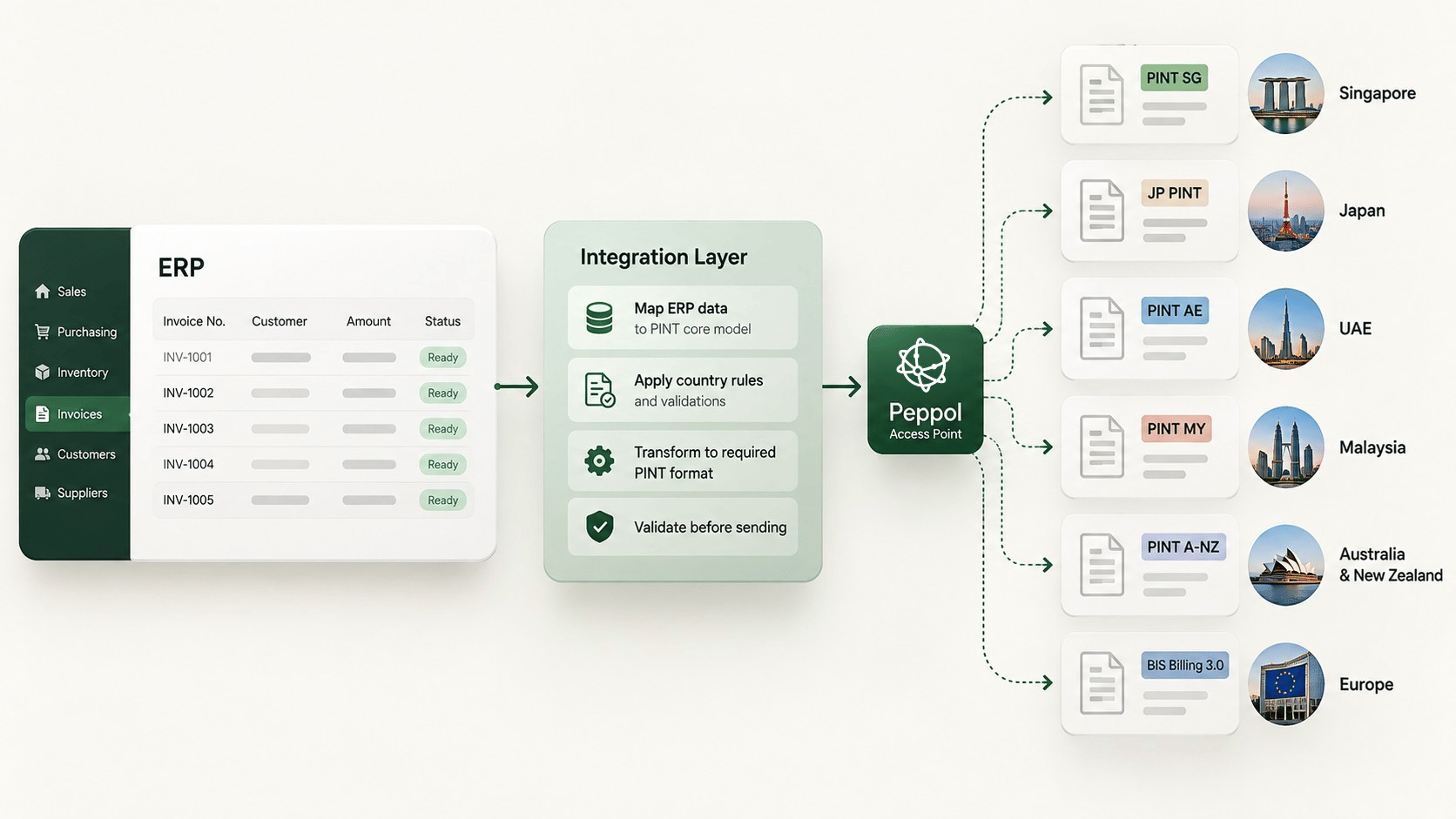
An integration layer handles this mapping and validation on top of the ERP you already run. That is HubBroker's approach: with our ERP integration services, invoice data leaves your system once and is converted to the format each market requires. For country-level requirements, see our e-invoicing by country section.
Frequently Asked Questions
Is Peppol PINT replacing Peppol BIS Billing 3.0?
Not today. The two run side by side on the Peppol network. BIS Billing 3.0 remains the format for EU trade, while PINT is used where a jurisdiction has adopted it.
Is Peppol PINT mandatory?
Only where a country's Peppol Authority makes it so. Since July 2023, PINT has been optional by default.
Do EU companies need Peppol PINT?
Only if they invoice buyers in countries that use a PINT specialisation, such as Singapore, Japan, Australia, New Zealand, Malaysia or the UAE.
How is PINT AE different from other PINT variants?
PINT AE is tied to the UAE's 5-corner model. VAT-relevant invoice data is reported to the Federal Tax Authority in a separate Tax Data Document, and the service providers on both sides report.
Can one ERP send both BIS Billing 3.0 and Peppol PINT invoices?
Yes, provided an integration layer or Access Point maps the ERP data to each format and validates it against the correct rules before sending.
Planning Invoices Beyond Europe?
If your customers or group entities are moving into PINT markets, a short review of your current invoice data against the target variants shows where the gaps are before the first rejection does. Book a conversation with our team to go through it.
