
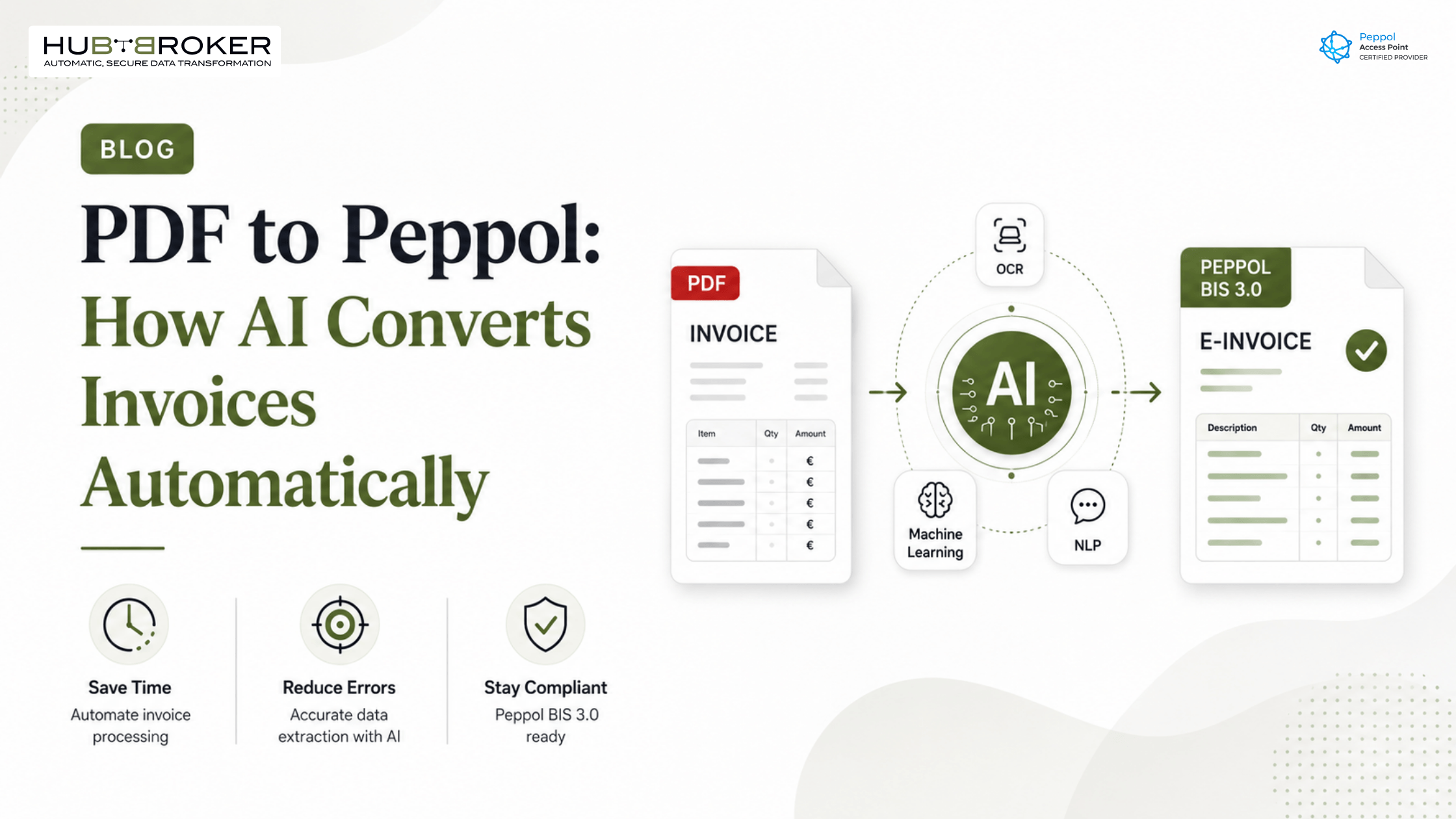
PDF to Peppol: How AI Converts Invoices Automatically
Most businesses still receive supplier invoices as static PDFs but tightening e-invoicing mandates across Europe require structured, machine-readable formats like Peppol BIS 3.0. AI-powered PDF to Peppol conversion tools use OCR, machine learning, and NLP to extract invoice data automatically and map it to compliant formats, without replacing your ERP.
Across Europe, the compliance clock is ticking. Germany mandated e-invoice receivability from January 2025. Belgium made B2B e-invoicing mandatory in January 2026. Poland followed in February 2026. France's deadline for all businesses falls on 1 September 2026. And yet, for most finance teams at manufacturing, wholesale, and distribution companies, a significant portion of supplier invoices still lands in the inbox as a PDF.
That gap between the unstructured PDF reality and the structured Peppol requirement is where costly errors, delays, and compliance risks accumulate. The good news: AI-powered PDF to e-invoice conversion closes that gap without forcing a full ERP overhaul.
This post explains why static PDFs fall short of e-invoicing standards, how AI bridges the divide, and what implementation actually looks like for a mid-sized business already operating within an ERP environment.
Why a PDF Invoice Is Not a True E-Invoice
It's a common misconception. A PDF invoice looks professional, it's digital, and it moves through email instantly so it must qualify as an e-invoice, right?
Not under European law. A true e-invoice is a structured, machine-readable document that can be processed automatically by the recipient's financial system without any human intervention. A PDF even a digitally-generated one is essentially a picture of an invoice. The data inside it is locked. Your ERP cannot read it directly.
Since 2025 in Germany, this distinction carries legal weight. Under the revised Section 14 of the German VAT Act (UStG), a classic PDF or scanned paper invoice explicitly no longer qualifies as an e-invoice. The Peppol BIS format is listed by the German Federal Ministry of Finance (BMF) as a permissible European invoice format PDF is not.
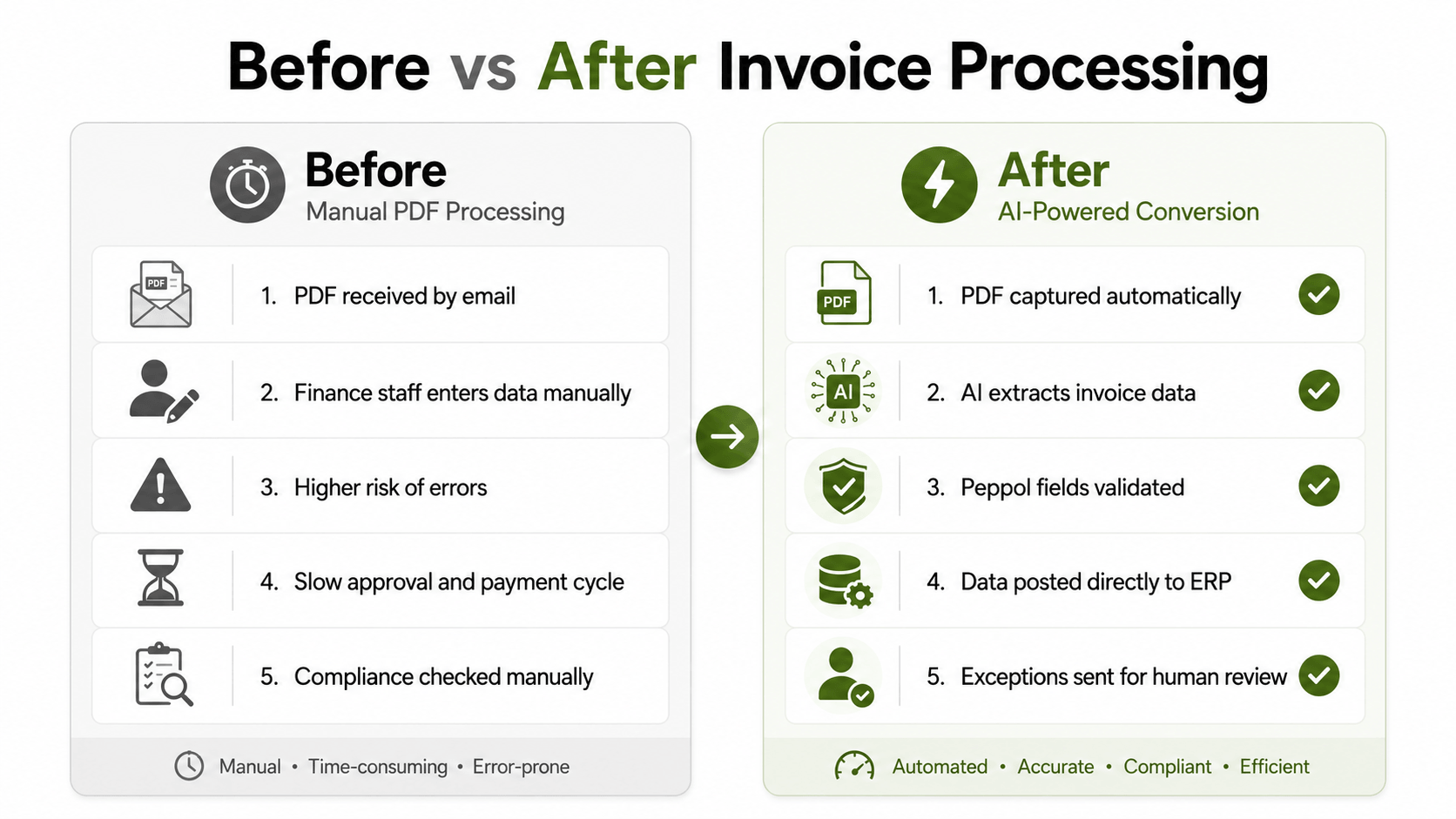
Manual data entry is the traditional workaround but it creates its own problems. Transposition errors, misread VAT numbers, incorrect line-item totals, and missing mandatory fields under Peppol BIS 3.0 all lead to invoice rejections, payment delays, and audit risk. For a finance team processing hundreds of supplier invoices monthly, the cumulative cost of manual handling is significant.
How AI Automates PDF to Peppol Conversion
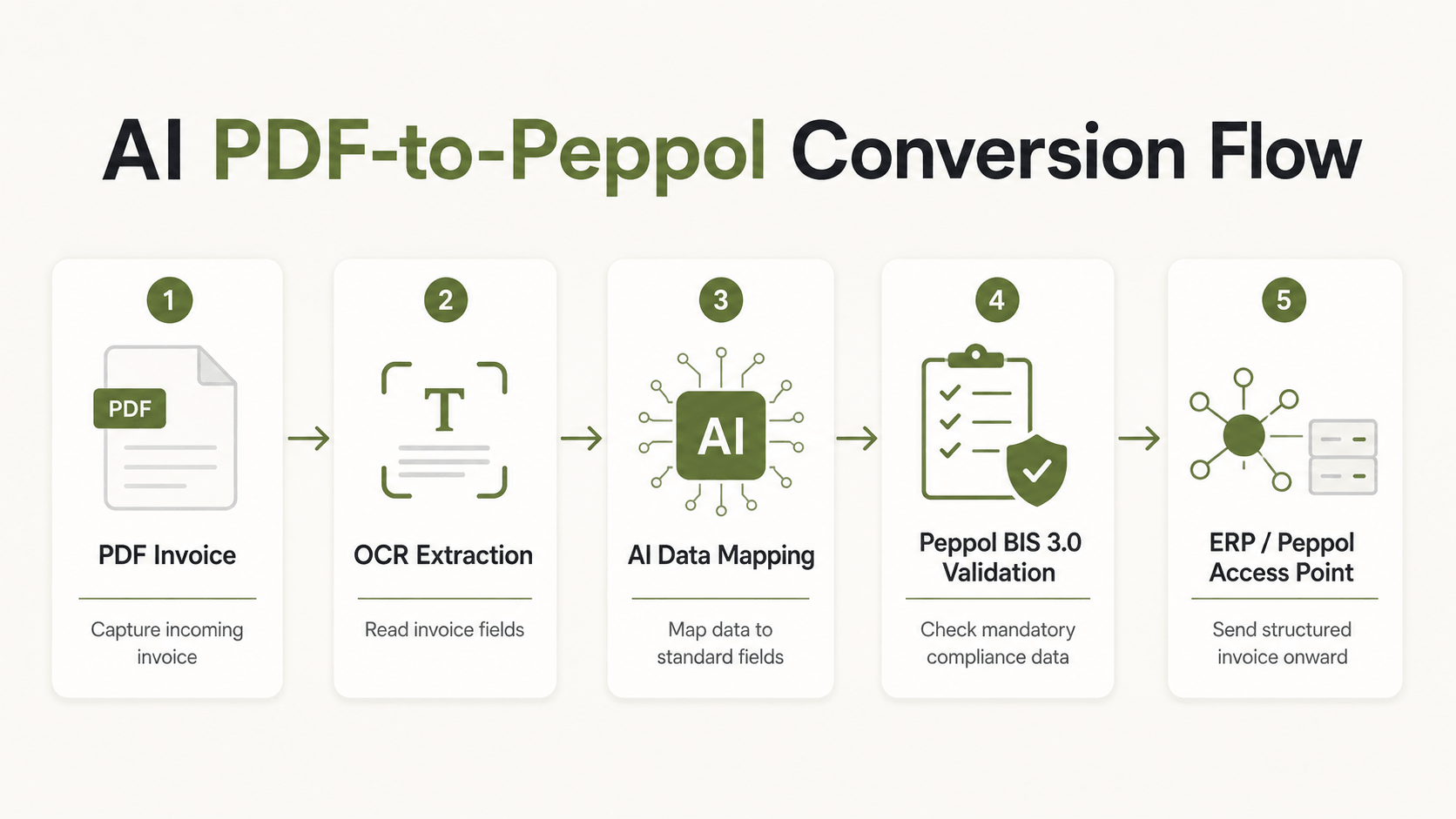
AI-powered PDF to Peppol conversion works through a combination of three core technologies: Optical Character Recognition (OCR), machine learning, and Natural Language Processing (NLP).
What does OCR do in invoice processing?
OCR handles the first layer converting text embedded in a PDF (or scanned image) into machine-readable characters. Modern OCR engines go well beyond basic character recognition; they identify invoice zones, distinguish header data from line items, and handle varied layouts across different suppliers.
How does machine learning improve data extraction accuracy?
This is where AI earns its value. Machine learning models are trained on large volumes of invoice data, learning to recognize patterns: where a supplier typically places the invoice number, how VAT is expressed across different document formats, and how to handle edge cases like multi-currency invoices or invoices with combined shipping and handling charges.
Over time, the model improves. The more invoices it processes from a given supplier, the more accurately it extracts and maps that supplier's data.
How does NLP handle structured invoice mapping?
Once the data is extracted, NLP maps it to the correct fields within the Peppol BIS 3.0 schema the standardized XML format required for transmission across the Peppol network via a certified Peppol Access Point. This includes mandatory fields like the buyer and seller identifiers, line-item descriptions, tax categories, and payment terms.
The output is a fully structured, validated XML document ready for compliant transmission generated from an incoming PDF, automatically.
Key Benefits of AI-Powered PDF to E-Invoice Conversion
Significant reduction in manual processing time
Automated invoice processing eliminates the need for manual data keying. What previously took minutes per invoice opening, reading, entering, verifying is reduced to seconds. For accounts payable teams handling large invoice volumes, this translates directly into headcount efficiency or reallocation of staff to higher-value tasks.
Lower error rates and fewer invoice rejections
Human data entry errors are a primary cause of invoice rejections in Peppol networks. AI extraction, combined with automated validation against Peppol BIS 3.0 schema rules before transmission, catches formatting errors, missing mandatory fields, and VAT inconsistencies before they reach the Access Point not after.
Faster payment cycles
Cleaner invoices mean faster approval workflows. When structured invoice data flows directly into your ERP already validated and correctly mapped the approval and payment process accelerates. This strengthens supplier relationships and may open opportunities for early payment discounts.
E-invoicing compliance across multiple jurisdictions
A single AI-powered PDF-to-Peppol pipeline supports compliance across the European mandates simultaneously. Whether a supplier invoice originates in Germany (EN 16931 required), Belgium, Poland (KSeF-aligned), or France (ahead of the September 2026 DGFiP mandate), the conversion process produces output that meets the structured invoice requirements of each jurisdiction.
How to Integrate an AI PDF-to-Peppol Tool Into Your Existing Workflow
Replacing an ERP is a multi-year project. AI-powered PDF to Peppol conversion does not require one.
Most implementations follow a connector-based model. The AI conversion layer sits between your email inbox (or document management system) and your ERP intercepting incoming PDF invoices, converting them to structured Peppol BIS 3.0 XML, validating the output, and posting the data directly into your ERP via API or EDI integration.
At a high level, the integration process typically involves four steps:
Intake configuration - Define the document sources (email, shared folder, supplier portal) from which the AI tool will capture incoming PDF invoices.
Supplier mapping - The AI model is trained or pre-configured to handle your most common supplier invoice layouts, with rules established for VAT treatment, currency, and business identifiers.
ERP connection - The tool connects to your existing ERP (SAP, Microsoft Dynamics, Business Central, Navision, or others) via API to post structured invoice data directly into the accounts payable module.
Peppol Access Point registration - Outbound validated invoices are routed through a certified Peppol Access Point for compliant network transmission.
The result is a workflow where PDF invoices arrive, are converted automatically, validated for compliance, and posted to your ERP with exceptions flagged for human review rather than manual entry as the default.
Future-Proof Your Accounts Payable Before the Mandates Arrive
The direction of travel in European e-invoicing regulation is unambiguous. Germany's mandate for all companies to issue structured B2B e-invoices takes full effect from 1 January 2028. France's DGFiP, which became the official Peppol authority in France in July 2025, has confirmed no further postponements to the September 2026 B2B receivability deadline. Across the Nordics, Benelux, and Central Europe, the shift to structured invoice formats is accelerating.
Waiting for a full ERP migration before acting on compliance is not a realistic strategy for most mid-sized businesses. AI-powered PDF to Peppol conversion offers a practical, deployable path to compliance today one that works alongside your existing systems rather than replacing them.
Frequently Asked Questions
What is PDF to Peppol conversion?
PDF to Peppol conversion is the process of extracting invoice data from a static PDF document and transforming it into a structured XML format that complies with the Peppol BIS 3.0 standard, enabling compliant transmission across the Peppol network. AI-powered tools automate this process using OCR, machine learning, and NLP.
Is a PDF invoice compliant with European e-invoicing mandates?
No. Under EU and national e-invoicing regulations, a compliant e-invoice must be structured and machine-readable. In Germany, a PDF has explicitly not qualified as an e-invoice under the revised Section 14 UStG since 2025. Similar requirements apply in Belgium, Poland, and France ahead of the September 2026 deadline.
Do I need to replace my ERP to implement Peppol e-invoicing?
No. AI-powered PDF to Peppol conversion tools are designed to integrate with existing ERP systems including SAP, Microsoft Dynamics, Business Central, and Navision via API or EDI. The conversion layer operates between your document intake and your ERP, without requiring a system replacement.
What is Peppol BIS 3.0?
Peppol BIS 3.0 (Business Interoperability Specification, version 3.0) is the standardized XML-based invoice format used across the Peppol network. It defines the mandatory and optional fields required for compliant cross-border B2B invoice exchange in Europe. The German BMF explicitly lists it as a permissible format under EN 16931.
How accurate is AI invoice data extraction compared to manual entry?
AI-powered extraction significantly reduces the error rates associated with manual data entry, particularly for high-volume, repetitive invoice processing. Accuracy improves over time as the model is trained on supplier-specific invoice layouts and automated pre-transmission validation against Peppol BIS 3.0 schema rules catches formatting errors before they cause rejection.
Which countries currently mandate Peppol or structured e-invoicing for B2B transactions?
Germany has required e-invoice receivability since January 2025, with issuance mandates phasing in from 2027. Belgium mandated B2B e-invoicing from January 2026. Poland's KSeF mandate went live in February 2026 for large taxpayers and April 2026 for all others. France's mandate for all businesses to receive B2B e-invoices takes effect on 1 September 2026.
Ready to see it in action? Book a demo with HubBroker to see AI-powered PDF-to-Peppol conversion live.
