
OIOUBL to Peppol BIS 4 Migration: How Danish Businesses Should Plan the 2029 Transition
Denmark’s move from OIOUBL towards NemHandel BIS 4 and Peppol-aligned document exchange is more than an invoice format update. It can affect ERP mappings, validation rules, document routing, supplier onboarding and transaction monitoring.
Danish businesses that delay their OIOUBL to Peppol BIS 4 migration may face rushed system changes, invoice rejections and increased manual processing. A phased migration plan provides time to test new document flows while keeping current invoice operations running.
What Is Changing from OIOUBL to Peppol BIS 4?
OIOUBL has supported electronic business document exchange in Denmark for many years. The future direction is towards modernised NemHandel specifications that provide closer alignment with Peppol and European interoperability requirements.
The transition may introduce changes to:
Invoice and credit note structures
Mandatory business fields
Validation and calculation rules
Electronic endpoint identifiers
ERP field mappings
Document transport and acknowledgements
Businesses should therefore manage the transition as an integration project rather than a simple XML conversion.
OIOUBL vs Peppol BIS 4: What Are the Main Differences?
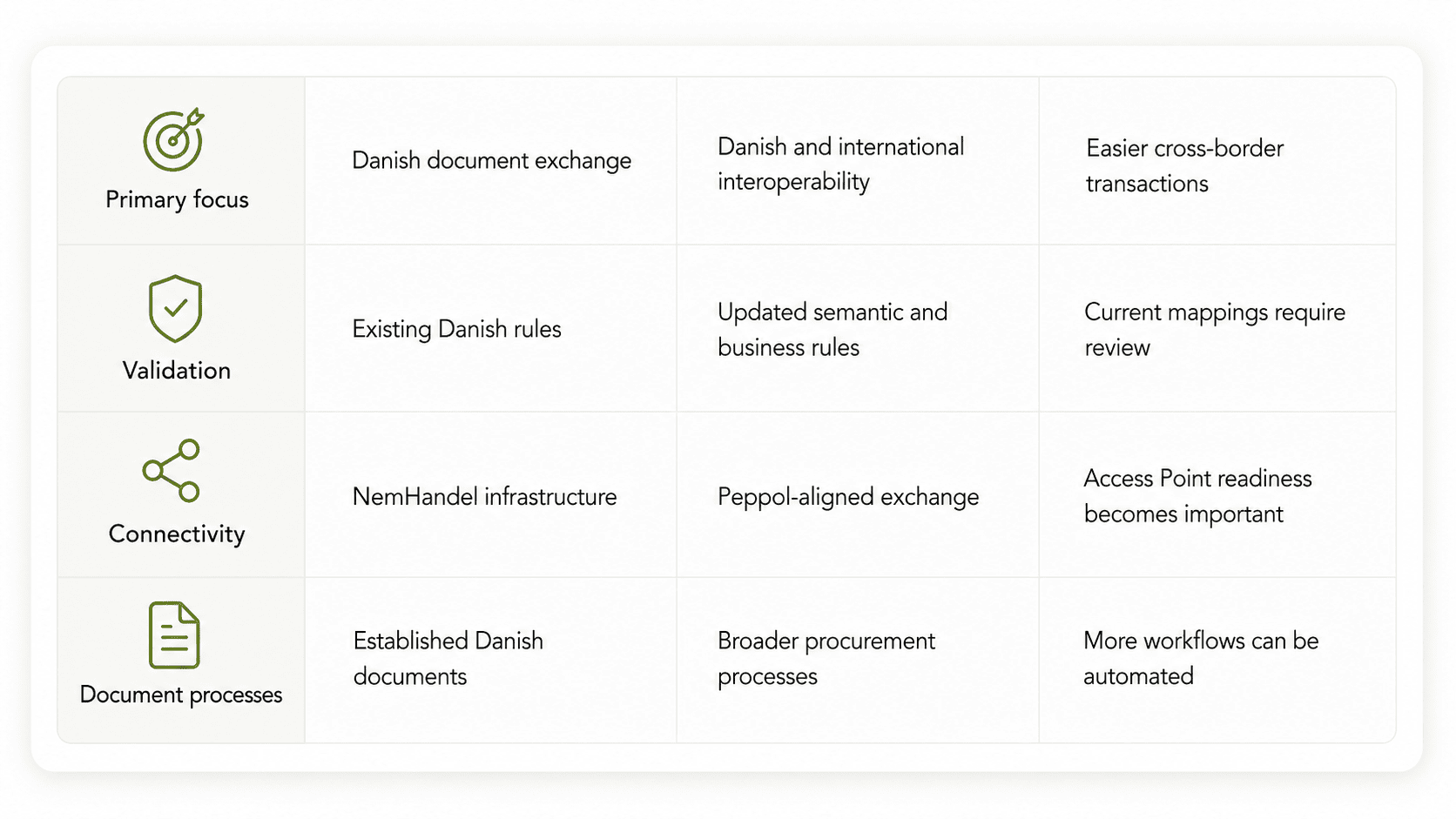
Changing the syntax alone is not enough. Each source field must retain its correct business meaning after transformation.
How Can Businesses Migrate Without Interrupting Invoicing?
A coexistence model allows current OIOUBL transactions to continue while new Peppol BIS 4 mappings are tested in parallel.
Documents can initially be routed according to each customer or supplier’s supported format. Once a partner successfully completes validation and production testing, its transactions can move to the new flow.
The integration setup should include:
Source data validation
Format transformation
Partner-specific routing
Peppol connectivity
Error notifications
Delivery status tracking
Controlled retry procedures
This approach reduces the risk of switching every transaction at the same time.
When Should Danish Businesses Start the 2029 Migration?
Businesses should begin assessing their systems well before the final transition stage.
 Actual implementation dates should be checked against the latest Danish specifications and official transition guidance before the final production rollout.
Which OIOUBL and ERP Fields Should Be Reviewed First?
Businesses should prioritise fields that commonly affect invoice validation and ERP posting:
Buyer and supplier identifiers
VAT numbers and tax categories
Invoice and credit note references
Purchase order numbers
Payment methods and bank information
Delivery dates and locations
Units of measure
Allowances and charges
Endpoint IDs
Item and product identifiers
Custom OIOUBL fields should also be reviewed to determine whether they have direct equivalents in the new specification.
What Percentage of Migration Effort Should Go Into Each Area?
The following percentages can be used as practical planning estimates rather than official regulatory allocations.
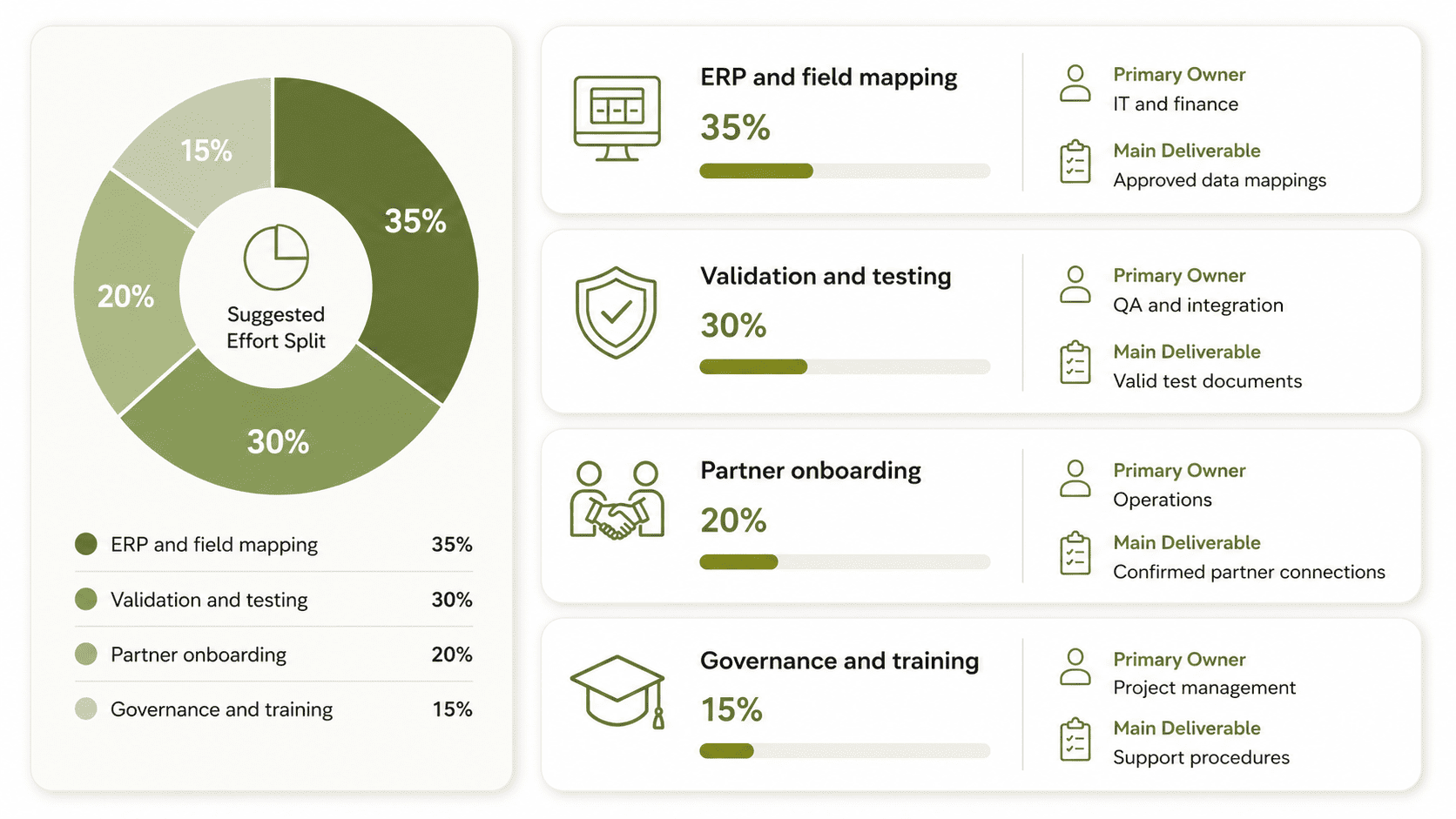
Partner onboarding should not be underestimated. A technically valid invoice may still fail because of an incorrect endpoint, buyer reference or receiving capability.
What Should You Look for in a Migration Provider?
A suitable provider should be able to:
Analyse current OIOUBL documents and mappings
Connect with existing ERP systems
Transform data into the required target format
Validate documents before transmission
Support old and new formats during migration
Manage Peppol registration and connectivity
Provide searchable transaction history
Return delivery and rejection statuses to the ERP
Working with one provider for transformation, validation and delivery reduces the need to maintain separate integration tools.
Plan Your OIOUBL to Peppol BIS 4 Migration with HubBroker
HubBroker helps Danish businesses connect ERP data, transform OIOUBL documents, validate Peppol-compatible output and exchange business documents through a certified Peppol Access Point. The HubBroker iPaaS platform can support parallel document formats, partner-specific routing, validation, transaction monitoring and ERP integration throughout the migration.
Contact HubBroker for an OIOUBL to Peppol BIS 4 migration assessment and implementation roadmap.