
How do we design ERP integrations that survive the OIOUBL to Nemhandel BIS 4 format change?
An invoice connection that works today might fail when its required format changes. That is the concern behind the OIOUBL to Nemhandel BIS 4 format change in Denmark. Businesses still need reliable invoicing as exchange rules change. Rebuilding ERP connections would be costly. A better design keeps accounting processes separate from external invoice formats.
What is actually changing in Denmark?
Denmark plans to move from OIOUBL to Nemhandel BIS 4, based on the Peppol BIS 4 family and European standard EN 16931. Danish-specific rules are expected, so a mapping built for another Peppol format may not be enough.
The Danish Business Authority's published strategy points to release candidates from late 2027, a phased rollout during 2028 and an OIOUBL phase-out around May 2029. These are planning milestones, not a reason to switch production systems today. Timelines depend on standards development. The first migration plans cover invoices, credit notes and invoice responses. Other document types could follow different schedules. Review each flow.
Why do tightly coupled ERP connections break?
Some ERP integrations contain format rules directly inside custom code. They take an ERP field, place it in a specific XML element and send the result through a fixed route. When a rule changes, several parts of the connection may need updating.

Imagine a Danish wholesaler invoicing municipalities and private customers. During the transition, different recipients may accept different formats. If invoice creation, mapping and delivery are tied together, supporting both formats could mean building almost the same connection twice. Maintenance becomes harder too. A change to VAT information, recipient identifiers or credit-note references may need several separate fixes. Fixes may affect other customers. Keeping format handling outside the ERP reduces that risk.
Will Your ERP Integration Handle Nemhandel BIS 4?Prepare your ERP for changing Danish e-invoicing requirements without rebuilding your integrations. HubBroker helps you manage OIOUBL and Nemhandel BIS 4 formats, automate document mapping, and keep invoice workflows running smoothly. |
The architecture that keeps invoice processes stable
Start with one internal invoice model: a consistent way to hold the data your ERP produces, without relying on OIOUBL or Nemhandel BIS 4 XML tags. It should retain the tax details, references and identifiers needed for processing.
Create separate, versioned mappings for each supported format. The ERP provides the business data; each mapping turns it into the right document structure. Changing one mapping should not require changing how the ERP posts invoices.
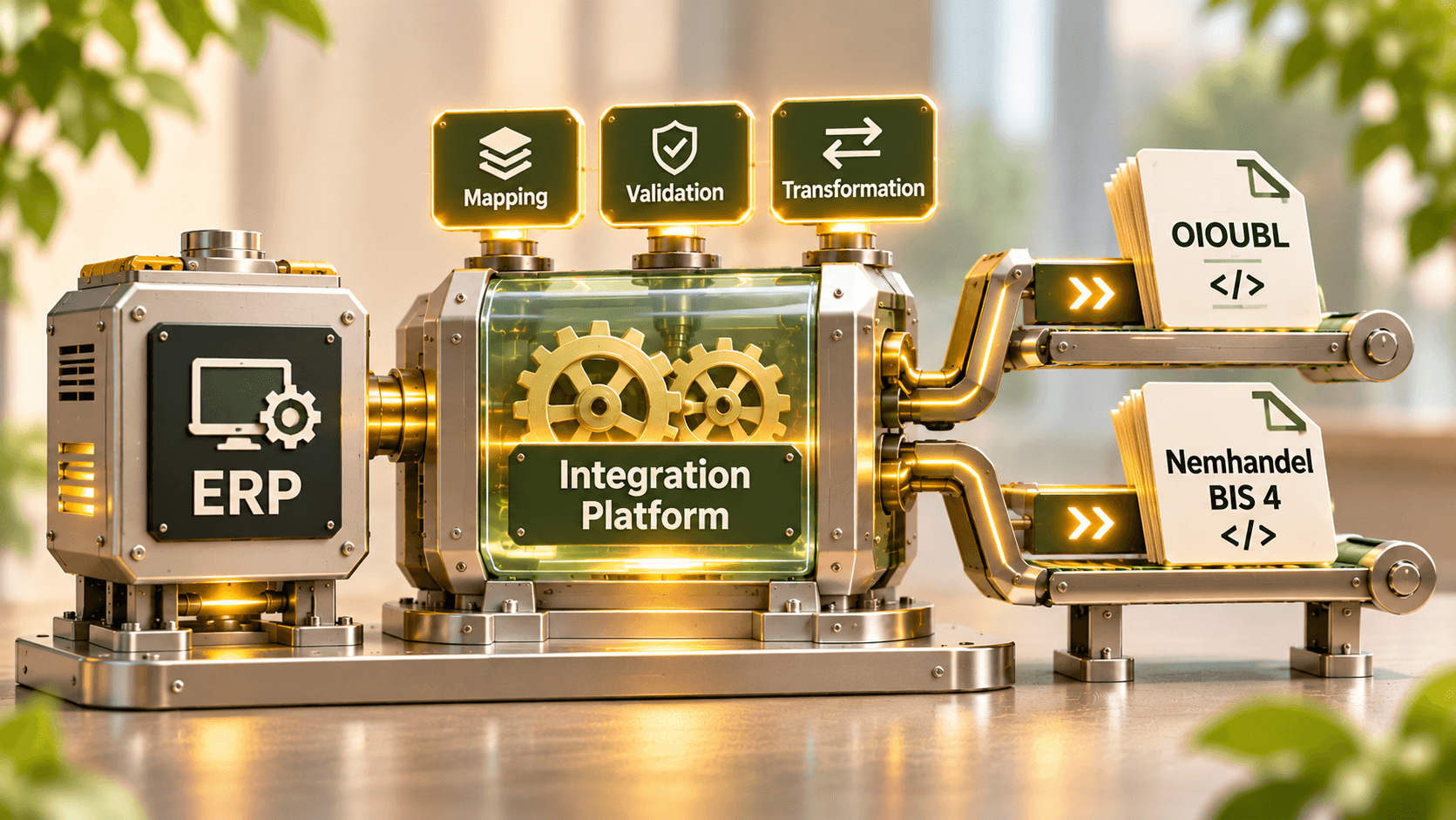
Then validate the output before sending it. XML can be technically well formed and still fail invoice rules. Check the applicable schema and business requirements, and show errors that finance and IT can understand. Delivery should be handled separately. Use recipient identifiers, supported formats and document types to choose the correct route. Keep acknowledgements, rejections and logs connected to the original ERP transaction.
How to prepare an ERP integration for the migration
Begin with a review of what you already exchange. These checks highlight problems before production changes.
What to check | Why it matters | Practical action |
|---|---|---|
ERP systems | Flows may use different setups | List sending and receiving systems |
Invoice mappings | Rules may be format-specific | Record current OIOUBL logic |
Credit notes | References need careful handling | Test corrected documents |
Invoice responses | Replies may follow separate flows | Trace response processing |
VAT details | Business rules affect validity | Compare tax data after mapping |
Recipient identifiers | Delivery depends on routing | Check recipient capabilities |
Error handling | Failed documents need attention | Track rejections and receipts |
Define the internal data model before building new transformations. Keep OIOUBL running while developing a separate BIS 4 mapping once official requirements are available. Test realistic invoices, discounts, corrections, VAT cases and rejected deliveries, not just valid XML samples.

Switch recipients in stages only after confirming what they support. Monitor results and keep a rollback option. Assign someone to follow official updates and revise tests as specifications change. Draft rules should not be treated as final.
Choosing integration software without creating another dependency
Ask potential providers how they update mappings, apply validation rules and manage two formats at once. A useful platform should not force changes to ERP business logic whenever external requirements move. Look beyond a successful test invoice.
Finance needs clear reasons for rejections. IT needs logs, repeatable tests and controlled deployments. Ask who owns updates and how problems are investigated after documents go live.
Keeping Danish ERP integrations adaptable with HubBroker
HubBroker can connect ERP data to electronic document exchange using integration, mapping, validation and delivery capabilities. Instead of making every ERP create each required format, businesses can manage those differences in a separate integration layer.
For companies in Denmark, that offers a practical way to keep existing OIOUBL flows while preparing for Nemhandel BIS 4 as specifications are published and support becomes available. HubBroker can help review existing customizations, identify format-dependent steps and plan changes without replacing everyday accounting processes.
The place to start is simple: find where OIOUBL rules sit today. From there,
HubBroker can help build a phased plan covering mappings, testing, routing and controlled activation against official Nemhandel releases.
