
Norway 2027 for Foreign Suppliers: Invoicing Norwegian Customers From the EU
From 1 January 2027, Norwegian businesses start invoicing each other in structured electronic formats. If you sell to Norway from an EU entity, you need to answer one question before the year ends: are you legally in scope, or will your customers expect EHF invoices from you anyway?
For most export finance teams, the honest answer to the question of norway e-invoicing foreign suppliers is "it depends on your Norwegian registration". This article sets out where the line sits, what the rules require, and what to check before January.
What Norway is changing in 2027 and 2030
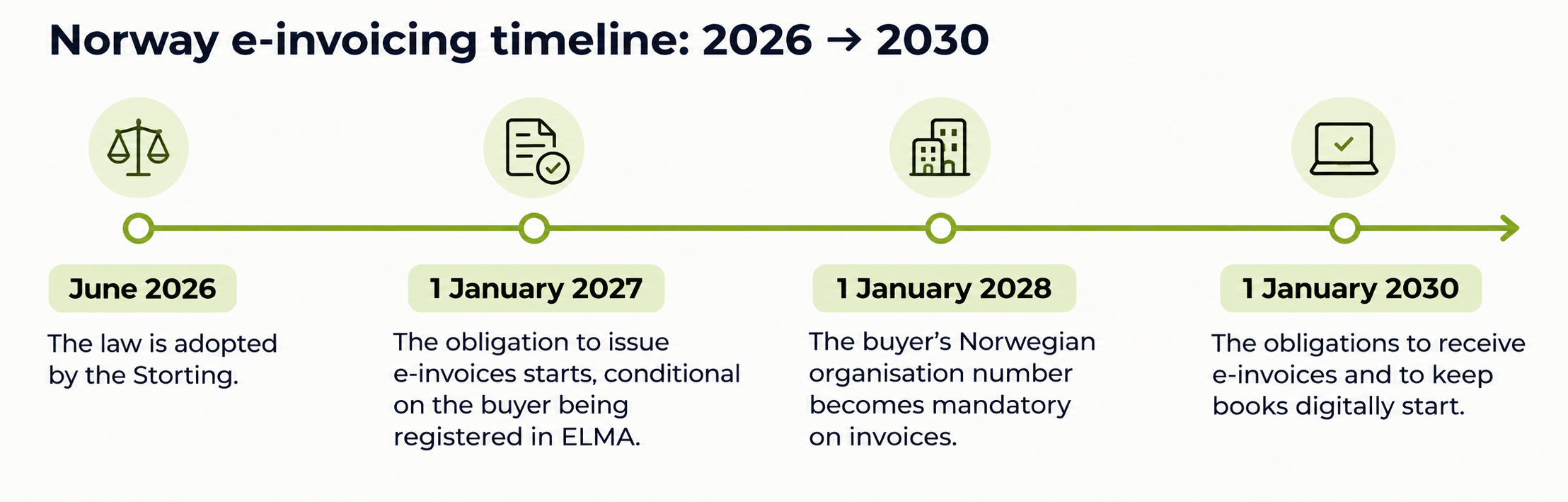
Norway has amended its Bookkeeping Act to make e-invoicing and digital bookkeeping mandatory. The changes were proposed in Prop. 44 L (2025–2026), adopted by the Storting in June 2026 and enacted as Lov 19. juni 2026 nr. 39. Details are set out in an amending regulation to the Bookkeeping Regulation issued on 29 September 2026.
You can see how Norway fits alongside other markets on our Norway e-invoicing country page.
1 January 2027: the obligation to issue
From this date, businesses that are bookkeeping-liable in Norway must issue electronic invoices when they sell goods or services to other bookkeeping-liable businesses.
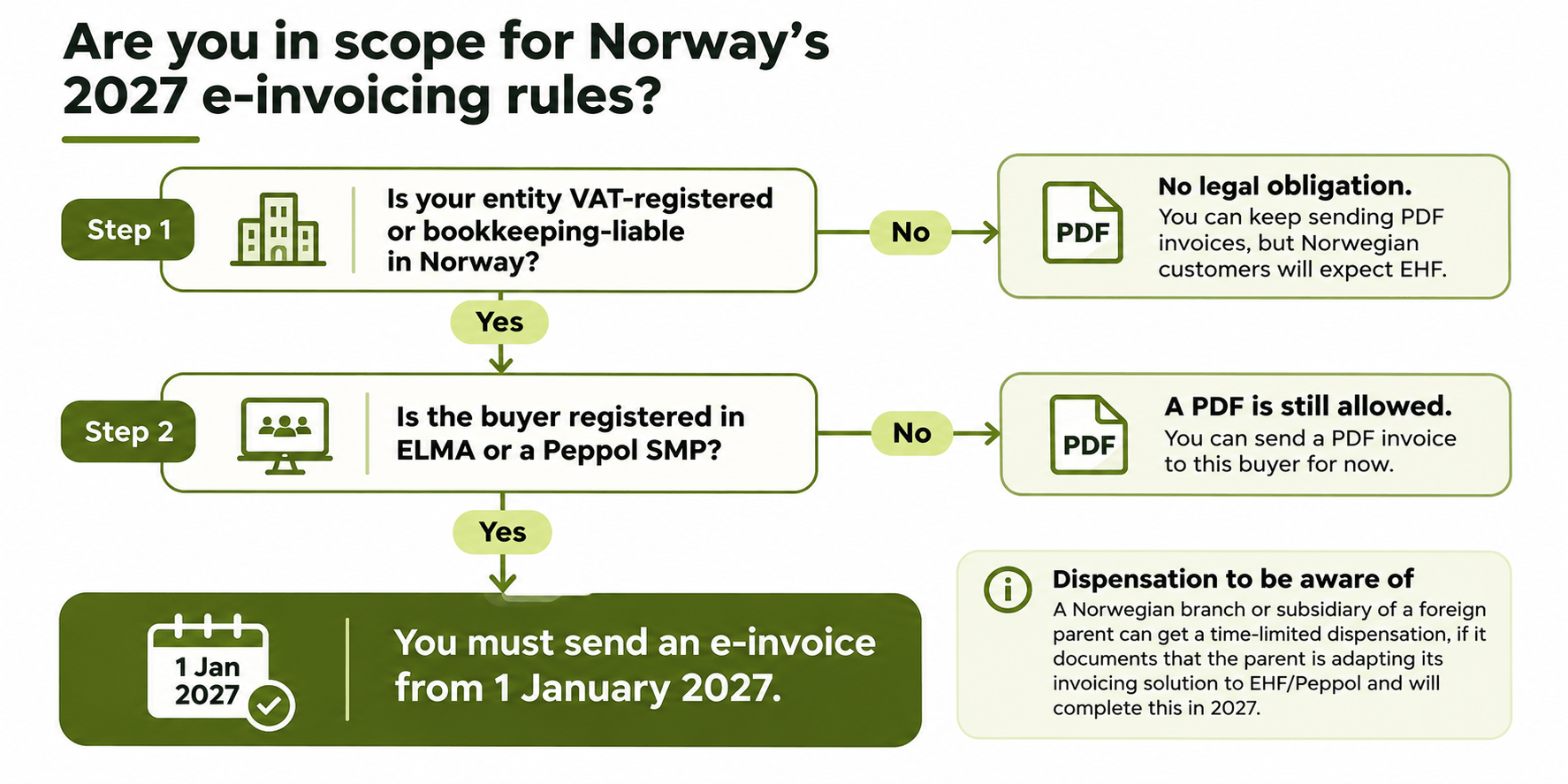
The duty applies only when the buyer is registered in ELMA, Norway's electronic recipient register, or another Peppol-approved SMP, and can receive e-invoices. If the buyer is not registered, a PDF remains acceptable for now.
1 January 2030: the obligation to receive and to keep books digitally
From 2030, bookkeeping-liable businesses must be able to receive e-invoices and must use an electronic accounting system. Before then, Norwegian buyers are not legally required to receive e-invoices. In practice, however, most already do.
How the rules got here
The 2025 consultation proposed 2028 for the issuing obligation. In March 2026, the Ministry of Finance brought the date forward to 2027. Exporters who planned around 2028 have lost a year.
Are foreign suppliers in scope? It depends on your bookkeeping status
The core rule for Norway e-invoicing and foreign suppliers is simple: the legal duty attaches to the seller's bookkeeping liability in Norway, not to where the seller is established.
Foreign suppliers registered for VAT in Norway
If your EU company is registered in the Norwegian VAT register, directly or through a fiscal representative, it is generally bookkeeping-liable in Norway. That puts it in the same position as a Norwegian business. From 1 January 2027, invoices to ELMA-registered Norwegian business customers must be e-invoices.
The Norwegian Tax Administration can grant a time-limited dispensation in specific cases. One case it names is directly relevant to foreign groups: a Norwegian branch or subsidiary that uses the same invoicing solution as its foreign parent. To qualify, the entity must document that the parent is adapting that solution to EHF/Peppol and will finish during 2027.
EU suppliers with no Norwegian registration
If you invoice Norwegian customers from your EU entity without any Norwegian VAT registration or bookkeeping liability, the issuing obligation does not apply to you. The consultation explicitly proposed excluding foreign businesses that are not bookkeeping-liable in Norway.
You can still choose to send EHF invoices, and that choice is becoming commercially sensible.
Exemptions to be aware of
Sellers with annual turnover not exceeding NOK 50,000 are exempt unless their invoicing system can already send e-invoices. Financial undertakings, insurance companies and pension undertakings are also exempt, linked to the type of sales documentation they use.
Why out-of-scope suppliers should still plan for EHF
From January 2027, Norwegian AP teams will be receiving most domestic invoices as EHF, flowing straight into their accounting systems. A PDF from an EU supplier becomes the exception that needs manual handling. That means slower approval and slower payment.
Public-sector buyers are a separate case. Suppliers to Norwegian public bodies, including foreign ones, already have to invoice in EHF over Peppol.
There is also a data change coming. From 1 January 2028, the buyer's Norwegian organisation number must always appear on the sales document, so master data needs cleaning even if you stay on PDF for now.
Formats and delivery: EHF, Peppol BIS Billing 3.0 and EN 16931
Approved formats
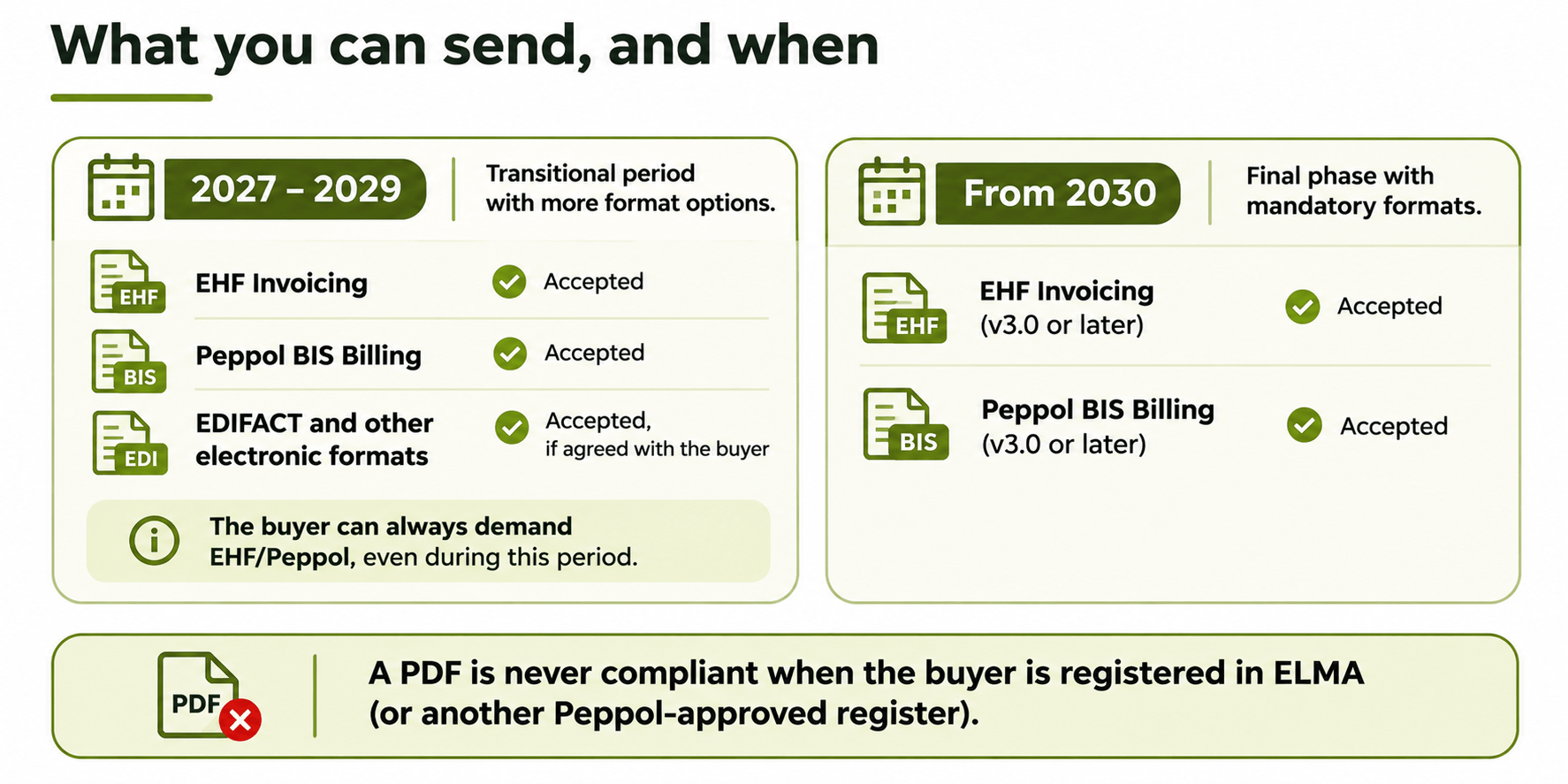
The approved formats are EHF Invoicing, Peppol BIS Billing, EHF Self-Billing and Peppol BIS Self-Billing, each in version 3.0 or later. EHF is Norway's implementation of Peppol BIS Billing 3.0 and conforms to the European standard EN 16931.
A transitional rule applies between 1 January 2027 and 1 January 2030. During that period, other electronic formats, such as EDIFACT, can be used if agreed with the buyer. If the buyer demands EHF/Peppol, you must send EHF/Peppol.
Sending through Peppol from an EU country
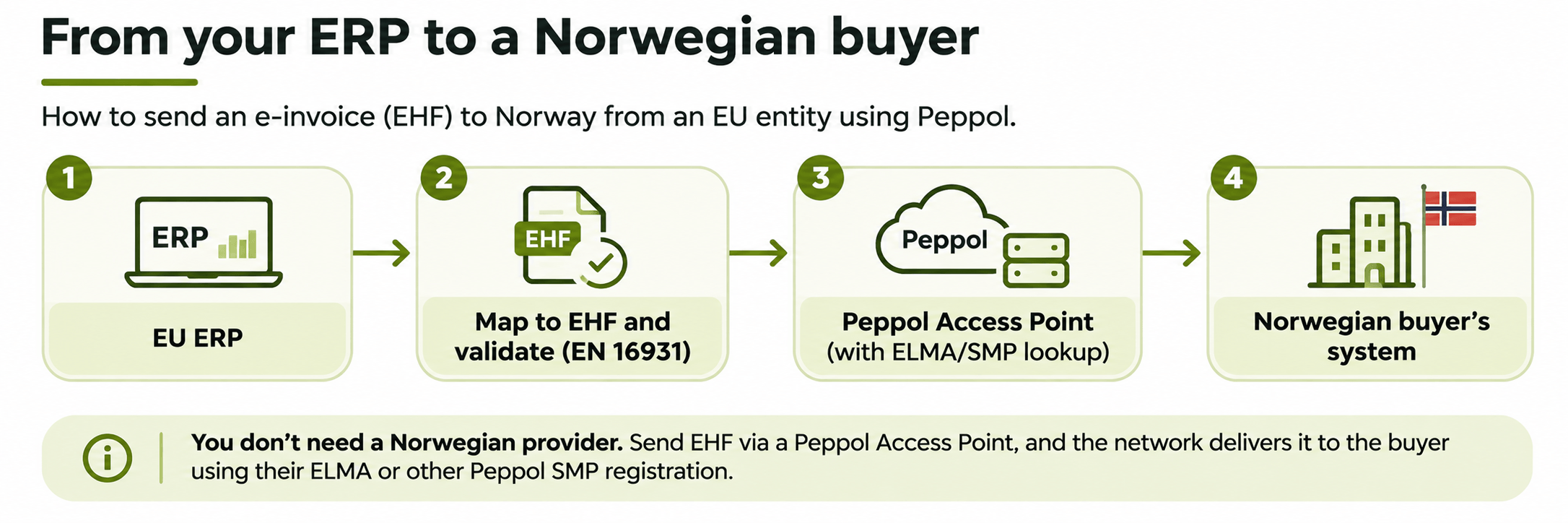
Peppol is a cross-border network, so an EU supplier does not need a Norwegian provider. You send through a Peppol Access Point, and the network looks up the buyer's receiving address. Our Peppol e-invoicing page explains how Access Point delivery and receiver lookup work.
A practical checklist for export finance teams
Map your Norwegian registrations. List every entity that invoices Norway and note whether it is VAT-registered or bookkeeping-liable there. This decides whether 2027 is a legal deadline or a commercial one.
Check your top customers in ELMA. The issuing duty only bites where the buyer can receive, and most Norwegian businesses can.
Collect organisation numbers now. You will need them on every invoice from 2028.
Test your ERP output against EN 16931. Many ERPs export invoice data that fails EHF business rules on VAT categories, buyer references or electronic addresses. Run a sample file through our free XML and e-invoice validator, which supports EHF Billing 3.0.
Choose a Peppol route without replacing your ERP. An integration layer can map existing ERP invoice data to EHF and deliver it over Peppol, so finance keeps working in the system it already knows.
FAQ
Do I need a Norwegian VAT number to send EHF invoices?
No. Any business can send EHF over Peppol. A Norwegian VAT registration matters because it usually makes you bookkeeping-liable in Norway, which turns sending EHF from an option into an obligation.
Can I keep sending PDF invoices to Norwegian customers after 2027?
If you are not bookkeeping-liable in Norway, yes, legally. If you are, a PDF is only acceptable when the buyer is not registered in ELMA or another Peppol-approved register.
Does the mandate cover invoices from Norway to EU customers?
Norwegian sellers invoicing foreign customers in connection with exports were proposed to be outside the obligation. The mandate is aimed at invoicing between Norwegian bookkeeping-liable businesses.
Which businesses are exempt?
Sellers with turnover up to NOK 50,000 a year (unless their system can already send e-invoices), financial undertakings, and insurance and pension undertakings. Skatteetaten can also grant time-limited dispensations in specific cases.
Are EDIFACT invoices accepted?
Until 1 January 2030, yes, if agreed with the buyer. After that, only EHF and Peppol BIS formats in version 3.0 or later are approved.
What happens in 2030 if I am not in scope?
Norwegian buyers must then be able to receive e-invoices and keep books digitally. Your legal position as a non-registered EU supplier does not change, but PDF invoices will be increasingly out of step with how your customers process invoices.
Get your Norway invoicing ready before January
Whether 2027 is a legal deadline for you or a customer expectation, the work is the same: clean master data, compliant EHF output and a reliable Peppol connection. If you would like to see how that works from your existing ERP, book a demo with HubBroker.
