
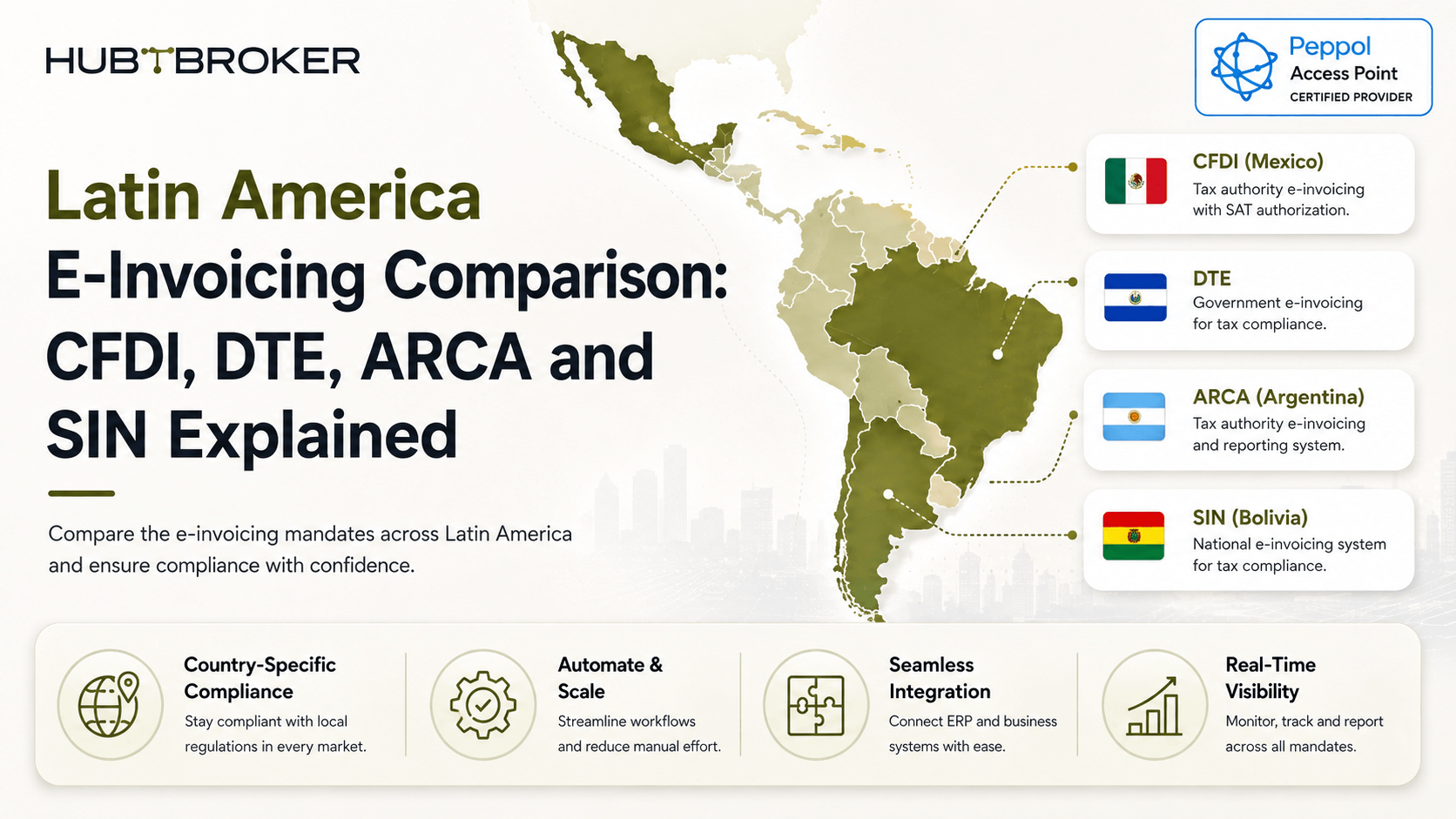
Latin America E-Invoicing Comparison: CFDI, DTE, ARCA and SIN Explained
A US finance team may connect successfully with Mexico’s CFDI model and think the same integration can be reused across the region. This is where the complexity starts. Latin America e-invoicing is not one regional standard. Each country can use different authorities, document formats, identifiers, validation steps and response rules. The main question is how to keep one ERP setup while still applying the right country rules to every invoice.
Latin America E-Invoicing Is Not One System
Latin American countries have used electronic tax documents for many years, but the way they work is different in each country. Differences can affect XML structure, numbering, signatures, authority validation, status responses, cancellations and credit notes. For regional businesses, the better approach is not one hard-coded process. It is better to keep a stable ERP core and apply country-specific rules around it.
Country | Tax Authority / Platform | Main E-Invoice Term | Typical Document / Format | Validation Model | ERP Integration Consideration | Key Difference |
|---|---|---|---|---|---|---|
Mexico | SAT | CFDI | CFDI 4.0 XML | Certification/timbrado and fiscal validation | Map SAT catalogs, tax data and cancellation/status logic | Strong certification model |
Chile | SII | DTE | SII-defined XML DTE | SII validation can accept, reject or accept with objection | Manage CAF/folios, signatures and SII status | Different document lifecycle |
Argentina | ARCA | Factura electrónica / comprobante electrónico | Electronic invoice through ARCA services | Issuance authorization through WSFE or Comprobantes en línea | Handle numbering and CAE/CAEA where needed | Authorization-based model |
Bolivia | SIN / SIAT | Facturación Electrónica en Línea | XML/XSD digital invoice | SIN services validate XML/XSD and electronic signature | Manage CUIS/CUFD, CUF and response status | Separate SIAT identifier model |
Mexico’s SAT confirms CFDI 4.0 is still the valid invoice version and keeps authorised certification providers for validation, folio assignment and digital sealing. Chile’s SII also continues to define DTE XML specifications and formal DTE validation rules.
CFDI, DTE, ARCA and SIN: What Do the Terms Actually Mean?
CFDI — Mexico
CFDI means Comprobante Fiscal Digital por Internet. SAT defines the invoice structure, while normal automated invoice flows usually also include certification and fiscal stamping. ERP integration therefore need Mexico-specific tax mapping, certificate and timbrado handling, and cancellation or status processing.
DTE — Chile
DTE means Documento Tributario Electrónico. It is the electronic tax document used by Chile’s SII, not the name of an authority or network. SII publishes XML schemas, DTEs use electronic signatures and authorised folios are controlled through CAF. Systems need to create the correct document and also understand the response coming back from SII.
ARCA — Argentina
ARCA means Agencia de Recaudación y Control Aduanero, created in 2024 as the legal successor to AFIP. Electronic invoices can be authorised through ARCA web services or Comprobantes en línea. For ERP integration, the important part is authorization, point-of-sale numbering and returned CAE/CAEA data. Simply creating an invoice file is not enough.
SIN — Bolivia
SIN is Bolivia’s Servicio de Impuestos Nacionales. Under electronic online invoicing, SIAT services receive structured invoices and check XML/XSD and the electronic signature. Integrations also need to manage Bolivia-specific identifiers such as CUF and CUFD and process receipt or error responses.
Why a Single Hard-Coded ERP Flow Breaks Across Latin America
The difference is bigger than only having different XML formats. Country rules can change:
Required fields
Tax codes
Customer identifiers
Invoice numbering
Certificates
Authorization
Credit notes
Cancellation
Response handling
A regional flow can look like this:
 This allows the ERP to keep a more consistent business process while the integration layer applies the correct country transformation, validation and authority flow. One ERP does not need four completely separate architectures, but each country still need its own rules.
What Should US Companies Evaluate Before Expanding Their E-Invoicing Setup?
Businesses should check country coverage, ERP data availability, configurable compliance rules, automatic authority-response handling, clear separation between compliance rejection and transmission failure, regulatory changes and multi-country monitoring. The design should also support future countries without making Finance rebuild the main invoicing process every time a new market is added. This is important because one country may reject invoice because of wrong tax data, while another problem may only be a temporary system connection issue. Both should not be handled same way.
When Does a Regional E-Invoicing Platform Make Sense?
A regional layer becomes more useful when a company works in several countries, uses one ERP across different subsidiaries, has multiple ERP systems, needs country-specific transformations, or wants EDI/API connectivity and central monitoring together with e-invoicing.
HubBroker can act as an integration and workflow layer between ERP data and country-specific invoice processes where supported. It can use mapping, transformation, validation, routing, status handling and monitoring to reduce separate custom integrations.
Managing invoice flows across Latin America?
Talk to HubBroker about checking your ERP data, country requirements and integration architecture for a more consistent Latin America e-invoicing model.
