

Germany's 2027 E-Invoicing Mandate: Why Your Next Invoice Run Could Stall Your Cash Flow
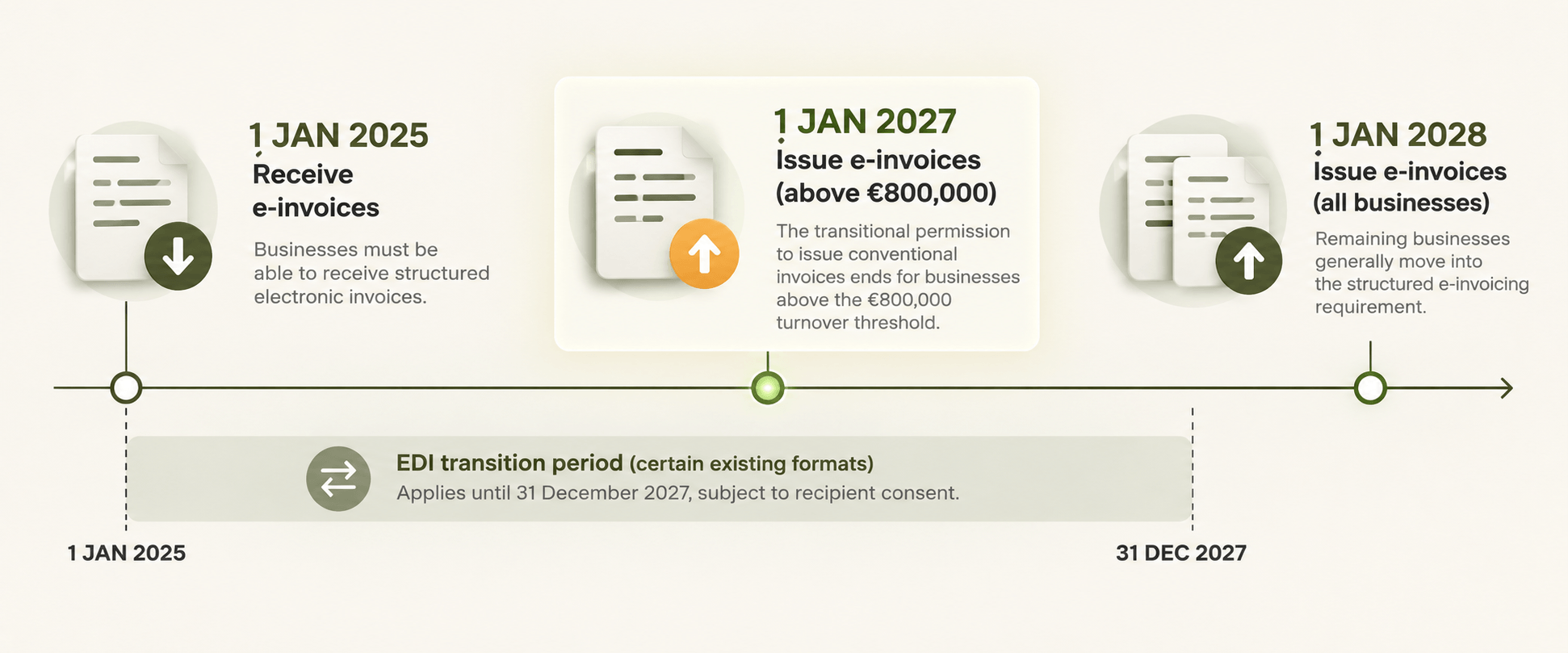
Most German businesses already handled the first step. Since 1 January 2025 they have had to be able to receive structured electronic invoices. The next step is harder. From 1 January 2027, businesses above the turnover threshold must also issue them.
An inbound mailbox that accepts XML is not the same as an accounts receivable process that produces valid XML for every customer, every time. If an outbound invoice fails validation, it does not get paid on time. For finance teams, the Germany e-invoicing mandate 2027 is a cash-flow risk before it is an IT project.
What Changes on 1 January 2027, and Who It Hits
The obligation comes from the Growth Opportunities Act (Wachstumschancengesetz), which amended §14 of the German VAT Act (UStG). The 2025–2027 transition rules allow paper and PDF invoices for a limited time. That allowance ends in two steps.
The €800,000 Test
From 1 January 2027, the transitional permission to issue conventional invoices ends for businesses whose prior-year turnover exceeded €800,000. For the 2027 deadline, the relevant year is 2026.
Groups should check each German legal entity on its own. Do not assume the consolidated group figure decides every entity's obligation.
The 2028 and EDI Dates
Businesses below the threshold generally have until 1 January 2028. A separate transition period, running until 31 December 2027, covers certain existing EDI formats that do not yet meet the new requirements. It applies only if the recipient consents. If your trading partners exchange invoices over EDI today, that is one year to confirm the connection will stay compliant. Our EDI integration team reviews exactly this kind of legacy connection.
Where Outbound E-Invoicing Breaks AR
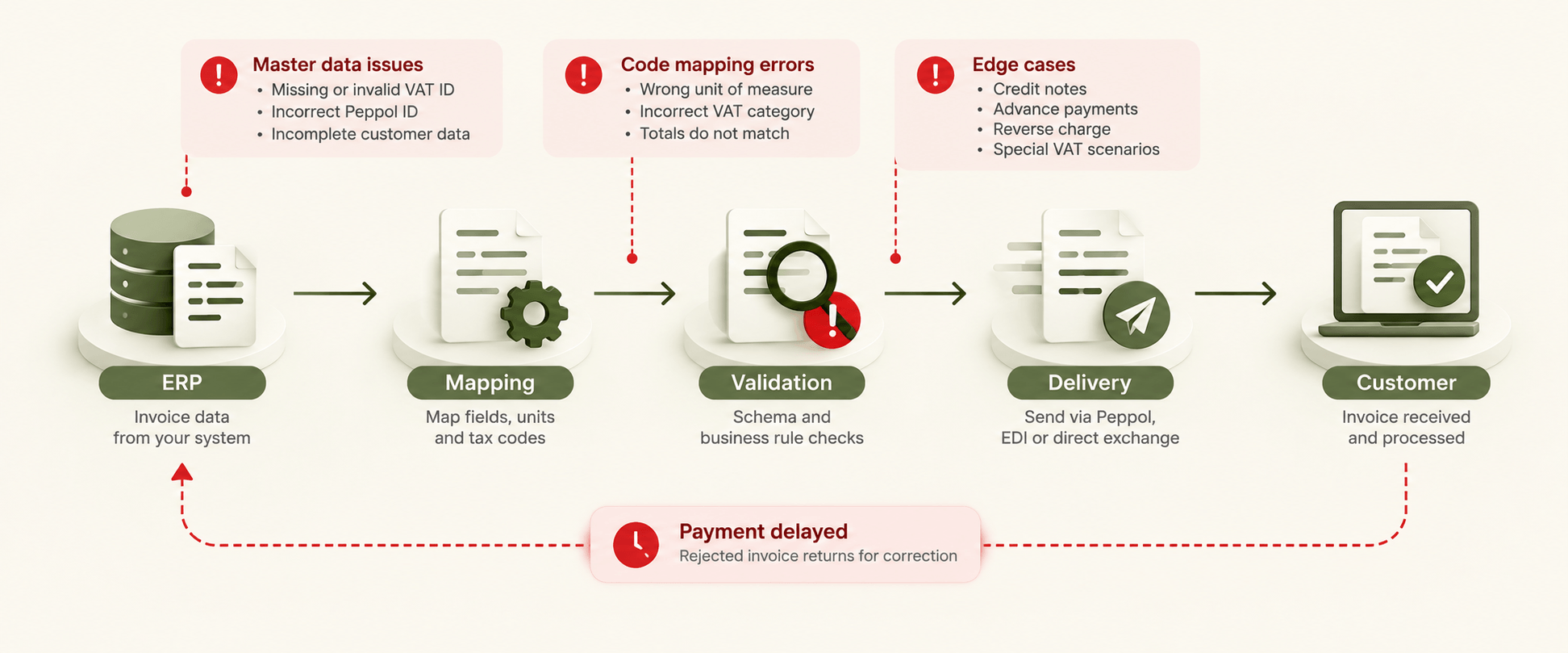
When a PDF invoice is wrong, an AR clerk can correct it by phone. When a structured invoice is wrong, it is rejected automatically, often before anyone sees it.
Validation Rejections Become Payment Delays
An invoice can look complete and still fail schema or business-rule validation. Typical causes are a missing mandatory field, a VAT category mapped to the wrong code, or line totals that do not reconcile. Each rejection restarts the payment clock.
Master Data Gaps
Outbound compliance depends on the quality of your master data. Before go-live, check:
customer USt-IdNr. and Steuernummer values
Peppol participant IDs for customers who receive invoices through the network
internal units of measure and tax codes that need mapping to the standard code lists
Edge Cases
Standard invoices usually pass first. The harder documents are credit notes, Anzahlungen (advance payments) and reverse-charge transactions. Test these deliberately, not after a customer complains.
XRechnung or ZUGFeRD: Choosing the Output Format
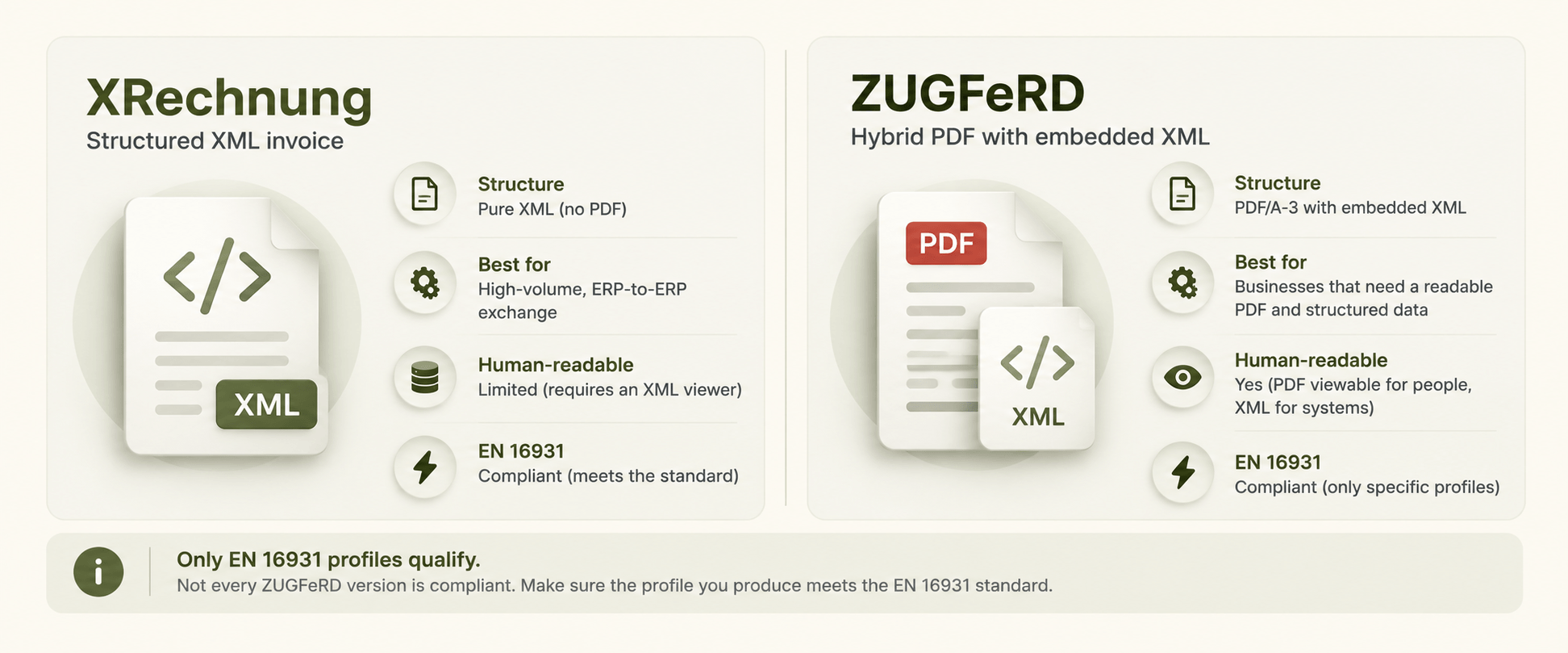
Both formats can meet the EN 16931 standard. Choose based on your customers and your degree of automation.
Structured XML or Hybrid PDF
XRechnung is pure XML. It suits high-volume, ERP-to-ERP exchange. ZUGFeRD embeds XML in a readable PDF, which helps when customers still check invoices visually.
A PDF With Attached XML Is Not Automatically Compliant
Only certain ZUGFeRD profiles meet EN 16931. Confirm the version and profile you produce. Do not rely on a file simply because it contains XML. Our PDF to XML invoice conversion service covers the structured output side.
Integration Layer vs. ERP Rebuild
Many companies assume compliance means a new ERP or a large upgrade. Usually it does not.
Keep the ERP You Have
An integration layer reads invoice data from your existing system, maps it, and produces the required format. HubBroker connects to Microsoft Dynamics 365 Business Central, Finance & Operations, e-conomic and others without replacing them. SAP users can read our breakdown of what to fix in SAP Business One before January 2027.
Validate Before Delivery
Validation should run before an invoice leaves your network, not after the customer rejects it. HubBroker validates structure and business rules, then routes each invoice through Peppol, EDI or direct exchange, depending on the recipient. Every transaction is visible in one place.
A 90-Day Readiness Checklist for Finance and IT
Days 1–30: Scope. List the in-scope legal entities, their billing systems and their 2026 turnover. Identify which customers use EDI and which use Peppol.
Days 31–60: Data and mapping. Clean VAT IDs, collect Peppol IDs, map units and tax codes, and choose XRechnung or ZUGFeRD for each customer group.
Days 61–90: Test and pilot. Validate real invoices, including credit notes and reverse charge, then go live with a small group of trading partners before rolling out further.
For a broader plan, see our e-invoicing implementation roadmap.
FAQ
Does the 2027 mandate apply to cross-border invoices? The obligation covers domestic B2B transactions between businesses established in Germany. Check your specific flows with your tax advisor.
Is a PDF sent by email still valid in 2027? Not for businesses above the €800,000 threshold, once the transitional permission ends on 1 January 2027.
Do I need Peppol in Germany? No. Germany does not require a specific transmission network. Peppol is a practical option when your customers are already connected to it.
What happens to our existing EDI? Certain EDI formats can continue until 31 December 2027 under specific conditions, including recipient consent. Plan the move to a compliant format now.
How is the €800,000 threshold calculated? It is based on the previous calendar year's turnover and assessed for each entity. Confirm the exact calculation method with your tax advisor.
Is any ZUGFeRD version acceptable? No. Only profiles that meet EN 16931 qualify. Check the profile your system outputs.
Get Your Outbound Flow Ready Without Rebuilding
The 2027 deadline does not require replacing your ERP. It requires reliable data, validated output and a delivery route to every customer. If you want to see where your current invoice flow would fail, book a walkthrough with our integration team.
