
EDIFACT INVOIC in Germany After 2027: Will Your EDI Invoices Still Count?
If your outbound EDIFACT INVOIC can't be mapped to EN 16931, it stops being a valid E-Rechnung in Germany from 1 January 2028. When that happens, your customer's Vorsteuerabzug is exposed. You don't need to replace EDI. You need to prove that every invoice it carries holds the data the German tax authority expects.
This post explains what changes and how to test your existing flows. If you need the full German timeline first, see our Germany e-invoicing overview.
What changes for EDI on 1 January 2028
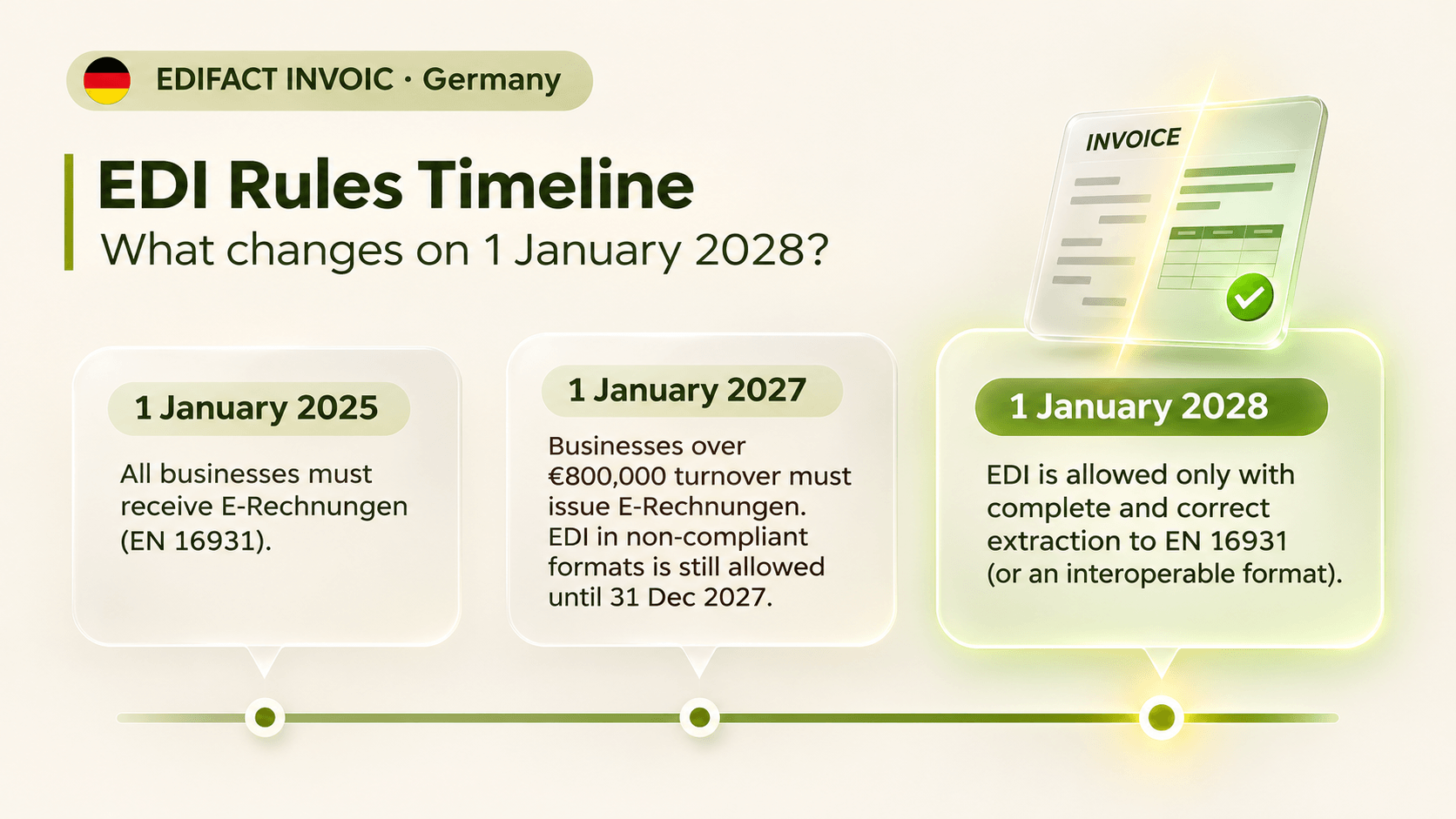
Germany's Wachstumschancengesetz redefined the E-Rechnung. It is now a structured electronic invoice that meets EN 16931. EDI was given its own transition rules.
The transition rule: until 31 December 2027
Until the end of 2027, invoices exchanged by EDI may use formats that don't meet the E-Rechnung definition. Your established EDIFACT subsets keep working unchanged, provided both parties agree to use them.
The permanent rule: from 1 January 2028
After 2027, EDI is allowed only under one condition. The invoice data must be extractable, correctly and completely, into a format that complies with EN 16931 or is interoperable with it. Both parties must also agree on the format. EDIFACT survives, but only where the content passes this test.
EDIFACT and EN 16931 in Germany: what "extraction" means in practice
EN 16931 defines a semantic data model of business terms (BT) and business groups (BG). Extraction means that every mandatory VAT data point in your INVOIC can be mapped to the right term without loss or guesswork.
Rechnungspflichtangaben mapped to business terms
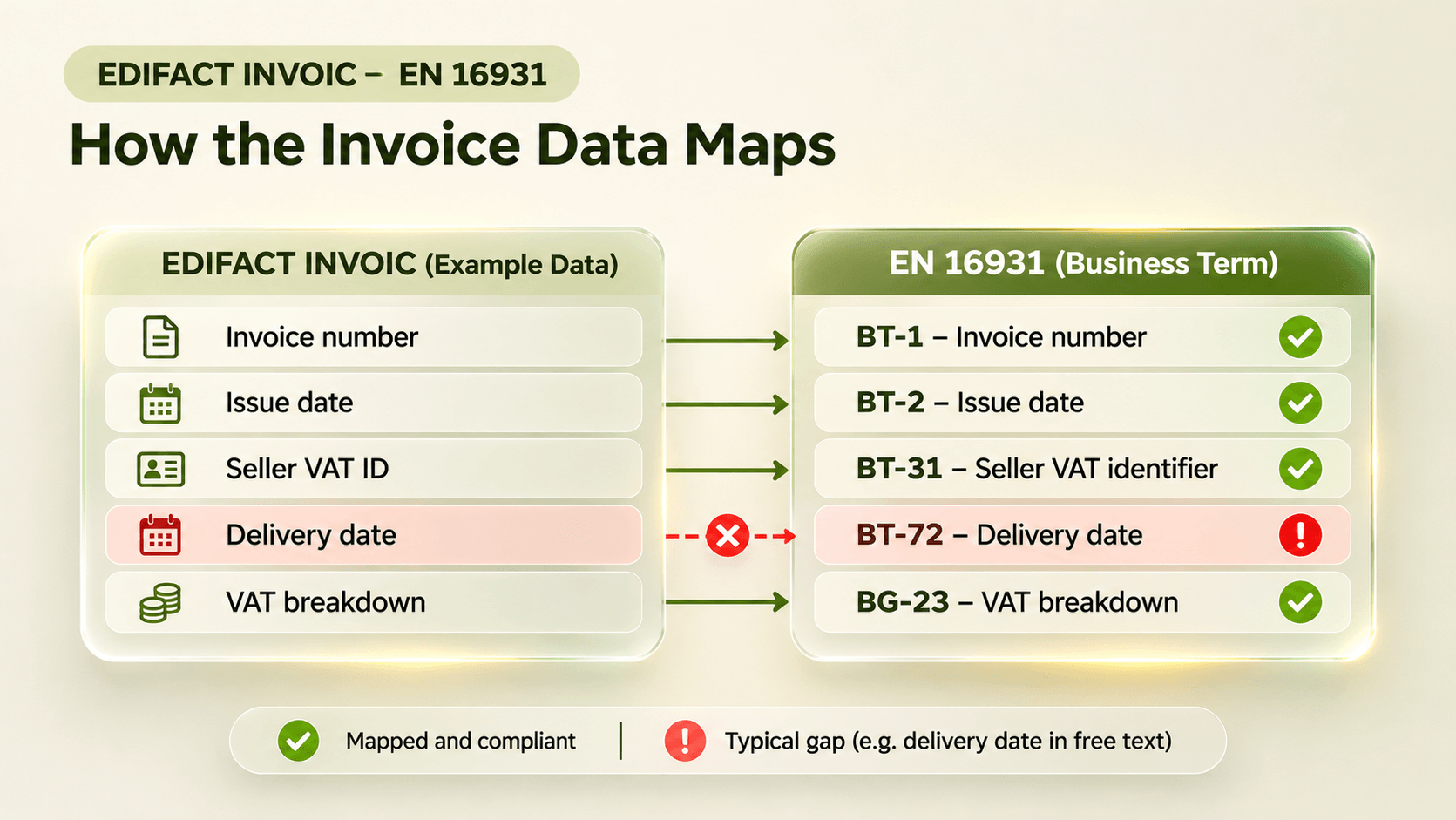
The test starts with the Rechnungspflichtangaben in § 14 Abs. 4 and § 14a UStG. Each one has to land in a defined EN 16931 field. Examples include the invoice number (BT-1), the issue date (BT-2), the seller VAT identifier (BT-31), the delivery date (BT-72) and the VAT breakdown (BG-23). If a value sits in free text, or in an attachment instead of a structured segment, extraction fails.
Where INVOIC subsets typically fall short
Most German INVOIC flows were built years ago around one retailer or industry guideline. Common gaps include:
tax information carried only at line level
delivery dates missing or carried as a period without a clear type
payment terms written in free text
code lists that don't match EN 16931 values, such as units of measure or VAT category codes
A mapping-layer approach to EDI integration lets you close these gaps per trading partner without changing the ERP that produces the data.
Three questions to ask about every INVOIC flow
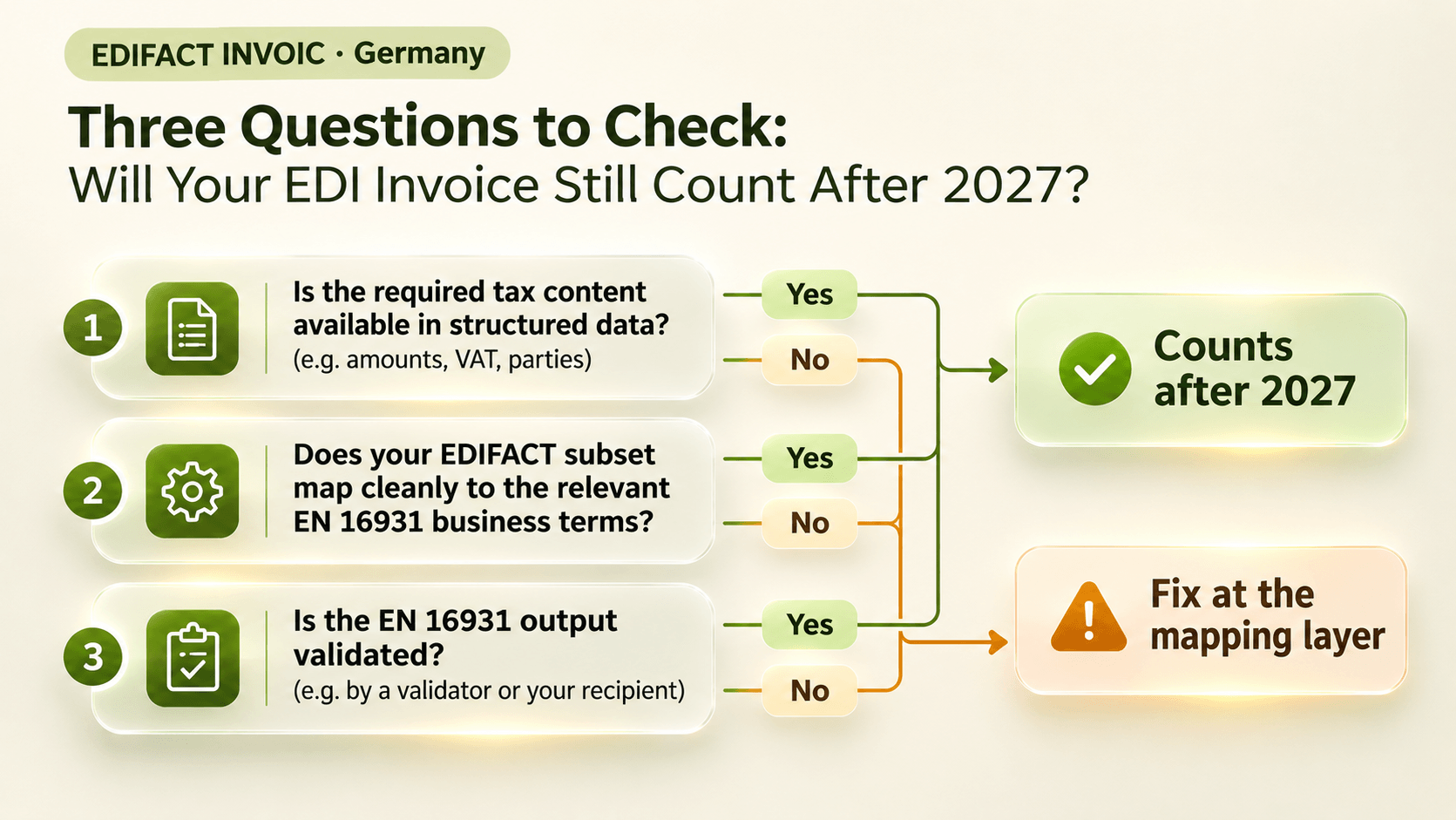
Is the full tax content in the structured data?
The structured message is the invoice. If key data exists only in an embedded PDF or a free-text segment, treat the flow as non-compliant.
Does your subset map cleanly, including industry variants?
Sector formats need particular attention. The German energy industry has formally asked the BMF for legal certainty that EDI@Energy-INVOIC remains a valid E-Rechnung after 2027. If an entire sector is asking, check your own retail, automotive or wholesale subsets as well.
Can you validate the EN 16931 output before invoices leave?
Map a sample of real invoices to EN 16931 XML, then validate the result against the schema and business rules. Our free XML and e-invoice validator checks EN 16931 UBL and CII files, including XRechnung. That gives you a fast way to test the target side of your mapping.
Your 2027 action plan
Inventory outbound INVOIC by partner and subset
List every German B2B trading partner, the INVOIC subset and version you send them, and the channel you use (AS2, VAN, SFTP).
Gap-map to EN 16931 and fix at the mapping layer
For each subset, compare segment usage against the EN 16931 business terms. Fix master data first: VAT IDs, units of measure and tax codes cause most validation failures. We cover the same master-data problems for SAP users in SAP Business One and German e-invoicing.
Agree the format with each partner in writing
The rule after 2027 depends on agreement between issuer and recipient. Document it in your EDI agreements, not only in your mapping specs.
What the BMF letters do and don't settle
The BMF has issued three application letters on the E-Rechnung, dated 15 October 2024, 15 October 2025 and 15 October 2026. The 2026 letter clarifies how format errors differ from business-rule errors. It also states that issuing a sonstige Rechnung where an E-Rechnung was required is not an Ordnungswidrigkeit. The BMF FAQ give orientation but have no binding legal effect. Base your decisions on the letters and on advice from your tax adviser.
FAQ
Can I keep sending EDIFACT INVOIC after 2027? Yes, if the data can be extracted correctly and completely into an EN 16931-compliant or interoperable format, and both parties agree to use it.
Does EDIFACT count as an E-Rechnung today? Under the transition rules, EDI invoices in non-compliant formats are accepted until 31 December 2027. Compliant extraction becomes mandatory after that date.
Do I have to switch to XRechnung or ZUGFeRD? No. Those are common EN 16931 formats, but EDIFACT can stay if it passes the extraction test.
What about inbound EDIFACT invoices from suppliers? The same rule applies. If supplier invoices fail extraction after 2027, your own input VAT deduction is at risk. Audit inbound flows as well as outbound.
Is a PDF attachment inside an EDI message enough? No. The required data must be in the structured part of the message.
Check your INVOIC flows before 2027 ends
Most EDIFACT flows need targeted mapping fixes, not a new platform. If you want a second pair of eyes on your German INVOIC subsets, book a demo and we'll walk through how HubBroker maps and validates them against EN 16931, with your ERP left as it is.
