
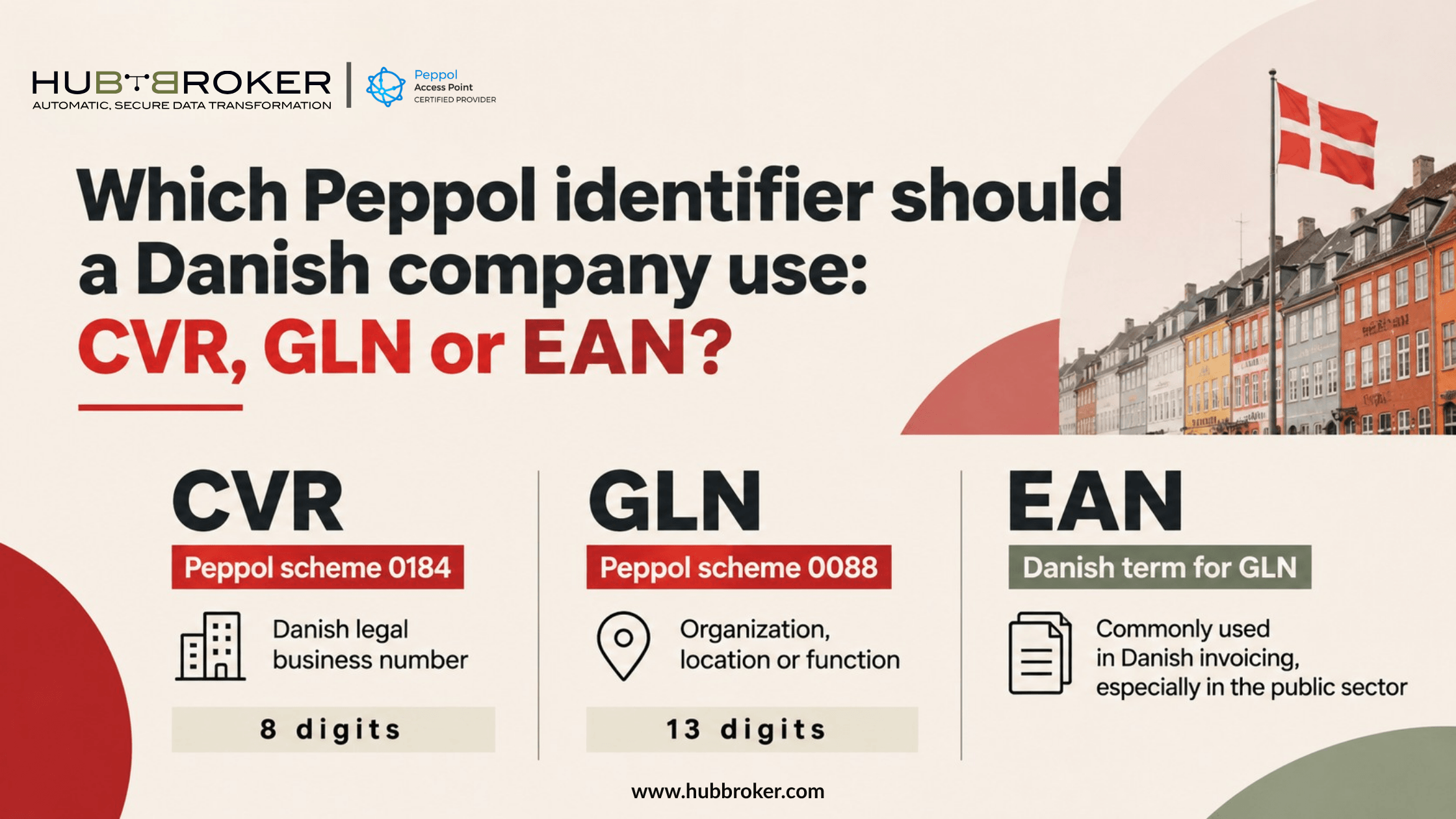
Which Peppol identifier should a Danish company use: CVR, GLN or EAN?
A Danish supplier sends an electronic invoice, but the customer says nothing arrived. The invoice itself might be perfectly valid. The receiving address could be wrong.
Anyone asking “Which Peppol identifier should a Danish company use” will soon come across CVR, GLN and EAN. They appear in customer instructions and ERP settings, but are not interchangeable in practice.
CVR, GLN and EAN identify different things
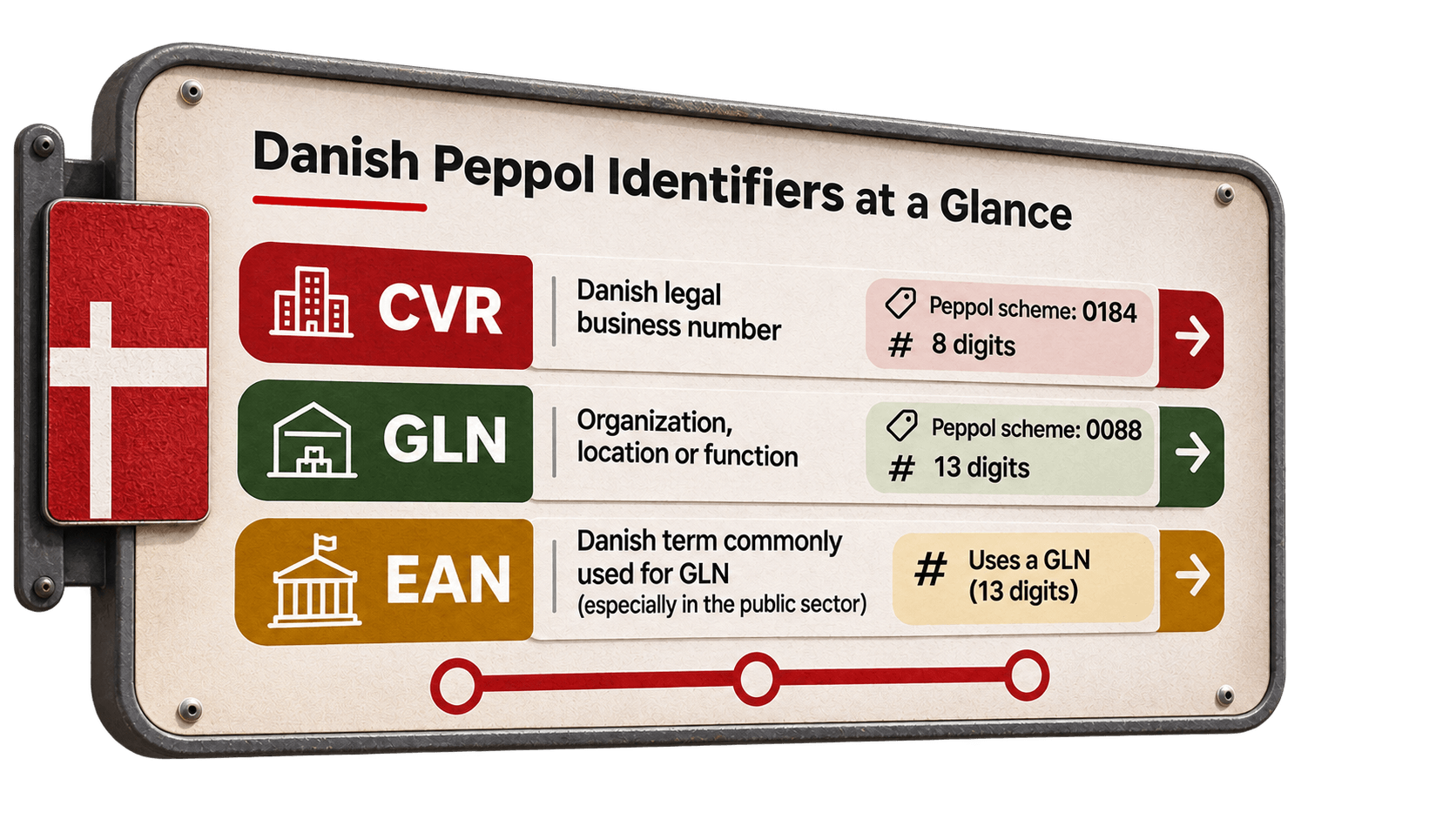
A CVR number identifies a legally registered Danish business. It has eight digits. A company may use its CVR as a single electronic invoicing address for the legal entity. In Peppol, the Danish CVR scheme code is 0184, so an illustrative participant address is 0184:12345678. This is only an example.
A GLN (Global Location Number) has 13 digits and follows GS1 standards. It can identify an organization, location or business function. Its Peppol scheme code is 0088. It can direct invoices to a specific unit. In Danish invoicing, people often say “EAN number” when they mean a GLN, particularly for public-sector customers. EAN is not another Peppol scheme that should be substituted for GLN. The participant address handles routing, not invoice tax details or buyer references.
Identifier or detail | What it means | What to check |
|---|---|---|
CVR | Danish legal business number | Eight digits |
Scheme 0184 | Peppol scheme for CVR | Recipient registration |
GLN | Organization, location or function | Thirteen digits |
Scheme 0088 | Peppol scheme for GLN | Exact receiving unit |
EAN number | Danish term commonly used for GLN | Customer's specified number |
Participant address | Scheme plus receiving identifier | Network reachability |
Buyer reference | Information within the invoice | Customer's required reference |
Which identifier works best for Danish business customers?
For a business that receives all invoices centrally, CVR may be the simplest choice. It avoids unnecessary location numbers. Still, having a CVR number does not mean that the company can receive every Peppol document. Its endpoint and accepted document types must be registered through a suitable provider.
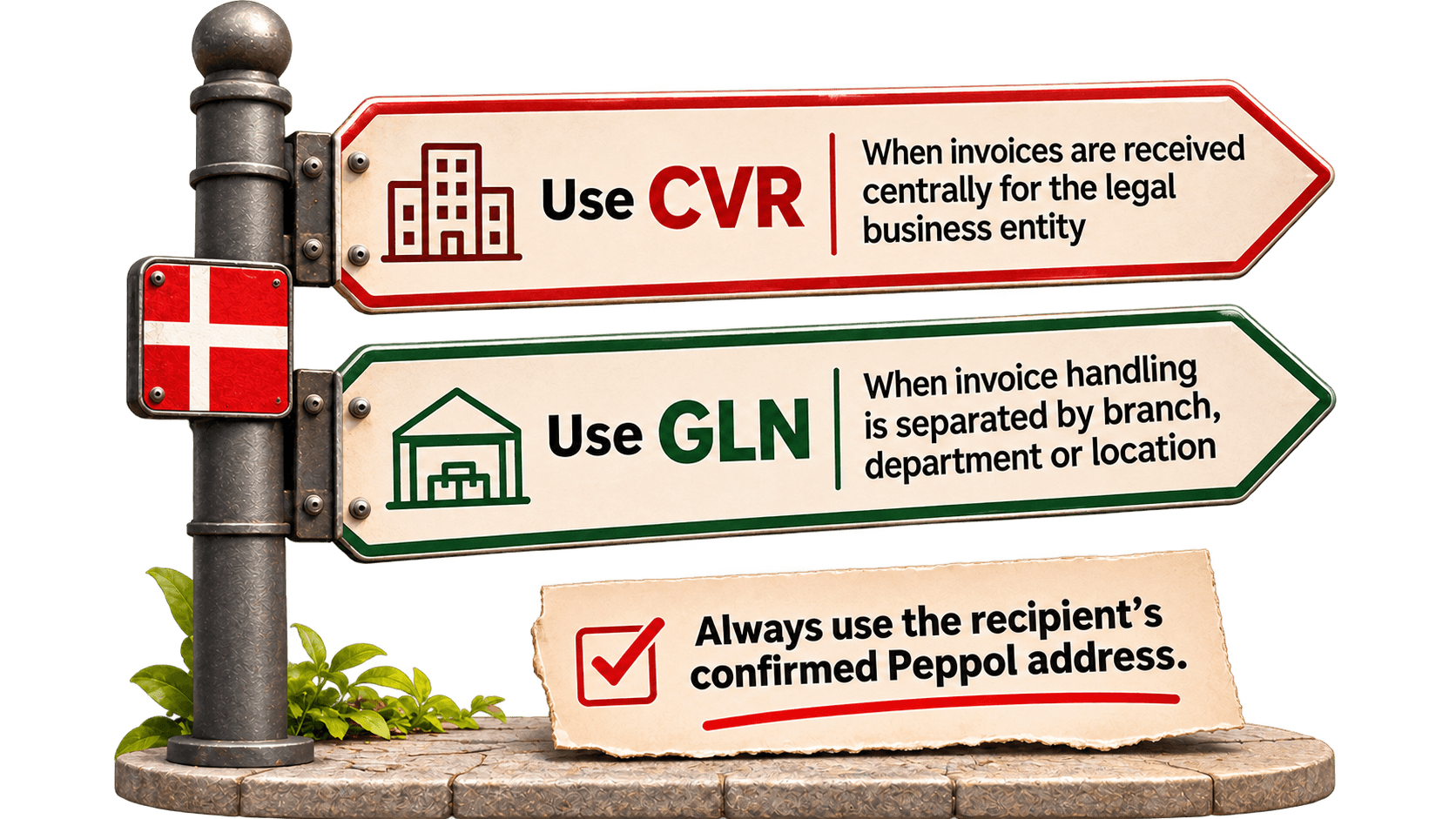
GLN makes more sense when an organization separates invoice handling by branch, department or purchasing function. A retailer with several stores under one CVR may assign each an invoicing GLN. The deciding factor is the customer's actual receiving setup. If the customer provides a GLN, do not replace it with the company's CVR merely because the business name matches. A valid address may still be wrong.
Why Danish public-sector invoices still mention EAN
Danish authorities have used electronic invoice addresses commonly described as EAN numbers for years. When an authority asks for its EAN and a purchase reference, follow those instructions. Also confirm the document format and network. Denmark also operates NemHandel, the national infrastructure for exchanging electronic business documents. NemHandel registration and Peppol registration should not be assumed to be identical.
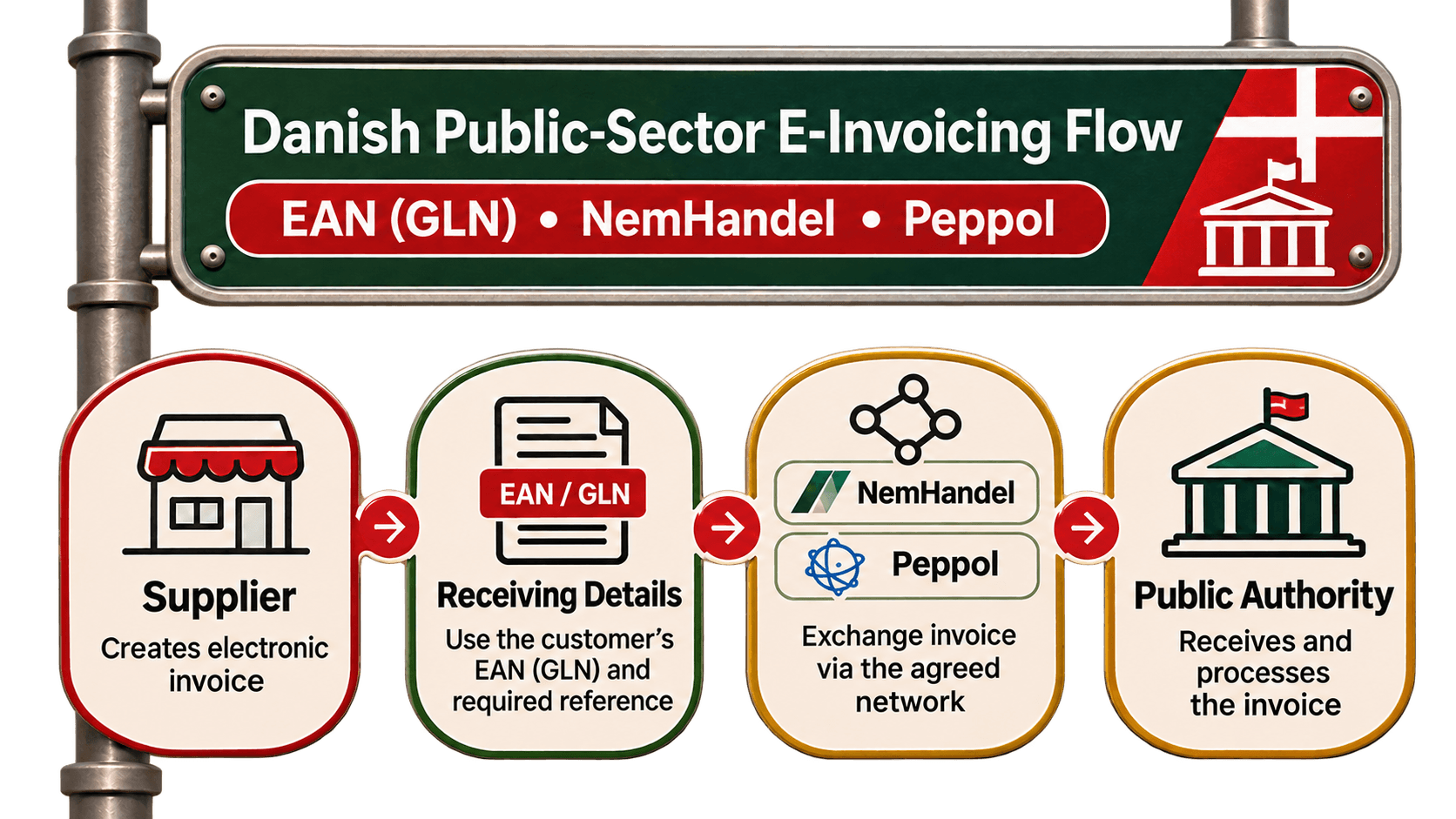
Danish bookkeeping requirements cover electronic invoicing with OIOUBL and Peppol BIS formats, while invoices sent to public authorities must be electronic. A correctly addressed invoice may still be rejected. Missing order references, incorrect structured fields or an unsupported invoice format can cause problems after routing succeeds. Check whether delivery or acceptance failed.
How to confirm the right Peppol address before sending
Ask for the full receiving address. Get the scheme code, identifier, accepted invoice format and required purchase or department reference directly from the customer.
Check the numbering scheme. Use 0184 for a Danish CVR endpoint or 0088 for a GLN endpoint, according to the address supplied. Do not guess or swap between them.
Verify registration. Use an appropriate Peppol lookup or ask your access point provider to confirm that the participant is reachable for the intended document type. Check NemHandel registration separately when using that network.
Update your customer record. Save the confirmed endpoint and references in your ERP or invoicing system. This reduces repeated typing and keeps future invoices consistent.
Review delivery and rejection responses. Where agreed, send a test document. Check technical results and any business-level rejection, then update your records if the customer changes its setup.
HubBroker connects Danish invoice identifiers to reliable document delivery
Managing multiple customer addresses is harder, particularly through an ERP. HubBroker helps businesses connect those workflows to electronic document exchange using Peppol connectivity, document mapping and format conversion.
HubBroker can help align trading-partner records with the identifier and invoice format each recipient requests. Structured data handling and validation can also help catch avoidable document issues before transmission, although no system can promise that every invoice will be accepted. For Danish companies, the practical rule is simple: use the receiving identifier the customer specifies. CVR may suit a legal entity; GLN may point to a particular function or location; EAN usually refers to GLN in this context. Confirm the network, supported format and references before sending.
Ask HubBroker about integrated invoicing when manual updates become difficult.
