
Which partners integrate SAP Business One with EDI and Peppol in Germany
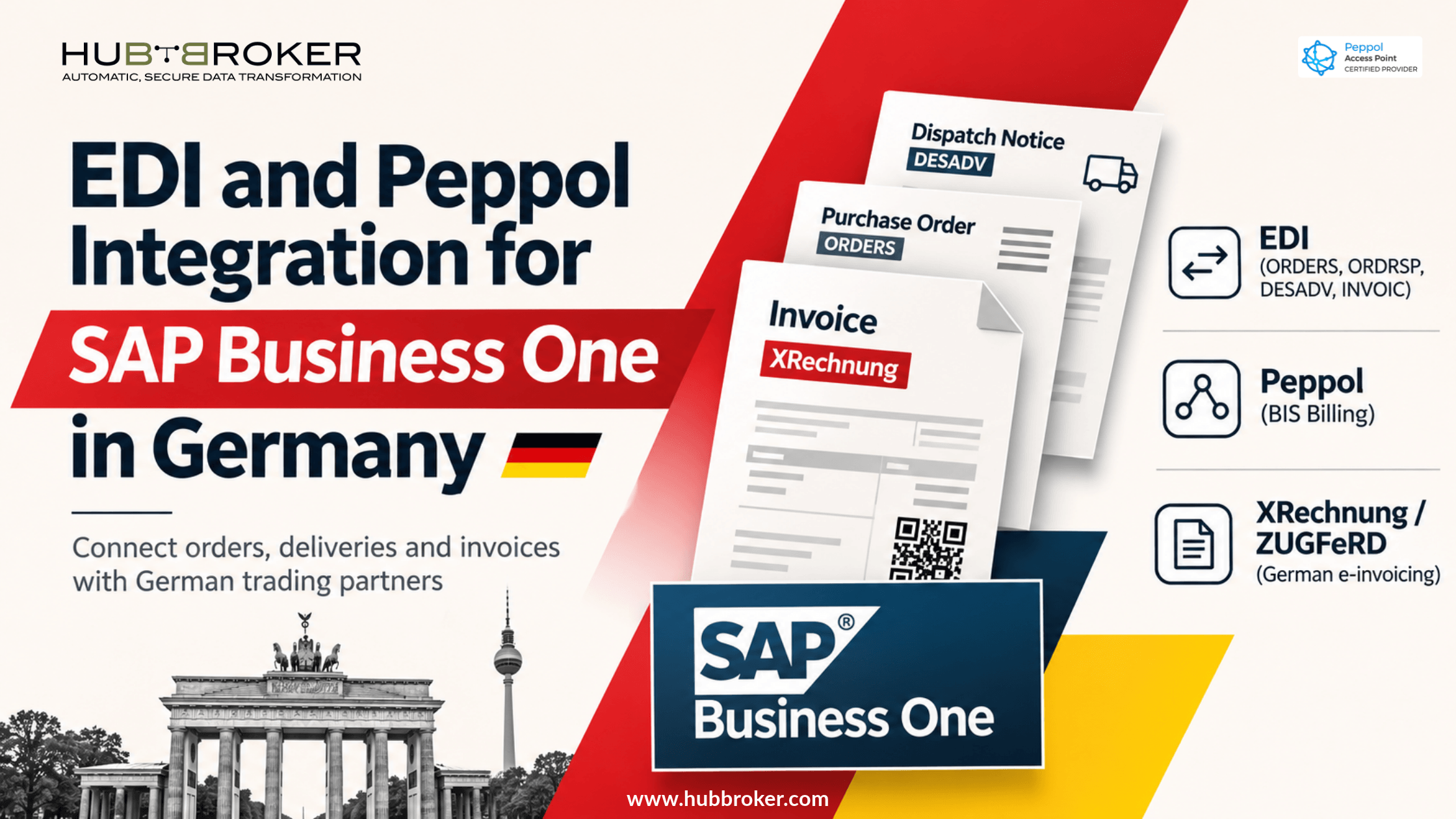
A growing wholesale business may already use SAP Business One to manage purchasing, stock and invoices. However, exchanging documents with customers often involves working with several separate systems. Companies looking to integrate SAP Business One with EDI and Peppol in Germany can consider HubBroker or the German partnership between PART and EDICENTER. SAP also provides its own Peppol functionality. Choosing between these options depends on whether a business needs electronic invoicing, supply chain document exchange or a combination of both.
Which integration partners support SAP Business One?
HubBroker connects SAP Business One with customers and suppliers through its integration platform. Businesses can exchange electronic orders and invoices, use Peppol and manage different document formats and communication channels through a common integration layer. PART and EDICENTER have developed an EDI interface for SAP Business One together. It covers purchasing, delivery information, transport orders and invoicing. The solution supports Peppol and AS2 connections as well as document formats such as EDIFACT and XML.
SAP offers Peppol connectivity through its Electronic Document Service and Document and Reporting Compliance cloud edition. Companies that also need retail or logistics EDI connections may require additional integration services. When comparing these options, check who maintains customer document mappings and how communication problems are handled when a document fails to reach its destination.
Need SAP Business One Integration with EDI and Peppol?Connect SAP Business One with German customers, suppliers, and the Peppol network through HubBroker. Automate EDI document exchange, streamline electronic invoicing, and manage partner-specific integration requirements without manual data entry. |
How do EDI and Peppol serve different business needs?
EDI allows businesses to exchange structured commercial documents directly between systems. For instance, a German retailer may send an EDIFACT purchase order and expect its supplier to send a dispatch notice before the goods arrive. Peppol works as a standardized document exchange network. SAP Business One users can reach participating government authorities and private customers without setting up individual technical connections with every recipient.
The table shows how common business documents relate to everyday SAP processes.
Document or standard | Business purpose | SAP Business One process |
|---|---|---|
ORDERS | Incoming customer orders | Create sales orders |
ORDRSP | Order confirmations | Send order responses |
DESADV | Shipment notifications | Export delivery documents |
INVOIC | Traditional EDI invoices | Exchange invoice data |
XRechnung | Structured German invoices | Convert invoice data |
Peppol BIS Billing | Electronic invoice exchange | Accounts receivable |
Credit note | Billing corrections | Process credit memos |
Some customers also request particular product identifiers, packaging details or delivery references that go beyond the information normally included in an invoice.
German electronic invoicing requirements for SAP B1 users
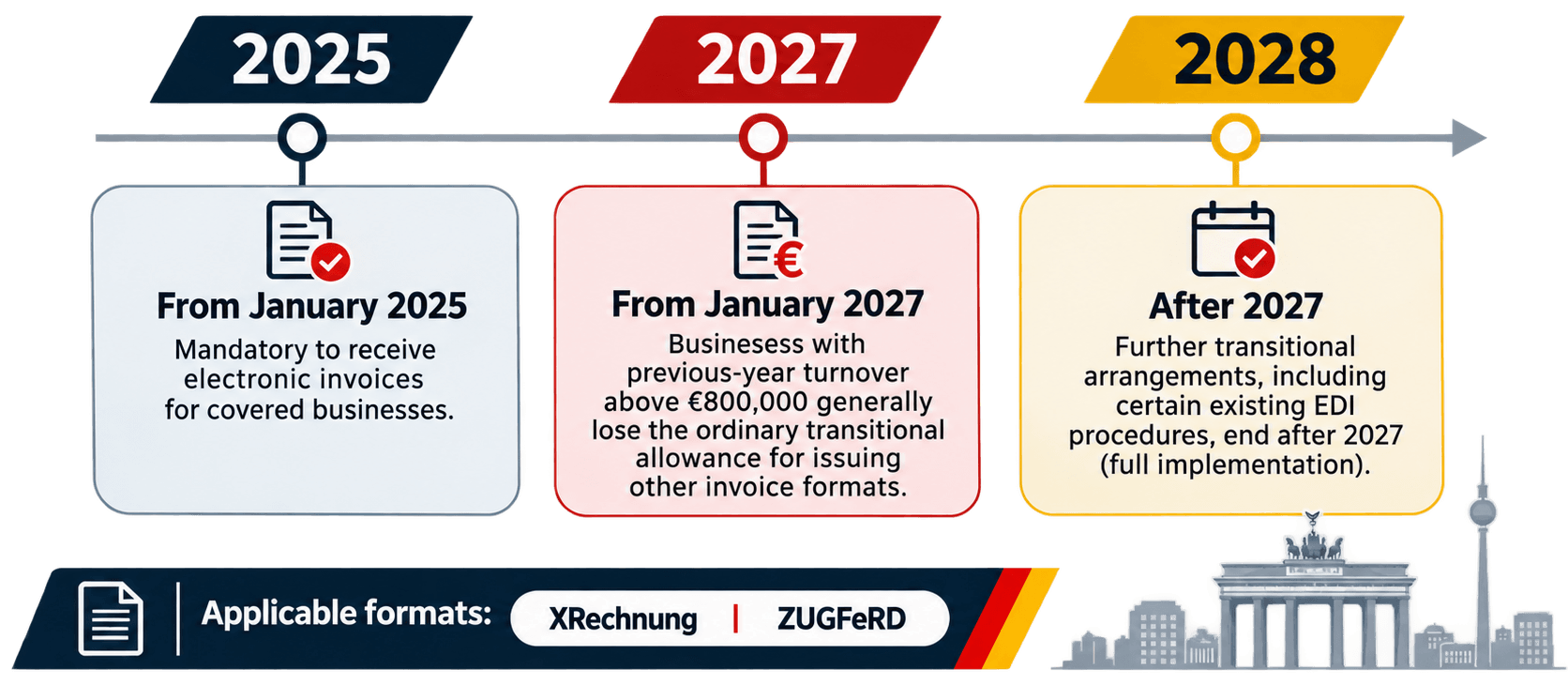
Since January 2025, businesses covered by Germany's domestic B2B invoicing rules have been required to receive electronic invoices. From January 2027, businesses with previous year turnover above €800,000 generally lose the ordinary transitional allowance for issuing other invoice formats. Further transitional arrangements, including certain existing EDI procedures, end after 2027.
XRechnung and qualifying ZUGFeRD profiles meet the applicable structured invoice format requirements. However, using Peppol is not mandatory for every German B2B invoice. Legal invoicing requirements and customer delivery preferences are two different things. Public authorities may also require a Leitweg-ID to identify the authority receiving the invoice.
How to assess an SAP Business One integration partner
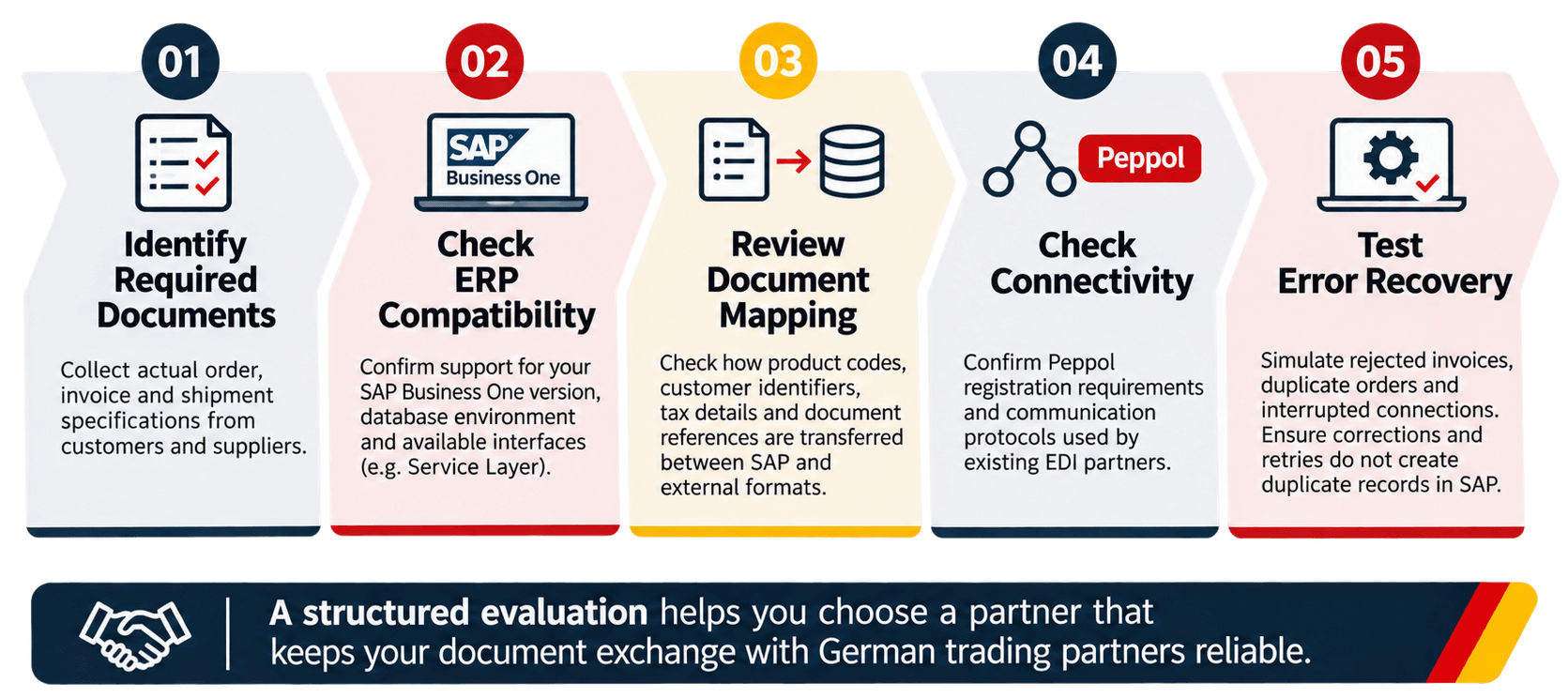
Checking whether a provider can generate an electronic invoice is only part of the assessment. Consider how documents move between systems from start to finish.
Identify required documents. Collect actual order, invoice and shipment specifications from customers and suppliers.
Check ERP compatibility. Confirm support for your SAP Business One version, database environment and available interfaces, including the Service Layer where applicable.
Review document mapping. Check how product codes, customer identifiers, tax details and document references are transferred between SAP and external formats.
Check connectivity. Confirm Peppol registration requirements and communication protocols used by existing EDI partners.
Test error recovery. Simulate rejected invoices, duplicate orders and interrupted connections. Make sure corrections and retries do not create duplicate records in SAP.
Ask the provider to demonstrate both incoming and outgoing document flows using data that represents your normal business activities.
Connecting German trading partners to SAP Business One through HubBroker
HubBroker combines EDI and Peppol connectivity through its iPaaS platform. Instead of building a separate connection for every customer, businesses can use an integration layer that converts, validates and routes documents according to each trading partner's requirements. For example, a retailer's incoming order can be converted into data that SAP Business One can process. The resulting customer invoice can then be converted into the required electronic format and sent through Peppol when appropriate.
HubBroker also provides transaction monitoring so finance and technical teams can investigate document processing problems without depending entirely on manual email communication. For German businesses, integration goes beyond meeting electronic invoicing requirements. Connecting purchasing, sales and delivery processes helps keep information consistent across trading partners while SAP Business One remains the central business system. Companies can book a free demo with HubBroker to discuss existing document flows, partner requirements and suitable integration options.
