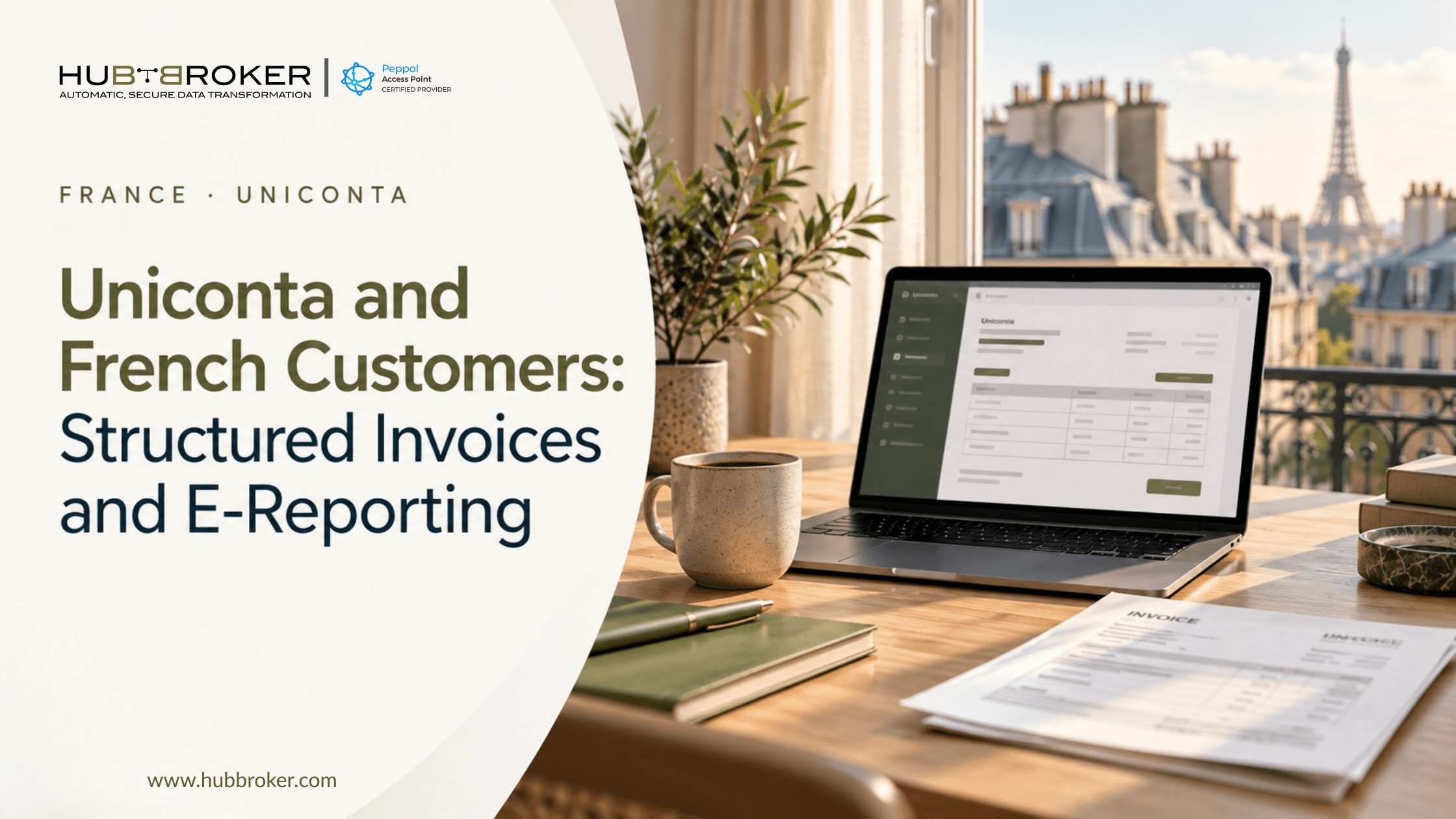
Uniconta and French Customers: Structured Invoices and E-Reporting
France switched on its e-invoicing reform on 1 September 2026. If your company runs Uniconta and invoices French customers, the obvious question is whether you now have to send structured invoices to France.
For most Danish suppliers, the short answer is no. The longer answer is that some Danish companies are in scope, and many more will see French customers change how they want to receive invoices. This guide explains the rules and shows where Uniconta France e-invoicing fits, so you can decide what to fix and what to leave alone.
What France’s E-Invoicing Reform Actually Requires
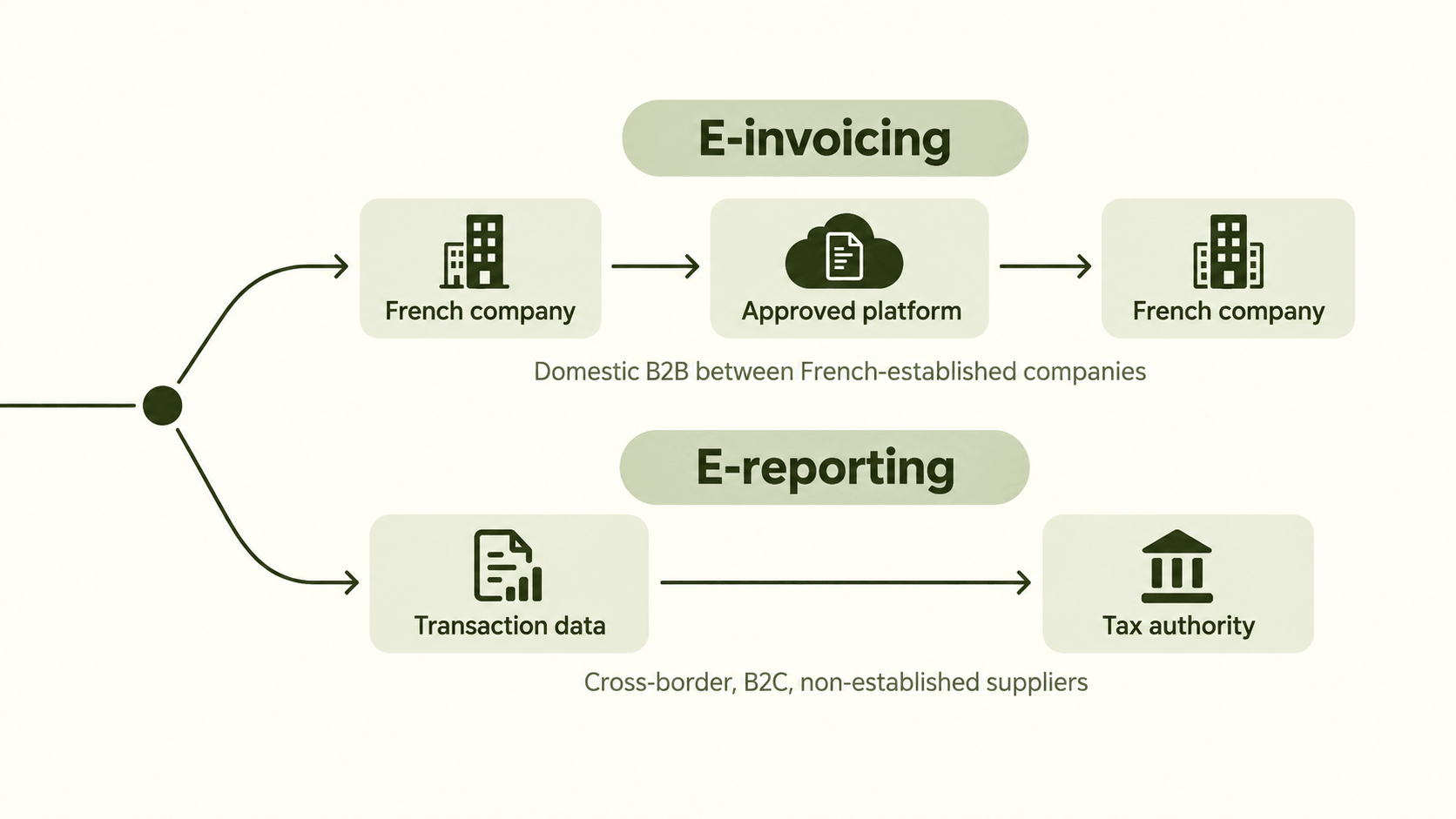
France has split its reform into two channels. Domestic B2B transactions between French-established taxable persons go through e-invoicing via certified platforms, while everything else, including B2C, cross-border, reverse charge, intra-EU acquisitions and non-established suppliers, flows through e-reporting.
Structured Invoices vs. PDF
A structured invoice is machine-readable data, not a picture of an invoice. France accepts three base formats: Factur-X (a hybrid PDF with embedded XML), UBL and CII. A plain PDF sent by email does not count as an e-invoice under the reform.
The Role of Approved Platforms
French companies send and receive e-invoices through approved platforms (plateformes agréées, previously called PDPs). These platforms also pass invoice and status data to the tax authority. The French tax authority publishes the list of approved platforms.
E-Reporting: Data, Not Invoices
E-reporting means sending transaction data, and in some cases payment data, to the tax authority for transactions that fall outside domestic e-invoicing. It is a data obligation. It does not change the invoice your customer receives.
Timeline
From 1 September 2026, all VAT-registered companies in France must be able to receive structured e-invoices via an approved platform, and large enterprises and ETIs must also issue them from that date. Small and medium-sized French companies must start issuing on 1 September 2027.
Does It Apply to a Danish Company Using Uniconta?
The key word in French guidance is established, not VAT-registered.
If You Are Not Established in France
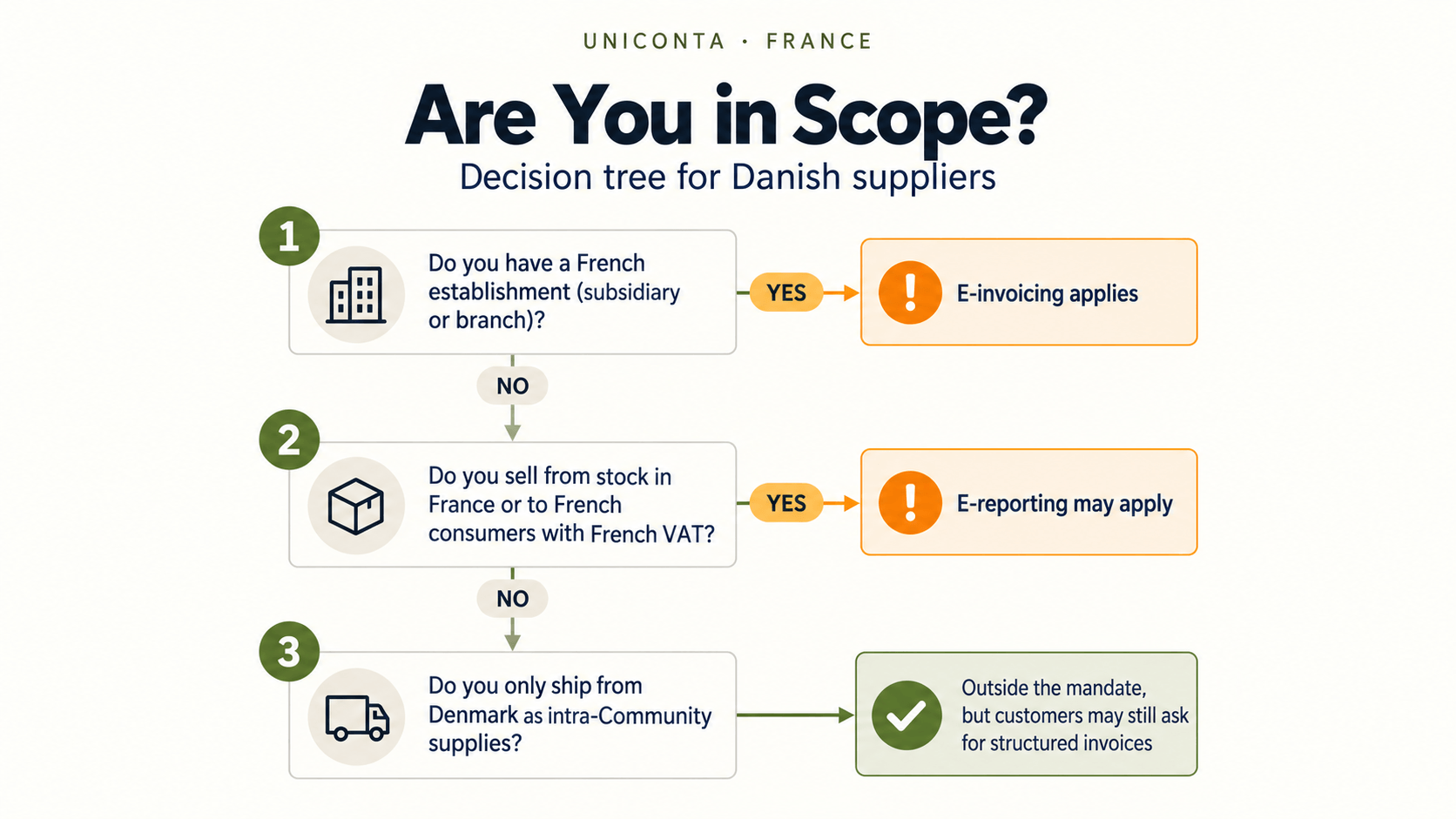
Businesses that are not established in France are exempt from the domestic B2B e-invoicing mandate, as the requirement applies only when both the issuer and the recipient are established in France. A Danish company that ships goods from Denmark to a French business customer, as a VAT-exempt intra-Community supply, is outside the e-invoicing mandate.
E-reporting is narrower than many assume. The French tax authority states that foreign companies without a permanent establishment have e-reporting obligations when they carry out transactions considered to take place in France and are liable for French VAT on them. Non-established businesses that are VAT-registered in France do not need to declare VAT-exempt transactions such as exports and intra-Community supplies in their e-reporting.
When a Danish Company Is in Scope
Look closer if any of these apply to you:
You hold stock in France and sell from it, so the supply takes place in France.
You sell to French consumers and charge French VAT.
You have a French subsidiary or branch. French branches and fixed establishments of foreign entities fall under the e-invoicing mandate for operations attached to that establishment.
For non-established companies that are in scope, large enterprises have had e-reporting obligations from 1 September 2026, and micro, small and medium-sized companies follow from 1 September 2027.
Scope depends on your actual transaction flows. For non-established businesses, scope is not automatic and requires careful analysis of transaction flows. Confirm your position with your revisor or VAT adviser.
When Your Customer’s Obligations Become Your Problem
Even if you are out of scope, your French customers are not. Their accounts payable teams now receive most supplier invoices as structured data through a platform. A PDF from a Danish supplier becomes the exception they handle manually.
The likely result is that customers ask for structured invoices, ask for invoices to be sent to a specific platform or Peppol address, or ask for more complete data such as SIREN numbers, order references and line-level detail. It is better to plan for that before a customer’s procurement team raises it.
Where Uniconta Fits
Uniconta holds the data a French-ready invoice needs: customer master data, VAT treatment, lines, references and payment terms. The challenge is getting that data into the format and channel each French customer expects. Check with Uniconta and your Uniconta partner which formats and delivery routes your current setup supports natively.
The Gap: From ERP Invoice to French-Compliant Delivery
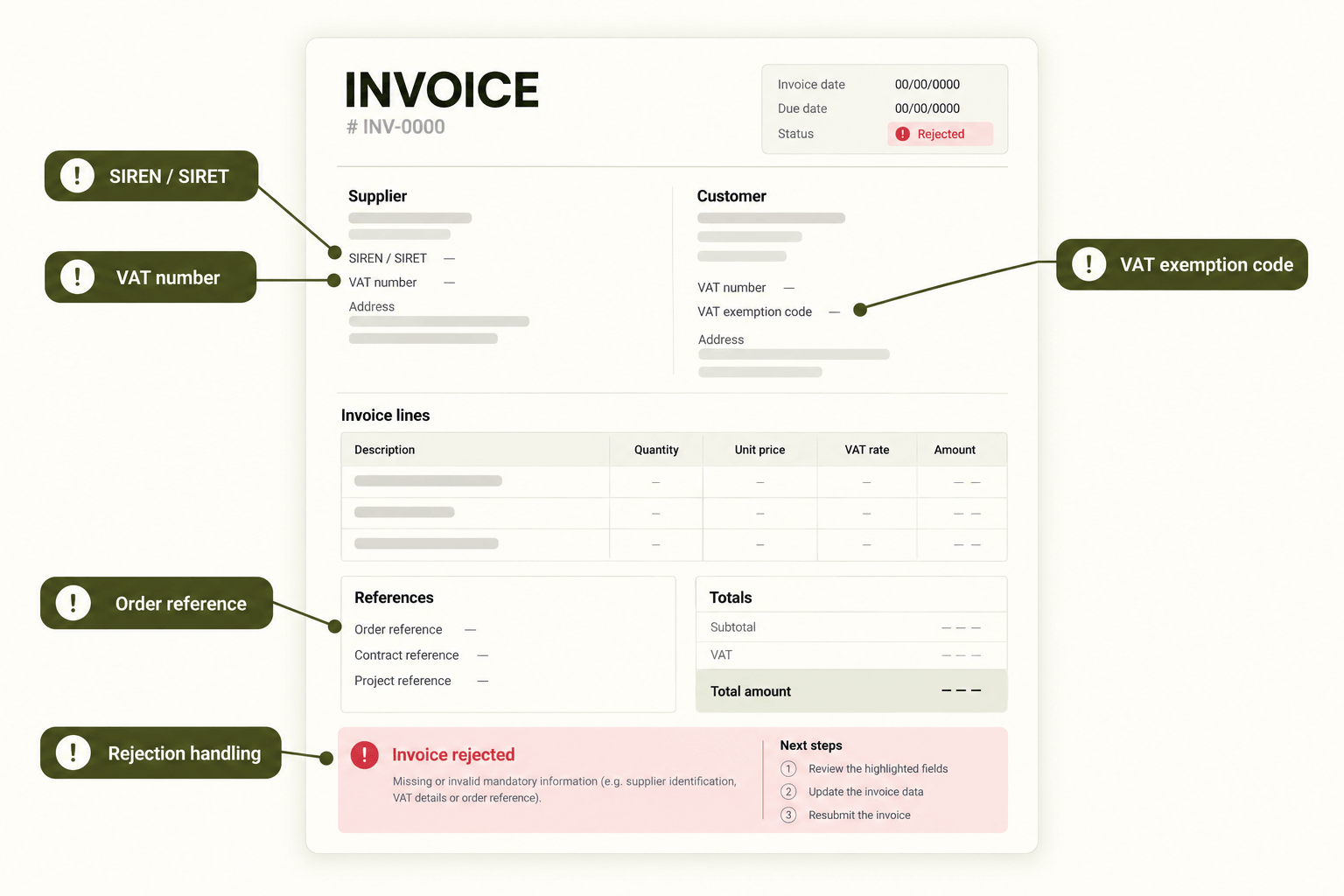
The gaps we see most often are in master data rather than software:
Missing SIREN or SIRET identifiers on French customers
Inconsistent intra-Community VAT numbers
Free-text order references instead of structured fields
VAT exemption reasons that are not mapped to a code
No process for handling rejected invoices
Connecting Uniconta to French Requirements with an Integration Layer
You do not need to replace your ERP to meet French customer expectations. An integration layer sits between Uniconta and your trading partners. It takes the invoice data Uniconta already produces and delivers it in the right format and through the right channel. That is the role of HubBroker’s Uniconta integration.
Mapping Uniconta Data to Structured Formats
Uniconta invoice data is mapped to the format each customer accepts, such as UBL, CII or Factur-X. The mapping also validates the data before sending, so a missing SIREN number is caught in Denmark rather than rejected in France. If you still produce PDF invoices from other systems, PDF to XML invoice conversion can bridge the gap.
Routing via Peppol and French Platforms
Many French customers can be reached through the Peppol network, alongside the French platform ecosystem. A single Peppol e-invoicing connection lets one Uniconta setup serve French, Belgian, Nordic and German customers. Read more about our e-invoicing solution or compare requirements in our e-invoicing by country overview.
Handling Status Messages and Rejections
French invoices carry lifecycle statuses such as received, approved, rejected and paid. An integration layer can return these statuses to your finance team, so a rejected invoice shows up as a task instead of as an overdue payment three weeks later.
A Practical Preparation Checklist for Finance Leads
Map your French flows. List every invoice type to France: goods from Denmark, services, stock held in France and consumer sales.
Confirm scope with your adviser. Establishment and French VAT registration decide your obligations, not invoice volume.
Clean customer master data in Uniconta. Add SIREN/SIRET numbers and verify VAT numbers and invoice addresses.
Ask your top French customers how they want to receive invoices from 2026-2027.
Choose formats and channels. Decide between UBL, CII, Factur-X and Peppol for each customer.
Test before switching. Run test invoices, including a deliberate rejection.
Our e-invoicing implementation roadmap covers these steps in more detail.
FAQ
Do I need to send structured invoices to French customers from Uniconta?
Not if you are a Danish company without a French establishment selling cross-border. The French e-invoicing mandate covers French-established parties. Your customers may still ask for structured invoices for practical reasons.
Is a PDF invoice still accepted in France?
For invoices from non-established foreign suppliers, the mandate does not require a structured format. Between French-established companies, a plain PDF no longer meets the requirement once each phase applies.
What is e-reporting, and does it apply to foreign sellers?
E-reporting is the transmission of transaction and payment data to the French tax authority. It applies to foreign companies only for transactions taking place in France on which they owe French VAT, not to exempt intra-Community supplies.
Can Peppol be used to reach French buyers?
Peppol is one route into the French ecosystem. Check with each customer which channel and platform they use.
How long does a Uniconta France e-invoicing setup take?
It depends on data quality and the number of customers and formats. Clean master data is usually the biggest factor.
Getting Uniconta Ready for French Customers
France’s reform does not put most Danish Uniconta users under a legal obligation today. It does change what French customers expect. Clean data, the right format and a reliable delivery channel now prevent payment delays later.
If you want to see how your Uniconta invoices would look in French-ready formats, book a demo with HubBroker and we’ll walk through your current flows.
