
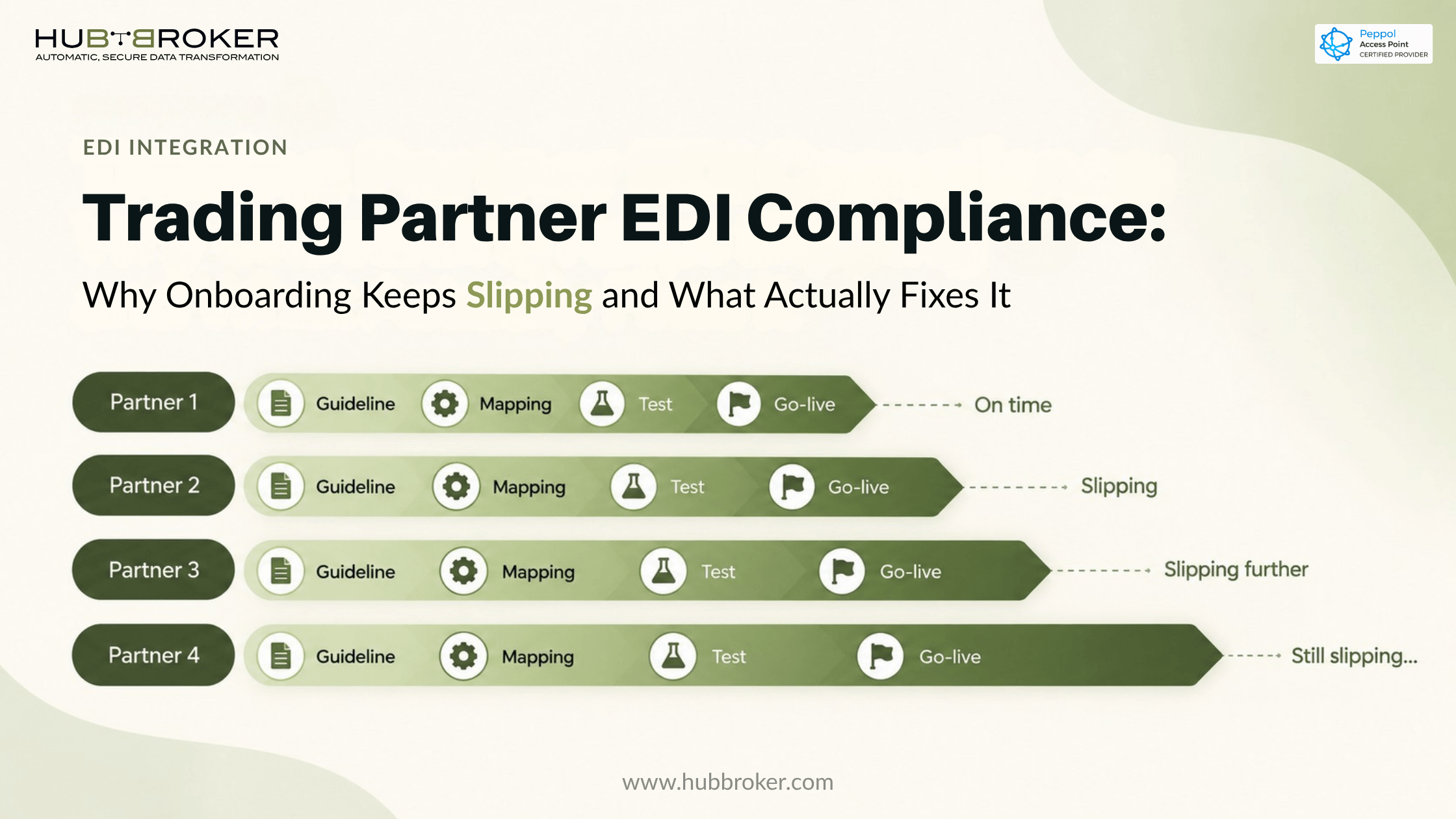
Trading Partner EDI Compliance: Why Onboarding Keeps Slipping and What Actually Fixes It
Your retailer sends over a compliance packet. Forty pages. Somewhere on page 23 there's a note about how they want the delivery note reference formatted, and it's different from how every other customer wants it.
You miss it. Three weeks later the ASNs start bouncing, the buyer's system flags late shipment notices, and someone in finance forwards you an email with the word "chargeback" in it.
That's trading partner EDI compliance in practice. Not a standard you meet once, but a moving set of rules that differ per partner and keep changing underneath you.
What trading partner EDI compliance actually means
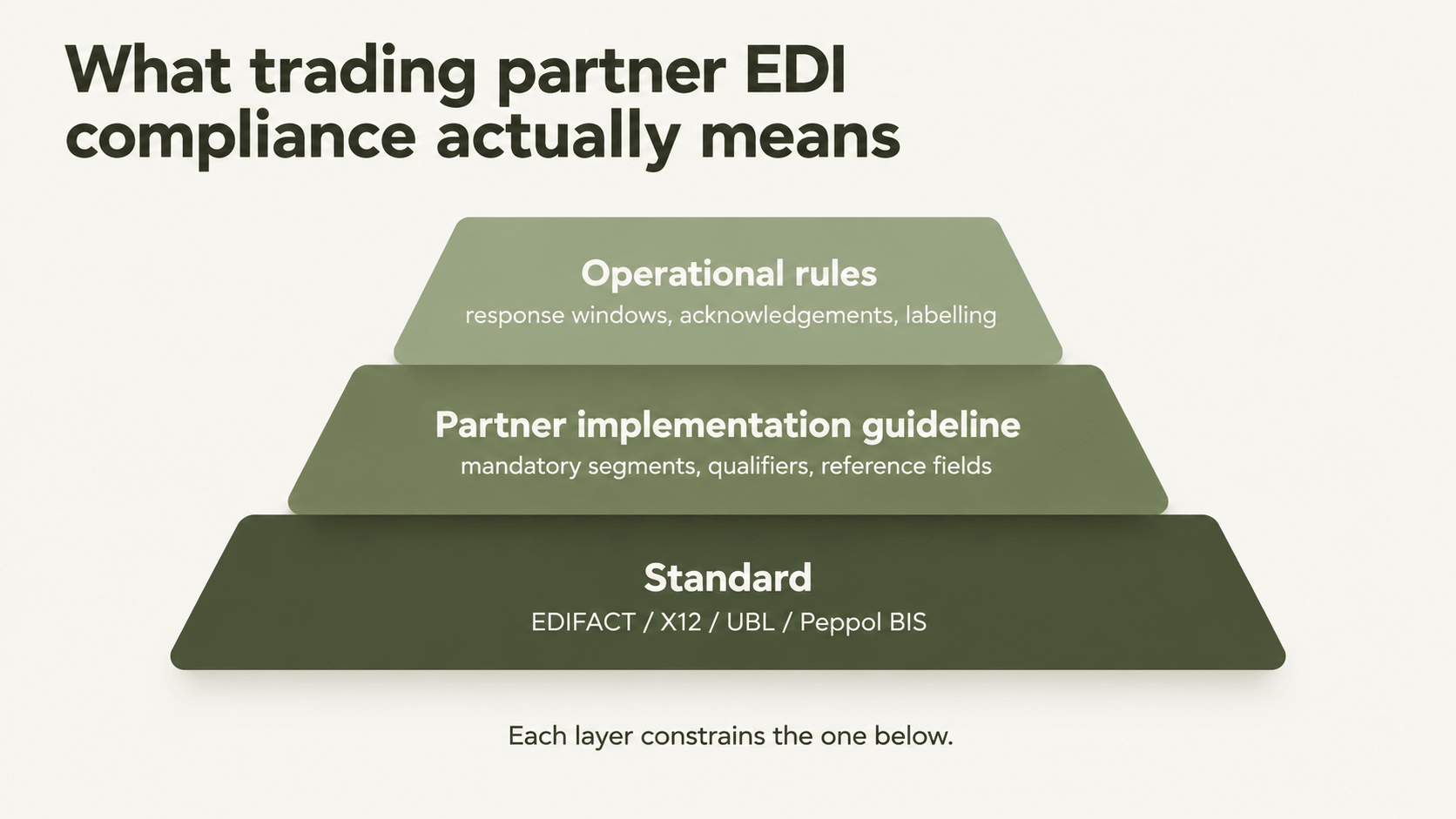
People use the phrase to cover three different things, and mixing them up is where most projects go wrong.
The standard. EDIFACT, ANSI X12, UBL, Peppol BIS. This is the grammar how a message is structured.
The partner's implementation guideline. This is the specific dialect your customer speaks. Which segments are mandatory, which qualifiers they accept, what goes in the reference fields. Two retailers can both use ORDERS D96A and still reject each other's messages.
The operational rules. Response windows, acknowledgement requirements, labelling and barcode standards, test cycles before go-live. These sit outside the message entirely but count just as much when penalties are calculated.
Meeting the standard is table stakes. Trading partner EDI compliance means meeting all three, for every partner, continuously.
Why compliance differs from partner to partner
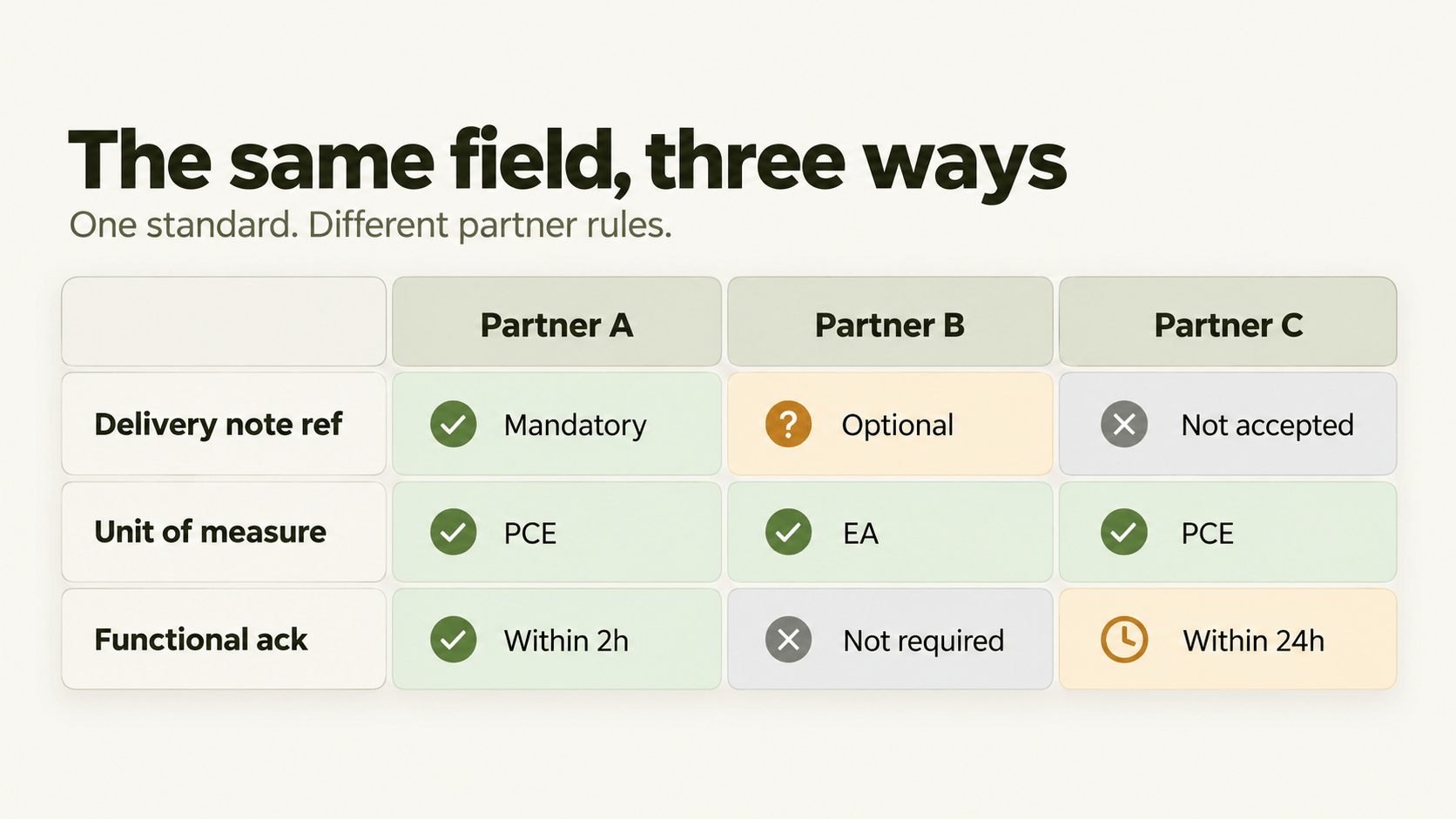
Same standard, different guidelines
An implementation guideline is where a partner narrows a broad standard to what their ERP actually consumes. One customer treats a field as optional; the next makes it mandatory and rejects anything without it. Nobody is wrong. They're just different.
Qualifier and code list variations
Unit-of-measure codes, party identification schemes, allowance and charge codes. Partners pick from the same code lists but use different subsets. Reusing a mapping across two partners in the same sector is one of the most common causes of silent failures.
Acknowledgement and timing rules
Many partners require a functional acknowledgement within a defined window. If you're not sending CONTRL or 997 messages or not reading the ones you receive you have no idea whether your documents landed until someone calls.
Labelling and master data rules
GS1 barcodes, GLN identifiers, SSCC numbers on pallets. These live outside the EDI message but are usually written into the same compliance agreement, and they're a frequent source of penalties.
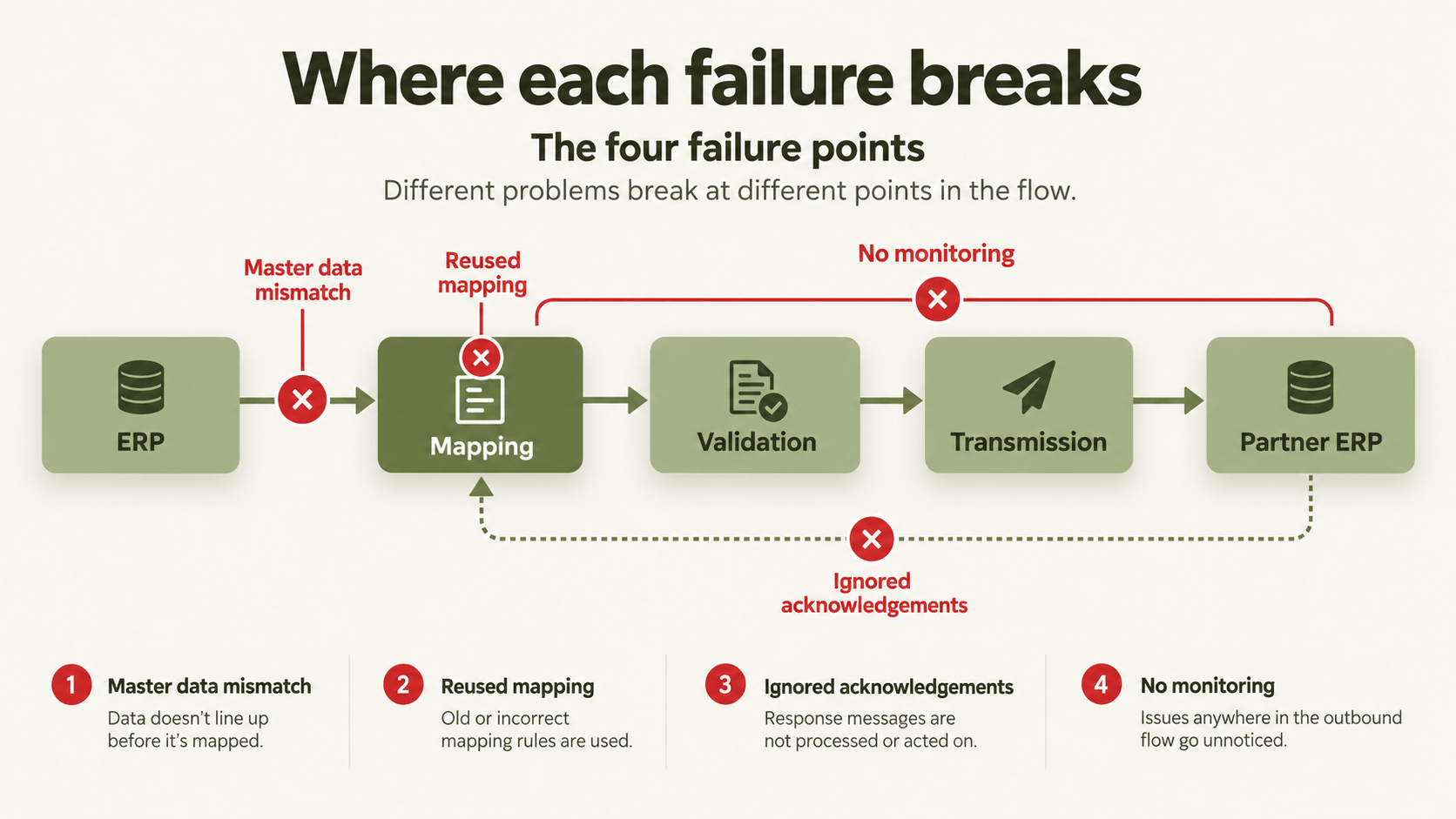
The four failure points that come up most often
Master data mismatch. Your item numbers, the partner's item numbers, and the GLNs on both sides all have to line up. When they drift, orders fail before the mapping even gets a chance.
A mapping built for one partner, reused for another. Fast on day one, expensive on day sixty.
Ignored acknowledgements. Receiving a rejection and not acting on it is functionally the same as never sending the document.
No monitoring on outbound flows. If the first signal that something broke is a chargeback notice, the feedback loop is far too long.
What good trading partner EDI compliance looks like
A repeatable onboarding path, run the same way for every partner:
Read the implementation guideline before building anything, and log every deviation from your baseline.
Reconcile master data GLNs, item codes, units of measure before the first test message.
Validate at the boundary, so a document fails in your platform rather than in the partner's.
Track acknowledgements as a monitored flow, not a log file nobody opens.
Alert on exceptions in near real time, and route them to a named owner.
The point is that partner two should be faster than partner one, and partner ten faster again. If each new connection costs the same as the last, the process is the problem not the partners.
Where the integration layer fits
Partner-specific rules don't belong inside your ERP. Customising the ERP for each customer's dialect creates upgrade risk and buries business logic where finance can't see it.
An integration layer sits between the ERP and the partner network, holding the mapping, the validation rules, and the partner profiles in one place. The ERP keeps doing what it does. The variation lives where it can be changed without a project.
EDI integration platform works this way, with reusable partner profiles, validation on inbound and outbound documents, and a certified Peppol Access Point for the e-invoicing side. It connects to your existing ERP rather than replacing it. If you're working through how EDI and ERP fit together more broadly, this guide covers the mechanics.
FAQ
Is EDI compliance the same as Peppol compliance? No. Peppol compliance means conforming to Peppol BIS specifications and any country-level rules layered on top. Trading partner EDI compliance is bilateral it's whatever your specific customer or supplier requires. You can be fully Peppol-compliant and still fail a retailer's ASN validation.
Who is responsible when a document fails us or the partner? Commercially, almost always the sender. Compliance agreements typically place the obligation on the supplier, and chargeback schedules reflect that. Technically the cause is often shared, but that rarely changes who pays.
How long does it take to onboard a new trading partner? It depends on the partner's test cycle more than on your platform. Some run a structured certification process over several weeks; others accept a single successful test message. Ask for their onboarding timeline at the start, not after you've built the mapping.
Does compliance change when a national e-invoicing mandate goes live? Yes, but in a different direction. A mandate adds a legal requirement on top of your bilateral agreements it doesn't replace them. You may need to satisfy both a partner's EDI guideline and a national format requirement for the same invoice.
Can we stay compliant without replacing our ERP? Yes. Partner-specific rules are better handled in an integration layer than inside the ERP, precisely so the ERP stays standard and upgradeable.
Before you onboard the next partner
If you're onboarding partners one custom build at a time, the cost curve only goes one way.
Worth doing: pull your last three onboarding projects and count how much was genuinely partner-specific versus rebuilt from scratch. That number usually makes the case on its own.
If you'd like a second opinion on your current partner setup and where the failure points sit, talk to our team or book a walkthrough.
