
How to Register a Peppol ID and What Really Decides How Long It Takes
A customer asks for your Peppol ID before they will pay your next invoice. Or a public buyer rejects a PDF and points you to Peppol. Either way, finance gets the task, and the first question is usually the same: how long will this take?
The short answer: the technical registration is fast. What takes time is everything around it. This guide explains what happens when you register a Peppol ID, which steps sit with your provider, and which sit with your own team.
What a Peppol ID Is (and What It Isn't)
A Peppol ID, or Peppol participant identifier, is the electronic address other companies use to find you on the Peppol network. It is not a new number you are issued. It is built from an identifier your company already has.
The format: scheme plus identifier
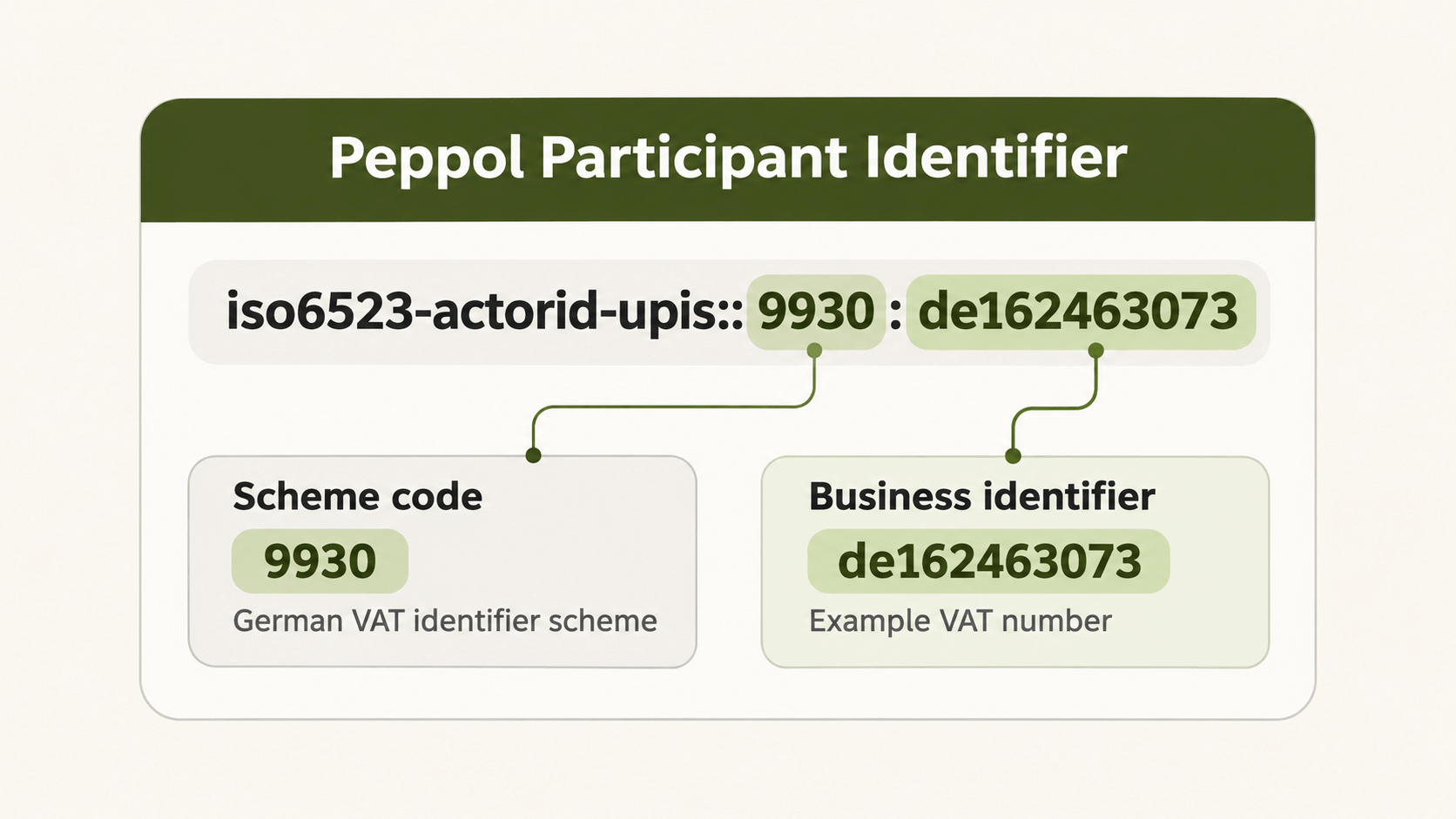
Every Peppol ID combines two parts: a numeric scheme code that says which register the number comes from, and the number itself. Common bases include a Global Location Number (GLN, scheme 0088), a national company registration number such as the Danish CVR number, or a VAT number. Written out in full, a German VAT-based ID looks like this: iso6523-actorid-upis::9930:de162463073.
The scheme matters. If your customer expects your CVR-based ID and you registered on GLN, their system will not find you, even though you are registered.
Sending vs. receiving
Not every company needs a published registration. If you only send invoices through Peppol, you do not need your Peppol ID registered in an SMP. Registration matters when you need to receive documents, because that is how senders discover you.
Want the bigger picture of how documents move between Access Points? See our explainer on the Peppol 4-corner and 5-corner models.
What Happens When You Register a Peppol ID
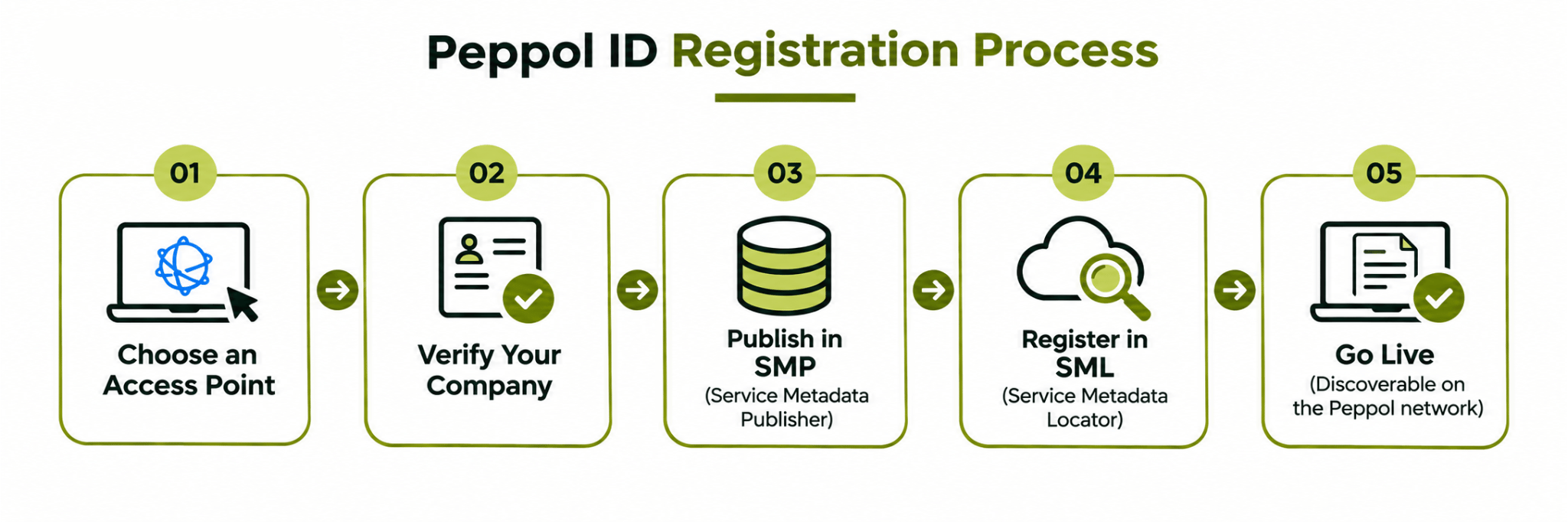
From the outside, registration looks like one step. In practice it is five.
1. Choose an Access Point provider
You do not register directly with Peppol. You register through a service provider that operates an Access Point and an SMP. Your choice here decides how the rest of the process runs.
2. Company verification
The provider checks that you are the legal entity behind the identifier. Expect to supply company registration details and confirm who is authorised to act for the company.
3. SMP publication
The provider publishes your receiving capabilities in its Service Metadata Publisher (SMP): which document types you accept, such as invoices and credit notes, and which Access Point delivers them.
4. SML registration
The Service Metadata Locator (SML) is the central directory that links your Peppol ID to your provider's SMP. Once this record exists, any sender on the network can find out where to deliver your documents.
5. Peppol Directory listing
Many providers also list you in the public Peppol Directory. This is useful for trading partners searching by company name, but the listing is asynchronous and can appear later than the actual registration.
HubBroker's Peppol service handles participant registration and receiver capability setup as part of onboarding.
How Long It Takes, Realistically
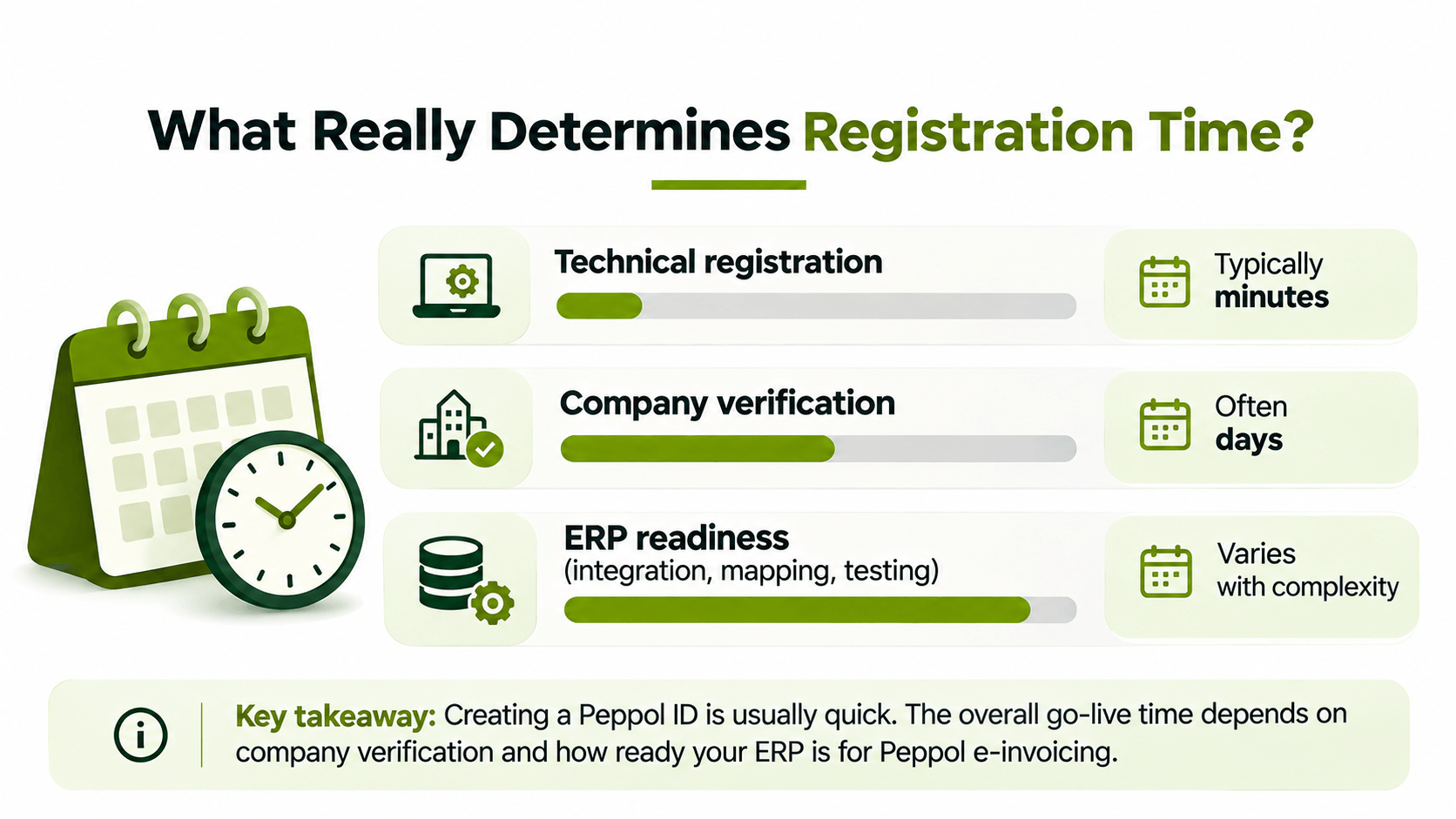
The technical step: minutes
Publishing to the SMP and SML is an automated call. Open-source SMP documentation states that SML DNS changes can take up to five minutes to propagate. Once that happens, you are reachable.
Verification and onboarding: days
The provider's verification and contract steps usually take longer than the technical registration. How long depends on the provider and on how quickly your team returns the documents they ask for.
ERP readiness: the real bottleneck
This is where most projects stall. A registered Peppol ID does nothing for you if your ERP cannot produce a valid Peppol BIS invoice, or cannot accept an inbound one. Missing buyer references, incorrect endpoint IDs and incomplete VAT data cause rejections long after registration is complete.
That is why ERP integration usually sets the timeline, not Peppol. For the full sequence from compliance scope to production monitoring, see our e-invoicing implementation roadmap.
Switching providers: no new registration
If you already have a Peppol ID with another provider, you do not start over. Your current provider issues a migration key, and the new provider uses it to take over the SMP registration. Your Peppol ID stays the same, so trading partners do not need to change anything.
What Finance Ops Should Prepare Before You Register
Have these ready before you contact a provider:
Legal entity details for every company that needs its own Peppol ID
Identifier choice: GLN, company registration number or VAT number, agreed with your key customers
Document types: invoices only, or credit notes, orders and order responses too
ERP master data: customer endpoint IDs, buyer references and VAT data checked for gaps
An internal owner who handles rejected invoices once you go live
After Registration: Check Before Go-Live
Confirm your registration is visible with a Peppol lookup tool. Then run a test exchange with one trading partner before switching all customers over. Test a credit note as well as an invoice, and confirm that rejections and status messages reach the right person.
FAQ
Do I need a Peppol ID to send invoices? You need an identifier to appear as the sender, but if you only send, you do not need a published SMP registration. You need one to receive.
Can a company have more than one Peppol ID? Yes. A company can be registered under different schemes, for example a GLN and a VAT number, or separate IDs per legal entity.
Is my Peppol ID the same as my VAT number? It can be based on your VAT number, but the full Peppol ID also includes a scheme code. The same VAT number with a different scheme is a different ID.
Can I change Peppol provider without losing my ID? Yes. A migration key transfers the SMP registration to the new provider while your ID stays the same.
Why can't my customer find me on Peppol? The most common causes are a scheme mismatch, a missing document type in your SMP registration, or a lookup made before the registration propagated. A Directory listing can also lag behind the actual registration.
How long does it take to register a Peppol ID? The technical registration takes minutes. Verification takes days. Getting your ERP to send and receive valid documents is usually what decides the total timeline.
Ready to Connect Peppol to Your ERP?
Registering a Peppol ID is the easy part. HubBroker connects Peppol to the ERP you already run, so invoices go out and come in without manual handling. Book a demo to map your entities, identifiers and invoice flows before you register.
