
Peppol Germany E-Invoicing: Choosing a Transmission Route Before January 2027
"Should we go with Peppol or XRechnung?" It is one of the most common questions IT managers in Germany ask about the e-invoicing mandate, and it rests on a misunderstanding. XRechnung is a format. Peppol is a network. Picking one does not rule out the other, and treating them as rivals leads to the wrong project plan.
From 1 January 2027, German businesses with prior-year turnover above €800,000 must issue structured e-invoices for domestic B2B sales. The format question is largely settled by the law. The open decision, and the one that lands on IT, is how invoices travel between you and each trading partner. This article explains how Peppol Germany e-invoicing fits alongside XRechnung, compares the four transmission routes, and gives you a framework for choosing.
Why "Peppol or XRechnung" Is the Wrong Question
Format and channel are separate decisions
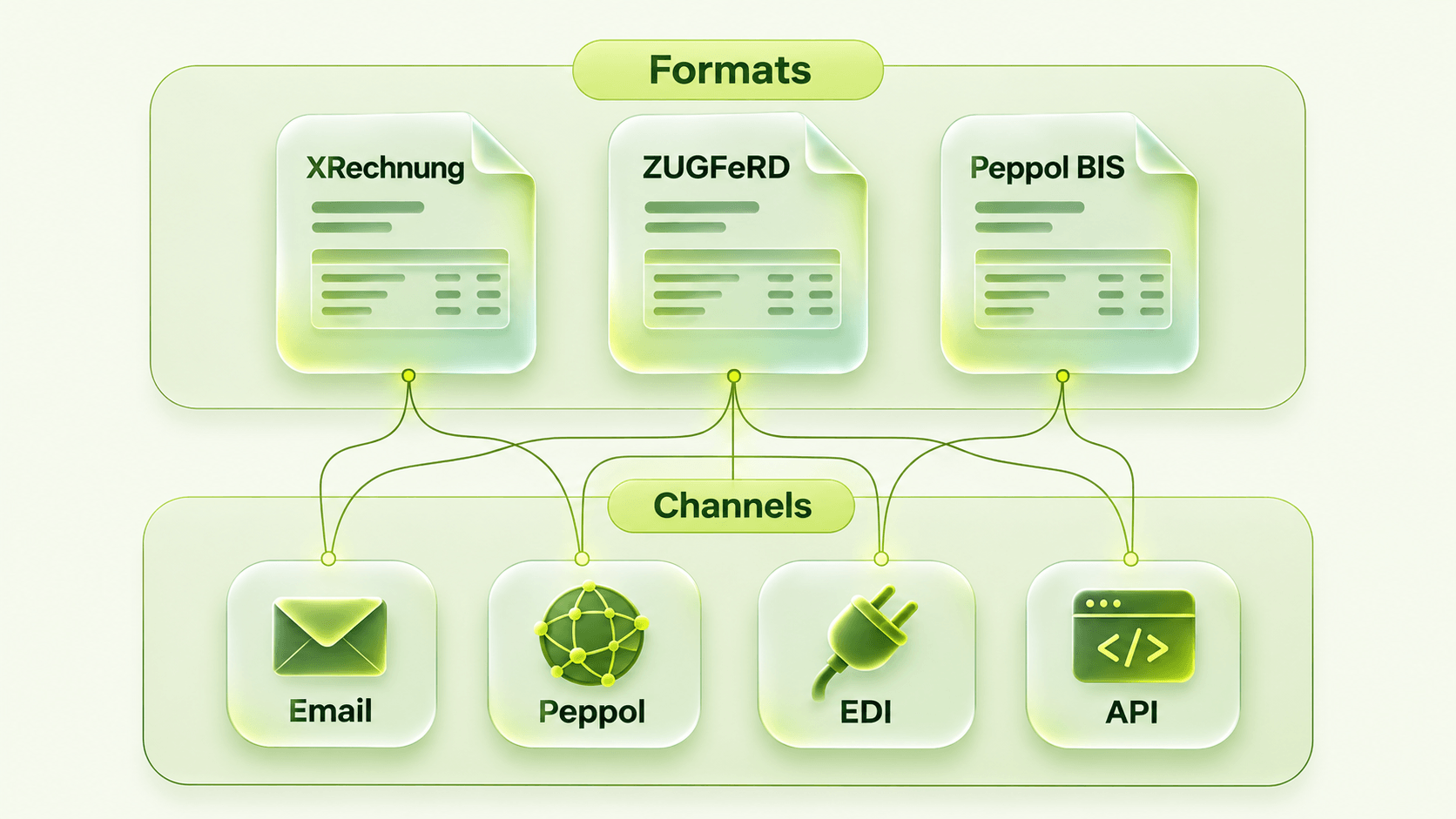
Every e-invoice involves two choices:
The format: how the invoice data is structured (XRechnung, ZUGFeRD, Peppol BIS Billing 3.0).
The channel: how the file gets from sender to receiver (email, Peppol, EDI, API or portal).
You can send an XRechnung file by email. You can send a Peppol BIS invoice over the Peppol network. A German public-sector buyer can receive XRechnung through Peppol. The two decisions interact, but they are not the same decision.
Where the formats sit under EN 16931
The German rules accept any format that complies with the European standard EN 16931. In practice, that means:
XRechnung: the German national specification (CIUS) of EN 16931, available in UBL and CII syntax. Pure XML, no human-readable layer.
ZUGFeRD: a hybrid PDF/A-3 with embedded XML, from version 2.0.1 using the EN 16931 profile or higher. If the PDF and XML disagree, the XML counts. Factur-X, its French twin, is technically identical.
Peppol BIS Billing 3.0: the Peppol network's own EN 16931 specification, based on UBL.
EDI formats such as EDIFACT: permitted where the invoice content meets EN 16931.
For a full overview of who must comply and when, see our Germany e-invoicing country guide.
What the German Mandate Requires
Receiving since 2025, issuing from 2027 and 2028
The obligation arrives in three steps under the Wachstumschancengesetz:
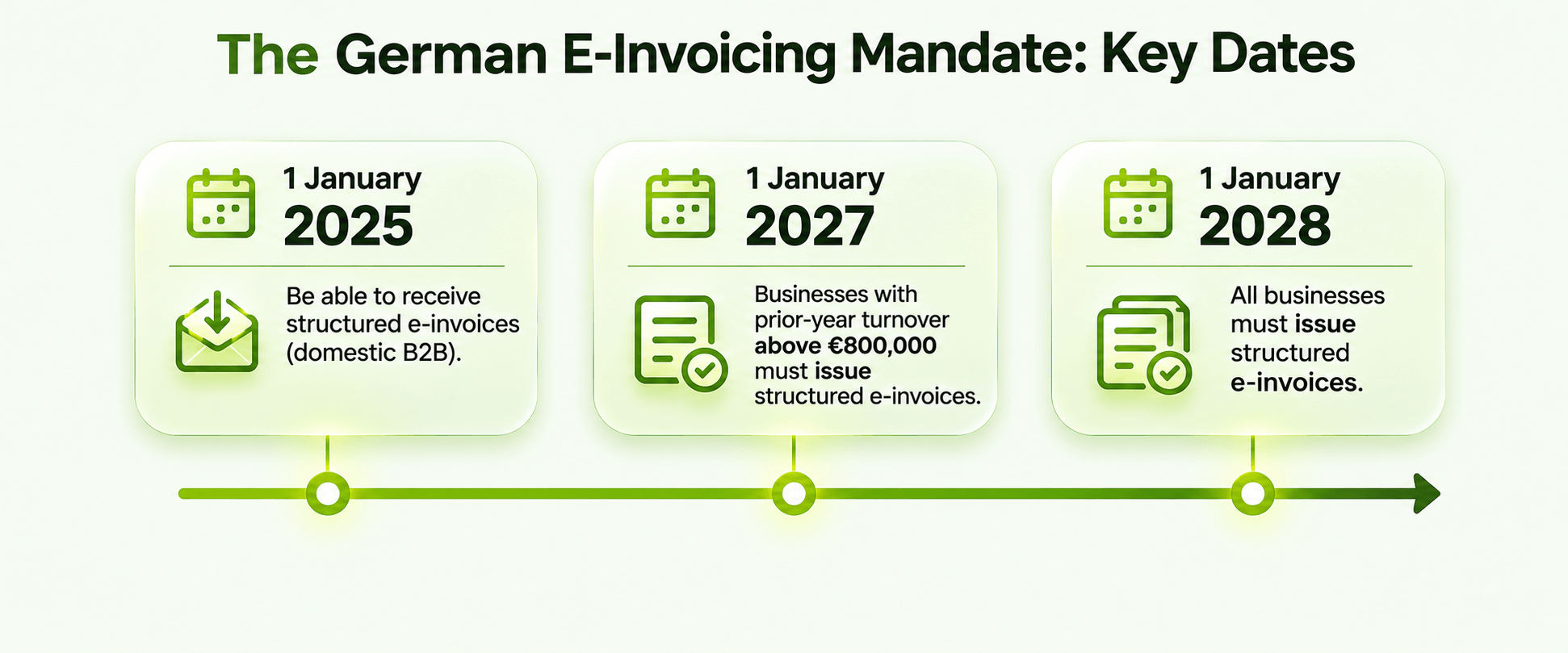
Until the transition ends, PDF and paper invoices are allowed only with the recipient's consent. EDI invoices that do not yet meet EN 16931 can continue until 31 December 2027 if the recipient agrees. Small-value invoices up to €250 are exempt, and B2C invoices are out of scope.
No central platform, and no prescribed channel
Unlike Italy or Poland, Germany has no government clearance platform for B2B invoices. The law does not prescribe a transmission channel. Trading partners agree between themselves whether invoices travel by email, Peppol, EDI or another method.
That flexibility is the reason the route decision lands on IT. Nobody hands you a single mandated pipe. You have to choose, and you will probably need more than one.
The Four Transmission Routes Compared
Email with a structured attachment
Email is where most German companies start, because it needs almost no setup. The supplier attaches an XRechnung or ZUGFeRD file and sends it to the buyer's invoice address.
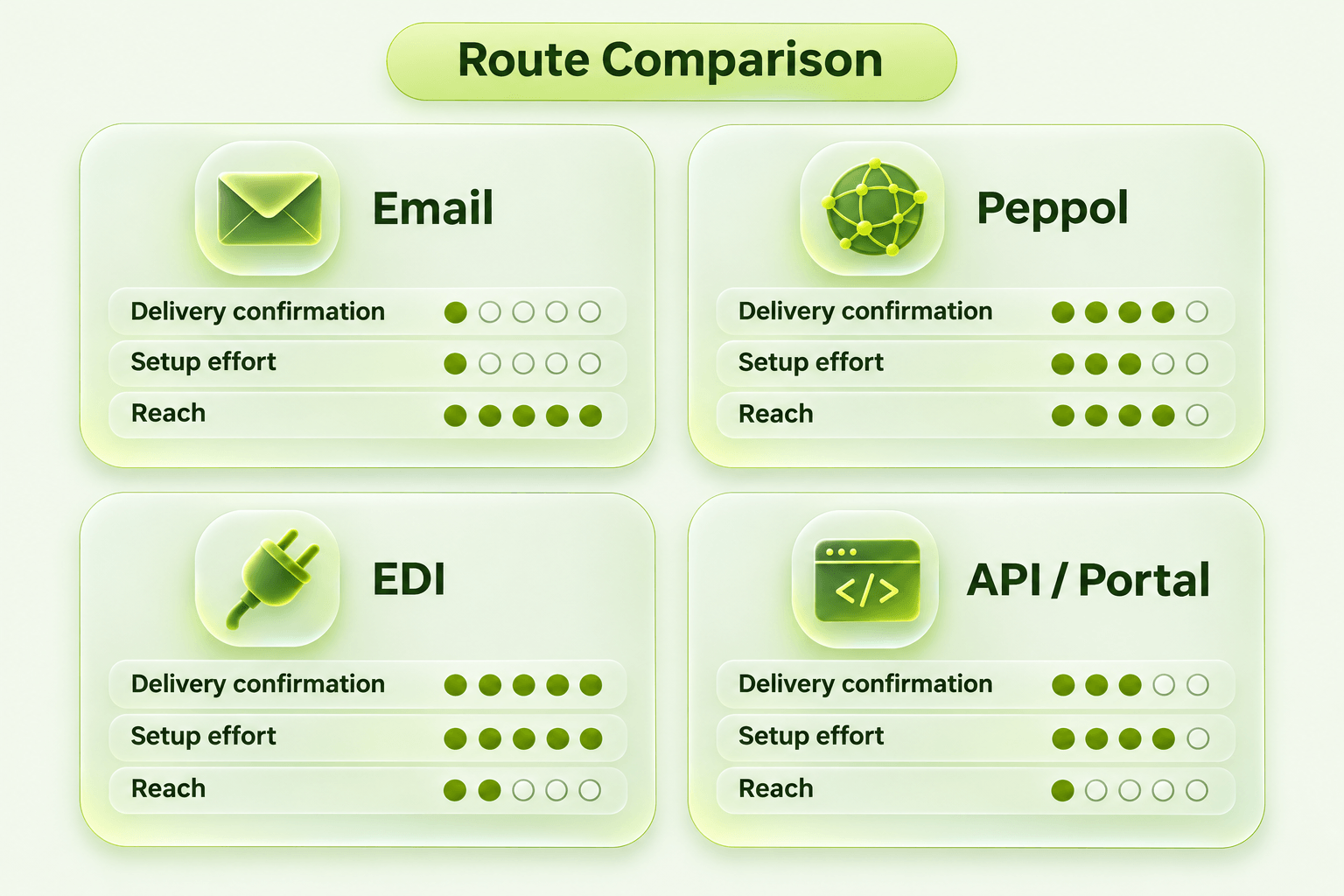
The weaknesses show at volume. Email gives no reliable delivery confirmation, invoices land in shared mailboxes that need monitoring, spam filters reject XML attachments, and someone has to extract the file before it reaches the ERP. Email works as a fallback channel. It is a poor foundation for thousands of invoices a month.
Peppol via an Access Point
Peppol is an open international network. You connect once through a certified Access Point, register a participant identifier, and exchange documents with any other registered participant. Before sending, the Access Point looks up the receiver's identifier and supported document types, so invoices reach the right endpoint in a format the receiver can process.
For Peppol Germany e-invoicing, the strongest argument is reach beyond Germany. If you also invoice customers in Belgium, the Nordics or the Netherlands, the same connection serves them. German public authorities must offer Peppol when they plan automated invoice exchange, so the route also covers B2G. The limitation is that adoption among German private-sector buyers varies, so check the Peppol Directory for your key customers before relying on it alone. Learn more about connecting to Peppol through HubBroker.
EDI (EDIFACT and other formats)
Many manufacturers, retailers and automotive suppliers already exchange orders and invoices with large customers through EDI, often over AS2 or SFTP. These connections remain usable through 2027 under the transition rules. After that, EDI invoices must allow the invoice data to be extracted in a form that meets EN 16931.
If your largest customers already run EDI with you, keeping that channel and validating the content against EN 16931 is usually cheaper than migrating them to something new. See how EDI integration fits alongside e-invoicing.
Direct API or portal integration
Some large buyers require suppliers to upload invoices to a supplier portal or push them to an API. For public-sector buyers, suppliers can use the federal and state invoice portals, identifying the recipient with a Leitweg-ID. Portals work for low volumes but turn into manual work quickly. API connections automate well but are built one customer at a time.
Side-by-side comparison
How to Choose: A Decision Framework for IT Managers
Map your trading partners and their capabilities
Start with your top 20 customers by invoice volume. For each, record which channel they can receive on today: Peppol identifier, EDI connection, portal requirement or email only. This list, not the mandate itself, decides your route mix.
Separate outbound from inbound
The issuing obligation drives outbound decisions, but the receiving obligation has applied since 2025. Your inbound side has to accept whatever your suppliers send: XRechnung by email, ZUGFeRD, Peppol BIS and, during the transition, PDFs. Plan both directions, viewed from your ERP's point of view, as one project.
Check your B2G obligations
If you invoice German public authorities, you will need XRechnung and either the relevant invoice portal or Peppol. Peppol avoids manual portal uploads once volumes grow.
Weigh cross-border exposure
If more than a handful of customers sit outside Germany, Peppol gives you one connection that serves several mandate countries. A Germany-only email setup will need rebuilding later.
Running Several Routes Without ERP Rework
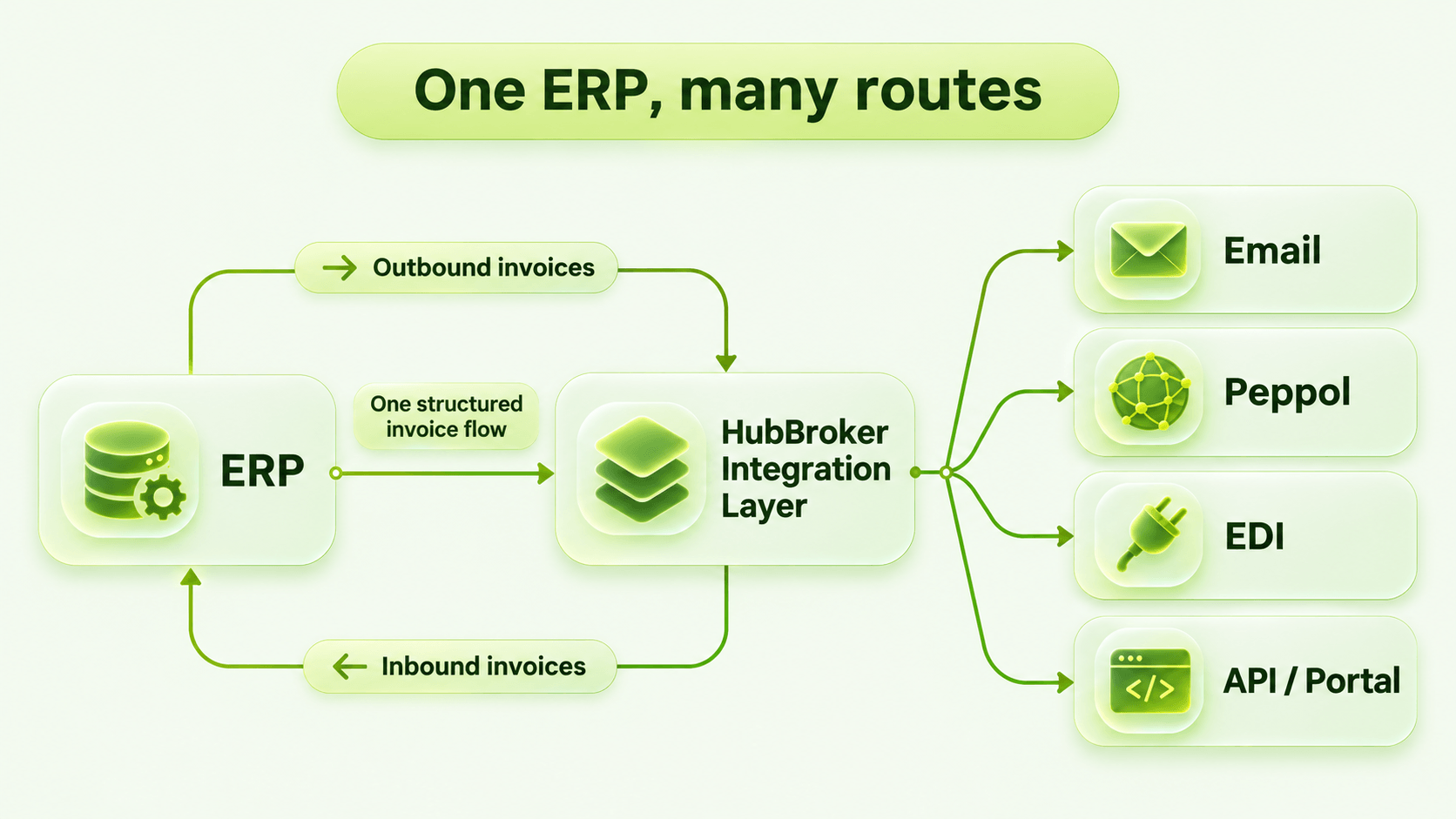
Most companies end up with a mix: Peppol for customers who are registered, EDI for key accounts, email as a fallback and portals where a buyer insists. The risk is building four separate exports from the ERP, each with its own mapping and failure points.
The alternative is an integration layer between the ERP and the channels. The ERP produces one invoice output. The integration layer maps it to XRechnung, ZUGFeRD or Peppol BIS, validates it against EN 16931 and the German business rules, and routes it to each partner on the channel they use. Inbound invoices arrive back in the ERP as structured data, whatever route they came by. Your ERP stays as it is.
If you run SAP Business One, our guide on what to fix in SAP B1 before January 2027 covers the master data and mapping gaps. For other systems, see how HubBroker's e-invoicing solution connects your existing ERP to each channel.
Frequently Asked Questions
Is Peppol mandatory for B2B e-invoicing in Germany?
No. German law does not prescribe a transmission channel for B2B invoices. Peppol is one option alongside email, EDI and portals. German public authorities must offer Peppol when they plan automated invoice exchange.
Can we keep sending XRechnung by email?
Yes. Email is a permitted channel, provided the attachment is a compliant structured format such as XRechnung or ZUGFeRD. A PDF on its own is no longer an e-invoice once the issuing obligation applies to you.
Is ZUGFeRD the same as XRechnung?
No. XRechnung is pure XML. ZUGFeRD combines a readable PDF with embedded XML. Both are accepted for B2B if they meet EN 16931. Public-sector buyers usually require XRechnung.
What happens to our EDI connections after 2027?
EDI invoices can continue under the transition rules until 31 December 2027 with the recipient's agreement. From 2028, EDI invoices must allow the invoice data to be extracted in a form that meets EN 16931.
Do we need a German Peppol Access Point?
No. Peppol is an international network, and any certified Access Point can send to and receive from German participants. What matters is that your Access Point handles the formats your German partners expect, including XRechnung where required.
Find Out Where Your Invoices Stand
Before choosing a route, check whether your current invoice output meets the standard. Our free XML and e-invoice validator checks Peppol and XRechnung files in seconds. If you want help mapping your trading partners to the right channels, book a demo and we will walk through your own invoice flows.
