
Peppol Access Point Explained: What Certification Actually Means for Your Invoices
Your ERP can create the correct invoice and your finance team can approve it, but the document can still get rejected prior to submission. Incorrect recipient information, invalid structured data, or wrong delivery route are among the reasons of failure and delayed payment.
This Peppol Access Point explained guide goes further than certification icon to help finance and IT teams understand what certified access point actually does and what tasks remain under responsibility of your business.
Peppol Access Point Explained: What Does Certification Actually Cover?
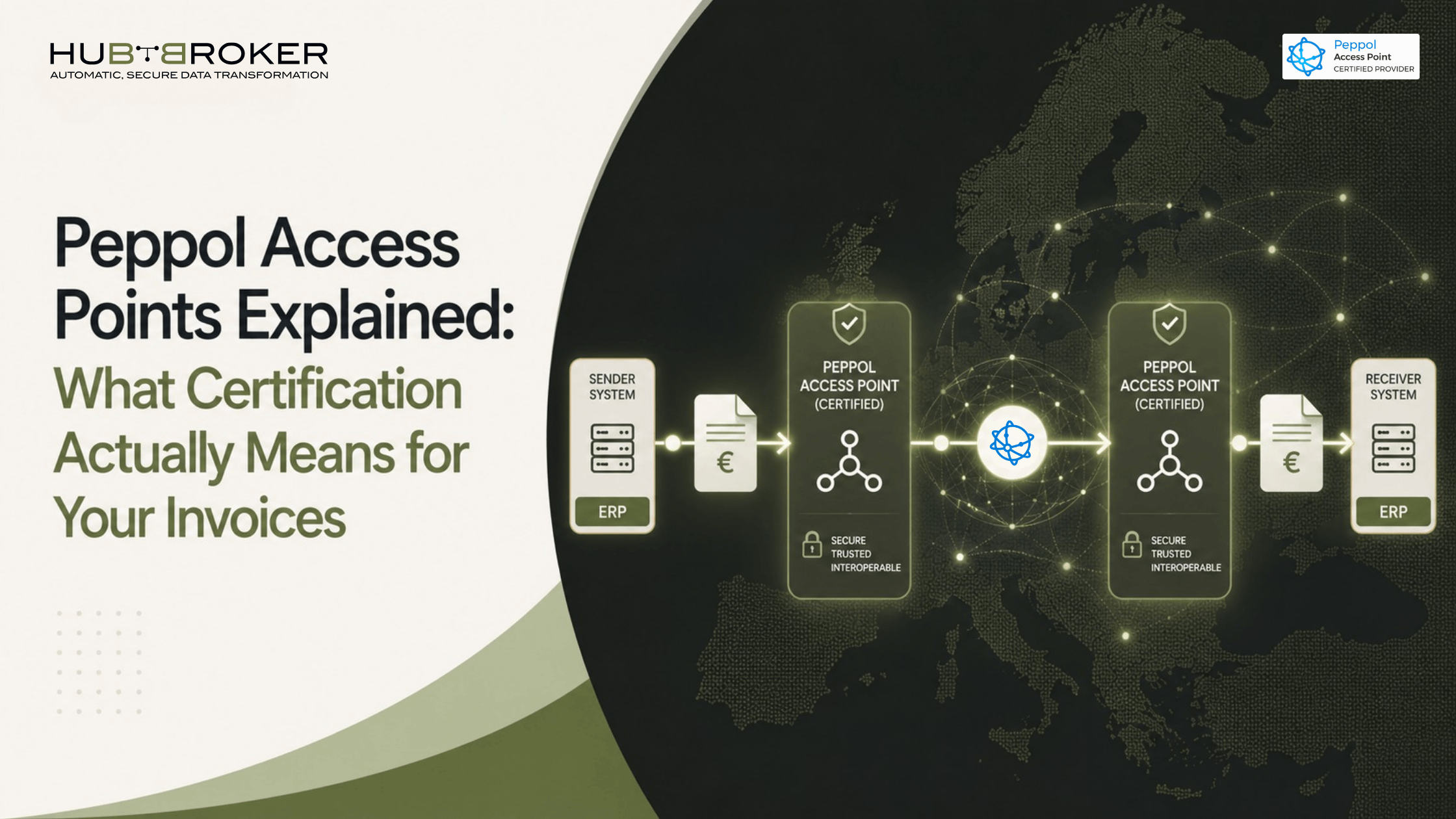
Peppol Access Point is a connection point through which businesses submit and receive structured documents through Peppol network. Instead of building direct connections between every customer and supplier, organisations use Peppol-certified Service Provider.
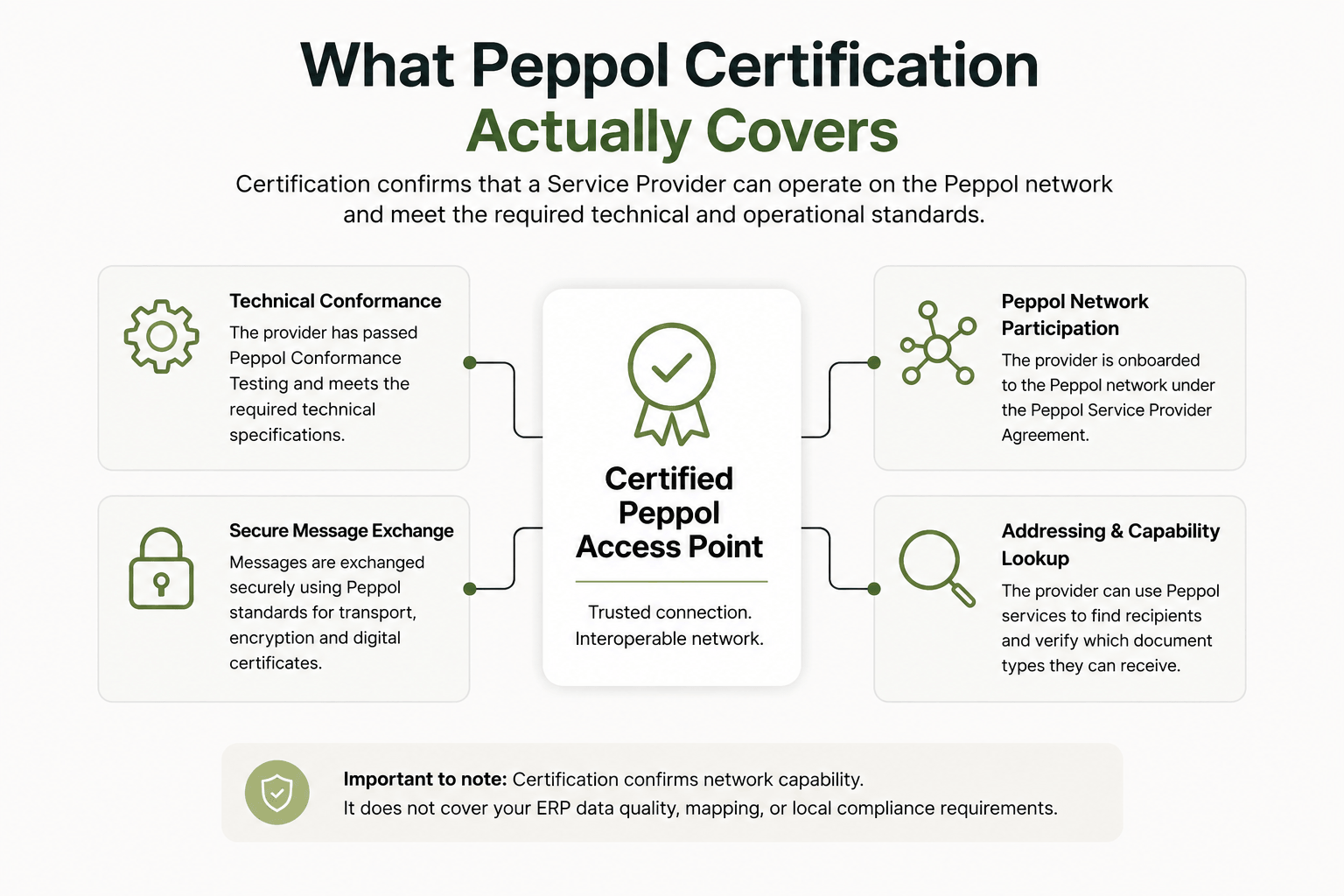
Certification is more than right to deliver invoices. OpenPeppol specifies that a Service Provider needs to sign appropriate Peppol Service Provider Agreement and pass Peppol Conformance Testing before starting to deliver Peppol services. The technical framework includes messaging, security, addressing, capability lookup and Peppol Business Interoperability Specifications (BIS).
The result is an interoperable network where a sender is able to use one Peppol service provider to reach recipients registered with other certified providers.
For businesses evaluating connectivity options, certified Peppol Access Point becomes a basic requirement rather than an extra feature.
What Does Peppol Certification Not Guarantee?
It's the moment of misconception here.
Certification means that the provider can operate inside Peppol framework and comply with relevant technical requirements. It doesn't mean that every invoice generated by your ERP is correct.
Certification does not guarantee that:
Customer and supplier master data is correct.
Required buyer references are filled in.
ERP fields are mapped correctly to outgoing invoice.
All country-specific requirements are implemented.
Your internal approval and posting workflows are automated.
All invoices will be received by the recipient.
Error monitoring and exception handling work fine for you.
For example, Access Point is able to provide a valid delivery route but the invoice gets rejected because the source ERP delivered incorrect identifier or business field.
It becomes important when choosing the provider because Peppol certification guarantees network participation while invoice automation relies on complete process from ERP to recipient.
What Happens to Your Invoice After It Reaches an Access Point?
In case of Peppol e-invoicing, the process starts inside the ERP or finance system, not Peppol.
It can be summarized as:
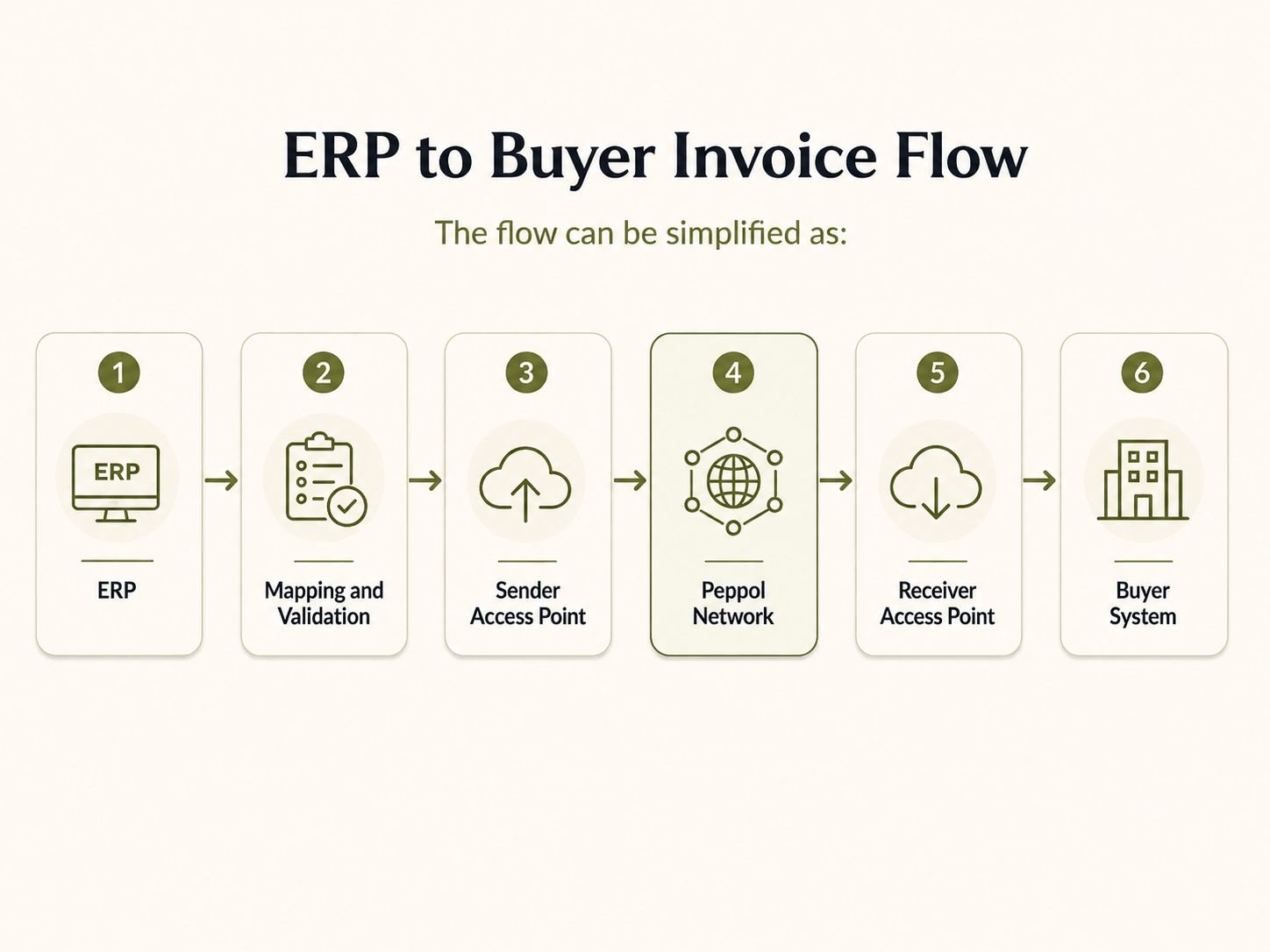
Prior to submission, the sending Access Point is supposed to validate outgoing messages according to relevant Peppol specifications. The network uses addressing and capability lookup services to find out where recipient is registered and what kind of documents it accepts.
Buyer and supplier don't have to use the same technology provider. This is the core of Peppol's Four Corner Model.
For additional clarification of document exchange process, refer to HubBroker's Peppol e-invoicing guide and Peppol Four Corner and Five Corner Models guide.
What Does a Peppol Access Point Mean for Your ERP and Existing Systems?
Adoption of Peppol should not involve replacement of ERP or finance system used by your teams. What needs to be done is to integrate the system with Peppol network and transform existing invoice data to structured workflow.
Integration can handle such tasks as:
Invoice data extraction from ERP.
Mapping of ERP fields to document structure.
Validation of data.
Document submission through the Access Point.
Incoming document and message receipt.
Transfer of document information to business processes.
In this context, HubBroker offers its Certified Peppol Access Point Provider service together with integration capabilities. Currently, HubBroker is listed in OpenPeppol Certified Service Providers directory as AP Certified for Denmark, ERST is Peppol Authority of HubBroker.
Instead of creating a disconnected invoicing portal, the goal is to keep all invoice activities integrated into systems used by finance and operations teams.
Businesses working with orders, invoices and trading partners can also consider HubBroker's ERP EDI Integration Services.
How Should You Evaluate a Certified Peppol Access Point Provider?
Certification is the first step but not the last one.
Before choosing a provider, finance and IT teams should consider the following questions:
Current Peppol certification – check the provider in OpenPeppol's current certified providers directory.
Document support – determine the Peppol BIS and other document profiles required by your business.
ERP integration – understand how invoice data moves to and from your existing system.
Validation – see how incorrect fields or formats are detected.
Error visibility – check the way how finance or IT teams investigate failures.
Country requirements – learn which local e-invoicing requirements belong to the implementation scope.
Onboarding – understand how new recipients, suppliers and document types are added.
Format transformation – check whether existing XML, EDI, API and other invoice flows are covered.
The question is not just “Can this provider connect us to Peppol?”
The question is “Can this provider connect Peppol to the way we actually create, receive and process invoices?”
Certification Is Just a Basis for Invoice Exchange, Not Whole Process
Certified Peppol Access Point gives your organisation a regulated path to Peppol network. However, reliable invoice exchange depends on ERP data, mapping, validation, recipient setup and error handling as well.
From the perspective of finance and IT teams, it means that the best option is to evaluate network connectivity and ERP integration together rather than treating Peppol as separate portal.
If you would like to check how your current ERP and invoice process can be connected to Peppol, get in touch with HubBroker for analysis of your existing invoice flow and receiving requirements.
