
Peppol 4-Corner vs. 5-Corner: What European Businesses Need to Know
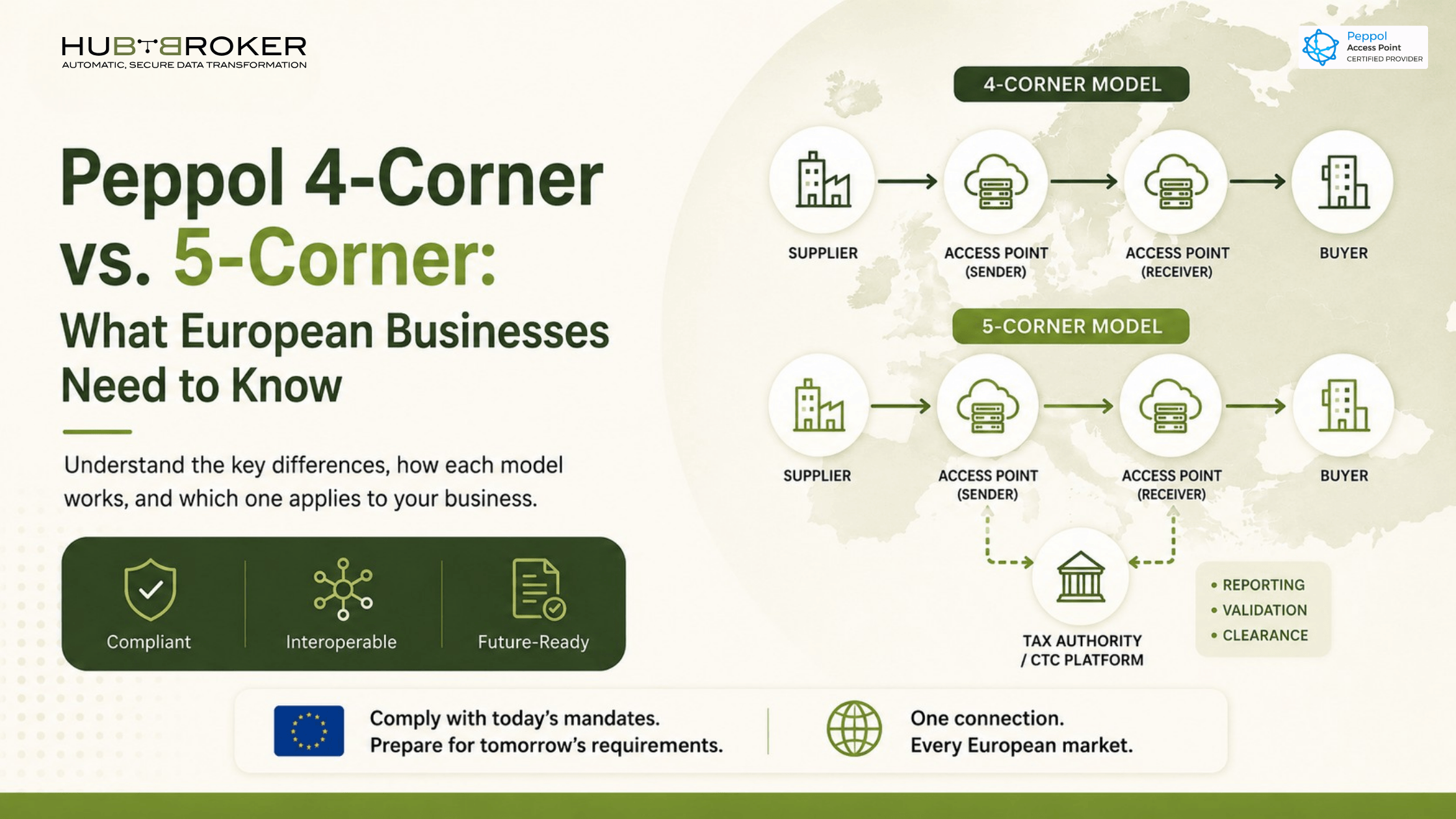
The Peppol 4-corner model routes e-invoices between two businesses through certified access points. The emerging 5-corner model adds a government tax authority or centralized platform as a fifth node for real-time validation or reporting. Which model applies to your business depends on the e-invoicing mandates active in the countries where you operate.
European e-invoicing requirements are expanding. The EU's ViDA (VAT in the Digital Age) initiative is accelerating Continuous Transaction Control (CTC) mandates across member states, and Peppol sits at the center of much of this infrastructure. Understanding how the network routes your invoices and who sits in the middle helps you assess compliance risk before a mandate deadline forces the question.
How Does the Peppol 4-Corner Model Work?
The 4-corner model is the standard Peppol architecture for business-to-business and business-to-government e-invoice exchange. It involves four distinct roles:
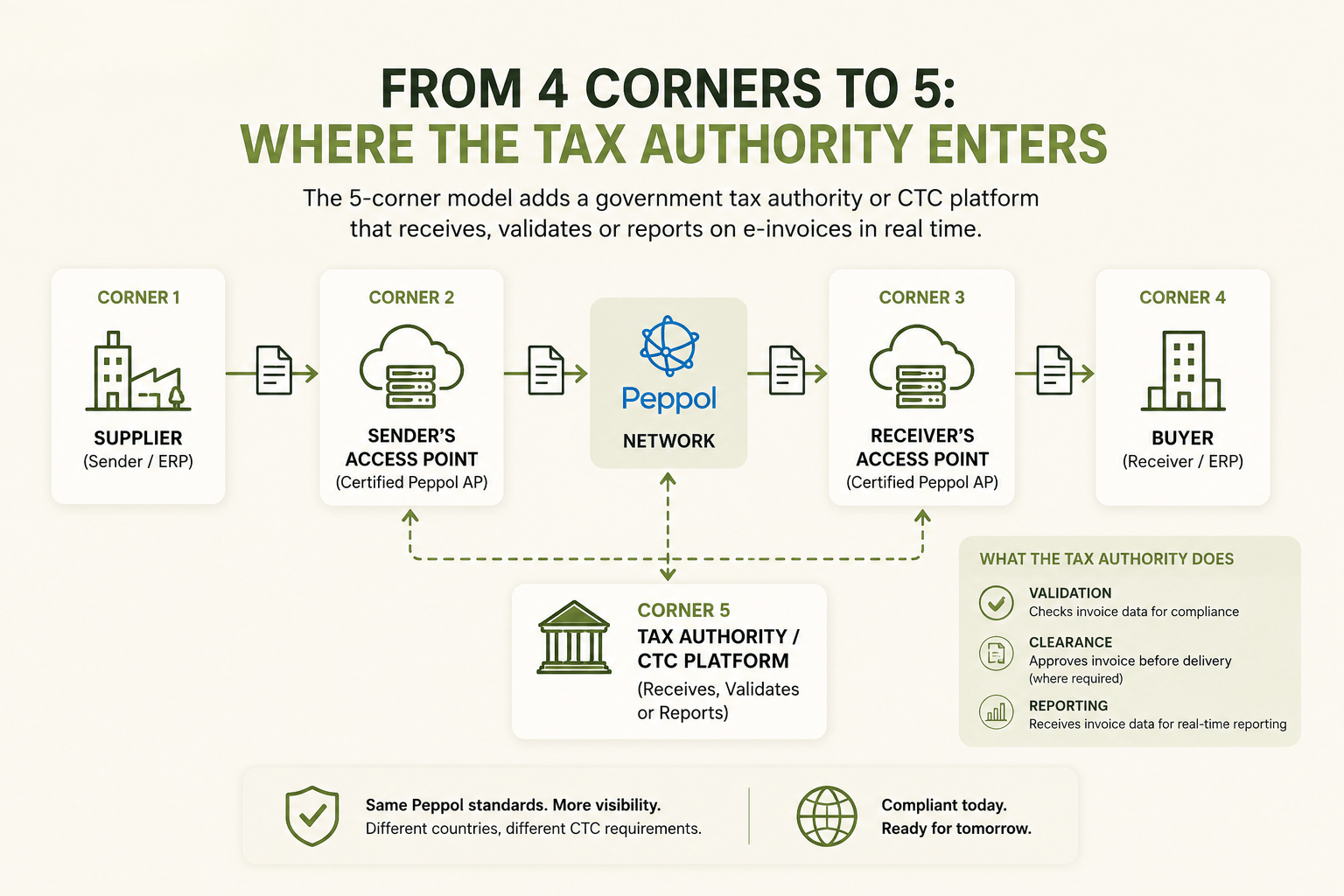
Corner 1 – The Sender (Supplier): Initiates the invoice from within an ERP or accounting system.
Corner 2 – The Sender's Access Point: A certified Peppol access point that validates and transmits the invoice on the sender's behalf.
Corner 3 – The Receiver's Access Point: A certified access point that receives the transmission and delivers it to the buyer.
Corner 4 – The Receiver (Buyer): Receives the structured invoice directly into their system.
The model works because every participant registers in the Peppol network's Service Metadata Publisher (SMP), which allows access points to locate each other automatically. Two businesses in different EU countries can exchange invoices without custom point-to-point connections.
What Is the Peppol 5-Corner Model?
The 5-corner model extends this architecture by introducing a fifth node typically a government tax authority or centralized reporting platform between the sender's and receiver's access points.
In practice, this means:
Corner 5 – The Tax Authority or CTC Platform: Receives a copy of the invoice in real time (or near real time) for validation, clearance, or reporting before or concurrent with delivery to the buyer.
Some country mandates require that an invoice receive clearance from the tax authority before it is legally valid. Others operate a simultaneous reporting model, where the invoice is sent to both the buyer and the authority at the same time. The specific requirement depends on national legislation.
4-Corner vs. 5-Corner: Which Model Applies to Your Business?
The model your business encounters depends on where your trading partners are located and which national mandates apply to those transactions.
Factor | 4-Corner Model | 5-Corner Model |
|---|---|---|
Government involvement | None | Tax authority validates or receives |
Invoice clearance required | No | May be required before delivery |
Compliance complexity | Moderate | Higher |
Typical use case | Cross-border B2B, B2G | Countries with CTC mandates |
Businesses operating across multiple EU markets may need to support both models simultaneously. A supplier sending invoices to buyers in a 4-corner country and a 5-corner country needs an access point that can handle both routing paths without manual intervention.
What Are the Business Benefits of These Models?
Both models contribute to three operational outcomes that matter for finance and procurement teams:
Interoperability: Peppol's common standards mean your ERP connects once and reaches buyers across Europe, regardless of the local document format or delivery requirement.
Legal compliance: Structured routing through certified access points creates an auditable delivery record. In 5-corner countries, invoice clearance through the tax authority satisfies the legal validity requirement directly.
Automated workflows: Invoices arrive as structured data rather than PDFs or paper, which reduces manual entry, accelerates payment cycles, and supports straight-through processing in AP systems.
How HubBroker Helps Businesses Navigate European E-Invoicing
E-invoicing compliance across Europe requires more than registering with a Peppol access point. Your ERP needs to produce the correct document format, route to the right corners, and adapt as country mandates evolve.
HubBroker operates as a certified Peppol access point and connects your ERP whether that is Microsoft Dynamics 365, SAP Business One, or another platform to the Peppol network for both 4-corner and 5-corner exchanges. HubBroker handles format conversion, routing logic, and compliance updates so your internal team does not need to track regulatory changes across each EU member state independently.
If you are assessing your current e-invoicing setup or preparing for an upcoming mandate, contact HubBroker to describe your trading partner countries and current ERP configuration. HubBroker can identify which model applies to your flows and what work is needed to reach compliance.
Frequently Asked Questions
What is the difference between the Peppol 4-corner and 5-corner models?
The 4-corner model routes invoices between a sender and receiver through two certified access points. The 5-corner model adds a government tax authority or CTC platform as a fifth node that receives or clears the invoice in real time. The key operational difference is whether your invoice requires government validation before it is legally valid.
Which European countries use the 5-corner model?
Country adoption of CTC mandates varies and continues to evolve under the EU's ViDA initiative. The specific model that applies depends on national legislation in each country where you have taxable transactions. Businesses operating across multiple EU markets may encounter both models simultaneously.
Does my ERP need to change to support Peppol e-invoicing?
Your ERP does not necessarily require structural changes, but it needs to produce invoices in a Peppol-compatible format and connect to a certified access point. HubBroker handles the conversion and routing between your ERP output and the Peppol network, which reduces the configuration burden on your internal systems.
What is a Peppol Access Point?
A Peppol Access Point is a certified service provider that transmits and receives invoices on behalf of businesses within the Peppol network. Access points locate each other through the Peppol SMP directory, enabling automated routing without custom integrations between trading partners.
