
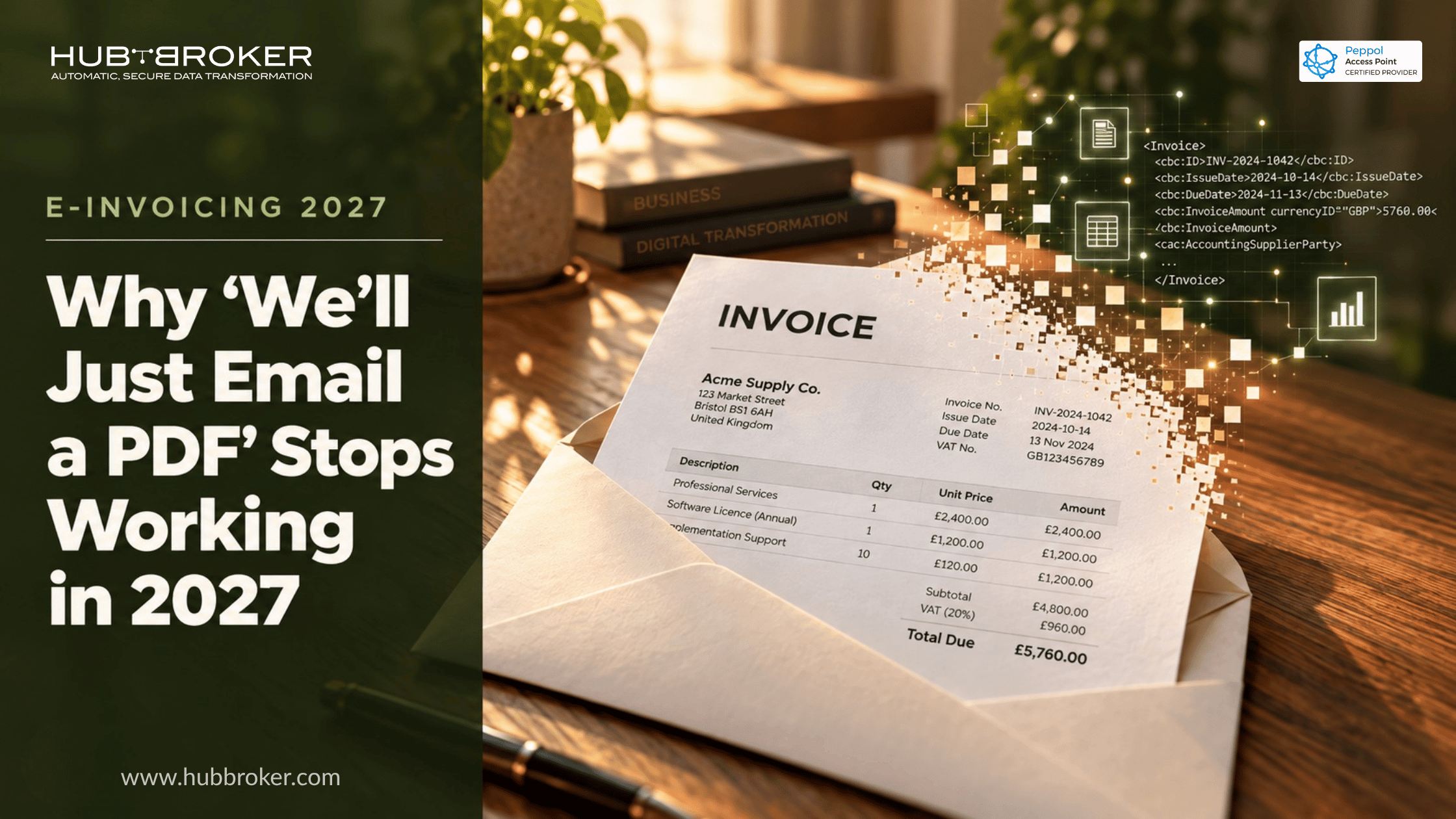
Why "We'll Just Email a PDF" Stops Working in 2027
For years, invoicing has been simple. Your ERP prints an invoice, someone saves it as a PDF, and it goes out by email. The customer pays. Nobody complains.
That habit is about to get expensive. PDF invoice compliance in 2027 is where many European finance teams will find out that the PDF they have sent for a decade no longer counts as a valid invoice in a growing number of B2B relationships. Germany is the clearest example, but it is not the only one.
Here is what changes, what breaks, and how to fix it without replacing your ERP.
A PDF Was Never Really an E-Invoice
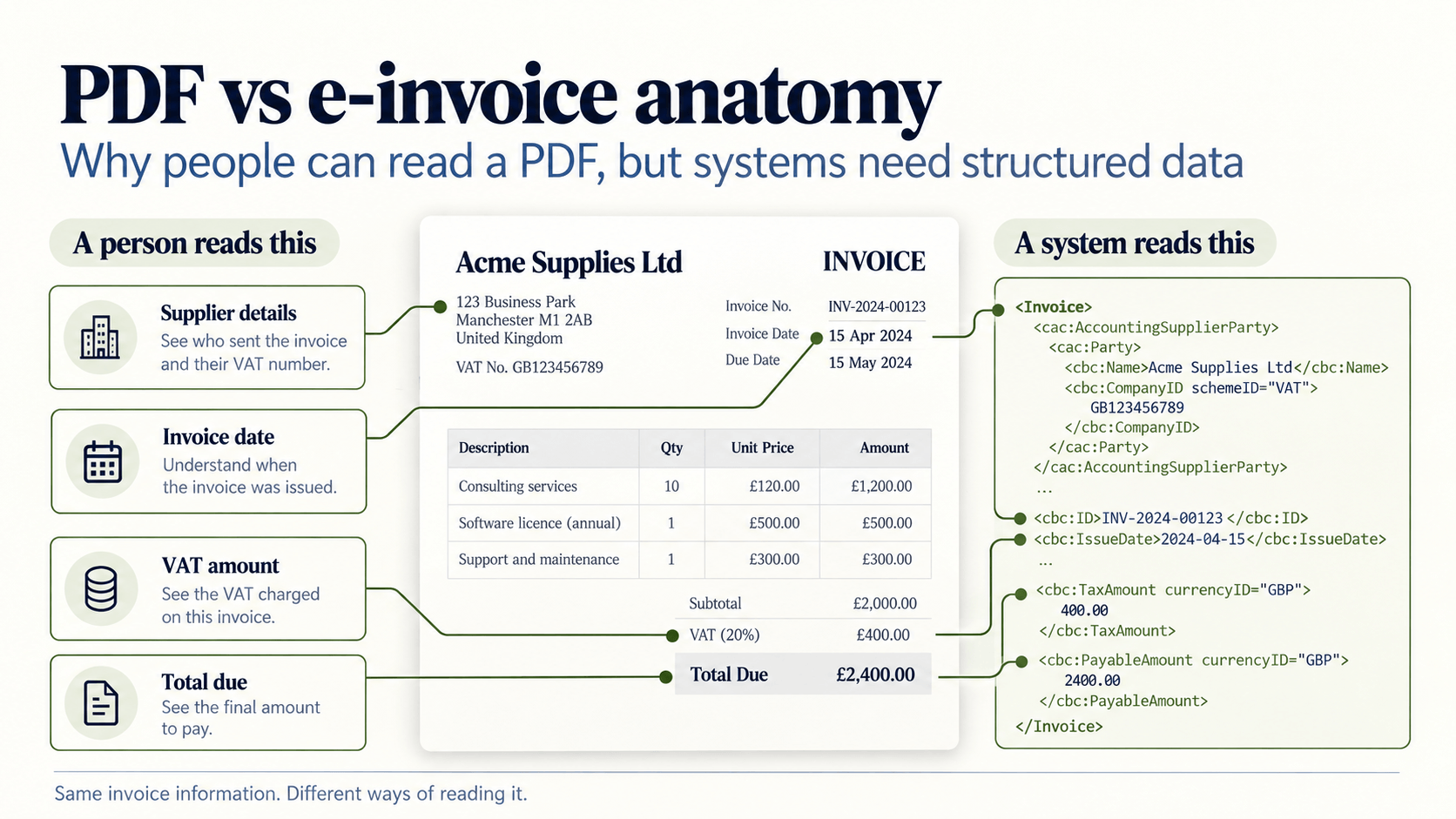
Human-readable vs machine-readable
A PDF is a picture of an invoice. A person can read it. A system cannot, at least not reliably. Someone on your customer's side still has to key the data in, or run it through OCR and check the result.
An e-invoice is different. It is structured data, typically XML, that the receiving system can read and book without human help.
Why tax authorities care
Structured invoices give tax authorities cleaner data and make VAT fraud harder. That is why most European mandates build on the European standard EN 16931 rather than on "any digital file". Under these rules, a plain PDF is classed as an "other invoice", not an e-invoice.
What Changes in 2027
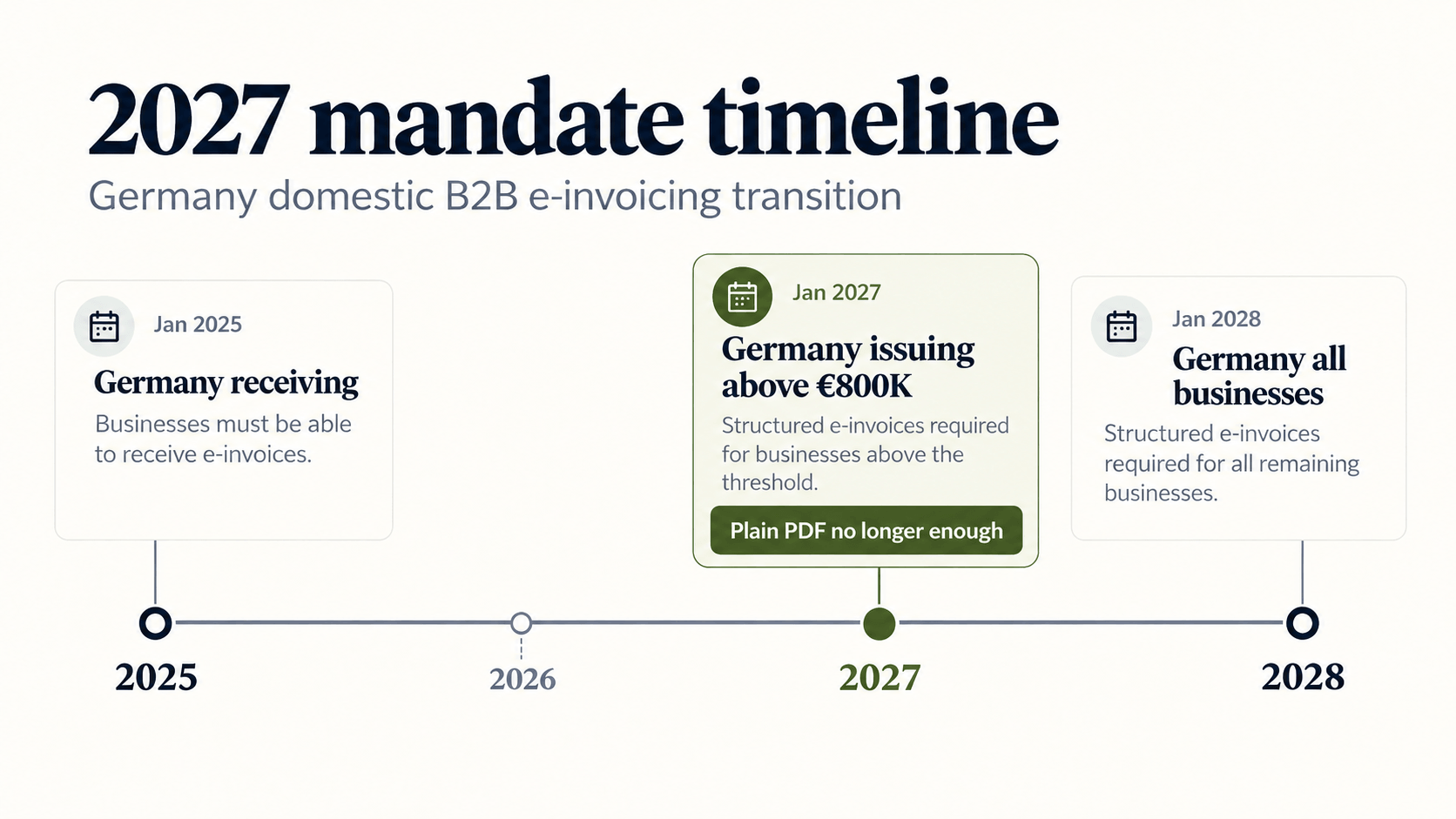
Germany: the issuing obligation starts
German businesses have had to be able to receive e-invoices since 1 January 2025. From 1 January 2027, companies whose prior-year (2026) turnover exceeded €800,000 must also issue structured e-invoices for domestic B2B sales. Everyone else follows on 1 January 2028.
The catch: 2026 turnover decides your deadline, so many companies will only know for certain at year end, with no run-up time left. If you invoice from SAP Business One, our guide on what to fix before January 2027 covers the gaps.
France, Belgium and the rest of Europe
France started its rollout in September 2026, with smaller companies due to follow in 2027. Belgium's B2B mandate is already live. Poland is rolling out KSeF. And the EU's ViDA package points the whole region the same way. Check the current status per market on our e-invoicing by country page.
What Actually Breaks When You Keep Emailing PDFs
Rejected invoices
Once structured invoicing becomes mandatory for you, a PDF may not meet the legal definition of an invoice. Your customer's AP team will start sending them back.
Payment delays and VAT risk for your customers
Customers who need a valid invoice for input VAT deduction have every reason to refuse a non-compliant one. Your invoice sits in a queue. Your cash flow waits.
Manual work that doesn't scale
On the receiving side, every PDF still needs manual handling. As your suppliers and customers move to structured formats, the PDFs that remain become the expensive exceptions.
"But Our PDF Has XML Inside": Hybrid Formats Explained
ZUGFeRD and Factur-X
Hybrid formats combine a readable PDF with an embedded XML file. They can count as e-invoices, but only if the XML part meets the required standard and profile. A PDF with an XML attachment from an old template is not automatically compliant.
Peppol and national platforms
Some countries route invoices through Peppol, others through national platforms or clearance systems. Many companies will need more than one channel. Our Peppol e-invoicing page explains how the network works.
Moving Off PDF Without Replacing Your ERP
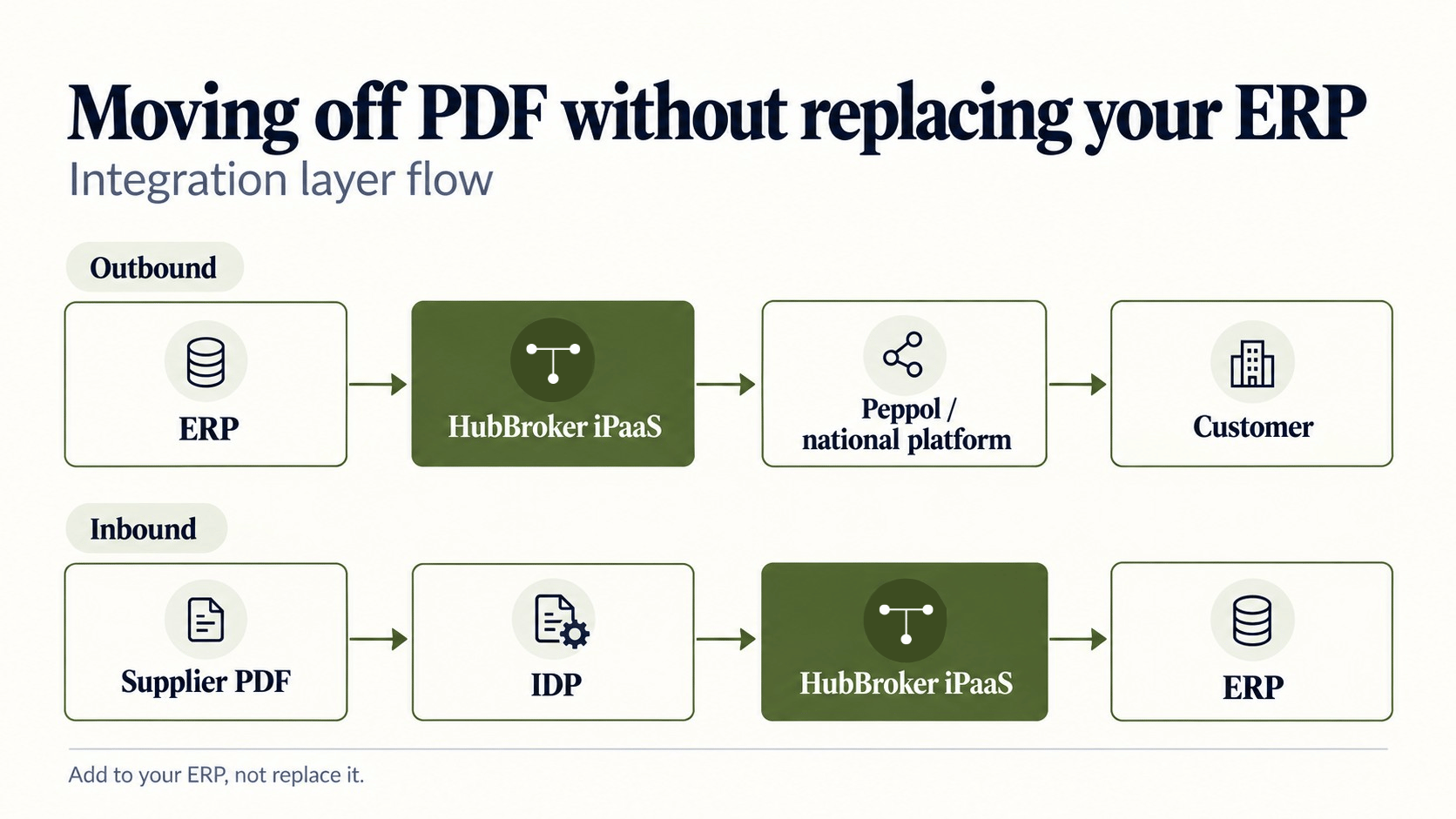
Add an integration layer
You don't need a new ERP to meet a mandate. An integration layer takes the invoice data your ERP already produces and turns it into the format each country and customer requires, then delivers it through the right channel. See how this works with HubBroker e-invoicing and ERP integration services.
Handle inbound PDFs from suppliers who aren't ready
Not every supplier will switch at once. AI-based document processing converts incoming PDFs into structured data your ERP can book. Read more about PDF to XML invoice conversion.
A Simple 2027 Readiness Checklist
Confirm which countries you invoice into, and each one's deadline.
Check your 2026 turnover against Germany's €800,000 threshold.
Test whether your ERP can produce EN 16931-compliant output.
Audit any hybrid PDF templates you already use.
Ask your largest customers which format and channel they expect.
Plan for inbound PDFs that will keep arriving.
FAQ
Is a PDF invoice still legal in 2027? It depends on the country and your company size. In Germany, companies above the €800,000 threshold must issue structured e-invoices for domestic B2B sales from January 2027. Smaller companies can use other formats until the end of 2027.
Does a ZUGFeRD or Factur-X invoice count as an e-invoice? It can, if the embedded XML meets the required standard and profile. The PDF part alone does not count.
Do small businesses have to switch in 2027? In Germany, businesses at or below €800,000 turnover have until 1 January 2028 to issue e-invoices, but must already be able to receive them.
What happens if a customer rejects my PDF invoice? You may need to reissue it in a compliant format, which delays payment.
Do we need a new ERP to comply? No. An integration layer can connect your existing ERP to the formats and networks each mandate requires.
Ready When Your Customers Are
The PDF isn't disappearing overnight, but 2027 is when it stops being enough. If you'd like to see how your current ERP can send compliant e-invoices without a system change, book a demo with our team.
