
Mexico CFDI Compliance Guide SAT Rules for Digital Platforms and Fuel Businesses
A customer enters the wrong fiscal postal code. A fuel transaction uses incorrect product code. Or the ERP creates XML with one required tax field missing. These may look like small data problems, but they can stop an invoice from being certified correctly and create extra work for finance and IT teams. For companies operating in Mexico, Mexico CFDI requirements are not only something for tax team to manage. ERP, POS, ecommerce, marketplace, and billing systems also need to provide correct information.
This becomes more important for digital platforms and fuel businesses where transaction volumes can be quite high.
What Are the Current Mexico CFDI Requirements?
Mexico uses CFDI (Comprobante Fiscal Digital por Internet) as its electronic invoice framework under SAT. A CFDI is created as structured XML and needs to follow SAT technical specifications before it can be certified. CFDI 4.0 has been the only valid general CFDI version since 1 April 2023. SAT states that version 4.0 introduced mandatory receiver information such as name, fiscal regime and fiscal address details. It also includes fields such as tax object.
A normal automated CFDI process may look like:
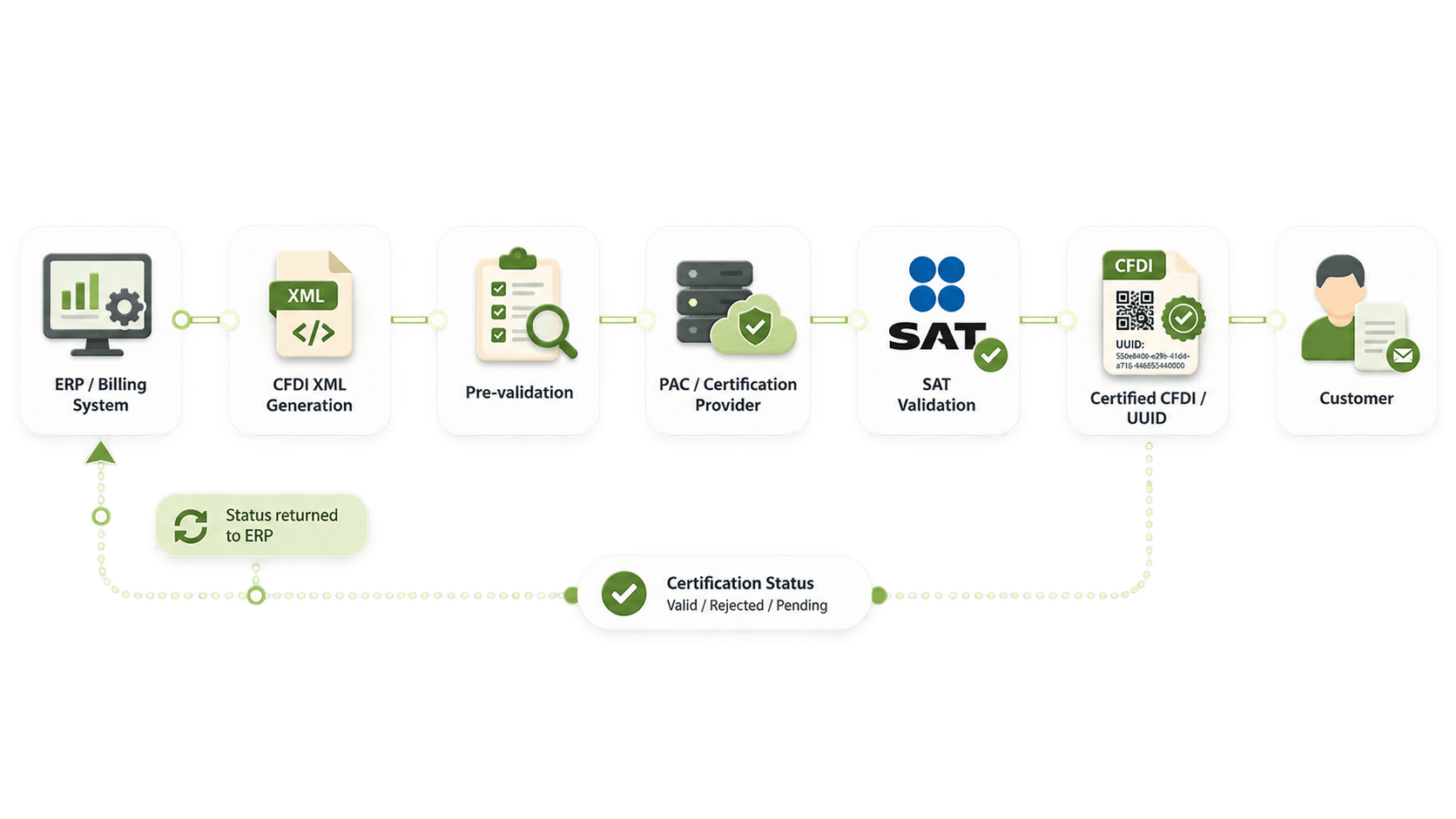
Before certification, authorized certification providers carry out technical validations. The 2026 RMF includes checks for areas such as certificate validity and whether the CFDI document has already been certified. This means good CFDI compliance starts before invoice reaches SAT.
What Information Is Required on a CFDI 4.0 Invoice?
Good CFDI validation depends heavily on correct master data.
SAT requires important information for both issuer and receiver. Other information will depend on transaction, payment method and type of goods or services being invoiced.
CFDI Data Field | What Business Must Provide | Why It Matters |
|---|---|---|
RFC | Tax registration number | Identifies issuer or receiver |
Legal name | Registered name or business name | Must identify taxpayer correctly |
Fiscal postal code | Registered fiscal address code | Used for receiver validation |
Fiscal regime | SAT tax regime code | Required in CFDI 4.0 |
CFDI use | Intended fiscal use | Classifies invoice purpose |
Product/service code | SAT catalogue code | Describes goods or services |
Tax data | Applicable tax information | Supports correct tax treatment |
Payment information | Method and form where applicable | Required depending on invoice scenario |
Currency | Transaction currency where applicable | Keeps monetary values correctly identified |
SAT specifically lists RFC, receiver name, fiscal regime and fiscal postal code among minimum receiver information needed when generating invoice. Because of this, incorrect customer master data can cause problems even when XML structure itself is correct.
How Do Mexico CFDI Requirements Apply to Digital Platforms?
Digital platforms should not assume every marketplace, ecommerce application, or online service follows same CFDI setup. The obligation can depend on what the platform does, who receives payment, which taxpayer is involved and whether taxes are being withheld. For 2026, RMF rule 12.2.2 states that qualifying digital intermediation platforms making applicable ISR, IVA or IEPS withholdings must issue a CFDI for Retenciones e Información de Pagos. It should show the payment and tax withheld together with the Complemento de Servicios Plataformas Tecnológicas.
Because of this, a digital platform CFDI process may need to manage information such as:
Seller or service-provider tax data
Transaction type
Withholding information
Platform commissions
CFDI and complement generation
Reporting information sent to SAT
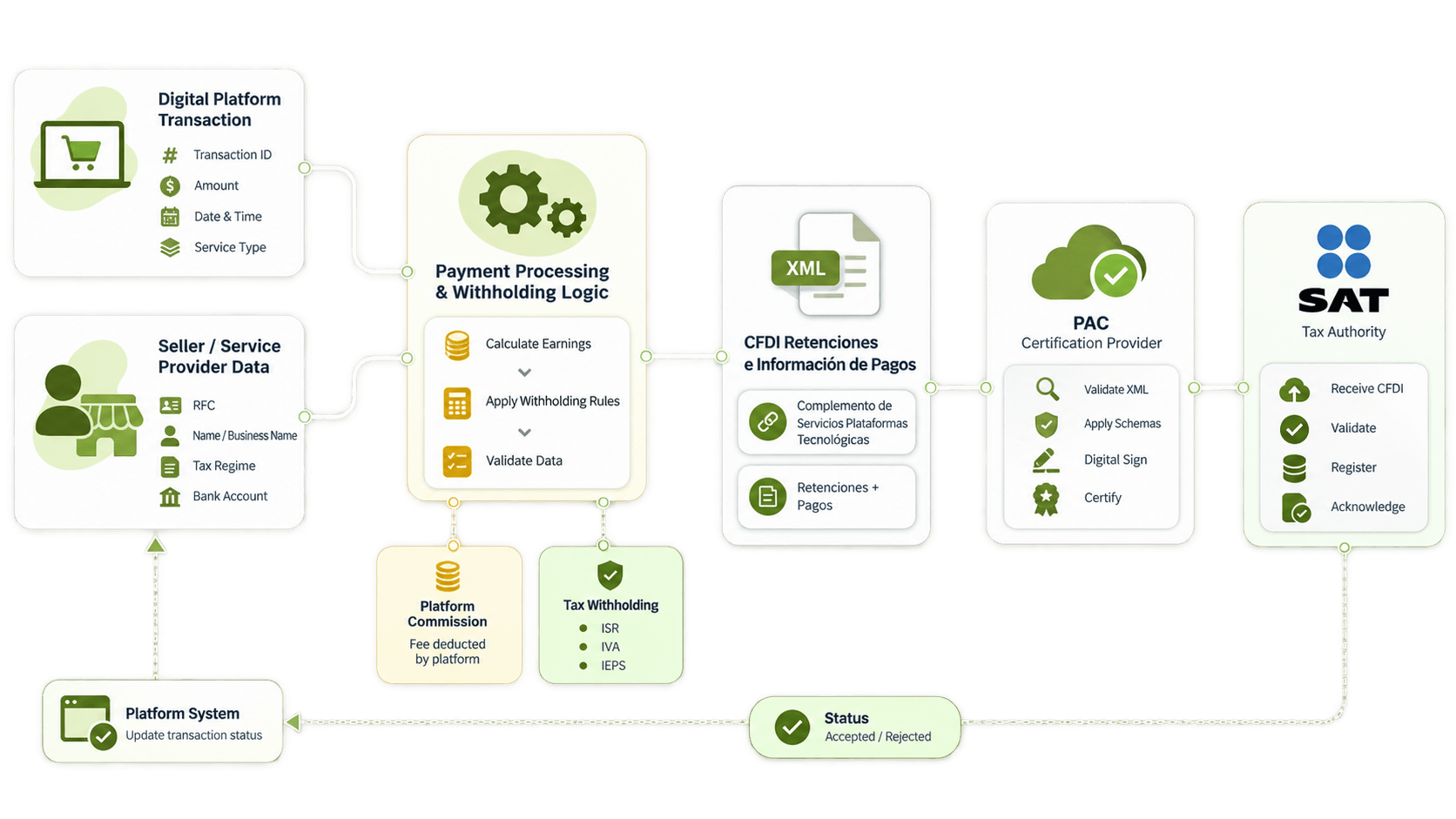
The exact setup should be based on how platform actually operates. For example, a platform acting as intermediary can have different requirements from a business simply selling its own products online. Applying same CFDI logic to every digital transaction can create unnecessary errors.
What CFDI Rules Apply to Fuel Businesses in Mexico?
Fuel businesses have some additional CFDI data controls to manage. Under RMF 2026 rule 2.7.1.48, taxpayers covered by the rule that sell gasoline and diesel must include the Complemento Concepto para la facturación de Hidrocarburos y Petrolíferos. The rule also specifies SAT product and service codes for diesel, regular gasoline and premium gasoline. SAT's 2026 Annex 29 also includes validation related to applicable permit information and matching product codes for these transactions.
A practical fuel CFDI Mexico process could look like:
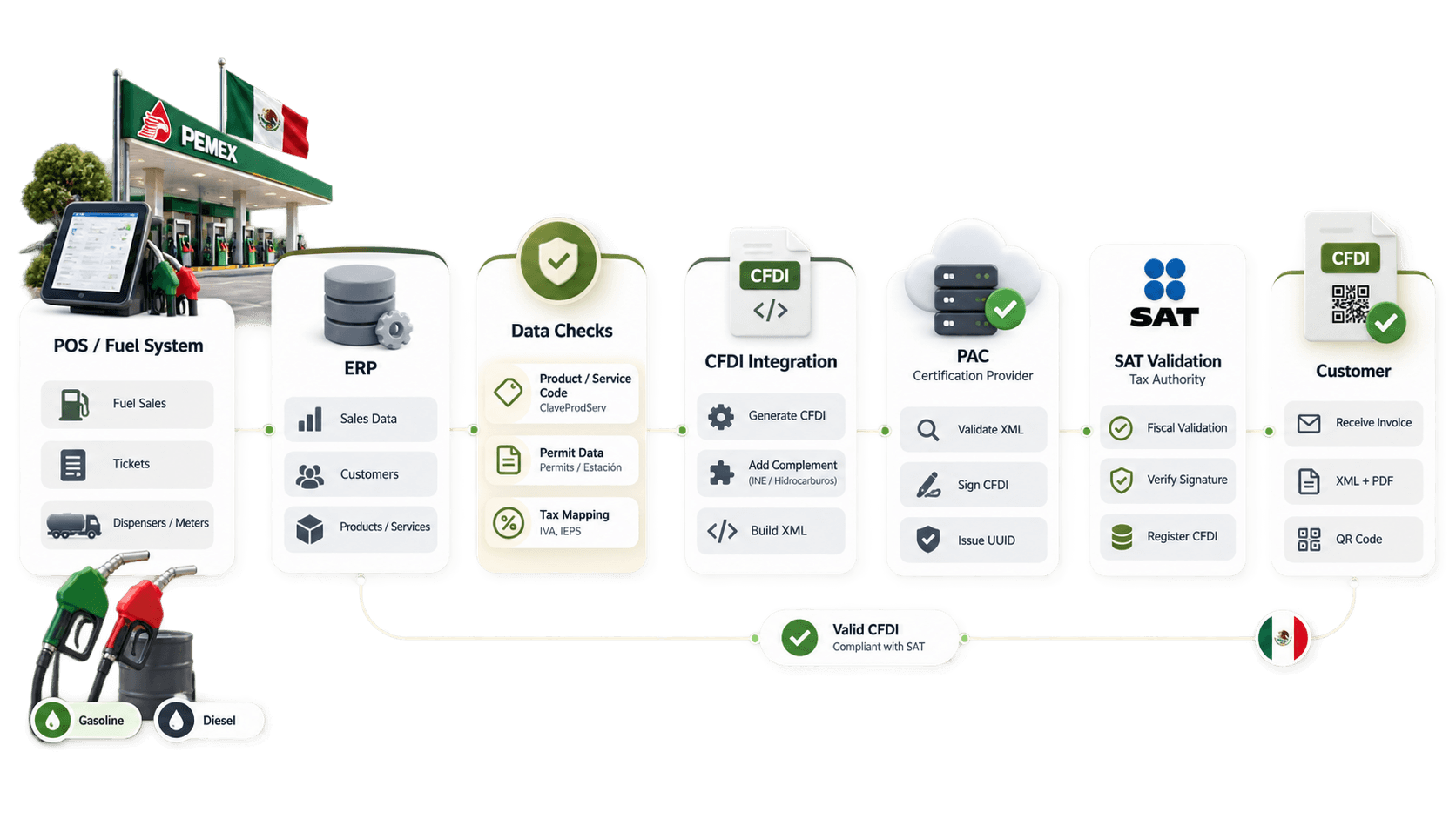
For fuel businesses, this means information coming from POS or operational systems needs to match CFDI rules before certification. Wrong fuel classification, permit information or tax mapping can become more than just ERP data issue. It can affect the CFDI that is finally submitted for certification.
Are CFDI Complements Required?
Sometimes they are, but not for every invoice. A CFDI complement adds extra information needed for a particular transaction or business scenario. Which complement is required depends on what the transaction actually involves.
Some relevant examples include:
Servicios Plataformas Tecnológicas for covered digital-platform withholding scenarios.
Complemento Concepto para la facturación de Hidrocarburos y Petrolíferos for covered gasoline and diesel sales under the 2026 rule.
Complemento para Recepción de Pagos when payment is received later under applicable payment rules.
Carta Porte when the applicable transaction involves transportation of goods, including covered hydrocarbon and petroleum movements.
A complement should not be added only because company works in certain industry. The transaction decides what is required. This is one reason automated rules can be useful when a business handles several transaction types.
What Happens If a CFDI Is Rejected or Incorrect?
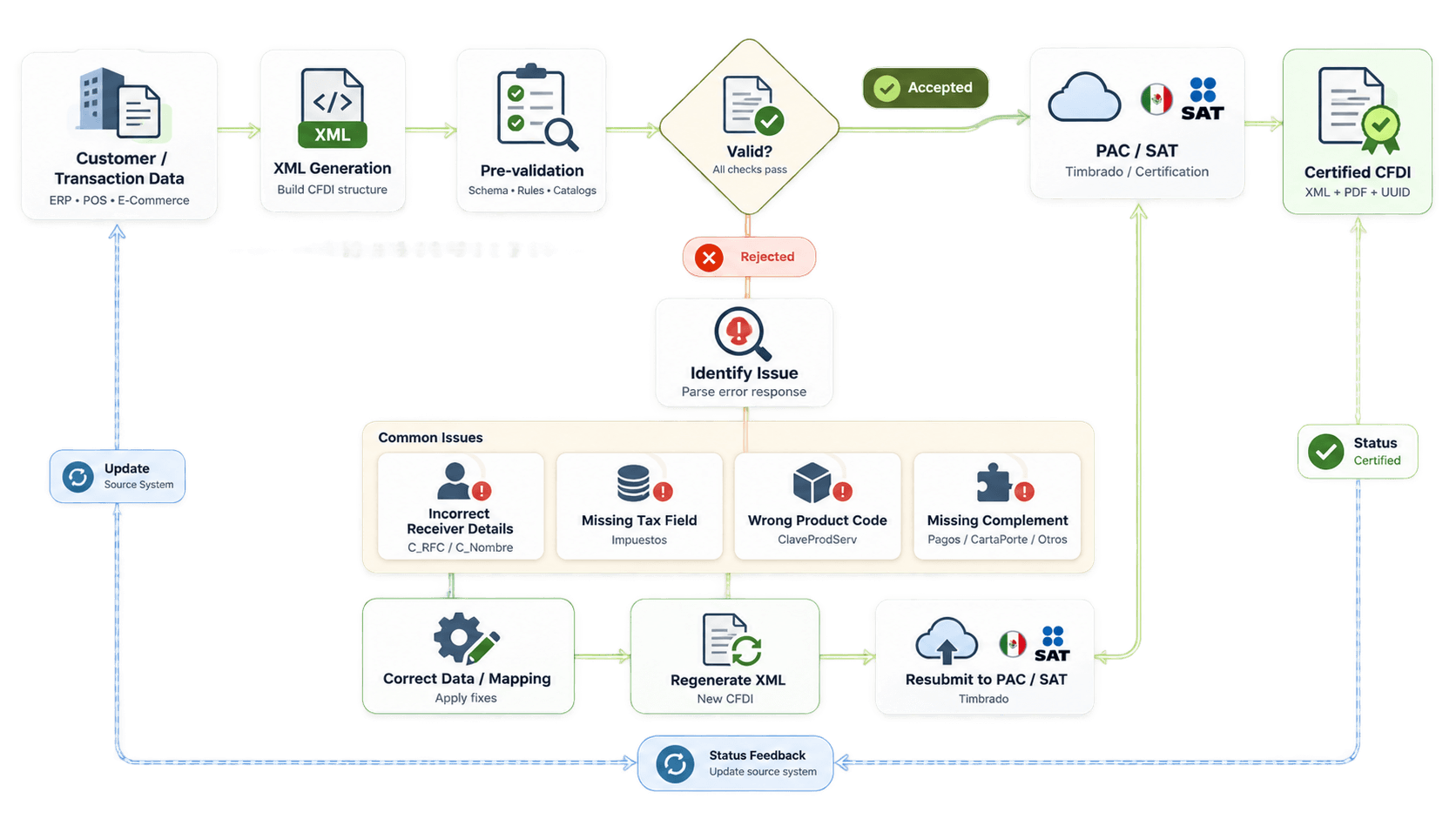
Many CFDI problems actually start before XML reaches the PAC. Incorrect customer data, missing fields or wrong SAT catalogue mapping can all create issues during invoice processing.
Issue | Possible Result | Recommended Action |
|---|---|---|
Incorrect receiver details | Validation failure | Validate customer master data |
XML schema error | CFDI cannot be certified | Pre-validate XML |
Wrong product/service code | Incorrect invoice classification | Map SAT catalogues correctly |
Incorrect tax setup | Tax and accounting issue | Review tax mapping |
Missing required complement | Certification or compliance problem | Apply transaction rules automatically |
Cancellation problem | Incorrect CFDI may remain active | Use controlled cancellation workflow |
This is why checking invoice data before certification can save lot of manual correction later. CFDI cancellation also follows its own SAT process, and some invoices require receiver acceptance. So correcting an invoice is not always as simple as deleting it and creating another one.
How Can Companies Automate CFDI Compliance?
For companies processing large invoice volumes, manually checking every CFDI field is usually not practical. A more scalable setup can look like:
ERP / POS / Ecommerce / Digital Platform → Integration Layer → PAC / SAT → Customer
The integration layer can apply common CFDI rules before transaction is sent for certification.
An electronic invoicing provider in Mexico may help automate areas such as:
✔ CFDI XML generation
✔ Tax-field mapping
✔ PAC connectivity
✔ Customer and supplier master-data checks
✔ CFDI complements
✔ Error monitoring
✔ Cancellation workflows
✔ API integration
✔ Status updates
✔ Audit trails
This becomes useful when several systems are creating transactions but finance team still needs one controlled SAT-compliant process. For example, a fuel company may receive transaction details from several POS locations while customer information comes from ERP. A digital platform may have seller data, payment information and withholding details coming from different applications. An integration layer can bring this data together before CFDI is sent for certification.
How to Choose a Mexico CFDI Integration Provider
A CFDI integration provider should do more than just generate XML. Companies should look at how provider handles the complete transaction from ERP or operational system through certification and back to finance team.
Capability | Why It Matters |
|---|---|
ERP CFDI integration | Reduces manual invoice creation |
PAC connectivity | Supports compliant certification |
Automated validation | Finds errors before submission |
Complement support | Handles transaction-specific CFDI data |
Error monitoring | Helps teams resolve failed invoices |
API connectivity | Connects platforms and external systems |
Audit trail | Gives finance and IT transaction visibility |
High-volume processing | Supports platforms, fuel operations and multiple branches |
It is also useful to ask how changes in SAT CFDI rules or technical validations are handled. A connector that only creates XML may still leave lot of work for internal teams if it cannot manage errors, acknowledgements, failed submissions and status updates. For companies processing high transaction volumes, monitoring and error handling can be just as important as creating invoice itself.
Simplify Mexico CFDI Compliance With Automated Integration
Digital platforms and fuel companies can face more complex Mexico CFDI requirements because invoice information may come from several systems, transaction types and tax scenarios. Managing all of this manually becomes difficult when invoice volumes increase or when different ERP, POS, ecommerce and marketplace systems are involved. Moving CFDI processing into an automated integration layer can help create one controlled flow for invoice data, validation, certification, error handling and status updates.
HubBroker can help connect ERP, POS, digital platforms and other business systems with CFDI workflows and external e-invoicing services.
If your company is reviewing PAC connectivity, CFDI automation or ERP integration in Mexico, discuss your current Mexico CFDI requirements with HubBroker and identify which manual invoice steps can be automated.
