
IDP vs OCR on Invoices: Why 90% Character Accuracy Still Means 40% Manual Touches
Your capture vendor says 99% accuracy. Your AP queue on Monday morning says something else.
That gap is not marketing dishonesty, exactly. It is a measurement mismatch. The vendor is quoting character-level recognition. You are living with document-level outcomes, and those are two entirely different numbers. Understanding why is the whole argument in the IDP vs OCR invoices debate, and it is the thing you need to get straight before you build a business case anyone will approve.
Let's walk through it.
What OCR actually does and where it stops
Character recognition is not field extraction
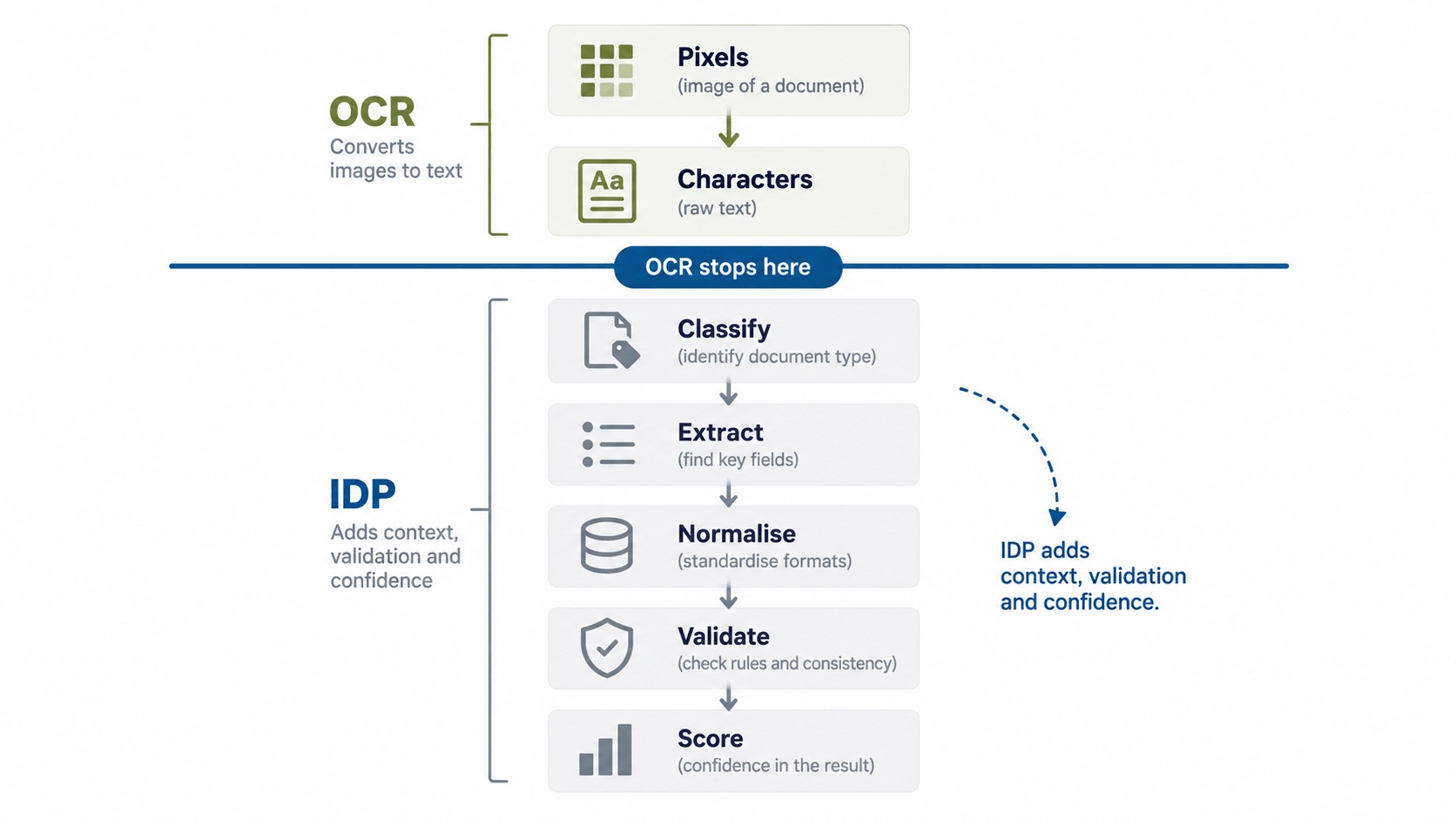
Optical Character Recognition does one job well: it turns pixels into characters. Given a reasonably clean scan, it will tell you the page contains the string 4711.
What it will not tell you is whether 4711 is the invoice number, the PO reference, a product code, or part of the supplier's street address.
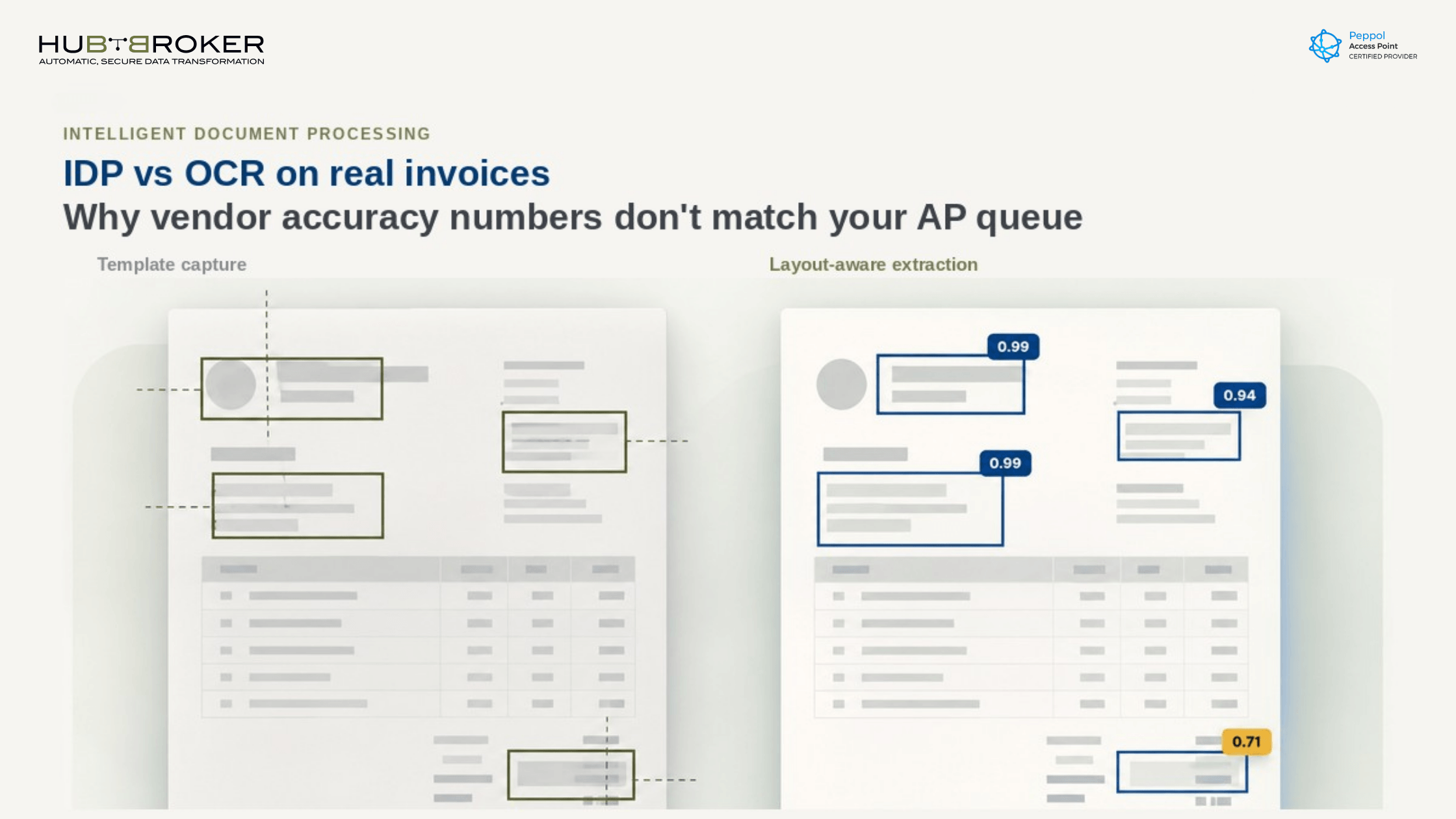
That interpretation step is separate, and in classic OCR pipelines it is handled by a template: a stored map that says "on invoices from Supplier A, the invoice number sits in this rectangle, 40mm from the top, 120mm from the left."
The template problem
Templates work beautifully right up until the moment something moves.
One supplier, one layout, one zone map. Multiply that by 800 suppliers and you have 800 template configurations to build and maintain. Every new supplier is a setup ticket. Every layout change is a broken flow. And the failure is usually silent the system does not error out, it just pulls the wrong value from the right coordinates and posts it.
That is the expensive kind of failure, because it reaches your ERP looking correct.
What Intelligent Document Processing adds on top
IDP does not replace OCR. It consumes it. The character recognition still happens; what changes is everything that comes after.
Layout-aware extraction instead of fixed coordinates
Rather than asking "what is in this rectangle", IDP models ask "which text on this page behaves like an invoice number". They use visual context, labels, proximity, and learned patterns across thousands of documents.
The practical consequence: an invoice from a supplier the system has never encountered can be processed on first arrival. No template, no setup ticket.
Validation against master data and business rules
Extraction is only half the value. The other half is checking the result against what you already know.
Does this supplier VAT number exist in your master data? Do the line totals sum to the header total? Does the PO reference point to an open order with remaining quantity? Have you already posted an invoice with this number from this supplier?
An OCR template has no opinion on any of these questions. It reads the box and moves on.
Confidence scores and human-in-the-loop
IDP returns a confidence score per field. That single design choice changes how AP works: instead of reviewing every invoice because any of them could be wrong, your team reviews only the ones the system flags as uncertain.
And when a reviewer corrects a field, that correction can feed back into the model. Accuracy improves with volume rather than degrading as your supplier base grows.
IDP vs OCR invoices: where real documents break template capture
Five failure modes worth testing in any pilot:
Line items that span pages
A 60-line invoice across three pages. Template capture handles page one, then loses the table structure. Layout-aware extraction tracks the table across page breaks and reconstructs it as one document.
Suppliers who redesign without telling you
They move their logo, add a sustainability footer, shift the totals block left. Your template breaks. Nobody tells AP until the exceptions pile up.
Photographed, skewed, re-scanned PDFs
The invoice that was printed, signed, photographed on a phone, emailed, and forwarded. Character accuracy drops on all of it. IDP compensates through context and validation; template OCR degrades without warning.
Language, VAT and formatting variation
1.234,56 in Denmark and Germany. 1,234.56 in the UK. Dates as DD/MM, MM/DD, or ISO. Multiple VAT rates on one invoice. Reverse charge lines with no VAT at all. Each is a normalisation rule, not a reading problem.
Mixed batches in one inbound stream
Credit notes, reminders, statements and invoices arriving through the same email address. IDP classifies first, then routes. Template OCR assumes it already knows what it is looking at.
How to measure the difference
Here is where an analyst can be useful, because the metrics your vendor quotes are rarely the metrics your CFO cares about.
Straight-through processing rate. The share of invoices that reach posted status with zero human intervention. This is the number. Everything else is diagnostic.
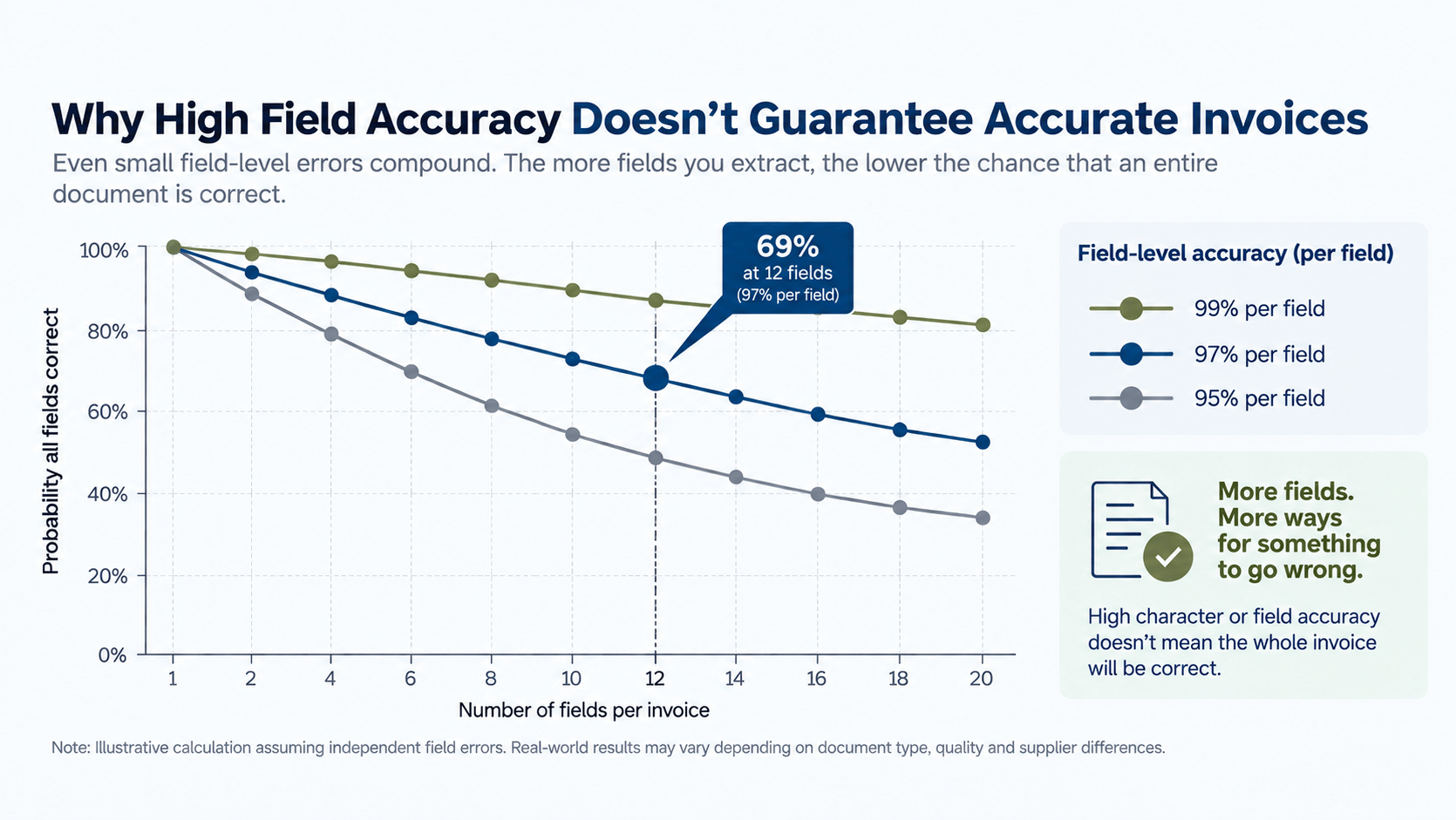
Document-level accuracy, not field-level. If 12 fields each hit 97% accuracy independently, the odds of all 12 being correct on one document are around 69%. That is the arithmetic behind "99% accurate" tools producing a third of documents needing a touch.
Touches per invoice, and cost per touch. Multiply by volume. This becomes your business case.
Exception ageing and rework rate. How long flagged invoices sit before resolution, and how often a "resolved" invoice comes back. Rework is invisible in most capture reporting and expensive in practice.
Baseline all four on your current process before the pilot starts. Without a baseline you have no argument, only vendor claims.
Where IDP fits and where you shouldn't need it
Worth saying plainly: the best invoice is one you never have to read.
If a supplier can send you a structured e-invoice Peppol BIS, UBL, EDIFACT take the structured data. There is nothing to extract, nothing to score, nothing to validate for reading errors. The data arrives as data.
IDP is the answer for the long tail that cannot or will not send structured documents. In most European AP functions that tail is large and shrinking slowly. A sensible strategy runs both: structured e-invoicing through a Peppol Access Point for suppliers who are ready, IDP for everyone else, and PDF-to-XML conversion so both paths land in your ERP in the same shape.
Treating them as competing options is how you end up with two projects and two vendors solving one problem.
Building the internal case
Baseline. Four weeks of current-state metrics: STP rate, touches per invoice, exception ageing, rework.
Scope a pilot on your worst segment. Not your cleanest suppliers your messiest. A pilot on easy documents proves nothing.
Set success criteria before you see results. An STP target and a maximum exception rate, agreed in advance.
Test with your own documents. Vendor sample invoices are curated. Yours are not.
Plan the rollout by supplier volume, highest first.
Frequently asked questions
Is IDP just OCR with AI marketing on top? OCR is a component inside IDP. The difference is classification, layout-aware extraction, validation against your business data, confidence scoring, and learning from corrections. If a tool does character recognition plus templates and calls itself IDP, ask to see the confidence scores.
How much training data does IDP need? Modern models arrive pre-trained on large invoice corpora and handle common layouts immediately. Tuning to your specific supplier base improves results over the first weeks. You do not need to label thousands of documents before go-live.
Can IDP handle suppliers we've never seen? Yes that is the main structural advantage over template capture. Expect lower confidence on first documents from an unfamiliar layout, which means more review initially and less over time.
Does IDP replace our AP approval workflow? No. It produces validated, structured data and feeds it into your existing approval flow in your ERP. Approvals, coding and payment stay where they are.
How does IDP relate to e-invoicing mandates? They solve different halves of the same problem. Mandates govern structured invoices between compliant parties. IDP handles what arrives outside that channel. As mandates broaden, the IDP share of your inbound volume shrinks but it does not reach zero.
What accuracy should we expect in production? Ask for STP rate on documents resembling yours, not character accuracy. Any vendor quoting a single headline accuracy figure without asking about your supplier mix is quoting a lab number.
A practical next step
If you want a real number rather than a benchmark, the fastest route is to run your own invoices through and compare the output against what your team currently produces by hand.
Send us a representative sample including the awkward ones and we will show you the extracted fields, the confidence scores, and where the exceptions land. Get in touch and we will set it up.